A chiropractor for headaches and neck tension addresses one of the most common — and most undertreated — mechanical pain patterns in the body. When the cervical spine is restricted or the surrounding musculature is chronically tight, headaches are a predictable downstream effect. Chiropractic care targets that source directly, without medication.
Why Neck Tension and Headaches Often Happen Together
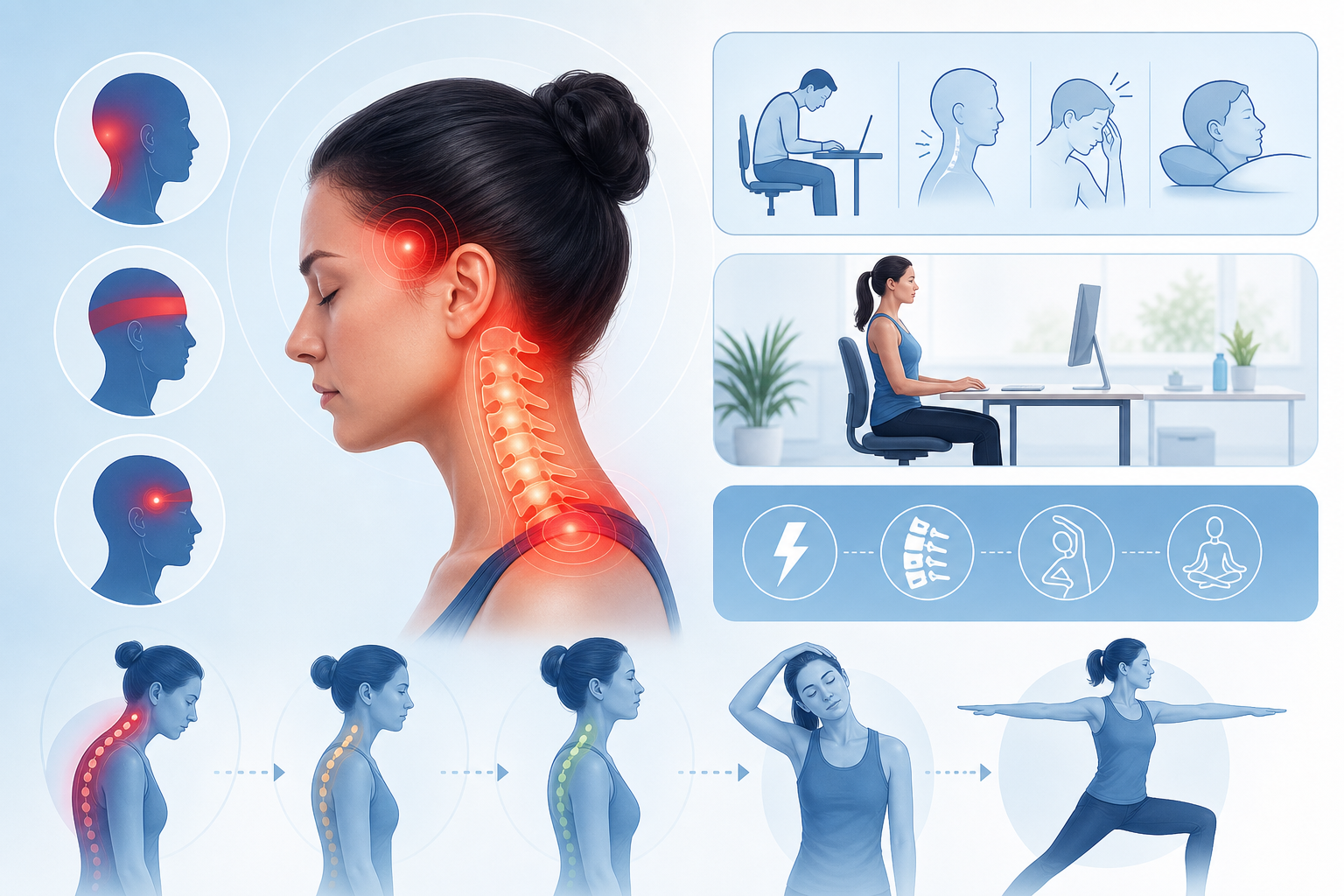
The cervical spine — specifically the C1, C2, and C3 vertebrae — shares neurological pathways with the trigeminal nerve, which supplies sensation to most of the head and face. When joints at these levels become restricted or misaligned, the surrounding musculature compensates. The suboccipital muscles (the four small muscles at the base of the skull), the upper trapezius, and the levator scapulae all tighten in response, compressing local nerves and referring pain upward into the skull.
This is why your neck hurts with every headache — the two symptoms share the same anatomical origin.
Tight neck muscles causing daily headaches is not a coincidence. Sustained forward head posture — common in desk workers and smartphone users — shifts the mechanical load on the cervical spine by roughly 10 pounds for every inch the head moves forward. At 3 inches of forward displacement, the effective load on C5–C6 approaches 42 pounds. That chronic load creates the muscle guarding and joint restriction that feeds the headache cycle.
- Forward head posture increases compressive load on the lower cervical spine
- Restricted C1–C2 rotation reduces blood flow through the vertebral arteries and irritates the greater occipital nerve
- Trigger points in the upper trapezius and sternocleidomastoid (SCM) refer pain to the temples, behind the eyes, and across the forehead
- Chronically tight musculature reduces lymphatic drainage at the base of the skull, worsening local inflammation
For a deeper look at how the cervical spine connects to head pain patterns, see how chiropractic doctors treat neck pain and the relationship between neck dysfunction and referred symptoms like tinnitus.
Cervicogenic vs. Tension Headaches vs. Migraine: What's the Difference?
Most local practice pages lump all headaches together. The clinical distinction matters because it determines which treatment approach will work — and how fast.
Cervicogenic Headache
A cervicogenic headache originates from the cervical spine itself. The defining feature: pain starts in the back of the neck or base of the skull and radiates forward, typically on one side. ROM of the cervical spine is reduced on the painful side. Sustained neck positions — looking down at a phone, driving long distances — provoke or worsen the headache. This type responds directly and well to cervical manipulation and soft tissue work.
Tension-Type Headache
Tension-type headaches present as bilateral, band-like pressure around the forehead or the back of the head. They are not typically throbbing and are not worsened by physical activity. The primary driver is myofascial tension in the pericranial muscles — the suboccipitals, temporalis, and upper trapezius. Trigger point therapy and cervical mobilization are both effective for this pattern.
Migraine
Migraine involves central sensitization — a neurological process — but cervical dysfunction frequently acts as a trigger. Research suggests that cervical manipulation can reduce migraine frequency in patients with concurrent neck dysfunction, though it does not address the underlying neurological mechanism. If you experience visual aura, unilateral throbbing, nausea, or photophobia, tell your chiropractor before treatment begins. For more on this connection, read about the link between migraine headaches and back pain.
Headache Type Key Symptoms Cervical Component Chiropractic Response Cervicogenic Unilateral, starts at base of skull, reduced neck ROM Direct — joint restriction at C1–C3 Excellent — typically 6–10 visits Tension-type Bilateral band pressure, pericranial muscle tenderness Strong — myofascial trigger points Very good — typically 4–8 visits Migraine Throbbing, unilateral, aura possible, nausea Moderate — cervical dysfunction as trigger Supportive — reduces frequency, not cureWhat a Chiropractor Actually Does for Headaches and Neck Tension
Chiropractic treatment for chronic tension headaches and cervicogenic headaches uses several specific techniques — not just a generic "adjustment." Understanding what happens in the treatment room removes the uncertainty from your first visit.
Cervical Manipulation
Cervical manipulation (also called a cervical adjustment) applies a controlled, high-velocity, low-amplitude thrust to a restricted joint in the cervical spine. The goal is to restore normal joint motion at a specific segment — typically C1–C2 for headaches originating at the base of the skull. The audible "pop" is cavitation of the joint capsule, not bone cracking. ROM typically improves immediately post-adjustment.
Upper Cervical Care
Upper cervical care is a more specific approach focused exclusively on the atlas (C1) and axis (C2). Techniques like NUCCA and Blair Upper Cervical use precise imaging to measure misalignment in millimeters before delivering a low-force correction. This approach is particularly relevant for patients with headaches that start in the back of the neck or those who have had poor results with general chiropractic. For more detail, see how upper cervical care addresses cluster headaches.
Soft Tissue and Trigger Point Therapy
Trigger point therapy targets hyperirritable nodules in the upper trapezius, SCM, and suboccipital muscles. Sustained manual pressure on these points — typically 30–90 seconds — causes the muscle fiber to release, reducing referred pain patterns into the head. Instrument-assisted soft tissue mobilization (IASTM) may also be used on the posterior cervical musculature.
Natural relief for headaches without medication is achievable through this combination of joint mobilization and soft tissue work. For a broader overview of non-pharmaceutical headache care, see medication-free treatment for tension headaches.
Your First Visit: What to Expect
Knowing what to expect at a chiropractor for neck pain and headaches makes the intake process faster and the treatment more targeted.
The first visit typically runs 45–60 minutes and includes:
- Intake history: Headache frequency, duration, location, triggers, and any prior imaging (X-ray, MRI). Bring records if you have them.
- Cervical ROM assessment: The provider measures active range of motion in all six planes. Restrictions at specific segments point toward cervicogenic involvement.
- Orthopedic and neurological screening: Tests like the Spurling's test rule out cervical radiculopathy or disc herniation before any manipulation is performed.
- Postural analysis: Forward head posture, shoulder height asymmetry, and thoracic kyphosis are documented — these directly affect cervical loading.
- Treatment (if appropriate): Many providers perform initial treatment on the first visit after clearing contraindications. This may include soft tissue work and gentle mobilization before any manipulation.
You will leave the first visit with a working diagnosis, a proposed care plan with specific visit frequency, and typically one or two home exercises to begin immediately.
How Many Visits Does It Take to Feel Better?
How many chiropractic visits to relieve headaches depends on headache type, chronicity, and how much postural correction is needed. These are realistic benchmarks, not guarantees:
- Acute cervicogenic headache (less than 4 weeks): 4–6 visits over 2–3 weeks. Most patients notice significant reduction in frequency and intensity by visit 3.
- Chronic tension-type headache (3+ months): 8–12 visits over 4–6 weeks for initial relief, followed by monthly maintenance if posture correction is ongoing.
- Migraine with cervical trigger: 6–10 visits to assess response; improvement in frequency typically observed within the first month.
Patients who complete a full care plan and address contributing factors — ergonomics, sleep posture, screen time — maintain results significantly longer than those who stop after symptom relief alone.
When to See a Chiropractor — and When to Seek Urgent Care
Searching for a chiropractor for headaches and neck tension near me is appropriate for the vast majority of recurrent, positionally-influenced headaches. However, certain presentations require emergency evaluation before any chiropractic care.
Seek emergency care immediately if your headache:
- Is the "worst headache of your life" with sudden onset — this is a red flag for subarachnoid hemorrhage
- Is accompanied by fever, stiff neck, and photophobia — possible meningitis
- Follows head trauma within the last 72 hours
- Is accompanied by sudden vision changes, facial drooping, or arm weakness
- Worsens progressively over days without any pain-free periods
When should you see a doctor for frequent headaches that do not involve the above? If headaches occur more than 15 days per month and are not responding to conservative care after 6 weeks, co-management with a neurologist is appropriate. Chiropractic and neurology are not mutually exclusive — many patients benefit from both simultaneously.
For patients with occipital nerve involvement, see the dedicated guide on occipital neuralgia and chiropractic care. For a broader overview of what head pain presentations look like clinically, this overview of common head pain types is a useful reference.
What to Do Next
If your headaches are recurrent, positionally aggravated, or consistently accompanied by neck tightness, a cervical spine evaluation is the logical first step. You do not need a referral to see a chiropractor in most states.
At your first visit, expect a full cervical ROM assessment, postural analysis, and orthopedic screening before any hands-on treatment. Come prepared with your headache history: frequency per week, typical duration, location, and any known triggers.
If headaches began after a car accident or sports injury, ask specifically about upper cervical evaluation — the C1–C2 complex is frequently affected by whiplash-type forces and is often missed on standard X-ray.
Find a chiropractor for headaches and neck tension near you using the Medximity provider directory — filter by specialty, location, and patient ratings to find a provider with experience in cervicogenic and tension-type headache management.
For more condition-specific guides, explore the Medximity health library.