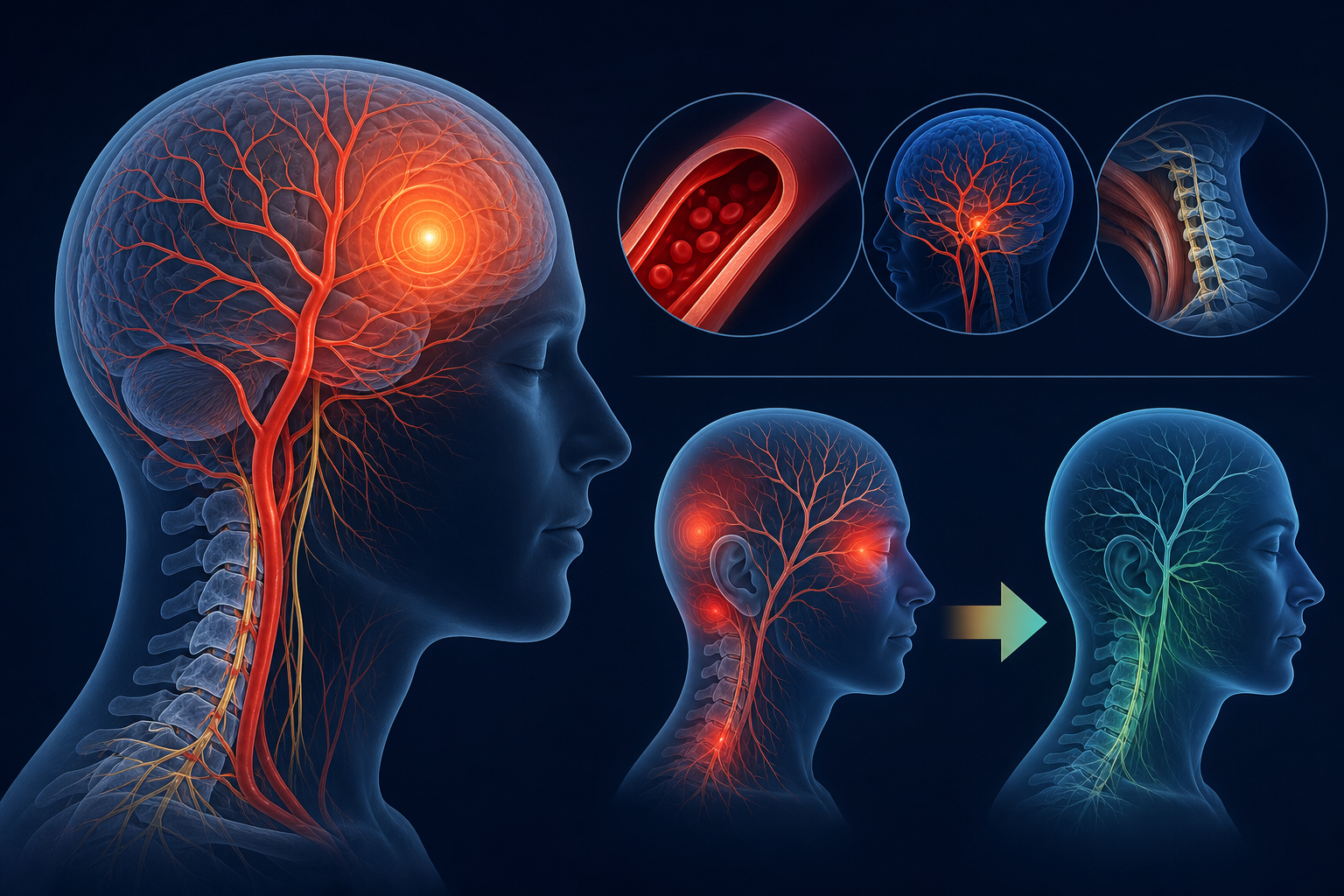
Can TMJ cause nausea and dizziness? Yes, in some cases temporomandibular joint dysfunction can be linked to both symptoms, especially when jaw irritation happens alongside neck tension, ear pressure, and muscle overactivity. TMJ is not the only possible cause, so you should look at the full pattern: jaw pain, clicking, limited mouth opening, headaches, cervical spine stiffness, and balance symptoms that flare with chewing, clenching, or posture strain.
If dizziness or nausea shows up with severe headache, fainting, chest pain, one-sided weakness, slurred speech, new hearing loss, or nonstop vomiting, get urgent medical evaluation.
Can TMJ Cause Nausea and Dizziness? A Direct Answer
TMJ can contribute to nausea and dizziness, but usually not in isolation. The more common pattern is jaw dysfunction plus tight chewing muscles, irritated upper-neck joints, and nearby ear-related symptoms such as pressure, fullness, or sound sensitivity. That combination can create a “floaty,” off-balance, or motion-sensitive feeling rather than true room-spinning vertigo.
The temporomandibular joint sits close to the ear canal and shares muscular and nerve relationships with the head and neck. When the masseter, temporalis, and lateral pterygoid muscles stay tense, you may feel jaw fatigue, temple pain, ear pressure, and nausea after chewing or clenching. If the suboccipital muscles and upper cervical joints are involved too, dizziness becomes more likely.
Research on TMJ disorders suggests dizziness, headache, ear symptoms, and neck pain commonly overlap. The key clinical point: jaw symptoms and balance symptoms often rise and fall together.
- Dizziness tends to worsen with jaw clenching, long desk work, or poor sleep posture.
- Nausea is more likely when dizziness, neck tension, and headache occur together.
- Symptoms that improve with jaw rest and posture correction are more consistent with a mechanical source.
If your symptoms also include neck pain, review can neck problems cause inner ear problems and straight neck syndrome symptoms, causes and treatment for related patterns.
What Is TMJ Jaw Disorder and How Does the Jaw Joint Work?
What is TMJ jaw disorder? TMJ disorder is a group of problems affecting the jaw joint, its cartilage disc, and the muscles that open and close your mouth. The joint works like a hinge and glide mechanism between the lower jaw and the temporal bone of the skull. A small disc helps the joint move smoothly during talking, chewing, and yawning.
Key structures involved
- Temporomandibular joint: the joint just in front of the ear.
- Articular disc: a cartilage pad that improves smooth movement.
- Masseter muscle: generates strong bite force.
- Temporalis muscle: helps close the jaw and often refers pain to the temple.
- Lateral pterygoid: helps control jaw opening and disc motion.
TMJ disorder often shows up as clicking, popping, jaw fatigue, painful chewing, morning tightness, headaches, and limited opening. Normal mouth opening is usually around 40 to 50 mm, or roughly the width of three knuckles stacked vertically. If you cannot comfortably reach that, joint restriction or muscle guarding may be present.
TMJ feature What you may notice What it can suggest Clicking without pain Jaw pops when opening or chewing Disc movement issue with less irritation Clicking with pain Sharp pain near the ear or temple Joint irritation plus muscle overload Limited opening Tightness, deviation, hard to yawn Muscle spasm or disc restriction Morning jaw soreness Jaw feels tired on waking Night clenching or grindingJaw dysfunction rarely stays only in the jaw. It commonly overlaps with headaches and cervical tension, which is why some people also read the hidden cause of migraines when symptoms spread into the temple and forehead.
How Can Jaw Dysfunction Trigger Dizziness and Nausea?
How TMJ causes dizziness feeling usually comes down to sensory overload from the jaw, neck, and ear region rather than one damaged structure. Your brain uses input from the inner ear, eyes, and neck joints to keep balance steady. If the jaw and upper neck are irritated, that input can become less accurate, especially during quick head turns, chewing, or prolonged forward-head posture.
Why nausea can happen too
Can jaw tension cause nausea? Yes. Nausea often appears when dizziness combines with muscle tension and headache. Tightness in the sternocleidomastoid, upper trapezius, and jaw muscles can create a motion-sensitive, pressure-filled sensation that makes eating or screen work unpleasant.
- Jaw clenching increases load through the TMJ and chewing muscles.
- Neck muscles stiffen to compensate, especially at C1-C3.
- Ear pressure or fullness may increase because the area is crowded and tense.
- Your balance system gets mixed signals from the neck and head position.
- Dizziness then feeds nausea, especially with driving, scrolling, or quick turns.
This is why the symptoms often appear together instead of separately. Jaw pain alone is common. Jaw pain plus dizziness plus nausea points to a broader head-neck-jaw pattern that needs an evaluation, not guesswork.
In mechanical TMJ cases, symptom flares often last 20 to 60 minutes after heavy chewing or clenching, while muscle soreness can linger 24 to 72 hours.
The Jaw-Neck-Ear Connection in Simple Terms
TMJ ear fullness and dizziness often happen together because the jaw joint sits immediately in front of the ear and shares space with muscles and nerves that influence head position. The jaw does not control the inner ear directly, but nearby tension can alter how the region feels and how your neck supports your head.
Think of the jaw, neck, and ear region as one functional neighborhood. If one part gets overloaded, the others often compensate.
What commonly links these areas
- Forward head posture increases load on the jaw and upper neck.
- Tight suboccipital muscles can produce dizziness and visual strain.
- Sternocleidomastoid trigger points can refer pain around the ear and temple.
- Clenching increases tension through the masseter and temporalis, which can mimic ear-related pressure.
For a deeper look at neck and ear overlap, see can cervical spine issues cause tinnitus and is tinnitus driving you mad? it may be caused in your neck.
What Symptoms Often Show Up Alongside TMJ-Related Dizziness?
TMJ symptoms with neck pain are common because the jaw rarely compensates alone. When you are trying to figure out whether TMJ may be part of the problem, look for symptom clusters rather than one isolated sign.
- Jaw clicking, popping, or catching
- Pain in front of the ear
- Temple headache or facial pressure
- Neck stiffness, especially at the base of the skull
- Ear fullness without clear infection
- Pain with chewing crusty foods, gum, or large bites
- Morning jaw soreness from overnight clenching
- Reduced jaw opening or deviation to one side
A flare often follows a predictable timeline. Muscle-dominant irritation may improve within 1 to 2 weeks with jaw rest, posture changes, and manual care. Joint irritation with clicking and limited opening often takes longer, typically 4 to 8 weeks of consistent conservative care. If the pattern is not improving over that time, broaden the evaluation.
True TMJ-related dizziness is usually described as “off balance,” “foggy,” or “rocking,” not always as intense spinning.
If your symptoms began after a neck injury, this related article may help: can a neck injury cause trigeminal neuralgia.
What Makes TMJ Symptoms Worse Day to Day?
What makes TMJ symptoms worse is often mechanical overload repeated hundreds of times per day. Most people focus on one painful meal and miss the habits that keep the jaw and neck irritated from morning to night.
- Clenching: teeth contact should be brief during swallowing, not constant all day.
- Gum chewing: repetitive loading keeps the masseter and temporalis active.
- Forward head posture: shifts the jaw backward and increases upper-neck strain.
- Poor workstation setup: low screens and laptop hunching drive chin-forward posture.
- Sleeping face-down: twists the jaw and cervical spine for hours.
- Wide yawning or large bites: can irritate a sensitive joint disc.
Simple self-check
- Your lips should be together.
- Your teeth should be slightly apart.
- Your tongue should rest gently on the roof of your mouth.
- Your screen should be at eye level.
- Your shoulders should stay stacked over your ribs, not rounded forward.
Patients with persistent posture-related strain often also have cervical issues. Straight neck syndrome symptoms, causes and treatment explains why prolonged head-forward posture can keep jaw and neck symptoms active.
Could Nausea and Dizziness Be Something Else?
Nausea and dizziness without ear infection can still come from several different causes, which is why TMJ should be considered one possibility, not the only diagnosis. A good provider will compare your symptom pattern rather than assume the jaw explains everything.
Possible source Common clues Typical next step TMJ/neck mechanical issue Jaw clicking, neck tightness, posture-related flares Chiropractic or PT evaluation Vestibular problem Positional spinning, nausea with rolling in bed Vestibular assessment Migraine-related dizziness Light sensitivity, headache, visual aura Medical evaluation plus rehab if needed Concussion or head injury Symptoms after trauma, brain fog, balance trouble Prompt evaluation Medical red flags Fainting, weakness, slurred speech, sudden hearing loss Urgent care nowSeek prompt medical evaluation if you have:
- New one-sided weakness or numbness
- Slurred speech or facial droop
- Sudden severe headache unlike your usual pattern
- Fainting or chest pain
- Sudden hearing loss
- Persistent vomiting or inability to keep fluids down
- Recent major trauma
Neck-driven dizziness is real, but it is not the only explanation. That distinction matters.
Conservative Care Options That May Help
TMJ dizziness treatment without surgery usually starts with reducing joint load, improving cervical mechanics, and calming overactive muscles. Most mechanical cases respond best to a combination of manual care and home changes rather than one isolated treatment.
Conservative option Primary goal Expected timeline Chiropractic care Improve cervical and jaw mechanics Often 4-8 visits over 2-4 weeks Physical therapy Restore ROM, posture, motor control Typically 6-8 sessions over 3-6 weeks Soft-tissue work Reduce masseter, temporalis, SCM tension Soreness may change within 1-3 visits Home exercise program Decrease daily overload Daily for 2-6 weeks Ergonomic correction Lower repeat strain at work Improvement often within 1-2 weeksStep-by-step home routine
- Sit tall with your ribs stacked over your pelvis.
- Place the tongue lightly on the roof of your mouth just behind the front teeth.
- Keep lips together and teeth apart for 60 seconds. Repeat 5 times daily.
- Perform gentle chin tucks: glide your head backward without tipping up or down. Hold 3 seconds. Do 10 reps, 2 to 3 sets daily.
- Open your mouth only to the point of no click or pain, then close slowly. Do 8 to 10 reps.
- Apply a warm compress over the masseter and temple area for 10 minutes once or twice daily.
- Stop gum chewing and choose smaller bites for 7 to 10 days.
If dizziness increases during these drills, stop and get evaluated. The goal is to reduce symptoms, not push through them.
You can find a chiropractor near you, find a physical therapy provider near you, or browse providers based on your symptoms and location.
FAQ: Ear Fullness, Headaches, Neck Pain, and Jaw Clicking
Is it normal to feel dizzy with TMJ?
Dizziness can happen with TMJ, especially when jaw symptoms overlap with upper-neck tension and ear fullness. It is not something to ignore. If dizziness is frequent, severe, or paired with neurological symptoms, get prompt evaluation.
Why does jaw clicking hurt?
Clicking often means the joint disc is not moving smoothly. Pain happens when clicking is combined with inflammation, muscle guarding, or repeated overload from clenching and chewing.
Can TMJ cause ear fullness?
Yes. Ear fullness can occur because the TMJ sits just in front of the ear and the surrounding muscles become tight. If you also have fever, drainage, or sudden hearing change, seek medical assessment.
Can neck pain make TMJ symptoms worse?
Yes. Poor cervical alignment and tight muscles such as the SCM, upper trapezius, and suboccipitals can increase jaw tension and make dizziness more likely. That is why combined jaw-and-neck treatment often works better than treating the jaw alone.
How long does a TMJ flare usually last?
A mild muscle-based flare may settle within several days to 2 weeks. A more stubborn joint-and-neck pattern may take 4 to 8 weeks of consistent care and home changes.
What to Do Next
Start with the right provider. If your main pattern is jaw pain, clicking, neck stiffness, and dizziness that worsens with posture or chewing, schedule an evaluation with a chiropractor or physical therapist who treats TMJ and cervical spine mechanics. If symptoms include severe vertigo, sudden hearing loss, fainting, neurological changes, or nonstop vomiting, seek urgent medical evaluation first.
At your first visit, expect three things:
- A jaw exam: mouth opening, deviation, clicking, bite habits, chewing tolerance
- A neck exam: ROM, joint stiffness, muscle tone, posture, dizziness triggers
- A symptom review: headache pattern, ear fullness, nausea timing, red flags
Bring a short symptom log if you can. Track when dizziness starts, how long it lasts, whether chewing triggers it, and whether neck position changes it. That saves time and helps separate TMJ-related dizziness from other causes.
If you are searching for tmj treatment for dizziness near me, use Medximity to find a TMJ provider near you or explore more health topics. The best next step is a hands-on evaluation that looks at your jaw joint, cervical spine, posture, and daily habits together.