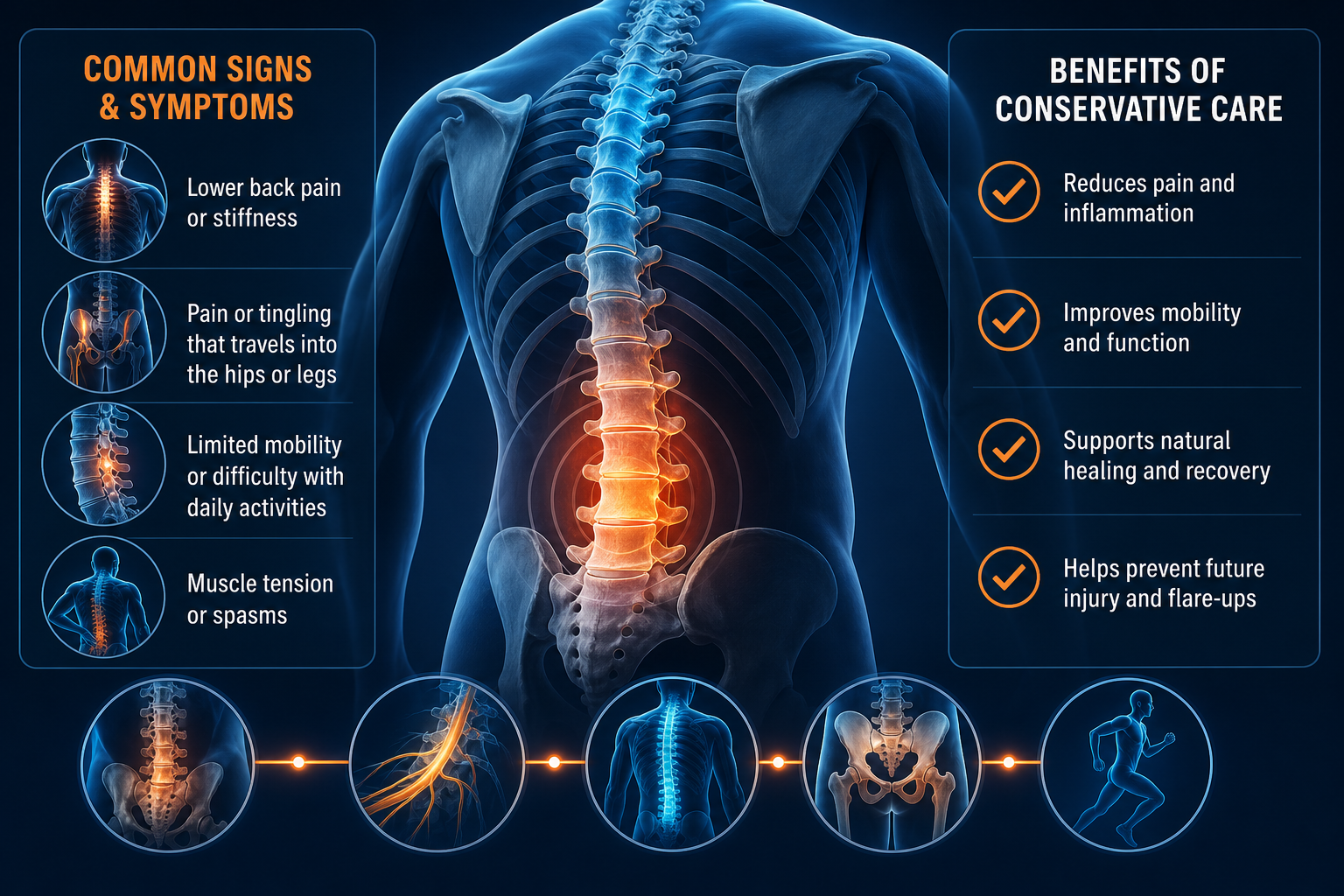
What does a chiropractor treat? Chiropractors commonly treat musculoskeletal problems that affect how your spine, joints, muscles, and nerves move and function, especially back pain, neck pain, headaches, sciatica, posture-related strain, and some shoulder, hip, knee, and wrist complaints. The best candidates for chiropractic care usually have pain, stiffness, reduced ROM, movement-related symptoms, or radiating discomfort that appears mechanical rather than caused by infection, fracture, or another medical emergency.
A chiropractor does not replace every provider. Chiropractic care fits best when your symptoms point to joint restriction, muscle tension, poor movement mechanics, repetitive strain, or nerve irritation that may respond to conservative care such as spinal manipulation, mobility work, exercise therapy, soft tissue treatment, and ergonomic changes.
What Does a Chiropractor Treat?
Chiropractors treat conditions involving the spine, sacroiliac joints, facet joints, surrounding muscles, and some extremity joints when the main problem is pain, stiffness, reduced movement, or mechanical irritation. That includes the cervical spine, thoracic spine, lumbar spine, shoulders, hips, knees, and wrists.
Common reasons people seek chiropractic care include:
- Low back pain after lifting, sitting long hours, or repetitive bending
- Neck pain and stiffness from desk posture, sleeping position, or collision-related strain
- Tension-type headaches linked to suboccipital muscle tension and upper cervical dysfunction
- Sciatica or leg symptoms from lumbar nerve root irritation
- Shoulder, hip, knee, and wrist pain when joint mechanics and soft tissue overload are part of the problem
- Sports injuries and repetitive strain affecting tendons, fascia, and movement patterns
- Posture-related dysfunction with limited extension, rotation, or hip mobility
Research and guideline-based care generally support conservative treatment first for many uncomplicated spine complaints. For example, acute mechanical low back pain often improves within 2 to 6 weeks, and a structured plan can reduce recurrence. Neck strain often improves over 2 to 4 weeks if there is no major tissue damage.
Most uncomplicated mechanical neck and back complaints improve faster when treatment addresses joint motion, soft tissue tension, and activity modification together rather than relying on rest alone.
If your symptoms include headache or upper-neck tension, related reading may help: What is a Common Head Pain? and Medication Free Treatment for Tension Headaches.
Can a Chiropractor Help Back Pain and Lower Back Stiffness?
Yes. A chiropractor can help back pain when the source is mechanical, meaning your symptoms change with movement, position, loading, bending, or prolonged sitting. The most common structures involved are the lumbar facet joints, erector spinae, quadratus lumborum, gluteus medius, and the sacroiliac joint.
Patterns that fit chiropractic care well
- Pain after lifting, twisting, yard work, or long drives
- Morning stiffness that eases after walking
- Pain worse with sitting and better with changing position
- Localized low back pain with tight hamstrings or hip flexors
- Recurrent “locking” or limited lumbar extension
What treatment may include
A typical plan may combine lumbar or SI joint manipulation, hip mobility drills, trunk stabilization, and load-management advice. Many patients with uncomplicated low back strain improve in 4 to 8 visits over 2 to 4 weeks. If symptoms have been present for more than 3 months, improvement often takes 6 to 12 weeks with home exercise and strength work.
A simple home protocol for back stiffness:
- Walk for 5 to 10 minutes at an easy pace.
- Perform 10 pelvic tilts on your back with knees bent.
- Do 8 to 10 prone press-ups if extension reduces stiffness.
- Stretch each hip flexor for 30 seconds x 2 per side.
- Finish with 10 bodyweight hip hinges to retrain bending.
If your pain also runs into the leg, see What Can Be Done for Sciatic Pain? for a more specific breakdown.
Can Whiplash Be Treated by Chiropractor Care?
Yes, many mild to moderate whiplash-related problems and cases of chiropractor for neck pain and stiffness fall within chiropractic care, especially when the issue is reduced ROM, muscle guarding, cervicothoracic stiffness, and headache after a collision or sudden acceleration-deceleration event. The key is proper screening first.
Structures commonly involved include the sternocleidomastoid, levator scapulae, upper trapezius, suboccipital muscles, and the lower cervical and upper thoracic facet joints.
- Typical symptoms: pain turning your head, stiffness looking over the shoulder, upper-trap tightness, headache at the base of the skull
- Symptoms that need more caution: severe midline neck tenderness, numbness in both arms, major weakness, unsteady gait
- Expected recovery for uncomplicated strain: often 2 to 6 weeks
Care may include gentle mobilization, soft tissue work, thoracic mobility drills, scapular strengthening, and posture correction. High-force techniques are not appropriate for every neck complaint. Your exam should guide the method.
If upper cervical mechanics are part of the discussion, you may want background on What is an Upper Cervical Subluxation?.
What About Headaches, Sciatica, and Pain That Shoots Down the Leg?
Chiropractors often manage headache and radiating symptoms when the driver is musculoskeletal or nerve irritation, but these symptoms require careful pattern recognition. A headache from the suboccipital muscles, upper cervical joints, and jaw-neck tension behaves differently from a headache caused by illness or a more serious neurological problem. Sciatica from lumbar nerve root irritation behaves differently from calf pain caused by vascular issues.
Headaches with a musculoskeletal source
Tension-type and cervicogenic headaches often present with:
- Tightness from the neck into the temples or behind the eyes
- Pain after computer work
- Headache triggered by neck rotation or sustained posture
- Tenderness in the suboccipitals, upper trapezius, and temporalis
These cases often respond over 3 to 6 weeks when treatment includes cervical/thoracic mobility, trigger-point work, and workstation changes. For more detail, see Medication Free Treatment for Tension Headaches.
Why does pain shoot down my leg?
Pain that shoots down your leg usually suggests irritation of the sciatic nerve or one of the lumbar nerve roots, commonly around L4-L5 or L5-S1. You may feel burning, tingling, or pulling into the buttock, posterior thigh, calf, or foot.
Treatment for sciatica without surgery often includes:
- Identifying whether flexion or extension worsens symptoms
- Reducing positions that peripheralize the pain
- Using repeated movements such as press-ups or nerve glides when indicated
- Restoring hip mobility and trunk control
- Progressing walking tolerance and loaded movement gradually
Some acute sciatica improves in 2 to 8 weeks. Persistent numbness, worsening weakness, or bowel/bladder changes require urgent evaluation. For deeper coverage, read Sciatica Treatment – Understanding the Pain.
Can a Chiropractor Help Joint Pain Beyond the Spine?
Yes. A chiropractor for shoulder hip and knee pain may help when movement restriction, tissue overload, and poor mechanics are driving the problem. Chiropractors do not only treat backs and necks.
Extremity complaints commonly seen in conservative care include:
- Shoulder: rotator cuff overload, limited overhead ROM, scapular dyskinesis
- Hip: anterior hip tightness, glute weakness, reduced internal rotation
- Knee: patellofemoral tracking issues, stiffness linked to hip/ankle mechanics
- Wrist: repetitive strain from keyboard or gripping tasks
The exam should assess linked segments. A knee that hurts on stairs may also involve weak gluteus medius and restricted ankle dorsiflexion. A shoulder that pinches overhead may involve the thoracic spine and scapula, not just the glenohumeral joint.
Complaint Common Structures Conservative Treatment Options Typical Timeline Mechanical low back pain Lumbar facets, SI joint, QL, erector spinae Manipulation, mobility work, trunk exercise, ergonomic change 2-4 weeks for many acute cases Neck stiffness / whiplash strain Cervical facets, SCM, levator scapulae, suboccipitals Gentle manual care, ROM drills, thoracic mobility, posture work 2-6 weeks Sciatica L4-S1 nerve roots, piriformis, lumbar discs Directional exercise, nerve glides, lumbar care, walking progression 2-8 weeks depending on irritability Shoulder movement pain Rotator cuff, scapula stabilizers, thoracic spine Joint mobilization, soft tissue work, scapular exercise 4-8 weeks Hip / knee mechanics-related pain Glute medius, hip capsule, patellofemoral joint, ankle Mobility, strength progression, gait and squat retraining 4-10 weeksWhat Treatments Chiropractors May Use Alongside Adjustments?
Adjustments are one tool. Effective chiropractic care often combines manual treatment with movement-based rehab and practical self-care. That matters because joint motion improves best when the surrounding muscles and movement habits also change.
Common supportive treatments
- Spinal manipulation or mobilization for restricted joints
- Soft tissue therapy for the paraspinals, piriformis, glutes, or upper trapezius
- Exercise therapy for trunk endurance, scapular control, or hip stability
- Stretching for hip flexors, hamstrings, pec minor, and calves
- Ergonomic advice for desk setup, lifting mechanics, and sleep position
- Return-to-sport progression for overuse or training-related pain
If you are looking for the best chiropractor for sports injury near me, ask whether the provider also builds a rehab plan. Athletes usually need load management, tissue treatment, and movement retraining together. For performance-related care, see Sports Therapy – Can a Chiropractor improve my game?.
Manual treatment can reduce pain and improve motion quickly, but the lasting change usually comes from repeated movement, strength work, and better mechanics between visits.
When Is Chiropractic Care Not the Right Stand-Alone Option?
Chiropractic care is not the right stand-alone option when your symptoms suggest fracture, infection, systemic disease, major neurological compromise, or another condition that needs immediate medical evaluation. This is where good conservative care earns trust: knowing when to refer.
Seek urgent care now if you have:
- Loss of bowel or bladder control
- Rapidly worsening leg or arm weakness
- Numbness in the saddle region
- Severe pain after a major fall or collision with suspected fracture
- Fever with severe spinal pain
- Sudden severe headache unlike your usual pattern
- New dizziness, double vision, fainting, or major balance loss with neck pain
Routine referral may also be appropriate if your symptoms do not improve after 2 to 4 weeks of appropriate conservative care, or if the exam suggests the main driver is outside the musculoskeletal system.
If dizziness or balance problems are a major issue, related reading includes Vestibular Disorders Treatment. Not every symptom that starts near the neck is best managed by chiropractic care alone.
Chiropractor vs Physical Therapist vs Other Conservative Providers
The best choice depends on the dominant problem. If you are comparing chiropractor vs physical therapist for back pain, think in terms of what your body needs most right now: joint motion, tissue treatment, exercise progression, or broader rehab after injury.
- Chiropractor: useful when joint restriction, spinal stiffness, headaches linked to the neck, or mechanical back/neck pain dominate
- Physical therapist: useful when weakness, post-injury rehab, gait deficits, postural endurance, or return-to-activity progression dominate
- Massage therapist: useful when soft tissue tension is primary but less complete for progressive rehab
- Acupuncture provider: may help pain modulation and muscle tension in some cases
There is overlap. Many of the best results come from coordinated conservative care rather than arguing over one title. If your problem is mostly stiffness and pain with motion, chiropractic may be a strong first step. If your problem is deconditioning, balance deficits, or rebuilding strength after injury, PT may lead the plan.
What Happens at First Chiropractor Visit?
What happens at first chiropractor visit should be straightforward: history, exam, movement testing, explanation, and a conservative plan. A good first visit does not start with treatment before the provider understands the pattern.
- History: where the pain is, what movements change it, how long it has lasted, and whether it radiates
- Screening: red flags, prior injuries, neurological signs, trauma history
- Exam: posture, ROM, orthopedic tests, reflexes, muscle strength, joint palpation
- Assessment: likely pain generator and whether conservative care is appropriate
- Plan: visit frequency, home exercises, activity changes, and expected timeline
You should leave knowing the working diagnosis, the short-term goals, and what progress should look like by visit 2 to 4. If the provider cannot explain why your pain behaves the way it does, ask more questions.
Common Questions About Chiropractic Care
Is chiropractic care only for back pain?
No. Back pain is common, but chiropractors also address neck stiffness, tension-related headaches, sciatica, posture problems, and some shoulder, hip, knee, and wrist complaints when they are musculoskeletal.
How many visits do people usually need?
Acute uncomplicated issues often improve in 4 to 8 visits. More chronic or recurrent problems may need 6 to 12 weeks with regular home exercise.
Can poor posture really cause pain?
Poor posture alone is rarely the whole cause, but sustained flexed sitting can overload the cervical extensors, thoracic spine, hip flexors, and lumbar tissues. If you want to know how to fix poor posture naturally, start with hourly movement breaks, thoracic extension, chin tucks, and hip flexor stretching.
Do chiropractors only use adjustments?
No. Many use soft tissue treatment, exercise guidance, mobility drills, and ergonomic advice. Those tools often matter more than the adjustment by itself.
What to Do Next
Start with the provider whose skill set best matches your pattern. Choose a chiropractor if your main issue is back pain, neck stiffness, posture-related strain, headache linked to the neck, or radiating discomfort that changes with movement. Choose a PT if your biggest limitation is weakness, balance, post-injury rehab, or return-to-sport progression. If you need help finding the right fit, find a chiropractor near you, browse providers, or explore more health topics.
At your first visit, expect a history, physical exam, ROM testing, and a plan that includes both in-person care and home work. Routine care makes sense for pain, stiffness, reduced motion, and symptoms that are mechanical and stable. Urgent evaluation makes sense for bowel or bladder changes, rapidly worsening weakness, major trauma, fever with spinal pain, severe unusual headache, or significant balance and neurological changes.
The right question is not whether chiropractic treats everything. It does not. The right question is whether your symptoms fit a musculoskeletal pattern that typically responds to conservative care. If they do, a focused chiropractic exam can tell you what to address first and whether another provider should be part of the plan.