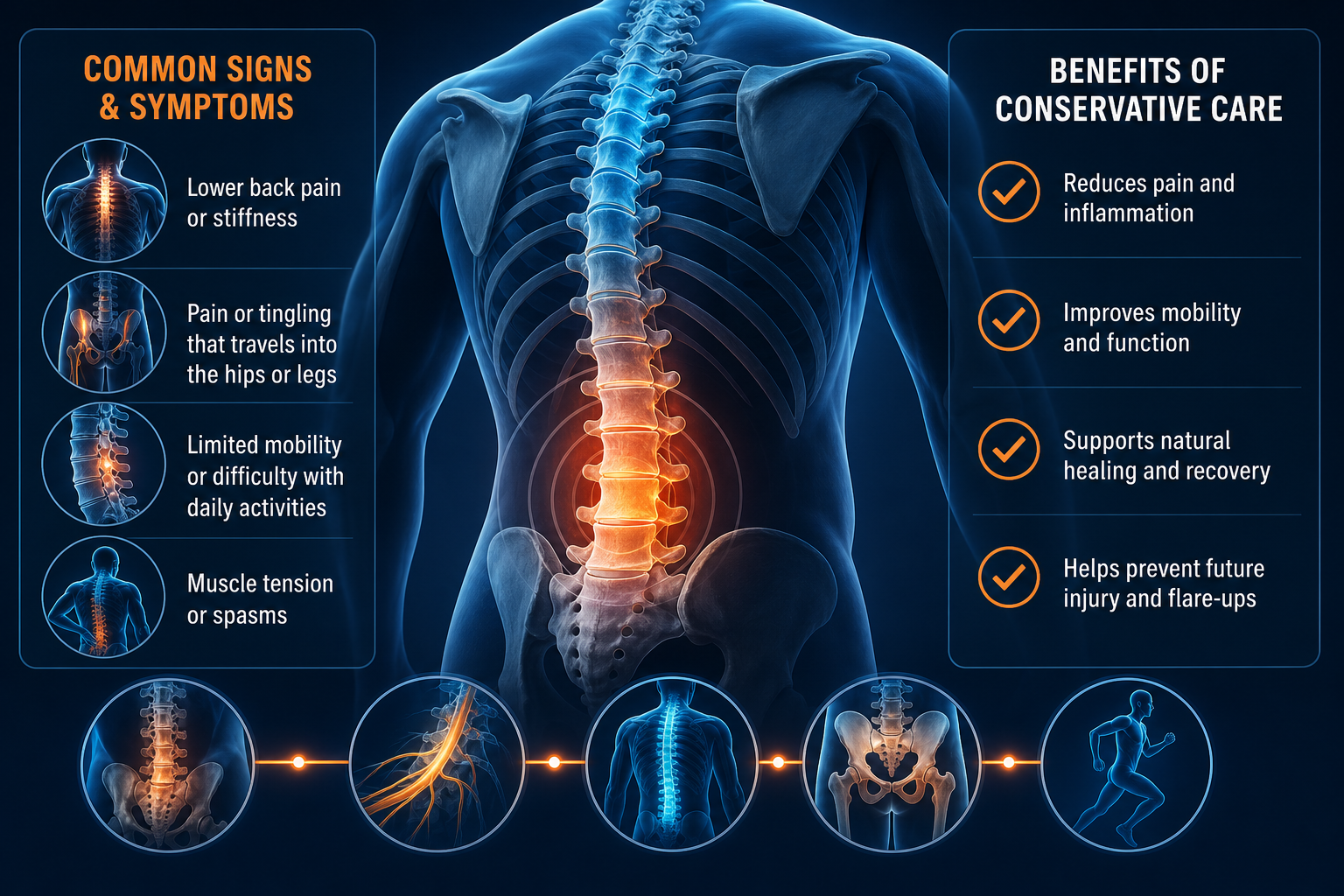
What does a chiropractor help with? A chiropractor typically helps with musculoskeletal problems such as low back pain, neck pain, tension-related headaches, posture strain, joint stiffness, reduced ROM, and movement-related discomfort. Chiropractic care is most often used for mechanical pain involving the spine, sacroiliac joints, surrounding muscles, and related nerves, with goals that include pain reduction, better mobility, and easier daily function.
Common reasons people look for chiropractic care include pain after long hours sitting, lifting strain, sports overuse, minor auto-collision injuries, and recurring stiffness that gets worse with movement or certain positions. Chiropractic care does not replace emergency evaluation for severe injury, unexplained weakness, bowel or bladder changes, chest pain, fever, or suspected fracture.
What Does a Chiropractor Help With? Common Conditions, Symptoms, and When to See a ProviderWhat Does a Chiropractor Help With?
Chiropractors most commonly help with mechanical neck pain, mechanical low back pain, mid-back stiffness, some headache patterns, and joint or soft-tissue problems that limit movement. The key word is mechanical. That means your symptoms change with posture, lifting, twisting, walking, sleeping position, desk work, or exercise.
If your pain is tied to how your body moves, a chiropractor may help improve how the joints, muscles, and connective tissues work together.
- Low back pain: often linked to the lumbar spine, sacroiliac joint, gluteal muscles, or poor hip mobility
- Neck pain: commonly involving the cervical spine, upper trapezius, levator scapulae, and suboccipital muscles
- Headaches: especially cervicogenic headaches and some tension-type headaches related to neck dysfunction
- Sciatica-like symptoms: pain radiating into the buttock or leg from irritation around the lumbar discs, nerve roots, or piriformis region
- Posture strain: stiffness from desk work, driving, phone use, or repetitive bending
- Joint-related discomfort: shoulders, hips, ribs, and thoracic spine often contribute to pain patterns
Research summaries commonly report that low back pain is one of the most frequent reasons adults seek conservative musculoskeletal care, and many clinical guidelines recommend non-invasive care first for uncomplicated cases.
Some providers also use focused upper cervical methods for selected patients. If that applies to your symptoms, you can learn more about upper cervical subluxation.
What Symptoms Can a Chiropractor Help Manage?
A chiropractor may help when the main problem is pain, stiffness, or limited movement rather than a systemic illness. If you are asking, can a chiropractor help lower back pain, the answer is often yes when the pain is mechanical, position-dependent, and not tied to a medical emergency.
Symptoms that often respond to conservative care
- Aching or sharp pain in the lumbar spine after bending, lifting, or prolonged sitting
- Neck stiffness with pain turning your head while driving
- Headaches that start at the base of the skull and move toward the forehead
- Mid-back tightness between the shoulder blades after desk work
- Buttock or posterior thigh pain that worsens with sitting
- Morning stiffness that improves after 10 to 20 minutes of movement
- Loss of ROM in the neck, low back, shoulder, or hip
Functional problems chiropractors may address
Symptoms are only part of the picture. Chiropractors also assess function: how you squat, rotate, reach, walk, sit, and tolerate work tasks. Functional issues often include:
- Difficulty standing longer than 15 to 30 minutes
- Pain getting up from a chair or out of a car
- Reduced neck rotation, often less than 60 to 70 degrees to one side
- Hip stiffness that forces the low back to compensate
- Repeated flare-ups with gym training or weekend sports
If leg pain, numbness, or tingling is part of the problem, read what can be done for sciatic pain for a more specific breakdown of conservative options.
What Conditions Do Chiropractors Treat by Body Region?
If you want a direct answer to what conditions do chiropractors treat, the short answer is common spine- and joint-related disorders grouped by region. Chiropractors do not treat every cause of pain. They most often manage conditions driven by joints, muscles, movement faults, and irritated but not severely damaged tissues.
Neck and head
A chiropractor for neck pain and headaches commonly evaluates the cervical facet joints, suboccipital muscles, sternocleidomastoid, and upper thoracic mobility. Problems in these areas may contribute to cervicogenic headaches and tension-related head pain. For more detail, see what is a common head pain and migraines: what you might not know.
- Mechanical neck pain
- Posture-related strain
- Cervicogenic headaches
- Upper back and shoulder girdle tension
- Jaw-related muscular tension in some cases, especially around the masseter and temporalis
Low back, pelvis, and leg
Is a chiropractor good for sciatica? A chiropractor may help when sciatic-type symptoms come from lumbar joint restriction, disc irritation, piriformis tightness, or poor lumbopelvic mechanics. The lumbar spine, sacroiliac joint, gluteus medius, hamstrings, and hip flexors are frequent contributors.
- Acute low back strain
- Recurrent low back pain
- Sacroiliac joint dysfunction
- Sciatica-like leg pain
- Hip mobility restrictions affecting the back
Mid-back, shoulder, and rib mechanics
Thoracic spine stiffness can change how your neck and shoulders move. Reduced thoracic extension often shows up with overhead reaching, deep breathing, or prolonged computer work.
- Thoracic stiffness
- Postural rib and scapular discomfort
- Shoulder movement limitations related to upper-back mechanics
- Sports overuse patterns involving rotation
What Chiropractic Care May Include
Chiropractic care is not limited to an adjustment. Most effective plans combine manual care with movement correction, self-care, and load management. If you are wondering how long does chiropractic treatment take, uncomplicated flare-ups often improve over 2 to 6 visits in 2 to 4 weeks, while more persistent problems may need 6 to 12 visits over 4 to 8 weeks plus home exercise.
Treatment approach What it targets Expected outcome Typical timeline Spinal manipulation or mobilization Restricted joints in the cervical, thoracic, or lumbar spine Less pain, improved ROM, easier movement Often felt within 1-3 visits Soft tissue work Upper trapezius, piriformis, quadratus lumborum, gluteals, paraspinals Reduced muscle guarding and stiffness 1-4 visits for short-term change Corrective exercise Core control, hip mobility, scapular stability Better function and fewer flare-ups 2-8 weeks of regular practice Stretching and mobility drills Hamstrings, hip flexors, thoracic spine, suboccipitals Improved flexibility and movement tolerance Daily for 2-6 weeks Ergonomic and activity modification Desk setup, lifting habits, sleep position, driving posture Less repeated strain during daily tasks Usually immediate once correctedCommon visit elements include:
- Orthopedic and movement testing
- Joint-specific manual therapy
- Soft tissue treatment
- Mobility drills for the thoracic spine, hips, or neck
- Strength work for the deep neck flexors, core, and gluteal muscles
- Advice on sitting, lifting, sleeping, and training volume
If athletic performance is part of your goal, see sports therapy and how a chiropractor may improve your game.
What Chiropractors Do Not Treat Alone
Chiropractic care does not replace emergency care or a medical workup for serious underlying disease. A chiropractor can evaluate musculoskeletal patterns, but not every back or neck problem should be handled as a routine spine complaint.
You need prompt medical evaluation first if symptoms suggest fracture, infection, significant neurologic compromise, or a non-musculoskeletal cause.
- Loss of bowel or bladder control
- Rapidly worsening leg weakness or foot drop
- Numbness in the groin or saddle region
- Fever with severe spinal pain
- Major trauma or suspected fracture
- Chest pain, shortness of breath, or pain unrelated to movement
- Unexplained weight loss with persistent pain
- Night pain that does not change with position
If pain is constant, severe, and not altered by movement, posture, or rest, the problem may not be mechanical. That needs a different evaluation path.
This is the distinction many searchers need: chiropractors commonly manage symptoms caused by movement dysfunction, but they do not replace emergency assessment or broader diagnosis of serious disease.
After a Car Accident or Minor Injury, When Can Conservative Care Help?
Conservative care may help after a low-speed collision, sports strain, lifting injury, or slip without major trauma when symptoms are consistent with whiplash-type strain, joint irritation, muscle spasm, or mobility loss. If you are searching for a chiropractor after car accident near me, first screen for red flags, then choose a provider who documents ROM, neurologic findings, and functional limits clearly.
Common post-impact problems chiropractors assess
- Whiplash-associated neck pain involving the cervical facets, levator scapulae, and deep neck muscles
- Mid-back stiffness from sudden seatbelt restraint
- Low back pain from bracing through the lumbar spine and pelvis
- Headaches starting 24 to 72 hours after impact
- Shoulder girdle restriction from gripping the wheel or seatbelt load
Expected recovery ranges
Minor strains often improve over 2 to 6 weeks with a combination of manual care and exercise. More persistent whiplash-related stiffness may take 6 to 12 weeks, especially if headaches, sleep-position pain, and reduced neck rotation are present.
Natural treatment for back pain without surgery often starts with movement, not rest. Too much inactivity after a minor injury usually prolongs stiffness.
- Use short walks 3 to 5 times per day.
- Change position every 30 to 45 minutes.
- Avoid aggressive stretching in the first 48 hours if it increases pain.
- Start gentle ROM drills once severe pain settles.
- Progress to strengthening when daily movement is easier.
For patients exploring upper cervical methods after related symptoms, Medximity also has articles on Meniere’s recovery with upper cervical treatment and upper cervical care for TMJ and TMD.
How Does Chiropractic Care Differ From Physical Therapy?
Chiropractor vs physical therapist for back pain is a useful comparison because the two fields overlap. Chiropractors often emphasize spinal and joint assessment, manual treatment, and movement-related diagnosis. PTs often emphasize exercise progression, strength deficits, gait, and functional rehab. Many patients benefit from either, and some do best with both.
Question Chiropractic care Physical therapy Main focus Joint mechanics, spinal movement, manual care, symptom relief Strength, motor control, endurance, functional rehab Common tools Manipulation, mobilization, soft tissue work, exercise advice Exercise prescription, mobility work, manual therapy, functional training Best for Acute stiffness, spinal pain, ROM loss, movement-triggered pain Post-injury rehab, weakness, return to activity, longer-term conditioning Typical timeline 2-6 visits for straightforward flare-ups 4-12 weeks for rehab progressionThe best option depends on the problem in front of you. If your main issue is sudden neck locking, acute low back restriction, or headache linked to cervical motion, chiropractic care may be a logical first step. If your main issue is balance, deconditioning, or rebuilding capacity after weeks of limited activity, PT may fit better.
How to Choose a Chiropractor
The best chiropractor near me for back pain is not the one with the flashiest website. Choose a provider who explains your exam findings, gives a clear treatment plan, and measures progress with pain, ROM, and function.
- Look for a provider who asks what movements trigger symptoms
- Expect an exam of posture, ROM, neurologic signs, and orthopedic tests
- Choose someone who gives home exercises, not just in-visit treatment
- Ask how progress will be measured by week 2 or week 3
- Ask what red flags would change the plan and require referral
- Look for practical guidance on work setup, lifting, and sleep position
A good first visit usually includes history, movement testing, palpation, and a short-term plan. That plan should tell you:
- What tissues or joints are likely driving symptoms
- How many visits are reasonable before reassessment
- Which daily activities to modify
- Which home drills to start immediately
If you are considering care for a child, see should my child get adjusted by a chiropractor.
What to Do Next
If you are asking when should you see a chiropractor, the practical answer is this: seek routine chiropractic evaluation when your pain is tied to movement, posture, lifting, desk work, sports, or a minor strain and has lasted more than a few days or keeps returning. Seek urgent medical evaluation instead for severe trauma, progressive weakness, saddle numbness, bowel or bladder changes, fever, chest pain, or pain that is constant and not altered by position.
Start with this home protocol for simple neck or low back stiffness
- Walk for 5 to 10 minutes, 3 times daily. Keep the pace easy.
- Do 10 gentle standing back bends every 2 to 3 hours if they reduce low back pressure. Stop if leg pain worsens.
- Perform chin tucks: stand tall, draw your head straight back, hold 3 seconds, repeat 10 times, 2 to 3 rounds daily.
- Try a hip flexor stretch: half-kneeling position, tuck the pelvis slightly, shift forward until you feel the front of the hip stretch, hold 20 to 30 seconds each side, 3 reps.
- Use thoracic extension over a chair back: support your head, extend gently over the mid-back, repeat 8 to 10 times.
If any drill causes spreading numbness, marked weakness, or sharp worsening pain, stop and get evaluated.
For routine musculoskeletal problems, start with a chiropractor, physical therapist, or rehabilitation-focused provider who can assess ROM, joint mechanics, strength, and movement tolerance. At your first visit, expect questions about onset, aggravating movements, work demands, sleep position, and prior injuries, followed by a physical exam of the cervical spine, thoracic spine, lumbar spine, hips, and related nerve function.
Use Medximity to find a chiropractor near you, browse providers, or explore more health topics before booking. The best next step is a provider who can tell you whether your problem looks mechanical, how long recovery typically takes, and what you should start doing today.
FAQ
Can a chiropractor help lower back pain?
Yes, chiropractors commonly help manage mechanical low back pain, especially when symptoms change with sitting, bending, lifting, walking, or sleeping position. Treatment often includes spinal manipulation or mobilization, soft tissue work, and home exercises for the core, hips, and lumbar spine.
What conditions do chiropractors treat most often?
Chiropractors most often treat low back pain, neck pain, posture-related strain, tension-related headaches, cervicogenic headaches, thoracic stiffness, sacroiliac joint dysfunction, and some sciatica-like symptoms. They focus on musculoskeletal conditions involving joints, muscles, connective tissue, and movement patterns.
How long does chiropractic treatment take?
Simple flare-ups often improve within 2 to 6 visits over 2 to 4 weeks. More persistent problems, especially those involving recurring low back pain, reduced neck ROM, or post-accident stiffness, may take 6 to 12 visits over 4 to 8 weeks with daily home exercise.
Is a chiropractor good for sciatica?
A chiropractor may help when sciatic-type pain is related to lumbar joint restriction, disc irritation without major neurologic loss, piriformis tightness, or poor hip and pelvic mechanics. Progressive weakness, foot drop, or bowel and bladder changes require urgent medical evaluation.
How is chiropractic different from physical therapy?
Chiropractic care often emphasizes joint mechanics, spinal motion, and manual treatment. Physical therapy often emphasizes exercise progression, strength, endurance, and functional rehab. Both can help back pain, and some patients benefit from a combined plan.
When should you see a chiropractor?
See a chiropractor when pain or stiffness is movement-related, keeps returning, or limits work, exercise, driving, or sleep position. Seek urgent medical care first for severe trauma, fever with spinal pain, chest pain, major weakness, bowel or bladder changes, or numbness in the saddle region.