Understanding Sacral Spondylosis: Symptoms, Causes, and Treatment starts with one key point: sacral spondylosis is age- or stress-related wear at the base of your spine that can cause stiffness, low back pain near the tailbone, and pain into the buttock region. In most cases, treatment focuses on movement, joint support, physical therapy, chiropractic care, and daily habit changes that reduce strain on the lower lumbar spine, sacrum, and SI joints.
If you are asking what is sacral spondylosis, the short answer is degenerative change around the sacrum and nearby spinal structures. It is not the same thing as sciatica, a disc bulge, or inflammatory arthritis, although those problems can overlap.
What Is Sacral Spondylosis?
Sacral spondylosis refers to degenerative wear affecting the structures where the lower spine meets the sacrum. The term usually describes changes involving the L5-S1 segment, nearby facet joints, supporting ligaments, and the transition into the sacroiliac joints. These changes can include joint narrowing, bone spur formation, reduced segmental mobility, and stiffness that is worse after rest.
The sacrum itself is the triangular bone below the lumbar spine and above the tailbone. It anchors the spine to the pelvis. When this region loses normal motion or develops wear, pain often stays low in the back instead of traveling far down the leg.
Research on degenerative spine conditions consistently shows that imaging changes become more common with age, but symptoms depend more on mobility loss, joint irritation, and load tolerance than on the scan alone.
What sacral spondylosis usually involves
- L5-S1 disc wear or loss of disc height
- Irritation in the facet joints at the base of the spine
- Stress at the sacroiliac joints
- Tightness in nearby muscles such as the gluteus medius, piriformis, and quadratus lumborum
- Reduced extension, rotation, or pelvic control during walking and standing
If leg pain is your main complaint, compare those symptoms with sciatica treatment and pain patterns. Sacral spondylosis usually acts more like a mechanical low back problem than a primary nerve-root problem.
Where Is the Sacrum in Your Lower Spine?
If you are searching where is the sacrum in spine, the sacrum sits directly below the five lumbar vertebrae and directly above the coccyx. You can think of it as the keystone between your spine and pelvis. It supports load transfer when you sit, stand, bend, walk, and roll in bed.
The upper part of the sacrum connects to the lumbar spine at L5-S1. The sides connect to the pelvic bones at the right and left SI joints. That is why sacral pain can feel central, off to one side, or deep in the buttock.
Why this location matters
- Pain near the belt line often points to the lower lumbar segments.
- Pain just below that, close to the dimples of the low back, often involves the SI region.
- Pain near the tailbone may come from altered sitting mechanics, pelvic tilt, or stiffness in the sacrococcygeal area.
- Pain with standing from a chair often reflects load sensitivity at L5-S1 or the SI joints.
For broader spine and balance-related care topics, you can explore more health topics on Medximity.
What Are the Symptoms of Sacral Spondylosis?
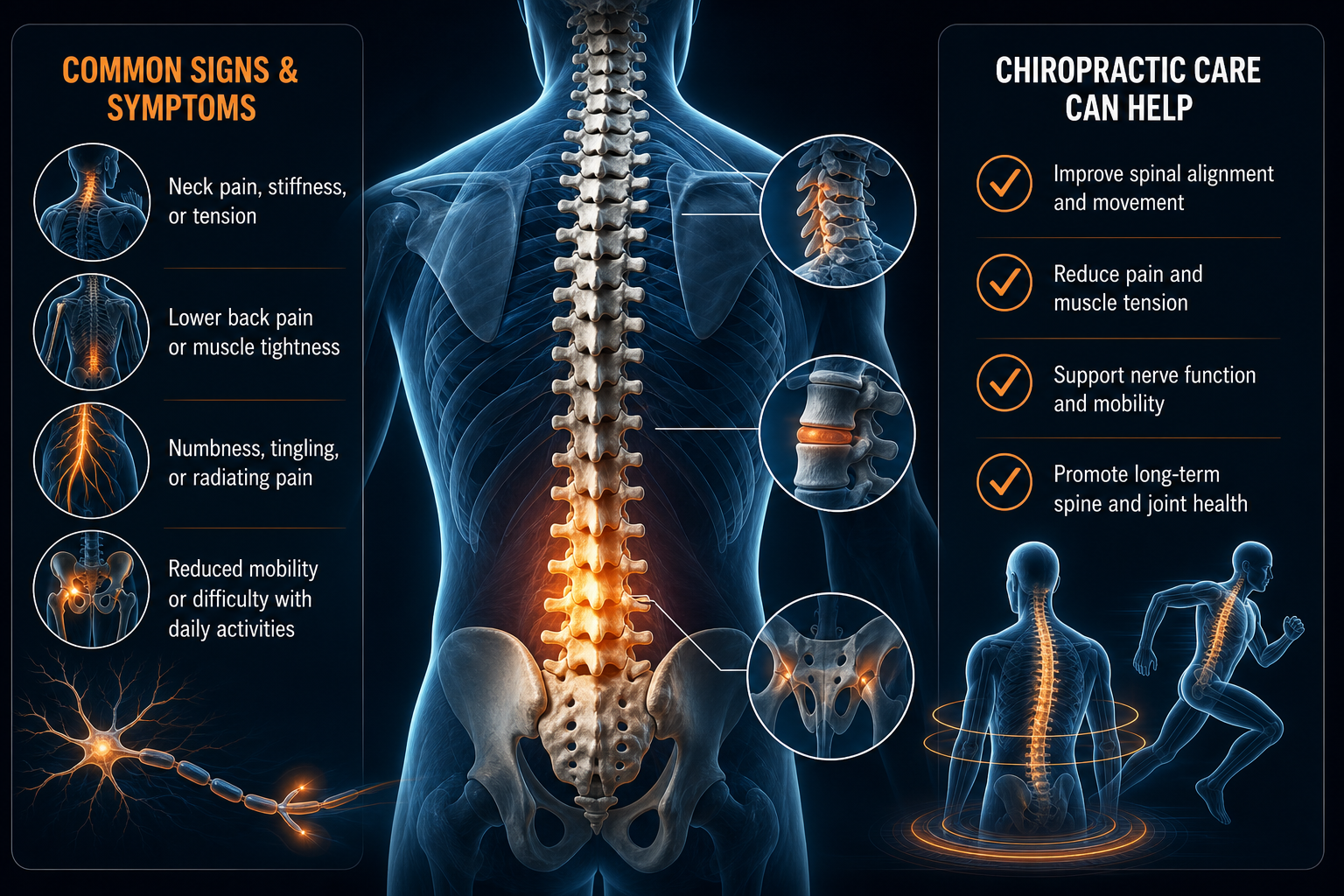
Symptoms of sacral spondylosis usually center on stiffness and pain at the base of the spine. The most common pattern is lower back pain near tailbone, often with aching into one or both buttocks. Pain typically increases after prolonged sitting, first steps after rest, repeated bending, or standing with poor pelvic support.
Symptoms are often mechanical. That means certain positions make them worse, and movement or position changes may reduce them.
- Central low back ache near the sacrum
- Buttock pain without true nerve symptoms
- Morning stiffness lasting 10 to 30 minutes
- Pain after long car rides or desk work
- Reduced ROM with lumbar extension or rotation
- Tight hamstrings or hip flexors that increase pelvic strain
- Pain when rolling in bed or standing up straight after sitting
Symptoms that suggest nerve irritation instead of isolated spondylosis
- Sharp pain shooting below the knee
- Numbness in the foot or outer calf
- Weakness with ankle lifting or toe walking
- Coughing or sneezing sharply increases leg pain
If dizziness or upper-cervical symptoms are also part of your care history, related articles like vestibular disorders treatment and vertigo solutions with chiropractic treatment cover very different symptom patterns. Sacral spondylosis stays in the lower spine and pelvis.
Typical flare-ups last 2 to 6 weeks when driven by strain and stiffness. Longer-standing degenerative patterns often improve over 6 to 12 weeks with consistent exercise, manual care, and load management.
What Causes Sacral Spondylosis and Who Gets It?
Sacral spondylosis causes and risk factors usually come down to repetitive loading, reduced mobility, and age-related tissue change. The area where the lumbar spine meets the sacrum absorbs high forces during bending, lifting, twisting, and prolonged sitting. If your hips are stiff and your trunk muscles are deconditioned, that force concentrates at L5-S1 and the SI region.
- Age-related disc dehydration and joint wear
- Repetitive lifting, bending, or rotational work
- Long periods of sitting with posterior pelvic tilt
- Poor hip mobility, especially limited hip extension
- Weak trunk stabilizers such as the transverse abdominis and multifidus
- Previous low back strain or untreated SI dysfunction
- Reduced walking volume and general deconditioning
Posture matters, but not because one posture is perfect. The real issue is staying in one position too long. A flexed sitting posture loads the lower discs. An extended standing posture can compress the facet joints. Alternating positions usually works better than trying to “sit straight” all day.
Common movement faults that increase sacral stress
- Bending from the low back instead of hinging at the hips.
- Standing with weight shifted onto one leg for long periods.
- Sleeping twisted with the top knee unsupported.
- Returning too quickly to loaded exercise after a flare.
How Does Sacral Spondylosis Differ From Sciatica, Arthritis, and Disc Problems?
Sacral spondylosis vs sciatica symptoms is one of the most useful distinctions to understand. Sacral spondylosis usually causes local pain, stiffness, and buttock aching. Sciatica is a nerve pattern. It tends to travel down the leg along the path of the sciatic nerve, often below the knee.
Condition Main pain location Common clues Movement pattern Sacral spondylosis Low back, sacrum, buttock Stiffness, pain after sitting, reduced ROM Often worse with prolonged postures Sciatica Buttock to leg or foot Burning, tingling, numbness Often worse with nerve tension Facet arthritis Low back, one or both sides Pain with extension and rotation Often worse standing backward Disc irritation Central low back, sometimes leg Pain with flexion, sitting, coughing Often worse with bending forward“Arthritis” is a broad term. Sacral spondylosis may include arthritic wear, but the label does not tell you which tissue is active. A disc issue can coexist. So can SI joint dysfunction.
For a clearer look at nerve-driven pain, review sciatica treatment – understanding the pain. If your symptoms are mostly neck-based rather than low-back-based, articles such as tension headache treatment without medication address a different region entirely.
What Treatment for Sacral Spondylosis Without Surgery Usually Helps?
Treatment for sacral spondylosis without surgery usually combines manual care, exercise therapy, mobility work, and activity modification. The goal is not to “erase” degeneration on imaging. The goal is to reduce joint irritation, improve segmental motion, restore hip and trunk function, and build tolerance for daily activity.
Conservative options that are commonly used
- Physical therapy for trunk stabilization, hip mobility, gait mechanics, and graded exercise
- Chiropractic care for joint restriction, spinal and pelvic mechanics, and movement-based management
- Soft-tissue work for the gluteals, lumbar paraspinals, and piriformis
- Home exercise targeting core control and hip extension
- Ergonomic changes for sitting, driving, and lifting
- Walking progression to improve circulation and load tolerance
If symptoms are persistent, start with a provider who treats spine and movement disorders conservatively. You can find a chiropractor near you or browse providers based on your location and care preferences.
What Natural Treatment for Sacral Spondylosis Can You Do at Home?
Natural treatment for sacral spondylosis works best when you move often, avoid end-range strain during a flare, and rebuild hip and trunk support. Rest helps only for very short periods. Most people do better with controlled movement the same day symptoms start, unless a red flag is present.
Simple home protocol for a typical flare
- Walk for 5 to 10 minutes, 2 to 4 times per day. Use a short stride and upright posture.
- Do pelvic tilts on your back with knees bent. Flatten and release your low back for 10 reps.
- Perform single-knee-to-chest gently for 5 reps each side, holding 10 seconds.
- Stretch the piriformis: lie on your back, cross one ankle over the opposite knee, and pull the thigh toward you for 20 seconds. Repeat 3 times.
- Bridge exercise: squeeze your glutes, lift hips a few inches, hold 3 seconds, repeat 8 to 10 reps.
- Take movement breaks every 30 to 45 minutes if you sit for work.
Sleep positioning changes can reduce night pain. Try side-lying with a pillow between your knees, or on your back with a pillow under your knees. Both positions reduce extension stress at the lumbosacral junction.
- Avoid deep, repeated forward bending during the first few painful days.
- Avoid sitting on very soft couches that drop your pelvis backward.
- Use a hip hinge when lifting laundry, groceries, or boxes.
- Resume normal walking before returning to loaded workouts.
These same principles show up across conservative care topics on Medximity, whether you are looking at spine pain or articles like treating post-concussion syndrome by natural means. The details differ by body region, but graded activity still matters.
When Should You See a Provider for Sacral Spondylosis?
You should see a provider if pain lasts more than 1 to 2 weeks, returns frequently, limits walking or sleep, or starts traveling below the knee. A chiropractic provider or physical therapist can usually assess movement, joint loading, ROM, hip restrictions, and whether the pattern fits sacral spondylosis, SI dysfunction, or nerve irritation.
- Book routine care if stiffness keeps returning with sitting, lifting, or exercise.
- Book prompt care if pain is worsening over several days instead of settling.
- Seek urgent medical evaluation if you have new bowel or bladder changes, saddle numbness, major leg weakness, or significant trauma.
Those red flags are uncommon, but they change the plan.
If you are searching for a sacral spondylosis specialist near me, conservative spine-focused providers are a practical first step. You can find a physical therapist near you or search by specialty on Medximity.
Frequently Asked Questions About Sacral Spondylosis
Is sacral spondylosis the same as sciatica?
No. Sacral spondylosis is degenerative wear near the base of the spine. Sciatica is irritation of the sciatic nerve or a nerve root, often causing pain, tingling, or numbness into the leg and foot.
Is it normal to have sacrum pain?
Occasional sacrum pain after prolonged sitting, lifting, or reduced activity is common. Persistent sacrum pain is not something to ignore. If it lasts beyond 1 to 2 weeks or keeps recurring, get it assessed.
How long does sacral spondylosis last?
The condition itself is usually chronic degenerative change, but symptoms come in episodes. A mild flare may settle within 2 to 4 weeks. More established cases often need 6 to 12 weeks of consistent conservative care and exercise to improve function.
Is sacral spondylosis the same as arthritis?
Not exactly. Spondylosis is a broader term for degenerative spinal wear. Arthritic joint changes may be part of it, especially in the facet or SI joints, but spondylosis can also involve discs, ligaments, and movement restriction.
What is the best treatment for sacrum pain?
The best treatment depends on the tissue involved, but most cases improve with a combination of movement assessment, physical therapy or chiropractic care, home exercise, walking, and posture changes that reduce repetitive strain.
What to Do Next
Start with an evaluation if your pain is limiting bending, walking, sleep, or work tolerance. A provider will usually check lumbar ROM, hip mobility, SI joint loading, glute strength, and whether the pain is mechanical or nerve-related. Your first visit often includes movement testing, posture review, and a home exercise plan you can begin the same day.
- Choose chiropractic care if joint stiffness and movement restriction are the main pattern.
- Choose physical therapy if weakness, poor endurance, and recurring flare-ups are the main pattern.
- Choose prompt evaluation if symptoms spread below the knee or you notice numbness or weakness.
- Choose urgent care immediately for bowel or bladder changes, saddle numbness, or major trauma.
For routine care, the next step is simple: find a chiropractor near you, find a physical therapist near you, or browse providers on Medximity. The right plan usually starts with restoring motion, reducing load at the sacrum, and building strength that keeps the problem from flaring again.