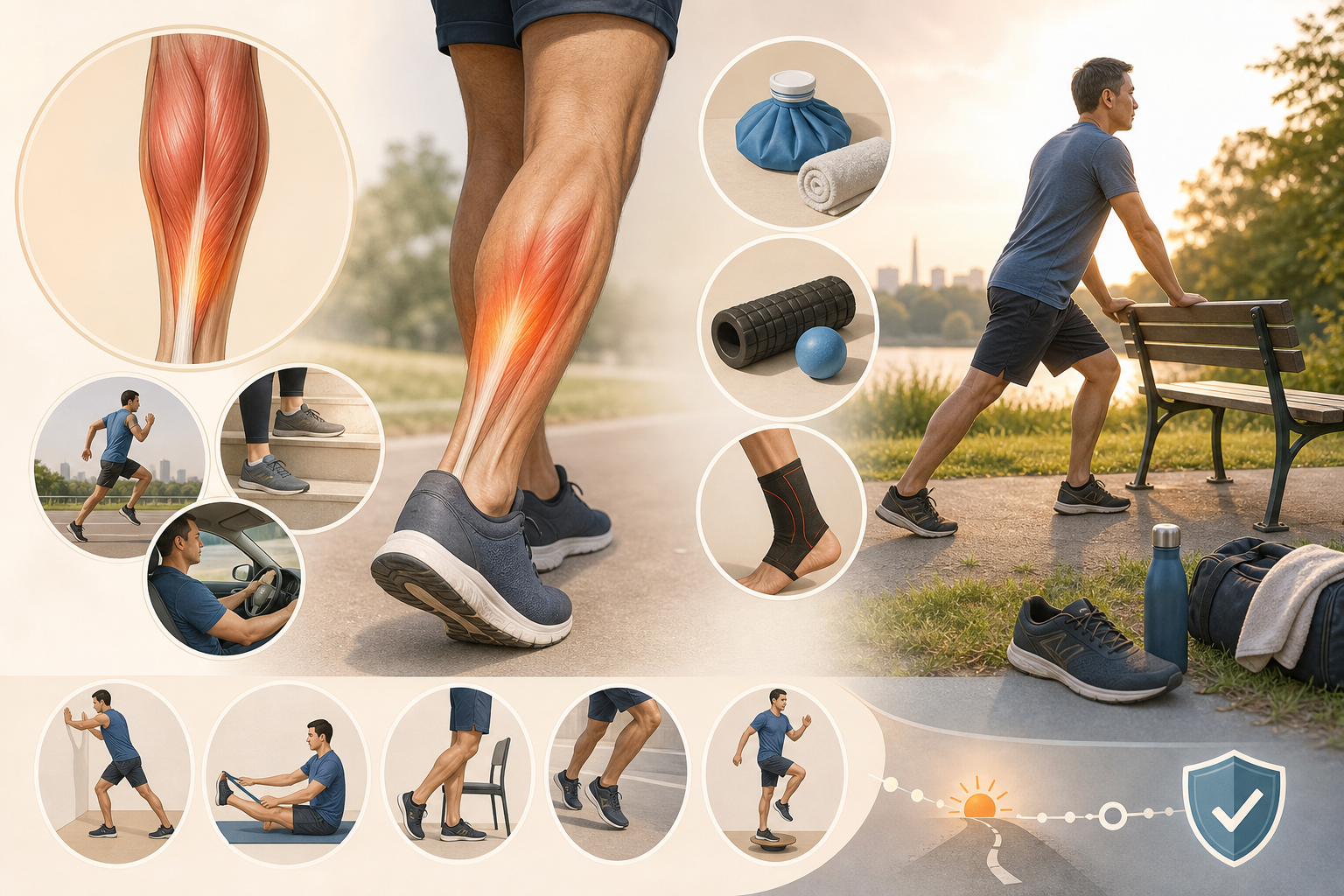
Understanding Right Lower Leg Muscle and Tendon Strain: Symptoms, Causes, and Treatment starts with one question: is the pain coming from the calf muscle, the tendon that attaches it, or another structure in the lower leg. A right lower leg strain usually involves overstretching or small tearing of the gastrocnemius, soleus, tibialis anterior, peroneal muscles, or the Achilles tendon, and most cases respond to conservative care, guided exercise, and load management. If you cannot bear weight, have marked swelling, or develop numbness, calf tightness with chest symptoms, or severe pain after a fall or crash, get prompt medical evaluation.
What Is a Right Lower Leg Muscle or Tendon Strain?
A right lower leg strain is a soft tissue injury caused by fibers being stretched beyond their tolerance. A muscle strain affects the contractile tissue that produces movement. A tendon strain, often called tendon overload or tendon irritation in everyday use, affects the thick connective tissue that attaches muscle to bone.
What is a lower leg strain in practical terms? It usually means the tissue could not handle the force placed on it during pushing off, landing, climbing stairs, changing direction, or compensating for another problem higher up the chain such as hip weakness or altered gait. The right side may be affected alone because your dominant leg often handles more braking, driving, pivoting, and step-down force.
- Grade 1: mild fiber disruption, soreness, tightness, little or no strength loss
- Grade 2: partial tearing, pain with walking, swelling, bruising, reduced push-off strength
- Grade 3: major tearing, major weakness, marked limp, difficulty bearing weight
Research on calf injuries consistently shows that strain severity, location, and early load management affect recovery more than pain alone.
If your symptoms also shoot from the low back into the leg, review sciatica treatment and understanding the pain because nerve-driven pain can mimic a calf problem.
Right Lower Leg Anatomy in Plain Language
Right lower leg muscle anatomy pain makes more sense when you know which structures do what. The lower leg runs from the knee to the ankle and contains muscle compartments in the back, front, and outer side.
Back of the leg
The calf is mainly the gastrocnemius and soleus. The gastrocnemius crosses the knee and ankle, so it is stressed during sprinting and jumping. The soleus sits deeper and works hard during walking, standing, and uphill movement. Both feed into the Achilles tendon, which attaches to the heel bone.
Front and outer side of the leg
The tibialis anterior runs along the shin and lifts the foot. The peroneus longus and peroneus brevis run on the outer leg and help control ankle stability. These tissues often get overloaded when footwear changes, running volume increases, or you walk differently after another injury.
Structure Main Job Common Pain Pattern Gastrocnemius Push-off, jumping, knee + ankle power Upper or mid-calf pain during sudden acceleration Soleus Endurance walking, standing, climbing Deep calf ache, worse with prolonged walking Achilles tendon Transfers calf force to heel Pain/stiffness 1-2 inches above heel or at insertion Tibialis anterior Lifts foot during gait Shin pain with walking, stairs, or overuse Peroneal tendons Stabilize outer ankle and foot Outer lower leg pain, worse on uneven groundFor more education on balance-related conditions that can change gait mechanics, see vestibular disorders treatment.
Muscle Strain vs Tendon Strain: What’s the Difference?
The muscle strain vs tendon strain leg question matters because the tissues behave differently under load. Muscle injuries usually hurt more during contraction or stretch. Tendon injuries usually hurt more with repeated loading and may feel stiff at the start of activity, then warm up, then ache later.
Signs that point more toward muscle
- Sharp pain during a sudden push-off or sprint
- Pain higher in the calf belly rather than close to the heel
- Bruising within 24-72 hours in moderate cases
- Pain when you stretch the calf or rise onto your toes
Signs that point more toward tendon
- Pain localized near the tendon, often above the heel
- Morning stiffness or pain during the first few steps
- Symptoms that build with repeated walking or running
- Thickened or tender tissue on palpation
Both can coexist. A calf strain can overload the Achilles for weeks, and an irritated Achilles can make you alter gait and strain the soleus. That is why providers assess the ankle, knee, hip, and walking pattern together rather than chasing the sore spot only.
A tendon usually tolerates load best when loading increases gradually. Sudden spikes in volume are a common reason symptoms persist.
What Symptoms Suggest a Right Lower Leg Strain?
Symptoms of right calf tendon strain or muscle strain range from mild tightness to obvious loss of function. Pain severity alone does not tell the whole story. Your ability to walk, push off, and tolerate repeated steps matters more.
- Mild: soreness, tightness, stiffness after activity, mild tenderness, no visible swelling
- Moderate: limp, pain on stairs, swelling, bruising, pain with heel raises, reduced ROM
- More severe: sudden pop, marked weakness, inability to push off, major swelling, trouble bearing weight
Common movement findings include reduced ankle dorsiflexion, pain with resisted plantarflexion, and reduced single-leg heel raise height on the right. A soleus problem often hurts with bent-knee calf loading. Gastrocnemius involvement often hurts more with the knee straight.
Get urgent care if you have any of these red flags:
- You cannot put weight on the right leg after the injury.
- The calf becomes rapidly swollen, hot, or unusually firm.
- You have numbness, foot drop, or major weakness.
- You develop chest pain or shortness of breath with calf swelling.
- You had a significant fall, twist, or collision and the pain is severe.
If dizziness or head impact happened with the event, review treating post-concussion syndrome by natural means for related evaluation considerations.
Why Does My Right Lower Leg Hurt on One Side?
Why does my right lower leg hurt instead of both sides? One-sided strain usually reflects asymmetrical loading. Your right leg may absorb more force because of sport mechanics, driving position, prior ankle sprain, hip weakness, pelvic rotation, or a shorter step on the opposite side.
Common non-sport causes are missed too often.
- Sudden increase in walking distance, hills, or treadmill incline
- Work that involves ladder climbing, prolonged standing, or repeated squatting
- Poor footwear or worn-out shoes that reduce shock control
- Compensation after foot pain, back pain, or knee stiffness
- Slip, fall, or car accident causing rapid braking or bracing through the leg
- Starting calf raises, pickleball, jogging, or weekend sports too quickly
Mechanical overload can start far from the calf. Limited hip extension, poor ankle mobility, and weak gluteal control can force the lower leg to do extra work on every step. That is why a chiropractor or PT may assess lumbar motion, pelvis position, knee tracking, and foot mechanics in the same visit.
Most unilateral lower leg strains are not random. They usually follow a change in load, movement pattern, or impact.
How Does a Strain Feel Different From Other Lower Leg Problems?
A strain usually causes pain linked to muscle use, stretch, or repeated load. Other lower leg conditions have different patterns, and this comparison helps narrow down what to ask about during an exam.
Condition Typical Location What It Feels Like Common Trigger Calf muscle strain Mid or upper calf Sharp pull, tightness, pain with push-off Sprinting, stair push-off, sudden step Achilles tendon overload Back of ankle/heel Stiff at first, worse with repeated loading Running volume increase, hills Shin splint pattern Inner shin Diffuse ache along tibia Impact loading, overtraining Cramp Calf belly Sudden involuntary tightening Fatigue, dehydration, prolonged activity Nerve-related pain From back to leg/foot Burning, tingling, numbness Lumbar irritation, prolonged sittingA nerve problem often includes tingling or symptoms below the ankle. A strain usually stays localized and is reproduced by loading the tissue. If your symptoms track from the low back or buttock, compare them with sciatica patterns.
How to Treat Lower Leg Strain Conservatively
How to treat lower leg strain depends on tissue irritability, location, and function. Lower leg strain without surgery options usually starts with relative rest, swelling control, progressive loading, and manual assessment of the entire kinetic chain. Total inactivity for too long often delays recovery because muscles and tendons need graded load to remodel.
First 3 to 7 days
- Reduce aggravating activity, but keep easy walking if your gait stays mostly normal.
- Use brief icing after activity if it reduces pain.
- Elevate if swelling is present.
- Avoid aggressive stretching into sharp pain.
Progressive rehab from week 1 onward
- Isometrics: stand facing a wall and press the forefoot into the ground without lifting the heel, 5 holds of 30-45 seconds.
- Heel raises: start double-leg, 2-3 sets of 10-15, then progress to single-leg as pain allows.
- Bent-knee calf raises: bias the soleus, 2-3 sets of 12.
- Ankle mobility: knee-to-wall dorsiflexion drill, 2 sets of 10 slow reps.
- Balance work: single-leg stand 30 seconds, 3 rounds.
A mild Grade 1 strain may improve in 2-4 weeks with proper loading. A moderate strain often needs 4-8 weeks before higher-speed activity feels normal. Achilles-related overload may take longer than a simple calf tightness episode because tendon tissue adapts more slowly.
Conservative care may include chiropractic evaluation for joint restriction, PT for loading progression, soft tissue work for the gastrocnemius-soleus complex, gait retraining, and return-to-sport planning. If neck or balance issues are changing your movement patterns, related education on vertigo solutions with chiropractic treatment may also be useful.
What a Provider May Evaluate During an Exam
A provider evaluates whether the problem is contractile tissue, tendon overload, joint restriction, nerve referral, or a more significant injury. The exam is usually straightforward and movement-based.
- Location of tenderness: muscle belly, musculotendinous junction, Achilles region, or shin
- Swelling, bruising, warmth, and tissue tone
- Active ROM and passive ROM at the ankle and knee
- Strength with plantarflexion, dorsiflexion, and eversion
- Walking, stair use, squat pattern, and single-leg heel raise
- Hip and pelvic mechanics that may overload the right side
You may be asked when symptoms started, whether there was a pop, and whether right lower leg pain after falling or after a car accident began immediately or the next day. Post-impact soft tissue injuries often appear after the adrenaline wears off, especially in the calf, shin, and ankle stabilizers.
Providers do not just look at the sore spot. They look for the movement pattern that keeps the sore spot overloaded.
For related conservative care topics, you can explore more health topics on Medximity.
What to Do Next
If pain is mild and you can walk without a major limp, start with load reduction, heel raises within tolerance, and ankle mobility work for 7-10 days. If symptoms are not clearly improving, book a chiropractor, physical therapist, or rehabilitation provider who treats lower-extremity soft tissue injuries. Use Medximity to find a physical therapy near you, find a chiropractor near you, or browse providers.
At a first visit, expect a history, gait assessment, calf and ankle testing, ROM measurements, and a plan that includes activity modification plus progressive exercise. A mild strain often returns to normal walking within days to 2 weeks. A moderate strain may need 4-8 weeks before running, jumping, or fast direction change is comfortable again.
Seek urgent evaluation now if you cannot put weight on the right leg, have major swelling, numbness, a visible deformity, or severe pain after a slip, fall, or collision. Routine evaluation makes sense if you have been limping for more than a few days, morning Achilles stiffness that keeps returning, or repeated right calf tightness every time activity increases.
FAQ About Right Lower Leg Muscle and Tendon Strain
Is it normal to limp after calf strain?
A mild limp can happen for a short period after a calf strain, but it should improve as pain and push-off strength improve. If the limp is worsening, lasts more than several days, or you cannot perform a controlled heel raise, get examined.
How long does calf strain take heal?
A mild strain often settles in 2-4 weeks. A moderate strain commonly takes 4-8 weeks, sometimes longer if the tendon is involved or you return to hills, sprinting, or long walks too early.
What is the best home exercise for a lower leg strain?
The most reliable starting point is a pain-limited calf isometric followed by progressive heel raises. Begin with 5 holds of 30-45 seconds, then add 2 sets of 10 double-leg heel raises once walking is tolerable.
Can a lower leg strain happen without sports?
Yes. Work demands, footwear changes, long periods of standing, sudden walking increases, and compensation after a fall or vehicle collision can overload the calf, shin, or Achilles region.
When should I worry about right lower leg pain?
Get prompt evaluation if you cannot bear weight, have marked swelling, numbness, severe weakness, chest symptoms with calf swelling, or major pain after trauma. Those findings need faster assessment than a routine overuse strain.


