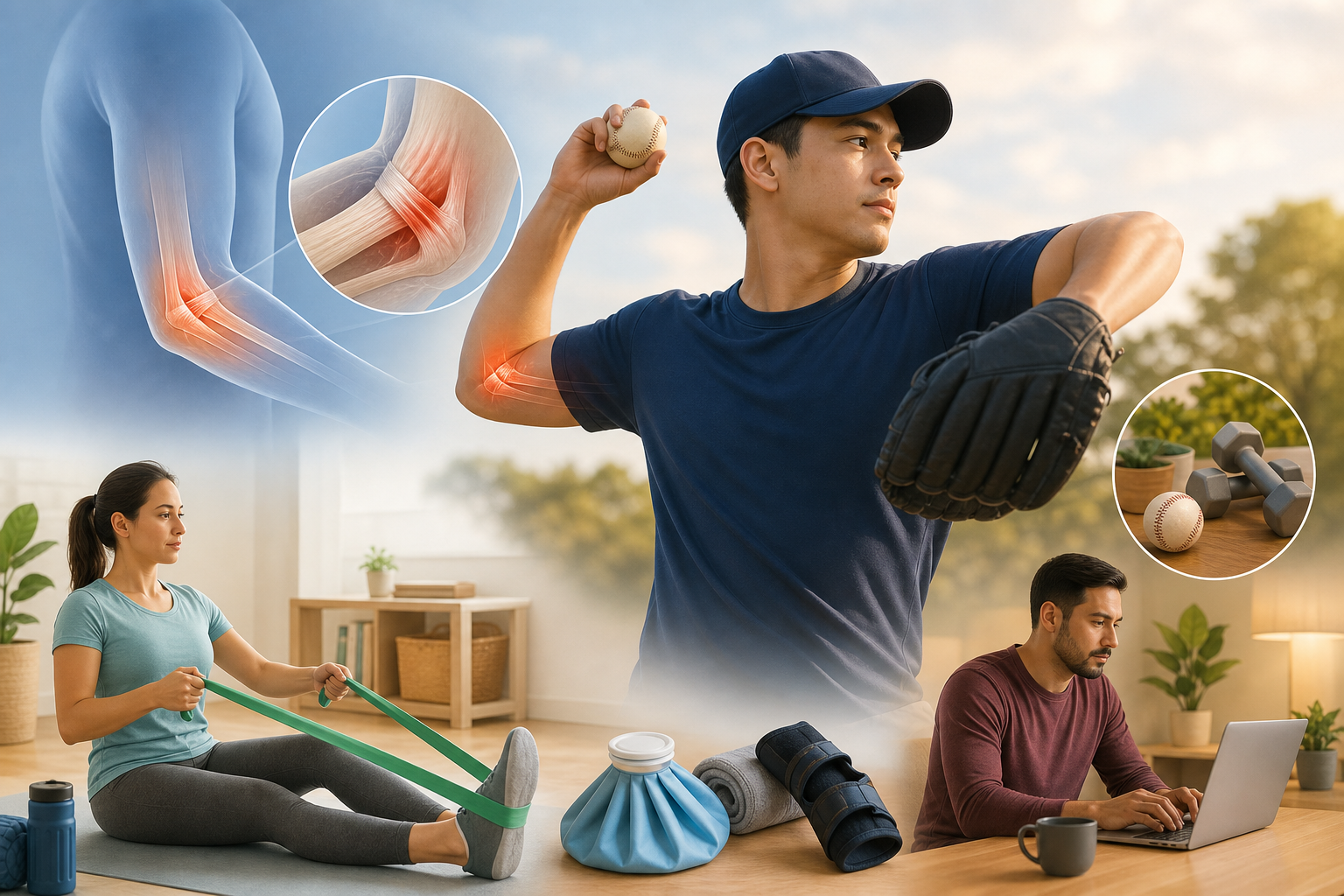
Understanding Left Elbow Ulnar Collateral Ligament Sprain: Symptoms, Causes, and Treatment starts with one key fact: a left elbow ulnar collateral ligament sprain is an overstretch or partial injury to the ligament on the inner side of your elbow, and it usually responds best to early load reduction, movement correction, and targeted rehab. If you have left inner elbow pain when throwing, lifting, gripping, or pressing, the goal is to identify whether the UCL, the flexor-pronator tendons, or the ulnar nerve is the main source, then start conservative care before instability becomes chronic.
The left-sided detail matters. Your left elbow may be your lead arm in baseball, your support arm in the gym, or the arm you use most for carrying, pushing up from a chair, or repetitive work tasks. That changes both the stress pattern and the treatment plan.
What Is a Left Elbow Ulnar Collateral Ligament Sprain?
What is an elbow UCL sprain? It is a ligament injury affecting the inner elbow, most often the anterior bundle of the ulnar collateral ligament, which helps resist valgus stress when your forearm moves away from your upper arm under load. The UCL sits between the medial epicondyle of the humerus and the ulna, and it works with the forearm flexor muscles to keep the joint stable during throwing, pressing, carrying, and forceful gripping.
A sprain is not always a full tear. In practice, providers usually think of UCL injuries on a spectrum:
- Grade 1: overstretching with microscopic fiber damage and mild tenderness
- Grade 2: partial fiber disruption, more pain with load, possible instability
- Grade 3: major disruption with marked laxity and poor tolerance to stress
Most people searching this term do not have a complete ligament failure. They have pain at the inner elbow, reduced throwing tolerance, soreness after pull-ups or pressing, or pain when lifting with the palm up.
Why the UCL gets overloaded
The UCL does not work alone. The flexor carpi ulnaris, flexor digitorum superficialis, and pronator mass help shield it from stress. If those tissues are weak, fatigued, or overused, more force reaches the ligament.
Throwing athletes can generate very high valgus stress across the elbow. Research on overhead mechanics consistently shows that the UCL must resist repeated high-load forces, especially during late cocking and acceleration.
If you also deal with neck or upper quarter mechanics during sport, you may benefit from broader kinetic-chain rehab similar to the movement-based strategies discussed in treating post-concussion syndrome by natural means, where cervical control and coordinated movement patterns affect symptom load.
How Can a Left Elbow UCL Sprain Feel?
A left elbow UCL sprain usually causes inner elbow pain, not pain at the point of the elbow or the outer forearm. You may feel a sharp pull during one effort, then a dull ache with gripping, carrying groceries, push-ups, bench pressing, throwing, or pulling a door open.
Left inner elbow pain when throwing is a classic complaint, especially if the pain appears during acceleration or just after release. In non-throwers, pain often shows up during repetitive lifting, climbing, racket sports, heavy rows, or work that requires forceful wrist flexion.
Common symptom pattern
- Tenderness 1-2 cm below the medial epicondyle
- Pain with valgus load or moving the elbow quickly from bent to straight
- Reduced throwing velocity or accuracy
- Pain with chin-ups, dips, push-ups, or biceps curls
- Soreness after carrying a bag with the elbow slightly bent
- Occasional tingling into the ring finger or small finger if the ulnar nerve is irritated nearby
Is it normal to feel elbow instability? Mild sprains can feel sore without obvious looseness. A repeated sense that the elbow is giving way, slipping, or failing during load needs a prompt exam because that pattern is less consistent with a minor strain.
Symptom More consistent with mild sprain More concerning for higher-grade injury Inner elbow pain After activity or with specific movements During simple daily tasks and throwing attempts Instability Rare or vague Clear giving-way sensation ROM loss Mild and temporary Persistent loss of extension Grip tolerance Reduced with heavy effort Pain with light grippingWhat Causes a Left Elbow Ulnar Collateral Ligament Sprain?
The common causes of ulnar collateral ligament injury are repeated valgus stress, sudden overload, and poor force transfer from the shoulder blade, trunk, wrist, or forearm. Throwing gets the most attention, but many left-sided UCL sprains happen outside organized sport.
- Overhead throwing: baseball, softball, football, javelin
- Gym loading: heavy pressing, dips, kipping pull-ups, abrupt catch positions
- Work tasks: repetitive lifting, hammering, pulling, carrying with the palm up
- Racket and stick sports: tennis, pickleball, hockey, golf
- Falls or sudden traction: catching yourself with the arm out
One hard event can trigger symptoms, but accumulation is more common. The ligament gets irritated after weeks of too much volume, too little recovery, and poor mechanics.
Left-sided aggravators people miss
If your left arm is your non-dominant arm, it may still absorb force as a stabilizer. That matters in barbell training, manual work, and contact sports. If your left arm is dominant, overuse is more obvious, but the same rule applies: the UCL gets stressed when load exceeds tissue capacity.
For broader examples of how mechanical dysfunction can create persistent symptoms outside the elbow itself, see sciatica treatment – understanding the pain and medication free treatment for tension headaches. Different body regions, same principle: movement quality changes tissue load.
Why Does My Elbow Hurt After Pitching, Lifting, or Work Tasks?
Your elbow often hurts after pitching because the elbow is handling force that should have been shared by the rotator cuff, scapular stabilizers, trunk, hips, and wrist. The same thing happens in the gym and at work. A UCL sprain is frequently a kinetic-chain problem, not just a local ligament problem.
If the serratus anterior and lower trapezius are underperforming, the shoulder blade loses control. If shoulder internal rotation is limited, the elbow may open up earlier during throwing. If wrist flexors fatigue, the ligament loses dynamic support. If your thoracic spine stays stiff, the arm has to create motion that should have come from the upper back.
- Shoulder contributors: poor external rotation control, weak cuff, limited ROM
- Upper back contributors: thoracic stiffness, rounded posture, poor trunk rotation
- Forearm contributors: weak flexor-pronator mass, overgripping, tendon overload
- Wrist contributors: repeated loaded wrist extension or flexion under fatigue
If pain spikes the day after activity rather than during it, your total workload may be the issue. Delayed soreness after throwing, pull days, or repetitive job tasks often points to capacity mismatch rather than one isolated event.
That is why good rehab usually includes the shoulder, thoracic spine, and wrist. Local rest alone rarely fixes a pattern that keeps reloading the same tissue.
How Do Providers Diagnose Elbow Ligament Injuries?
Providers diagnose elbow ligament injuries by combining history, movement testing, palpation, and stress tests. Imaging may be useful in some cases, but a strong conservative exam often identifies the main problem quickly.
What to expect at the first visit
- History: when the pain started, what movement triggered it, whether you heard a pop, and which activities now reproduce symptoms
- ROM testing: elbow flexion, extension, forearm pronation, and supination
- Palpation: checking the UCL, medial epicondyle, flexor tendon origin, and ulnar nerve groove
- Resisted tests: wrist flexion, pronation, gripping, and sometimes shoulder tests
- Valgus stress tests: often at 20-30 degrees of elbow flexion, plus moving valgus stress when appropriate
- Functional tests: push, carry, throw simulation, or sport-specific mechanics
Providers also screen for mimics. Medial epicondylalgia, cubital tunnel irritation, triceps strain, and referred pain from the cervical spine can look similar.
Condition Typical pain location Helpful exam clue UCL sprain Inner elbow along ligament Pain with valgus stress Flexor-pronator strain Inner forearm near tendon origin Pain with resisted wrist flexion/pronation Ulnar nerve irritation Inner elbow with ring/small finger symptoms Tingling with nerve provocation Medial epicondyle irritation Bony prominence at inner elbow Point tenderness at epicondyleIf your symptoms involve dizziness, balance, or head/neck mechanics during return to activity, related conservative evaluation models appear in vestibular disorders treatment and vertigo solution with chiropractic treatment, where examination also focuses on functional triggers rather than symptoms alone.
What Is the Best Nonsurgical Treatment for a Left Elbow UCL Sprain?
Nonsurgical treatment for elbow UCL sprain usually means temporary load reduction, early pain-free motion, progressive strengthening, and correction of the mechanics that caused overload. The exact timeline depends on sprain grade, workload, and whether you keep aggravating it.
For a mild sprain, many people improve in 2-6 weeks with activity modification and structured rehab. A moderate sprain often takes 6-12 weeks before higher-force throwing or pressing feels reliable again. Return to maximal overhead sport usually takes longer than return to daily activity.
Conservative treatment phases
- Phase 1, calm it down: reduce throwing, heavy pressing, dips, kipping, and painful carries for 7-14 days
- Phase 2, restore motion: regain elbow extension, forearm rotation, and wrist mobility without provoking sharp pain
- Phase 3, build support: strengthen the flexor-pronator mass, rotator cuff, scapular stabilizers, and grip
- Phase 4, reload gradually: return to pressing, lifting, or interval throwing with controlled volume
Conservative care may include physical therapy, sports rehab, chiropractic evaluation for kinetic-chain mechanics, soft tissue treatment, taping, and progressive exercise. If your symptoms extend beyond the elbow into neck and upper quarter tension, targeted movement care can overlap with the principles described in Meniere’s recovery with upper cervical treatment.
How to Heal an Elbow Sprain Faster With Daily Activity and Exercise Changes
You heal an elbow sprain faster by reducing the exact loads that irritate the ligament while keeping nearby joints and muscles active. Full rest for too long often leaves the elbow stiff and weak. Smart modification works better than doing nothing.
Daily activity changes that help
- Carry bags with the elbow closer to straight instead of half-bent under tension
- Use two hands for heavier lifts for 2-3 weeks
- Pause dips, heavy skull crushers, kipping pull-ups, and high-volume push-ups
- Reduce throwing volume first before changing mechanics at full speed
- Avoid sleeping with the elbow tightly bent if tingling develops
Simple home exercise protocol
- Wrist flexor isometric: sit with forearm supported, palm up. Make a gentle fist and resist wrist flexion with the other hand at about 30-40% effort for 20-30 seconds. Repeat 4-5 reps.
- Pronation isometric: hold a hammer or light object vertically, elbow at 90 degrees. Rotate slightly into pronation and hold 15-20 seconds for 4 reps.
- Scapular wall slide: forearms on wall, slide upward while keeping ribs down. Perform 2 sets of 8-10 reps.
- Thoracic extension over a chair back: support your head, extend gently over the chair, exhale, return. Perform 8 reps.
Use a simple rule: discomfort up to 3/10 during exercise is often acceptable if it settles within 12-24 hours and does not increase your baseline pain the next day.
If a movement causes a sharp inner-elbow pain every rep, regress it the same day. Do not “train through” repeated valgus pain.
When to See a Provider
See a provider if inner elbow pain lasts more than 7-10 days, returns every time you throw or lift, limits extension, or includes tingling into the ring and small fingers. Search intent for elbow ligament sprain treatment near me usually means you need a hands-on exam, not more guesswork.
Seek prompt assessment if you have any of these signs:
- A pop at the time of injury followed by immediate weakness
- Clear instability or giving way
- Rapid swelling or bruising at the inner elbow
- Persistent numbness in the hand
- Inability to grip, carry, or straighten the elbow normally
- Severe pain after a fall or direct trauma
Seek urgent care immediately for major deformity, loss of circulation, progressive hand weakness, or intense pain after trauma that prevents use of the arm.
For routine conservative care, start with a provider who treats sports and overuse injuries: physical therapist, chiropractor with rehab focus, or sports injury provider. Use Medximity to find a physical therapist near you, find a chiropractor near you, or browse providers.
Frequently Asked Questions
Elbow UCL tear vs sprain symptoms: what is the difference?
A sprain usually means the ligament is overstretched or partially injured, so symptoms may be activity-specific and improve with reduced load. A more severe injury is more likely to cause obvious instability, persistent pain with simple tasks, and failure to tolerate return to throwing or pressing.
Can an elbow ligament sprain heal without surgery?
Many elbow ligament sprains heal without surgery, especially grade 1 and many grade 2 injuries. Conservative care works best when you address forearm strength, shoulder control, thoracic mobility, and workload progression instead of relying on rest alone.
How long does an elbow UCL sprain take to heal?
Mild cases often improve in 2-6 weeks. Moderate cases commonly need 6-12 weeks before higher-force activity is tolerated. Throwing progressions and return to maximal sport load can take longer because the elbow must handle repeated stress, not just become pain-free at rest.
Is it normal to feel elbow instability after a sprain?
No. Mild soreness is common, but recurrent instability is not a normal recovery sign. If your elbow feels like it shifts, opens, or gives way under load, get examined.
Why does my elbow hurt after pitching even when I warm up?
Warm-up helps, but it does not fix excessive workload, poor trunk rotation, weak scapular control, or forearm fatigue. If pain keeps returning, your mechanics and load management need to change.
For more condition education, explore more health topics.
What to Do Next
If you suspect a left elbow UCL sprain, stop the movements that create sharp inner-elbow pain today. Then book an evaluation with a provider who treats elbow pain, sports overuse injuries, and upper-quarter biomechanics. At the first visit, expect questions about throwing, lifting, work tasks, grip demands, ROM, and pain with specific movements. Expect hands-on testing of the elbow, wrist, shoulder, and upper back.
Use routine care if your symptoms are mild, activity-linked, and have been present for more than a few days without improving. Use prompt care if the elbow feels unstable, tingles into the hand, loses extension, or became painful after a clear injury event. Use urgent care for major trauma, visible deformity, severe weakness, or circulation changes in the hand.
- Start with a sports-focused PT or rehab provider for graded exercise and return-to-activity planning
- Consider a chiropractor with rehab training if elbow loading is being affected by shoulder, neck, or thoracic mechanics
- Track pain during activity, pain the next morning, and any loss of ROM so your provider can adjust load accurately
The best next move is a conservative exam before the problem becomes a long-term instability pattern. Use Medximity to find a sports injury provider near you and get a plan built around your actual workload.


