Treatment Options for a Medial Meniscus Tear usually start with activity changes, guided rehab, knee mobility work, strengthening, balance training, and bracing when a provider recommends it. A medial meniscus tear affects the C-shaped cartilage on the inner side of the knee, where the femur, tibia, patella, and surrounding ligaments share load during walking, squatting, stairs, and twisting.
Most non-emergency meniscus injuries improve with conservative care when the knee can move, bear weight, and gradually regain strength. Locking, major swelling, inability to bear weight, or a knee that will not straighten needs prompt evaluation.
What Is a Medial Meniscus Tear?
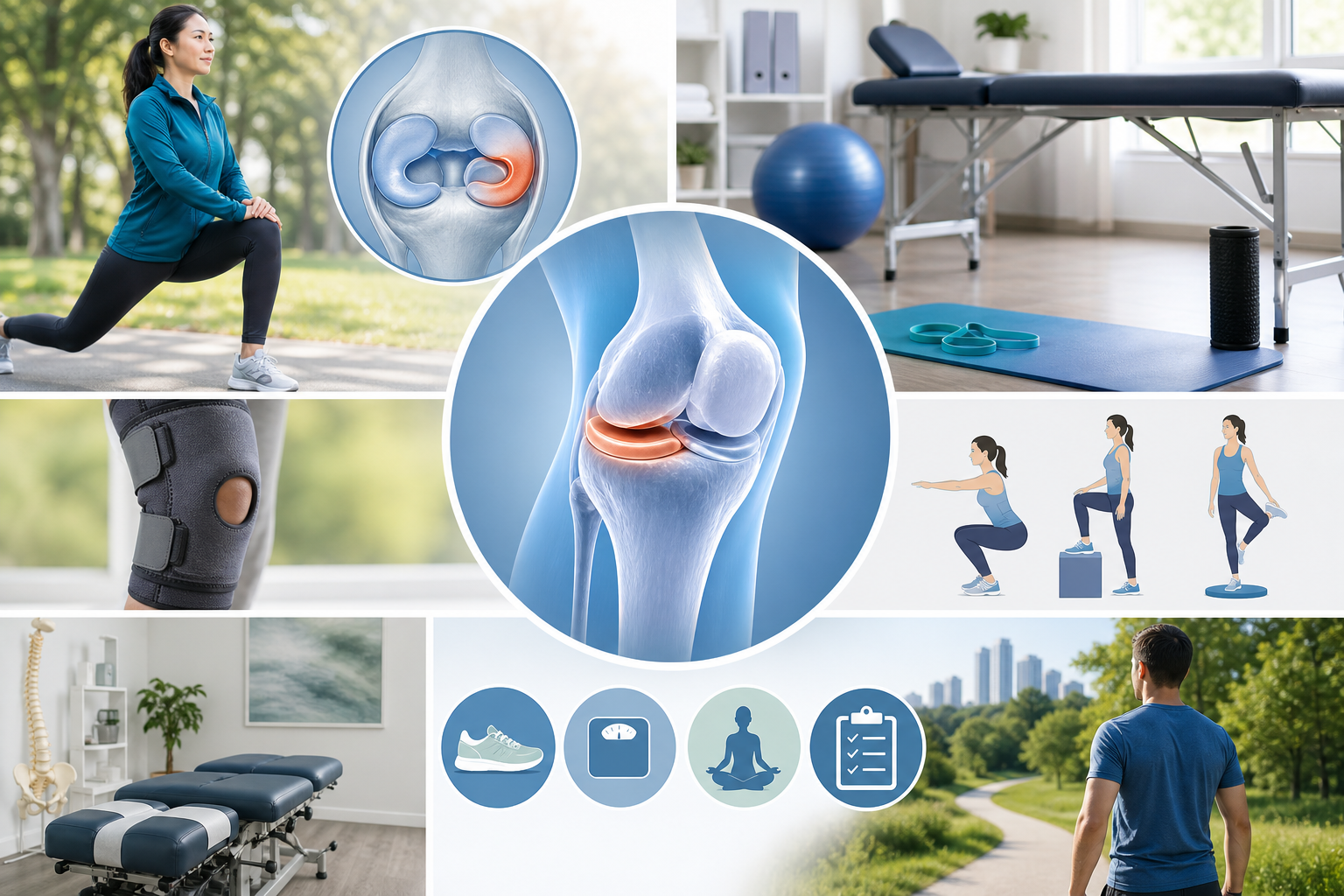
A medial meniscus tear is an injury to the shock-absorbing cartilage on the inner half of the knee joint. The medial meniscus sits between the femur and tibia, spreads pressure through the joint, assists stability, and helps the knee glide during flexion and extension.
The medial side gets stressed when the knee twists while the foot stays planted. Common examples include pivoting during sports, turning quickly while carrying weight, rising from a deep squat, or stepping awkwardly off a curb. Degenerative meniscus changes can also occur over time when cartilage loses hydration and becomes less tolerant of compression.
Simple anatomy that matters
- Medial meniscus: inner knee cartilage that absorbs load and improves joint congruency.
- Medial collateral ligament or MCL: inner knee ligament that limits side-to-side gapping.
- Quadriceps: front thigh muscles that control knee extension and stair descent.
- Hamstrings: back thigh muscles that assist knee control during walking and bending.
- Gluteus medius: hip muscle that helps keep the knee from collapsing inward.
Research on meniscus injuries consistently shows that symptoms, function, swelling, ROM, strength, and mechanical locking matter more than MRI wording alone when choosing conservative care.
“What is a medial meniscus tear” is a useful starting question, but the better clinical question is whether the knee is stable, moving, and improving. A tear seen on imaging does not always match pain level, especially in adults with age-related cartilage changes.
What Symptoms May Point to a Meniscus Injury?
Medial meniscus tear symptoms when walking usually include inner knee pain, swelling after activity, stiffness after sitting, pain with twisting, and difficulty with stairs or squats. A true locked knee, where the knee cannot fully straighten, is more concerning than general stiffness.
Meniscus symptoms often follow a pattern rather than one single sign. Mild cases may feel sore after a long walk but calm down within 24 hours. Moderate cases may swell, catch, or limit squatting for several days. More limiting cases may cause sharp pain with pivoting, repeated giving-way, or a knee that cannot fully bend or extend.
Symptom patterns to discuss with a provider
- Mild pattern: inner knee ache, slight stiffness, walking still possible, no locking, symptoms settle in 1-3 days after reducing load.
- Moderate pattern: swelling after activity, pain with stairs, knee pain when twisting meniscus tissue under load, limited squat depth.
- More limiting pattern: catching, sharp joint-line pain, visible swelling, trouble bearing weight, or the feeling that the knee blocks motion.
“Can’t straighten knee meniscus tear” searches often describe a mechanical block, not simple tightness. If the knee physically will not straighten, or straightening produces sharp locking pain, schedule prompt care.
Seek urgent evaluation if you have major swelling within a few hours of injury, cannot bear weight for four steps, have visible deformity, develop calf swelling or shortness of breath, or have fever with a hot swollen knee. These signs need same-day medical assessment.
Treatment Options for a Medial Meniscus Tear
Treatment options for medial meniscus tear symptoms depend on swelling, ROM, weight-bearing tolerance, activity goals, and whether the knee locks. Conservative care usually focuses on reducing irritation, restoring motion, rebuilding strength, improving balance, and correcting movement patterns that overload the inner knee.
Rest alone rarely restores full function if quadriceps strength, hip control, and knee ROM decline. Physical therapy without load management may also irritate the joint. The best conservative plans combine protection and progressive loading.
Treatment option Best used for Expected outcome Typical timeline Activity modification Pain with twisting, deep squats, running, or stairs Less swelling and fewer pain spikes while tissue calms 3-14 days initially Guided physical therapy Reduced ROM, weakness, poor stair control, return-to-sport goals Better knee stability, walking tolerance, and squat mechanics 4-8 weeks for many mild to moderate cases Home rehab exercises Maintaining gains between visits Improved quadriceps activation, hip control, and knee motion Daily or 4-6 days weekly, adjusted by symptoms Bracing or compression Swelling, mild instability, activity-related soreness External support and swelling control during walking tasks Short-term use during higher-load activity Chiropractic movement assessment Hip, pelvis, ankle, or gait mechanics adding knee stress Improved lower-chain mechanics and reduced compensatory loading Often reassessed over 2-6 visitsNatural treatment for meniscus tear pain usually means conservative load management rather than ignoring the injury. Good care removes the specific aggravators: twisting on a planted foot, deep knee flexion under load, rapid direction changes, and repeated kneeling. Walking on flat ground may stay in the plan if it does not increase swelling or sharp joint-line pain.
Use a provider if symptoms last more than 7-10 days, swelling returns after normal walking, or your knee confidence drops on stairs. You can find a physical therapy provider near you through Medximity if your knee needs structured rehab.
How Can Physical Therapy and Rehab Exercises Improve Knee Stability?
Physical therapy improves knee stability by restoring extension, flexion, quadriceps control, hip strength, balance, and gradual load tolerance. The comparison of meniscus tear physical therapy vs rest is not equal: rest may reduce symptoms, but PT addresses the movement deficits that often keep symptoms returning.
Rehab usually progresses through phases. The first phase reduces swelling and restores comfortable ROM. The second phase builds strength in the quadriceps, hamstrings, gluteus medius, and calf. The third phase adds balance, step-down control, lateral movement, and sport-specific drills when appropriate.
Safe home exercise starter protocol
Use this as general education, not a personal plan. Stop if you get locking, sharp joint-line pain, increasing swelling, or worse pain the next day.
- Heel slides: Lie on your back with the leg straight. Slide the heel toward your hip until you feel mild knee tightness, not sharp pain. Hold 2 seconds, then straighten. Perform 10 slow reps.
- Quad sets: Sit or lie with the knee straight. Tighten the front thigh by pressing the back of the knee gently toward the floor. Hold 5 seconds. Perform 10 reps.
- Straight-leg raise: Tighten the quad first, lift the leg 8-12 inches, hold 1 second, lower slowly. Perform 8-10 reps if no lag or pain occurs.
- Supported sit-to-stand: Use a chair. Keep knees tracking over the second toe, stand up slowly, sit down with control. Start with 5-8 reps.
- Single-leg balance support: Stand near a counter. Balance on the involved leg for 10-20 seconds without letting the knee collapse inward. Repeat 3 times.
Meniscus tear rehab exercises at home work best when symptoms guide dosage. A normal response is mild muscle fatigue. A poor response is swelling, catching, limping, or pain that persists into the next day.
Balance training matters because knee injuries often change proprioception. If dizziness, vestibular issues, or balance deficits affect your movement confidence, review Medximity’s guide to vestibular disorders treatment and discuss balance screening with your provider.
How May Chiropractic Care Support Knee Mechanics?
Chiropractic care may support meniscus recovery by assessing the hip, pelvis, ankle, foot mechanics, spinal mobility, and gait patterns that change knee loading. The chiropractor does not “move” a torn meniscus back into place; the goal is to improve how the lower limb shares force.
The knee sits between the hip and ankle. If the hip lacks internal rotation, the foot overpronates, or the pelvis shifts during walking, the medial knee may absorb more torsion. A conservative chiropractor may assess squat depth, step-down control, ankle dorsiflexion, hip abductor strength, and pelvic mechanics before recommending manual therapy or corrective exercise.
Mechanics that can increase medial knee load
- Limited ankle dorsiflexion: the heel lifts early and the knee may rotate inward during squats or stairs.
- Weak gluteus medius: the thigh drifts inward, increasing strain along the medial joint line.
- Hip stiffness: poor hip rotation may force the knee to twist during turns.
- Altered gait after back or nerve pain: limping may overload one knee during recovery.
If you are searching for a chiropractor for knee pain near me, choose a provider who evaluates the full kinetic chain, not only the painful joint. You can find a chiropractor near you through Medximity.
Knee symptoms sometimes overlap with back-related nerve pain, especially when leg pain, numbness, or weakness changes walking mechanics. Medximity’s guide on sciatica treatment and leg pain patterns explains how nerve irritation can affect movement from the hip to the foot.
How Should You Modify Walking, Stairs, Squatting, and Exercise?
Daily activity should keep the knee moving without repeatedly provoking swelling, sharp twisting pain, or limping. The safest early rule is simple: choose movements that stay below a 3 out of 10 pain level and do not worsen symptoms later that day or the next morning.
Walking is usually acceptable when your gait stays smooth. Short, flat walks of 5-15 minutes may be better tolerated than one long walk. Hills, uneven trails, fast turns, and side-slopes increase meniscus shear. If swelling increases after walking, reduce distance by 25-50% and reassess.
- Stairs: step up with the stronger leg first when symptoms flare; step down slowly while holding a rail.
- Squatting: avoid deep knee flexion early; use hip hinge mechanics and keep knees aligned over toes.
- Turning: pick up your feet instead of pivoting on a planted foot.
- Exercise: start with flat walking, gentle cycling if tolerated, and controlled strengthening before running or lateral drills.
- Work tasks: use a knee pad or change position frequently if kneeling is unavoidable.
Return-to-exercise usually works in stages. Many mild irritations tolerate low-impact conditioning within 1-2 weeks. Running, jumping, pivoting, and court sports often need 6-12 weeks of progressive strength and movement testing before full return.
Balance and head-position control can influence lower-body mechanics during training. If dizziness affects exercise, Medximity’s article on vertigo and chiropractic treatment explains conservative options for balance-related movement problems.
How Long Does a Meniscus Tear Take to Heal?
How long does a meniscus tear take depends on tear location, swelling, age, activity level, knee alignment, strength, and whether the tear causes mechanical blocking. Mild, non-locking meniscus irritation may improve in 2-6 weeks. Moderate symptoms often need 6-12 weeks of consistent conservative care.
The meniscus has different blood supply zones. The outer edge has better blood flow than the inner portion, which helps explain why some tears calm and function better while others remain symptomatic. Healing also depends on whether the knee keeps getting overloaded during twisting, deep squatting, or heavy stairs.
Factor Why it matters Practical action Tear location Outer-zone tissue has better blood supply than inner-zone tissue Get evaluated if symptoms persist beyond 2-3 weeks Swelling Swelling inhibits quadriceps activation and slows strength return Reduce aggravating load and use compression if advised ROM loss Limited extension changes walking and increases joint stress Prioritize gentle extension and flexion work Hip and ankle mechanics Poor control above or below the knee increases twisting stress Include hip, calf, and balance trainingAge alone does not determine recovery. A 55-year-old with good strength, normal ROM, and no locking may progress better than a younger athlete who keeps pivoting through swelling. Function drives the plan.
Neck, spine, and nervous system factors may change coordination after injury or concussion. For broader conservative rehab context, see Medximity’s article on post-concussion syndrome and natural means of care.
FAQ: Walking, Bracing, and Rehab for Meniscus Tears
Is it normal to walk on a meniscus tear?
Yes, walking can be normal with some meniscus tears if you can bear weight, keep a smooth gait, and avoid increased swelling afterward. Stop and get evaluated if walking causes sharp joint-line pain, catching, buckling, or worsening swelling.
Should I use a knee brace?
A brace may help short term when swelling, mild instability, or activity-related soreness changes your walking mechanics. A brace should not replace strength work, ROM restoration, or provider evaluation when the knee locks or repeatedly gives way.
Can rest alone fix a medial meniscus tear?
Rest can reduce irritation, but rest alone may leave weakness, stiffness, and poor balance uncorrected. Conservative rehab usually works better when rest from aggravating movements is paired with progressive strengthening and mobility work.
What exercises should I avoid early?
Avoid deep squats, loaded twisting, jumping, pivoting drills, kneeling with full body weight, and downhill running early in recovery. Reintroduce these only after you regain ROM, strength, balance, and symptom control.
When should I get imaging?
Imaging may be considered when symptoms persist despite conservative care, the knee locks, swelling remains significant, or the diagnosis is unclear after an exam. A provider can decide whether imaging changes the treatment plan.
Conservative care often overlaps across spine, balance, and lower-extremity rehab. You can explore more health topics on Medximity for related movement and wellness education.
What to Do Next
Get evaluated promptly if your knee locks, will not straighten, swells significantly, cannot bear weight, gives way repeatedly, or worsens despite 7-10 days of reduced aggravating activity. Routine conservative care is appropriate when symptoms are mild to moderate, walking is possible, and the knee is not mechanically blocked.
Your first visit should include a history of the injury, gait assessment, knee ROM testing, joint-line tenderness testing, swelling check, strength screening, squat or step-down observation, and hip and ankle mobility review. A physical therapy provider may build a phased rehab plan. A chiropractor may assess pelvis, hip, ankle, spinal mobility, and gait mechanics that contribute to knee stress. A rehab-focused wellness provider may help with activity planning, mobility, and progressive exercise habits.
- Seek urgent care: major swelling, inability to bear weight, fever with a hot swollen knee, calf swelling, shortness of breath, visible deformity, or a locked knee.
- Schedule routine care: pain with twisting, recurrent swelling, difficulty with stairs, limited ROM, or symptoms lasting more than 1-2 weeks.
- Prepare for the visit: note when symptoms started, what movements trigger pain, whether swelling occurs, and what activities you need to return to.
If you are searching for meniscus tear conservative care near me, use Medximity to browse providers who focus on chiropractic, physical therapy, rehabilitation, and wellness. For knee-specific rehab, you can also find a sports rehabilitation provider near you.
This article is educational and does not replace an exam from a licensed healthcare provider. A provider should evaluate persistent knee pain, swelling, locking, instability, or loss of motion before you progress activity.