A neck pain chiropractor in Sarasota can identify what is restricting your cervical spine, apply targeted adjustments or mobilization, and in most cases get you turning your head freely again within 2–4 weeks. If you are dealing with a stiff neck, sharp pain between your shoulder blades, or radiating discomfort down your arm, this guide covers exactly what causes those symptoms, which chiropractic techniques address them, and how to find the right provider in the Sarasota area.
What Causes Neck Pain? Common Sources and Symptoms
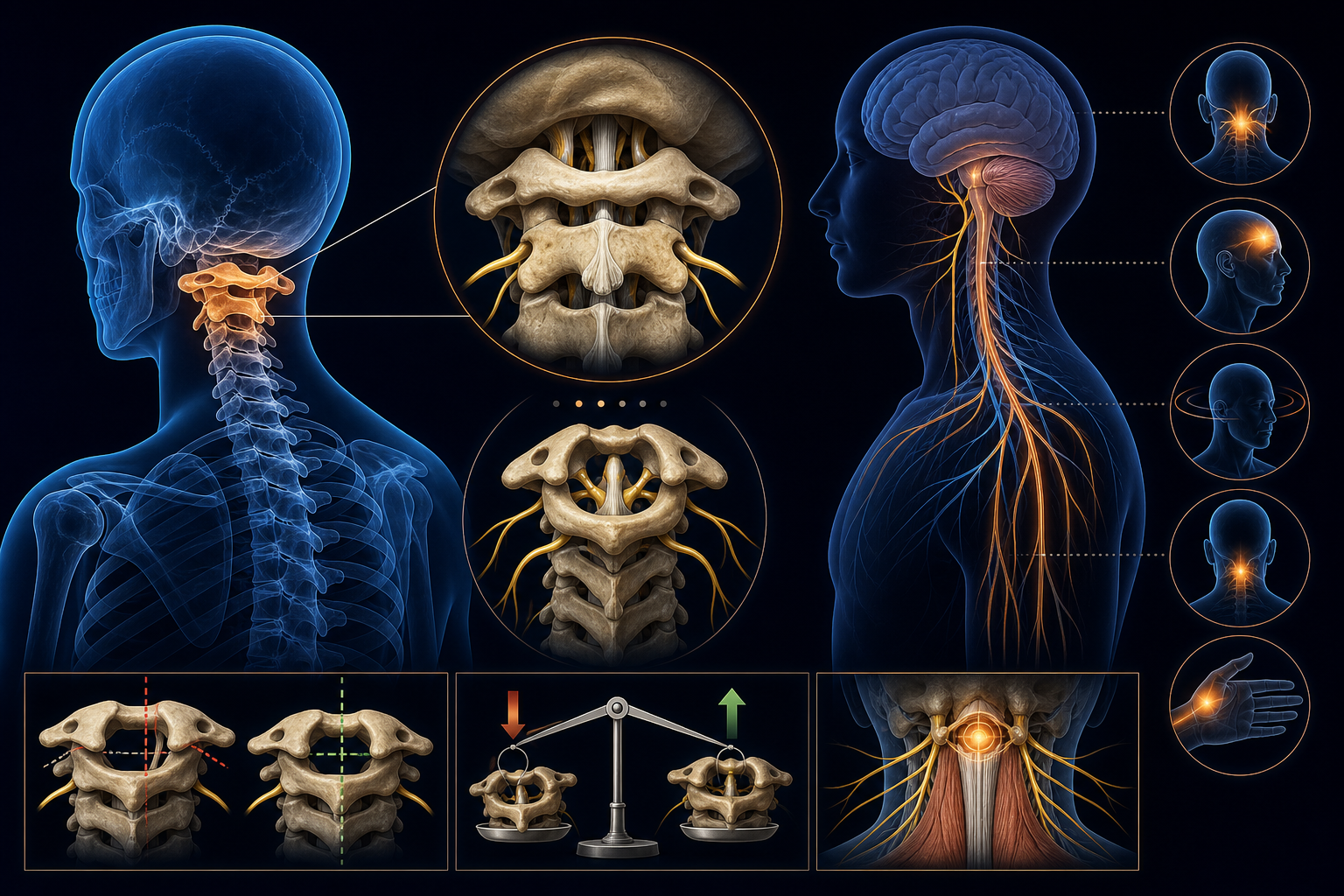
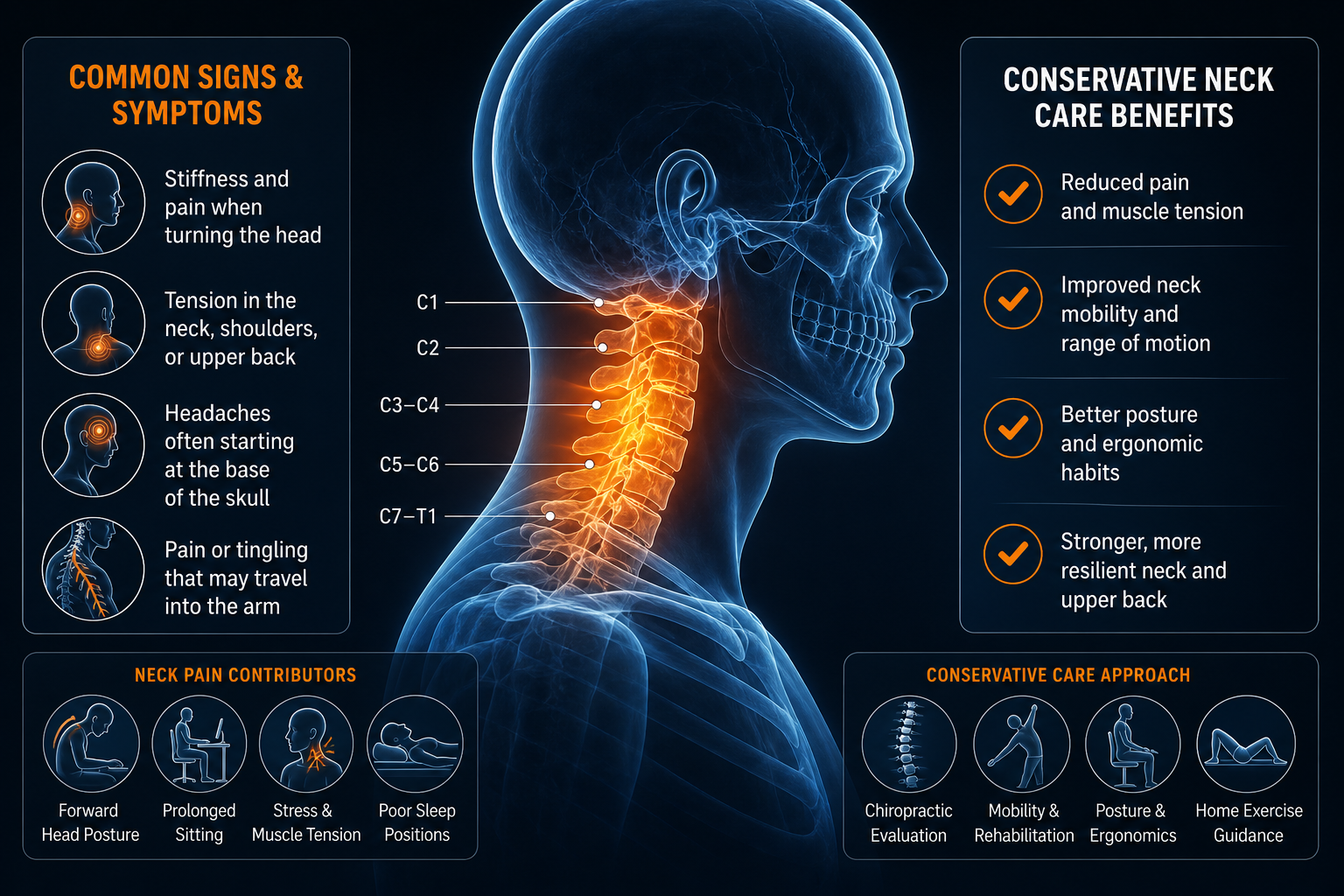
Your cervical spine stacks seven vertebrae (C1–C7) on top of each other, separated by intervertebral discs and stabilized by more than 20 muscles — including the sternocleidomastoid, upper trapezius, and levator scapulae. Any of those structures can become a pain generator.
Mechanical Causes
- Facet joint restriction — the small paired joints along the back of each vertebra lock up, usually at C4–C5 or C5–C6, producing a sharp catch when you rotate your head.
- Cervical disc bulge or herniation — the disc between two vertebrae presses on a spinal nerve root, causing neck pain radiating into the shoulder and arm, and sometimes numbness or tingling in the fingers.
- Muscle strain — sustained postures (desk work, phone scrolling, sleeping on a thick pillow) overload the levator scapulae and suboccipital muscles, producing stiffness and tension-type headaches.
- Whiplash — auto-accident forces stretch cervical ligaments and strain deep flexor muscles, often causing delayed-onset symptoms 24–72 hours post-collision.
What Causes Sharp Neck Pain and Headaches?
The C2–C3 facet joint and the greater occipital nerve share a referral pathway into the back of the skull. When the upper cervical spine is restricted or inflamed, you can experience sharp neck pain and headaches simultaneously — a pattern called cervicogenic headache. Research published in the Journal of Manipulative and Physiological Therapeutics found that spinal manipulation at C1–C2 reduced cervicogenic headache frequency by roughly 50% over 8 weeks. If headaches and migraine-like symptoms accompany your neck pain, that overlap is worth mentioning at your first visit.
How Can a Neck Pain Chiropractor in Sarasota Help?
Chiropractic care targets the mechanical cause — the restricted joint, the tight muscle, the irritated nerve — rather than masking the symptom. A 2019 systematic review in the journal Spine found that cervical spinal manipulation produced clinically significant pain reduction and improved range of motion (ROM) within 4 weeks for most patients with acute or subacute neck pain.
Is Chiropractic Care Safe for Neck Pain Treatment?
Yes, when performed by a licensed chiropractor. Adverse events from cervical manipulation are rare — estimated at roughly 1 per 1 million adjustment sessions according to data reviewed by the Bone and Joint Decade Task Force. Your chiropractor will screen for contraindications (vertebral artery insufficiency, fracture, upper cervical instability) before performing any adjustment. If high-velocity techniques are not appropriate for your case, low-force alternatives exist.
Chiropractic vs. Physical Therapy for Neck Pain
These two approaches are complementary, not competing. A chiropractor focuses on restoring joint motion through manual adjustments; a physical therapist typically emphasizes progressive strengthening and neuromuscular retraining. Many Sarasota-area providers offer both under one roof or co-manage cases. For straightforward mechanical neck pain, chiropractic adjustment alone often resolves symptoms in fewer sessions. For complex cases — post-whiplash, disc herniation with radiculopathy, or chronic postural dysfunction — combining chiropractic with exercise-based rehabilitation tends to produce longer-lasting results.
What Should You Expect at Your First Chiropractic Visit for Neck Pain?
A thorough first visit typically lasts 45–60 minutes and follows a predictable structure:
- Health history review — onset, duration, aggravating/relieving factors, any radiating symptoms, prior imaging.
- Orthopedic and neurological exam — cervical ROM measurement, Spurling's test (checks nerve root compression), upper-limb reflex testing, grip strength, dermatome screening for numbness.
- Palpation — the provider manually assesses each cervical segment for motion restriction, tenderness, and muscle guarding.
- Imaging if indicated — X-rays may be taken in-office if fracture, instability, or degenerative changes are suspected. MRI is typically ordered only when radiculopathy or disc herniation signs are present.
- First treatment — many chiropractors begin care the same day, starting with soft-tissue work and a gentle adjustment unless exam findings require additional imaging first.
Bring any previous imaging (MRI, X-ray), a list of your symptoms with approximate dates, and your insurance card. Most Sarasota chiropractic practices accept major medical insurance, auto-accident (PIP) coverage, and self-pay.
Chiropractic Techniques Commonly Used for Neck Pain
Not every neck gets the same adjustment. Your chiropractor selects a technique based on your diagnosis, body type, comfort level, and imaging findings. Here is how the most common approaches compare for a chiropractic adjustment for stiff neck without relying on invasive procedures:
Technique How It Works Best For Typical Sessions to Initial Relief Diversified (HVLA) Short, quick thrust to a specific vertebral segment Acute facet joint lock-up, general stiffness 2–4 sessions Cervical mobilization Low-velocity, rhythmic stretching of the joint through its range Patients who prefer no "cracking," post-whiplash 4–6 sessions Flexion-distraction Gentle, pump-like traction applied to the cervical spine on a segmented table Disc bulge, foraminal stenosis, nerve root irritation 6–10 sessions Instrument-assisted (Activator) Spring-loaded device delivers a precise impulse to a single segment Elderly patients, osteopenia, highly acute pain 4–8 sessions Soft-tissue therapy (ART, Graston) Manual or instrument-assisted breakdown of adhesions in muscles and fascia Chronic upper trapezius/levator scapulae tension, scar tissue 3–6 sessionsMost treatment plans combine two or more techniques — for example, soft-tissue release of the upper trapezius followed by a diversified adjustment at C5–C6.
How Long Does Chiropractic Care for Neck Pain Take?
Recovery timelines depend on the cause, severity, and how long you have had symptoms.
- Acute mechanical neck pain (less than 4 weeks, no radiculopathy) — most patients report meaningful improvement within 3–6 visits over 2–3 weeks.
- Subacute neck pain (4–12 weeks) — typically 8–12 visits over 4–6 weeks. Progress is re-evaluated at visit 6.
- Chronic neck pain (longer than 3 months) — an initial course of 12–16 visits, often tapering to maintenance care every 4–6 weeks once pain stabilizes.
- Cervical disc herniation with radiculopathy — expect 10–20 visits over 6–10 weeks. About 80% of disc herniations respond to conservative care (manipulation, traction, rehab exercises) without invasive intervention, per data from the American College of Physicians.
How many chiropractic sessions for neck pain relief? For the average Sarasota patient with a new-onset stiff neck and no neurological deficits, 4–6 sessions is a reasonable estimate. If you are not noticing any change after 6 visits, your chiropractor should reassess your diagnosis and consider co-management with another provider.
When to See a Provider: Signs You Should Not Wait
Most neck pain resolves with appropriate care. But certain symptoms require same-day evaluation:
- Neck pain and numbness in fingers — especially if you notice weakness in your grip or difficulty with fine motor tasks (buttoning a shirt, holding a pen). This suggests nerve root compression at C6, C7, or C8.
- Neck pain so bad you cannot turn your head combined with fever or severe headache — rule out meningitis or infection.
- Loss of balance, difficulty walking, or bilateral arm/hand weakness — possible cervical myelopathy (spinal cord compression). This is a medical emergency. Go to the ER.
- Neck pain after trauma (fall, auto accident, sports collision) — get imaging before any manual treatment to rule out fracture or ligament rupture.
- Unexplained weight loss combined with progressive neck pain — rare, but warrants further workup.
If your symptoms are not on this list — stiffness, dull ache, tightness across the upper back, occasional headaches originating from your neck — a chiropractic evaluation within the next few days is appropriate. You do not need an emergency visit, but you should not wait months either. Neck pain that persists beyond 2 weeks without treatment tends to become chronic.
Home Exercise: Chin Tuck for Cervical Posture Correction
This is the single most effective self-care exercise for forward-head posture and upper cervical tension. Your chiropractor will likely assign it on day one.
- Sit upright in a chair with your back against the backrest. Feet flat on the floor.
- Look straight ahead. Place two fingers on your chin.
- Gently push your chin straight back — not down — creating a "double chin." You should feel a stretch at the base of your skull and along the back of your neck (the suboccipital muscles).
- Hold for 5 seconds. Release.
- Repeat 10 times. Perform 3 sets per day.
This exercise activates the deep cervical flexors (longus colli, longus capitis), which are typically inhibited in people with chronic neck pain and desk-related postural strain. A 2015 study in the Journal of Physical Therapy Science showed that 4 weeks of daily chin tucks reduced neck disability index scores by an average of 30%.
Finding a Neck Pain Chiropractor in Sarasota
Sarasota has a dense concentration of chiropractic practices, which can make choosing one feel arbitrary. Focus on three criteria:
- Technique match — if you want gentle, low-force care, look for providers trained in Activator or Cox Flexion-Distraction. If you want traditional manual adjustments, look for Diversified or Gonstead practitioners. Provider profiles on Medximity list technique specialties.
- Condition experience — a chiropractor who regularly treats disc herniations will approach your care differently than one focused primarily on wellness maintenance. If you are looking for the best chiropractor for a herniated disc in the neck in Sarasota, filter by providers who list spinal decompression or flexion-distraction as services.
- Convenience — you will likely need 2–3 visits per week initially. Pick a practice near your home or workplace in Sarasota, Lakewood Ranch, or Siesta Key to minimize travel friction.
Use the Medximity chiropractor directory to compare providers by location, specialty, and patient reviews. Each listing includes accepted insurance plans, office hours, and direct contact information so you can book without a referral.
What to Do Next
If your neck pain has lasted more than a few days, is limiting your ROM, or is producing radiating symptoms into your shoulder or arm, schedule an evaluation with a chiropractor for neck pain in Sarasota FL this week — not next month.
At your first visit, expect a thorough exam (45–60 minutes), a clear explanation of what is causing your pain, and in most cases, your first treatment the same day. Bring imaging if you have it, wear a comfortable shirt, and be prepared to describe when and how your symptoms started.
Find a neck pain chiropractor in Sarasota through the Medximity directory to compare providers, check credentials, and book your visit. You can also explore more condition guides on the Medximity blog.
Frequently Asked Questions
How long does neck pain take to heal with chiropractic?
Most acute neck pain — stiffness, limited rotation, muscle tension — improves within 2–3 weeks with 3–6 chiropractic visits. Subacute cases (4–12 weeks of symptoms) typically require 8–12 visits. Chronic neck pain lasting longer than 3 months often needs an initial 12–16 visit course before transitioning to periodic maintenance.
Is chiropractic care safe for treating neck pain?
Yes. Serious adverse events from cervical chiropractic adjustment are extremely rare, estimated at approximately 1 per 1 million sessions. Your chiropractor will screen for contraindications — vascular risk factors, fracture, upper cervical instability — before performing any adjustment. Low-force alternatives are available for patients with higher risk profiles.
Should I see a chiropractor or physical therapist for neck pain?
For a locked-up cervical joint or acute stiff neck, chiropractic manipulation typically restores motion faster — often within 2–4 sessions. For chronic neck pain with postural weakness or post-injury rehabilitation requiring progressive exercise programming, physical therapy adds significant value. Many providers offer both, and co-managed care produces the strongest long-term outcomes.
When should neck pain and numbness in the fingers prompt an urgent visit?
If you experience numbness, tingling, or weakness in your hand or fingers alongside neck pain — especially if grip strength is declining or you notice difficulty with fine motor tasks — schedule an evaluation within 1–2 days. These symptoms suggest cervical nerve root compression at C6, C7, or C8 and need proper diagnosis before starting manual treatment.
What chiropractic technique works best for a stiff neck?
Diversified (HVLA) manipulation is the most commonly used and most studied technique for acute cervical joint restriction, typically producing noticeable improvement in 2–4 sessions. For patients who prefer gentler approaches, cervical mobilization or instrument-assisted (Activator) methods achieve similar outcomes over a slightly longer timeline of 4–8 sessions.
Can a chiropractor help with neck pain radiating into the shoulder and arm?
Yes. Radiating pain typically indicates cervical nerve root irritation from a disc bulge or foraminal narrowing. Flexion-distraction technique and cervical mobilization can reduce pressure on the nerve root. Approximately 80% of cervical radiculopathy cases respond to conservative care — including chiropractic — within 6–10 weeks without needing invasive procedures.