The deep neck flexor chin nod exercise is one of the most effective neck pain relief exercises you can do at home without equipment. It targets the longus colli and longus capitis — two deep stabilizing muscles that run along the front of your cervical spine — and retrains them to support your head properly. If your neck muscles feel weak and tight at the same time, this exercise likely addresses the root cause.
What Are the Deep Neck Flexors (and Why Do They Matter)?
Your deep neck flexors (DNFs) are a group of small muscles sitting directly in front of your cervical vertebrae (C1–C7). The two primary muscles are the longus colli, which spans from C1 to T3 and controls segmental neck flexion, and the longus capitis, which runs from C3–C6 up to the base of the skull and helps flex your head on the upper cervical spine.
These muscles are not power muscles. They are endurance stabilizers. Their job is to hold your cervical spine in neutral alignment against gravity throughout the day — while you work, drive, and sleep. When they function correctly, the larger superficial muscles like the sternocleidomastoid (SCM) and upper trapezius only activate for larger movements, not postural holding.
Research published in the journal Pain found that people with chronic neck pain consistently show reduced activation and endurance of the deep neck flexors compared to pain-free controls. Deep neck flexor exercises for chronic neck pain directly address this measurable deficit. Without retraining these muscles, the superficial muscles compensate — which is why your neck feels both weak and tight simultaneously.
Why Do Deep Neck Flexors Weaken — and What Does That Mean for Your Neck?
The most common reason is forward head posture. For every inch your head sits forward of your shoulders, the load on your cervical spine increases by roughly 10 pounds. In this position, the deep neck flexors are lengthened and inhibited while the SCM and suboccipital muscles shorten and overwork.
The Compensation Cycle
Here is what happens biomechanically when your DNFs stop doing their job:
- The longus colli and longus capitis become inhibited (they stop firing at the right time and intensity).
- The SCM and anterior scalenes take over postural stabilization — a role they are not designed for.
- The suboccipital muscles at the skull base tighten to keep your eyes level, compressing the greater occipital nerve.
- You develop tension headaches, neck stiffness, and pain at the base of the skull.
This is why forward head posture exercises to fix neck alignment almost always start with DNF retraining. You cannot stretch your way out of this pattern — the weak link must be strengthened first. If you experience recurring head pain, weak deep neck flexors are a likely contributor.
Whiplash injuries also directly damage or inhibit the deep neck flexors. Studies using MRI have shown fatty infiltration of the longus colli within weeks of a whiplash event, meaning the muscle literally begins to atrophy. Post-whiplash rehabilitation protocols prescribed by chiropractors and physical therapists almost universally include DNF retraining.
Which Conditions Can This Exercise Help?
The chin nod is not a cure-all, but it has research support for several specific conditions:
- Chronic mechanical neck pain — the most studied application, with multiple randomized controlled trials showing pain reduction within 6–8 weeks
- Cervicogenic headaches — headaches originating from the upper cervical spine, often linked to migraine-like symptoms and neck dysfunction
- Forward head posture — directly retrains the muscles responsible for holding your head over your shoulders
- Post-whiplash neck pain — included in clinical practice guidelines for whiplash-associated disorders
- Cervical radiculopathy (mild) — the chin tuck exercise can reduce nerve root compression by improving cervical alignment, though it should be combined with provider-guided care for nerve symptoms
- Neck-related tinnitus — some cases of cervicogenic tinnitus respond to upper cervical stabilization exercises
If you are looking for neck pain relief exercises without equipment at home, this is where to start.
How to Do the Deep Neck Flexor Chin Nod: Step-by-Step
Getting the chin tuck exercise correct form step by step matters more than repetition count. This is a precision movement, not a strength exercise.
Setup
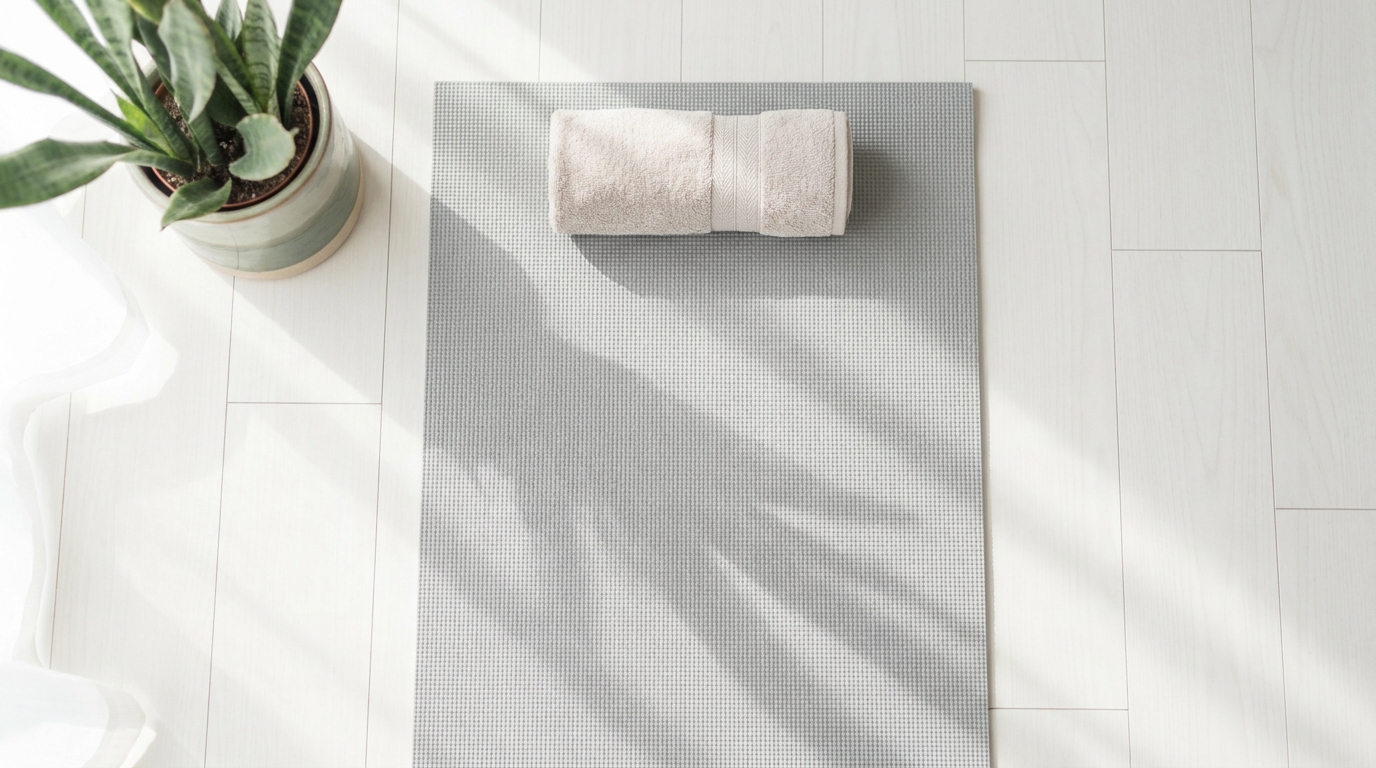
- Lie on your back on a firm surface (floor or exercise mat). No pillow under your head.
- Bend your knees and place your feet flat on the floor.
- Let your arms rest at your sides. Relax your jaw completely.
The Movement
- Find neutral: Your head should rest with a natural small curve behind your neck. You should feel a slight gap between your neck and the floor.
- Initiate the nod: Gently draw your chin toward your throat — as if you are making a small "yes" nod or giving yourself a slight double chin. The movement is tiny. Your head should not lift off the floor.
- Feel the right muscles: You should feel a gentle deep tightening at the front of your throat, right along the spine. If you feel your SCM (the ropy muscles on the sides of your neck) bulging or your jaw clenching, you have gone too far.
- Hold for 10 seconds. Breathe normally throughout the hold. The contraction should feel like 20–30% of maximum effort — no more.
- Release slowly back to neutral. Rest 5 seconds before the next rep.
A 2015 study in the Journal of Orthopaedic & Sports Physical Therapy found that patients who performed the craniocervical flexion test protocol (the clinical version of this exercise) 2x daily for 6 weeks showed significantly greater reductions in neck pain intensity than those doing general neck strengthening alone.
Key Form Cues
- Think "nod" not "tuck" — the motion happens at the upper cervical spine (C0–C2), not by jamming your chin down
- Your head rotates on the spine like a ball on a socket — it does not slide forward
- Place two fingers lightly on your SCM — if it hardens during the nod, reduce your effort
Sets, Reps, and Frequency
How many reps of the chin tuck exercise per day depends on your current level, but here is the standard progression most providers use:
Phase Hold Time Reps Sets per Day Duration Beginner (Week 1–2) 5–10 seconds 10 2 2 weeks Intermediate (Week 3–4) 10 seconds 12–15 2 2 weeks Maintenance (Week 5+) 10 seconds 10–15 1–2 OngoingHow long until neck exercises reduce pain? Most patients report noticeable improvement in neck stiffness and headache frequency within 2–3 weeks of consistent daily practice. Measurable gains in DNF endurance on clinical testing typically appear by 6 weeks. This is not a fast-fix exercise — it is a motor control retraining that builds gradually.
Common Mistakes to Avoid
The most common mistakes doing the chin tuck neck exercise sabotage results or create new problems:
- Using too much force. This is a 20–30% effort exercise. If your neck is shaking or straining, you are using the wrong muscles entirely. The SCM and anterior scalenes will dominate, and your deep flexors will remain inhibited.
- Lifting the head off the floor. The head stays in contact with the surface throughout. If it lifts, you have converted the exercise into a neck curl — a completely different (and unhelpful) movement.
- Holding your breath. Breath-holding activates global bracing patterns. Breathe normally and keep your shoulders relaxed.
- Moving too fast. Each rep should take 3 seconds to nod in, 10 seconds to hold, and 2 seconds to release. Rushing trains speed, not endurance and motor control.
- Performing on a soft pillow. A pillow pushes your head into flexion before you start, eliminating the neutral starting position. Use a flat surface or, at most, a folded towel.
Progressing the Exercise: Beginner to Intermediate
Once you can hold a 10-second chin nod for 15 reps with zero SCM activation and no discomfort, you are ready to progress.
Progression 1: Gravity-Reduced Seated Chin Nod
Sit upright in a chair with your back supported. Perform the same gentle chin nod without any wall or surface contact. This removes feedback and challenges your proprioception. Hold 10 seconds, 10 reps, 2x daily.
Progression 2: Head Lift and Hold
Lying on your back, perform the chin nod first, then lift your head approximately 1 inch off the surface while maintaining the nod position. Hold 5 seconds. This is significantly harder and should only be attempted after 3–4 weeks of foundational work.
A beginner to advanced neck strengthening exercise progression should always follow this order: supine nod → sustained holds → seated nod → head lift. Skipping the foundational phase is the most common reason patients plateau or aggravate their symptoms. If you want a customized progression plan, a chiropractor experienced in neck rehabilitation can assess your DNF endurance and prescribe the right level.
What to Do Next
If your neck pain is mild and recent (less than 4 weeks): Start the beginner protocol described above. Perform it daily and reassess after 2–3 weeks.
If your neck pain is chronic, worsening, or accompanied by arm tingling, numbness, or headaches: See a provider before starting. You may need a clinical assessment to rule out disc involvement, nerve compression, or upper cervical instability. A chiropractor or physical therapist can perform the craniocervical flexion test to measure your exact DNF endurance deficit and tailor your program.
Red flag — seek same-day evaluation: If you experience sudden severe neck pain with dizziness, difficulty swallowing, loss of coordination, or arm weakness, these may indicate a vascular or neurological issue requiring immediate attention.
If your neck pain is getting worse with exercise, stop and consult a provider. More exercise is not always the answer — sometimes the cervical spine needs manual care or alignment correction before strengthening is appropriate.
Ready to connect with a provider who can guide your neck rehabilitation? Find a chiropractor near you or search for a physical therapist through the Medximity directory. You can also explore more exercises and health topics on the Medximity blog.
Frequently Asked Questions
Is the chin tuck exercise good for cervical radiculopathy?
The chin tuck can help mild cervical radiculopathy by improving cervical alignment and reducing mechanical compression on nerve roots exiting the C5–C7 levels. However, if you have radiating arm pain, numbness, or weakness, get a provider assessment first. The exercise works best as part of a supervised rehabilitation program for radiculopathy, not as standalone self-treatment.
How many reps of the chin tuck exercise should I do per day?
Start with 10 reps of 5–10 second holds, performed 2 times per day. After 2 weeks, increase to 12–15 reps per set. Most clinical protocols cap at 2 sets of 15 reps daily during the active retraining phase, then drop to 1 set daily for maintenance.
How long until deep neck flexor exercises reduce my neck pain?
Most patients notice reduced stiffness and headache frequency within 2–3 weeks of consistent daily practice. Measurable endurance gains in the deep neck flexors typically occur by the 6-week mark. Full symptom resolution for chronic neck pain may take 8–12 weeks, especially when combined with chiropractic or physical therapy care.
Can I do this exercise sitting up instead of lying down?
The lying-down position is preferred for beginners because the surface provides feedback and reduces the gravitational load on your neck. Once you can perform 15 clean reps supine with no SCM compensation, you can progress to the seated version. Doing the seated version too early often leads to superficial muscle dominance.
What should I do if my neck pain gets worse during this exercise?
Stop the exercise and reassess your form — most pain increases come from using too much force or recruiting the wrong muscles. If pain persists even with corrected form, see a chiropractor or physical therapist. Your cervical spine may need manual treatment or mobilization before strengthening exercises are appropriate.
When should I see a chiropractor for neck pain instead of exercising at home?
See a provider if your neck pain has lasted more than 4 weeks, is worsening despite exercise, radiates into your arm or hand, follows a whiplash or trauma event, or is accompanied by headaches, dizziness, or jaw pain. A chiropractor can assess your spinal alignment, test your deep neck flexor function, and determine whether manual care should precede your exercise program.