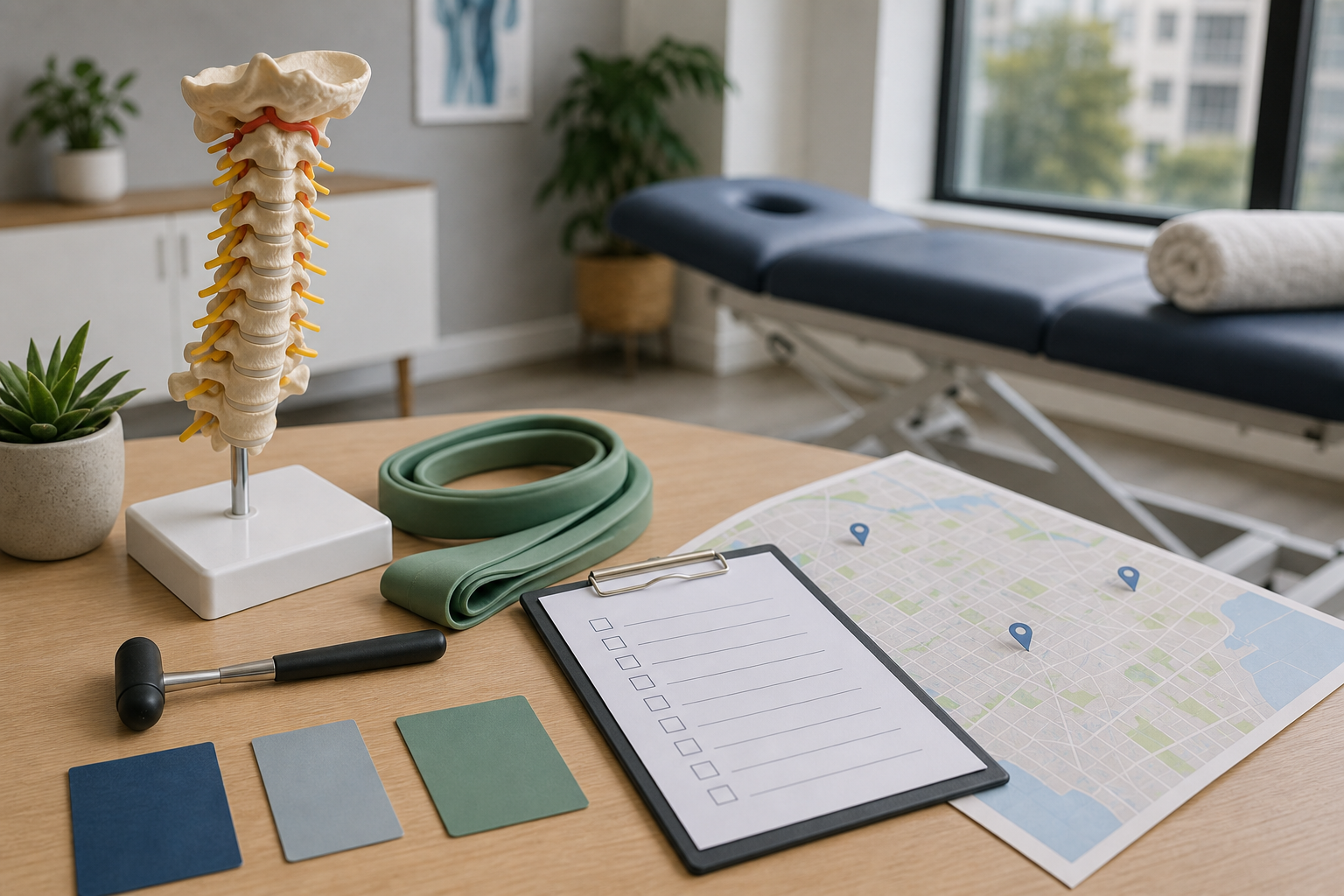
Find chiropractor for neck pain by narrowing your search to providers who regularly assess cervical spine mechanics, posture strain, whiplash-related stiffness, and mobility loss rather than choosing the first general listing you see. The best match is usually a provider who combines hands-on care with rehab, explains when imaging or referral is needed, and gives you a clear plan for reducing pain when turning your neck, restoring ROM, and preventing the problem from returning.
How to Find a Chiropractor for Neck Pain Near YouHow to Find a Chiropractor for Neck Pain
How to find chiropractor for neck pain starts with one rule: search for condition-specific experience, not just the nearest opening on a schedule. Neck pain can come from joint restriction in the facet joints, muscle overload in the upper trapezius and levator scapulae, irritation around the cervical paraspinals, postural stress, or a recent acceleration-deceleration injury. A provider who works with these patterns every week will usually evaluate you more precisely than a practice that markets every service to everyone.
Start with the cause pattern, not the pain label. “Neck pain” after sleeping awkwardly is different from pain after a car crash, and both differ from daily desk-related stiffness with headaches.
Use a practical search filter
- Search by symptom plus condition: neck pain, stiff neck, whiplash, pain when turning neck, posture-related neck strain, neck pain with headaches.
- Check whether the provider mentions cervical mobility work, exercise therapy, soft tissue treatment, ergonomic guidance, or rehab.
- Look for same-week availability if your ROM is sharply limited.
- Confirm the practice accepts new patients and has a clear intake process.
- Review whether they discuss referral or imaging policies when red flags are present.
Neck pain that began from workstation posture often improves within 2 to 6 weeks when treatment is paired with exercise and desk changes. A simple positional strain from sleeping may settle in 3 to 10 days if there is no nerve involvement and you restore movement early.
Research on neck pain consistently shows that multimodal conservative care works better than passive care alone. Hands-on treatment plus exercise, mobility work, and self-management produces better functional change than rest-only strategies.
If headaches are part of the pattern, a provider who understands the neck-head connection matters. Medximity has related education on common head pain and migraine-related patterns that often overlap with cervical dysfunction.
Once you identify likely causes, use a directory built for provider discovery rather than scrolling random local results. You can find a chiropractor near you and compare providers by relevance, not just proximity.
What to Look for in a Neck Pain Chiropractor
What to look for in neck pain chiropractor comes down to assessment quality, treatment range, and decision-making. A good provider should be able to tell you whether the main problem appears muscular, joint-related, posture-driven, trauma-related, or possibly nerve-related after a focused history and exam. That exam should include cervical ROM, symptom reproduction with turning or extension, palpation of involved tissues, and screening for referral patterns into the head, shoulder blade, or arm.
You are not looking for the flashiest brand. You are looking for a provider who can explain what structure is likely involved and what they plan to do about it.
Signs the provider is a strong fit
- They assess cervical rotation, flexion, extension, side-bending, and shoulder girdle function.
- They check the scapula, thoracic spine, and posture rather than only the neck.
- They offer more than one treatment option, such as manipulation, mobilization, myofascial work, and exercise guidance.
- They explain expected timelines instead of asking for open-ended visits.
- They document red flags and know when to refer for prompt medical evaluation.
- They give home exercises after the first or second visit.
Signs to be cautious
- No discussion of mechanism of injury.
- No neurological screening when symptoms travel into the arm or hand.
- No mention of self-care, ergonomics, or strengthening.
- No clarity on visit frequency, progress checks, or discharge goals.
- Heavy sales language with little explanation of your exam findings.
For work-related neck pain, look for a provider who also addresses monitor height, keyboard position, arm support, and sitting time. Medximity’s article on preventing back pain at work covers ergonomic mistakes that often also drive cervical strain.
Provider Feature Why It Matters for Neck Pain What a Good Answer Sounds Like Neck-specific exam Identifies whether pain is joint, muscle, posture, or trauma related “We check ROM, posture, neurological signs, and tissue tension before starting care.” Rehab integration Reduces recurrence after hands-on relief “You will get mobility and deep neck flexor exercises early.” Imaging/referral policy Prevents delay when symptoms need prompt evaluation “If weakness, major trauma, or non-mechanical signs show up, we refer.” Timeline clarity Helps you judge value and progress “Simple mechanical neck pain often improves in 2-4 weeks; whiplash may take longer.” Communication style Improves adherence to home care and follow-up “We explain what is restricted, what to avoid briefly, and what to do daily.”What Services May Help Neck Pain Without Procedures?
Neck pain treatment without surgery chiropractor usually means a combined plan built around restoring joint motion, reducing muscle guarding, retraining posture, and gradually loading the tissues that have become deconditioned. A good conservative program does not rely on one technique. It layers care based on the pattern you present with.
For mechanical neck pain, common targets include the suboccipital muscles, sternocleidomastoid, levator scapulae, upper trapezius, lower cervical segments, and the upper thoracic spine. Restricted thoracic extension alone can force the neck to overwork all day.
Common services that may help
- Spinal manipulation or mobilization: Used to improve joint motion in restricted cervical or thoracic segments.
- Soft tissue treatment: Targets trigger points and overload in the trapezius, SCM, levator scapulae, and paraspinals.
- Exercise therapy: Restores deep neck flexor control, scapular stability, and thoracic mobility.
- Posture coaching: Reduces repeated forward-head loading from screens, driving, and sleeping setup.
- Rehabilitation support: Progresses from pain reduction to endurance and strength so the problem does not return in two weeks.
- Home stretching: Often useful when stiffness is worst in the morning or after desk work.
Natural treatment for neck pain and headaches often works best when the cervical source is clearly identified. Tension-type headaches and cervicogenic headaches frequently improve when upper cervical restriction, suboccipital tightness, and scapular mechanics are addressed together. If that pattern sounds familiar, see Medximity’s article on the link between migraine headaches and back pain and related cervical contributors.
Treatment Best Fit Expected Outcome Typical Timeline Spinal manipulation Restricted cervical or thoracic joints, mechanical stiffness Improved rotation, less pain with turning, reduced guarding Often noticeable in 1-3 visits Mobilization Irritable neck pain, guarded movement, lower tolerance for quick movement Gradual ROM gains with less soreness 1-2 weeks for early change Soft tissue work Muscle spasm, trigger points, headache referral Reduced muscle tension and tenderness Same day to 2 weeks Exercise therapy Posture strain, recurrent neck pain, whiplash recovery Longer-lasting stability and endurance 2-8 weeks depending on severity Posture and ergonomic coaching Desk work, laptop use, driving-related stiffness Fewer daily flare-ups and better tolerance for sitting 1-3 weeks with complianceFor some patients, shoulder blade weakness is the hidden driver. If your neck pain worsens after sports, lifting, or repetitive training, rehab-based care may matter as much as the adjustment. Medximity’s sports therapy article explains why movement-based follow-up often determines whether pain stays gone.
How to Compare Chiropractors Near You
The best way to compare local providers is to use the same checklist for each one. Reviews alone are not enough. A five-star rating tells you very little about whether the provider treats cervical radicular symptoms, whiplash stiffness, postural overload, or recurring pain with rotation. Look for objective differences.
- Availability: Can they see you this week if you have acute pain when turning your neck?
- Scope of care: Do they provide both hands-on care and exercise progression?
- Neck pain focus: Do they mention headaches, whiplash, posture strain, or rehab for the cervical spine?
- Communication: Do they explain treatment plans in plain language?
- Location: Is the practice close enough for 2-3 visits during the first 1-2 weeks if needed?
- New-patient access: Is the provider a neck pain chiropractor accepting new patients?
Acute mechanical neck pain often benefits from a short burst of care early. If travel time makes you skip visits, the “best chiropractor for neck pain near me” is not always the provider with the biggest ad presence. It is the one you can realistically see and follow up with.
Use review themes, not just star counts
Read reviews for details such as clear explanations, same-week scheduling, short-term improvement in ROM, and useful home exercises. Ignore vague praise with no clinical substance.
Check whether the provider treats related conditions
Neck pain rarely exists in isolation. If you also have ringing with neck tension, headache referral, shoulder tightness, or a whiplash history, choose a provider who mentions those patterns. Medximity covers related issues in neck-related tinnitus patterns, which can matter when upper cervical tension is part of the picture.
Comparison Factor Low-Value Listing High-Value Listing Condition detail “We treat pain” “We assess whiplash, posture strain, neck pain with headaches, and restricted cervical ROM” Treatment detail No specifics Manipulation, mobilization, soft tissue work, rehab, home exercise Scheduling detail No timeline mentioned Same-week evaluation, clear new-patient process Clinical safety No referral guidance States when urgent evaluation or referral is appropriateYou can compare options directly through Medximity and browse providers based on specialty, location, and practice profile detail.
What questions should you ask before you book?
Questions to ask chiropractor for neck pain should reveal whether the provider can match your problem pattern, explain your diagnosis clearly, and give you a realistic treatment plan. Ask direct questions. Good providers answer directly.
- Do you regularly treat neck pain, whiplash, or pain when turning the neck?
- What does the first visit include? You want history, exam, ROM testing, and a care plan.
- Do you use rehab or home exercises in addition to adjustments?
- How many visits are typical for a straightforward mechanical neck pain case?
- How do you handle headaches, upper back involvement, or arm symptoms?
- When do you recommend prompt medical evaluation instead of routine care?
- Do you treat posture-related neck pain from computer work?
- Can you coordinate with PT or refer if exercise progression is the main need?
A straightforward answer sounds like this: “For uncomplicated mechanical neck pain, we usually start with 1 to 2 visits per week for 2 to 3 weeks, add daily mobility work, reassess ROM and pain with turning, then taper as you improve.” That is useful. “It depends” with no framework is not.
If you also have head pain, ask whether the provider distinguishes between cervicogenic headache, tension-type patterns, and migraine triggers. The overlap matters because not every headache responds to the same cervical approach. Medximity’s head pain guide and migraine article can help you understand those differences before booking.
A well-run first visit should end with three things: likely pain generator, short-term treatment plan, and specific home instructions for the next 3 to 7 days.
When can chiropractic care help neck pain?
Chiropractic care may help neck pain when the pattern is mechanical. That means your symptoms change with posture, movement, work position, sleep position, or joint motion. Typical examples include stiffness after long computer sessions, a sudden painful “kink” after sleeping awkwardly, soreness after lifting, upper neck pain tied to headaches, or reduced ROM after minor strain.
Pain when turning neck chiropractor is a common search because rotation loss often points to joint restriction and muscle guarding. If turning left or right reproduces localized pain in the lower neck or upper trapezius, conservative care often works well when started early and combined with movement instead of prolonged rest.
Good candidates for routine chiropractic evaluation
- Neck stiffness that changes with posture or position
- Localized pain without major trauma
- Morning stiffness that improves as you move
- Headaches linked to neck tension or desk work
- Upper back tightness contributing to neck overload
- Recurring flare-ups from laptop use, driving, or sports
Expected timelines for improvement
Mild postural neck pain often starts improving in 1 to 2 weeks with treatment plus ergonomic correction. More established mechanical neck pain usually improves over 4 to 6 weeks. Whiplash-related stiffness may take 6 to 12 weeks depending on severity, sleep disruption, ROM loss, and how early active rehab begins.
Neck pain that radiates into the shoulder blade can still be mechanical, especially if the scalenes, levator scapulae, or cervicothoracic junction are involved. But if symptoms run below the elbow, include numbness, or reduce grip strength, your provider should screen for nerve root involvement before proceeding.
Neck Pain Pattern Common Source Conservative Care May Help? Typical Early Response Stiff neck after sleeping Muscle spasm, facet irritation Yes 3-10 days Desk-related neck ache Posture strain, thoracic stiffness, weak deep neck flexors Yes 1-3 weeks Whiplash-related stiffness Soft tissue strain, joint irritation, motor-control deficit Often 2-6 weeks for early gains, longer for full recovery Neck pain with arm tingling Nerve irritation or radicular pattern Possibly, but needs careful screening VariesIf your symptoms also involve the low back, glute, or leg, the broader mechanics of your spine may matter. Medximity’s education on natural approaches for low back pain shows how regional stiffness often travels up and down the kinetic chain.
When should you seek prompt medical evaluation for neck pain?
When to seek medical care for neck pain is straightforward: if your symptoms suggest more than routine mechanical strain, do not wait on a standard appointment. Neck pain is often simple and treatable, but a small group of presentations needs prompt medical evaluation first.
- Major trauma, especially after a car crash, fall, or sports collision
- Progressive arm weakness, dropping objects, or worsening grip loss
- Numbness that is spreading or persistent
- Severe headache unlike your usual pattern with sudden onset
- Fever, unexplained weight loss, or non-mechanical constant pain
- Loss of balance, coordination changes, or trouble walking
- Bowel or bladder changes with spinal symptoms
- Night pain that does not change with position and keeps escalating
One red flag matters more than most patients realize: weakness. Pain alone can often wait for routine evaluation. Weakness that is progressing should not.
Examples of routine vs prompt scheduling
Situation Best Action Stiff neck after sleeping, no arm symptoms, improving with movement Routine chiropractic evaluation within a few days Desk-related neck ache and tension headaches Routine evaluation plus ergonomic correction Neck pain after crash with major ROM loss Prompt medical evaluation first Neck pain with new arm weakness or spreading numbness Prompt medical evaluation Sudden severe unusual headache with neck pain Urgent medical assessmentGood chiropractic practices do not ignore these patterns. They screen for them on intake and in the exam. If a provider cannot clearly explain when neck pain needs urgent workup, keep looking.
How do whiplash, rehab, and posture support change your provider choice?
Chiropractor vs physical therapy for neck pain is often the wrong question. The better question is whether your problem needs hands-on mobility work, exercise progression, or both. Many neck pain cases improve fastest when a provider combines manual treatment with structured rehabilitation. That is especially true for whiplash, recurrent desk-related pain, and symptoms that return every time your workload increases.
Whiplash is not just a sore neck. It commonly reduces cervical ROM, disrupts deep neck flexor control, increases tenderness in the suboccipitals and SCM, and alters shoulder blade mechanics. A provider who only treats the neck and ignores motor control may reduce pain short term but leave the stability problem untouched.
When chiropractic care may be the better first step
- Your main problem is joint restriction or acute stiffness.
- You have a clear mechanical pattern with pain on turning or extension.
- You want rapid hands-on care plus a home exercise plan.
- Your upper thoracic spine and posture seem to drive the neck pain.
When rehab emphasis matters more
- Your pain keeps returning after temporary relief.
- You have whiplash or prolonged deconditioning.
- You sit for long periods and fatigue quickly in upright posture.
- Your scapular control, thoracic mobility, and endurance are poor.
For athletes and active adults, rehab progression is often the deciding factor. Sports-related neck strain, contact-related stiffness, and training overload usually improve faster when shoulder girdle strength and thoracic extension are trained, not just treated. Medximity’s sports therapy guide explains this overlap well.
If your neck pain began after a crash or sudden deceleration, ask whether the provider handles staged whiplash care. Early care often focuses on pain-free ROM and reducing guarding; later care shifts to endurance, gaze stability, and postural control. Improvement usually comes in phases rather than all at once.
Mechanical neck pain responds to treatment. Recurrent neck pain responds best to treatment plus retraining.
What home care should you start while looking for a provider?
Start with gentle motion, postural unloading, and short, frequent exercise rather than aggressive stretching. If your symptoms are mechanical and there are no red flags, the goal for the first 3 to 5 days is to restore motion without provoking a flare that lasts all day.
Step-by-step home protocol for a stiff neck
- Reset your sitting posture. Sit tall with your ribs stacked over your pelvis. Bring the screen to eye level. Keep elbows supported.
- Do chin nods. Gently draw your chin straight back without looking down. Hold 3 seconds. Repeat 8 to 10 reps, 3 times daily.
- Rotate within tolerance. Turn your head left and right only to the first point of stiffness, not sharp pain. Do 8 reps each direction, 3 to 5 times daily.
- Add scapular setting. Pull your shoulder blades slightly down and back, then relax. Do 10 reps, 3 times daily.
- Use thoracic extension over a chair back. Support your head with your hands, lean gently over the chair, and return. Perform 6 to 8 reps twice daily.
- Walk for 5 to 10 minutes. Light walking reduces guarding better than staying still.
If your pain is concentrated in the upper neck and base of the skull, gentle suboccipital unloading helps. Lie on your back with a small towel roll under the curve of your neck for 3 to 5 minutes while breathing slowly. Stop if symptoms spread into the arm or worsen afterward.
Avoid full-day immobilization, repeated self-cracking, and high-force stretching into sharp pain.
Home Strategy When It Helps How Often Stop If Chin nods Forward-head posture, upper neck strain 8-10 reps, 3x/day Headache or arm symptoms sharply worsen Gentle rotation Pain when turning neck 8 reps each side, 3-5x/day Motion causes escalating sharp pain Scapular setting Desk-related neck fatigue 10 reps, 3x/day Shoulder or neck tension increases significantly Thoracic extension Rounded posture, upper back stiffness 6-8 reps, 2x/day Dizziness or severe pain appearsThese drills are not a replacement for an exam. They are a bridge while you arrange care. If symptoms are persistent or recurrent, use Medximity to find a physical therapist near you or compare chiropractic options depending on what your exam is likely to require.
Common Questions About Finding a Chiropractor for Neck Pain
Is it normal to have neck stiffness after sleeping?
Yes, mild neck stiffness after sleeping is common when the neck stays rotated for hours or your pillow height pushes the cervical spine into side-bending. It should usually improve as you move within the first few hours. If stiffness lasts more than several days, keeps returning, or sharply limits rotation, get evaluated. Morning stiffness that improves with movement is often mechanical. Morning stiffness with arm numbness, severe headache, or major trauma is not routine.
How long does neck pain take to improve?
How long does neck pain take to improve depends on the cause. A simple positional strain often improves in 3 to 10 days. Desk-related mechanical pain commonly needs 2 to 6 weeks of treatment plus posture correction. Whiplash may require 6 to 12 weeks or longer if ROM, endurance, and headache patterns are significant. If there is no measurable progress in 2 to 3 weeks, your provider should reassess the diagnosis or treatment plan.
Can a chiropractor help neck pain and headaches together?
Often, yes, when the headache is linked to cervical mechanics. Tight suboccipitals, restricted upper cervical joints, and prolonged forward-head posture can refer pain into the back of the head, temple, or behind the eye. A provider should still distinguish tension-type headache, cervicogenic headache, and migraine-related patterns because management differs. Medximity’s migraine education and head pain guide explain this overlap in more detail.
What if I am searching for the best chiropractor for neck pain near me?
The best chiropractor for neck pain near you is usually the provider who matches your condition, explains the exam findings clearly, offers rehab when needed, and can see you on a realistic schedule. Do not choose by ad rank alone. Compare experience with whiplash, headaches, posture strain, and pain when turning the neck. Local convenience matters because early care often happens 1 to 2 times per week.
Should I choose a chiropractor or physical therapy for neck pain?
Choose based on what you need most right now. If you have sharp mechanical stiffness and restricted joint motion, chiropractic care may be the best first step. If the problem is recurrent, endurance-related, or post-whiplash with poor motor control, rehab-heavy care may matter more. Many patients benefit from both approaches over time.
What if my neck pain also includes ringing, shoulder tightness, or upper back tension?
That pattern often means the neck is not working alone. Upper thoracic stiffness, scapular weakness, and suboccipital tension may all contribute. Ringing can occasionally worsen with neck tension in some patients, though not every case is cervical in origin. Shoulder blade pain often points to levator scapulae, rhomboid, or cervicothoracic involvement. Those patterns should change your provider choice toward someone who treats regional mechanics, not just the painful spot.
What to Do Next
If your neck pain is mechanical, position-dependent, or linked to posture, a routine chiropractic evaluation is a reasonable next step. Book with a provider who examines cervical ROM, screens neurological signs, explains the likely pain generator, and includes home exercise or rehab support. If you also need movement retraining, shoulder girdle work, or whiplash recovery, consider practices that coordinate chiropractic care with rehabilitation.
- Book routine care if you have stiffness, pain when turning your neck, posture-related aching, or recurring tension headaches without red flags.
- Seek prompt medical evaluation if you have major trauma, worsening weakness, spreading numbness, severe unusual headache, fever, balance changes, or constant non-mechanical pain.
- Expect the first visit to include history, ROM testing, orthopedic and neurological screening, palpation, and a care plan for the next 1 to 3 weeks.
- Expect home instructions such as chin nods, rotation drills, thoracic mobility work, and workstation changes from day one.
If you are ready to compare local options, find a chiropractor near you, browse providers, or explore more health topics on Medximity. The right provider should help you move better quickly, explain what they are seeing, and give you a plan with measurable goals rather than vague promises.


