Chiropractor for TMJ and vertigo Santa Clarita searches usually mean you want one clear answer: can conservative care help when jaw pain, neck tension, and dizziness show up together. In many cases, a chiropractor may help by assessing the temporomandibular joint, upper cervical spine, posture, muscle tension, and movement patterns that can contribute to TMJ-related dizziness, while also identifying when you need prompt medical evaluation instead.
Treatment for TMJ dizziness Santa Clarita should stay practical. You need an exam that looks at the jaw, atlas and axis, suboccipital muscles, bite habits, and balance symptoms as one pattern rather than treating each complaint in isolation.
Chiropractor for TMJ and Vertigo in Santa Clarita: What to KnowHow a Chiropractor for TMJ and Vertigo in Santa Clarita May Help
A chiropractor may help by reducing mechanical stress around the jaw and neck, improving ROM, and identifying whether your dizziness pattern fits a musculoskeletal trigger versus something that needs a different workup. TMJ-related dizziness is not one single diagnosis. It is usually a cluster of findings such as jaw clicking, limited mouth opening, tenderness in the masseter and temporalis, upper neck stiffness, and dizziness that worsens with head position, chewing, clenching, or prolonged desk posture.
Care is conservative. The goal is to improve function, calm irritated tissues, and reduce triggers.
- Jaw assessment: opening and closing mechanics, deviation, clicking, tenderness, bite habits, clenching history
- Cervical assessment: C0-C1-C2 mobility, mid-cervical ROM, posture, dizziness with rotation or extension
- Muscle assessment: trigger points in the sternocleidomastoid, upper trapezius, lateral pterygoid region, and suboccipitals
- Balance symptom review: spinning, rocking, floating, ear pressure, nausea, headache, light sensitivity
Typical treatment plans vary by irritability. A mild mechanical case may improve over 4 to 6 visits in 2 to 3 weeks. A more persistent pattern with jaw clenching, neck restriction, and recurring dizziness may take 8 to 12 visits over 4 to 8 weeks, often alongside home care and sometimes co-management with dental or PT providers.
Research on cervicogenic dizziness and TMJ-related dysfunction suggests symptom improvement is more likely when care addresses both cervical mechanics and masticatory muscle tension rather than focusing on one region alone.
If your symptoms center more on neck-driven dizziness, vertigo treatment with chiropractic care and upper cervical care for vertigo conditions provide useful background on the conservative options commonly used.
What TMJ Disorder and Vertigo Can Feel Like
What is TMJ related vertigo? It usually refers to dizziness, motion sensitivity, or a sense of imbalance that appears alongside TMJ symptoms such as jaw pain, facial tightness, ear pressure, or headache. It does not always mean true room-spinning vertigo. Some people describe it as rocking, swaying, lightheadedness with head turns, or pain in jaw and ears with dizziness.
The symptom pattern matters more than the label.
Common TMJ Findings
- Jaw clicking, popping, or catching
- Pain near the ear or in front of the tragus
- Morning jaw tightness from clenching
- Limited opening, often under 35 to 40 mm
- Headaches at the temple, behind the eye, or along the occiput
Common Dizziness Findings
- Worse when turning the head quickly
- Triggered by chewing, yawning, or talking for long periods
- Associated with neck stiffness or ear fullness
- Sometimes paired with nausea, especially during flare-ups
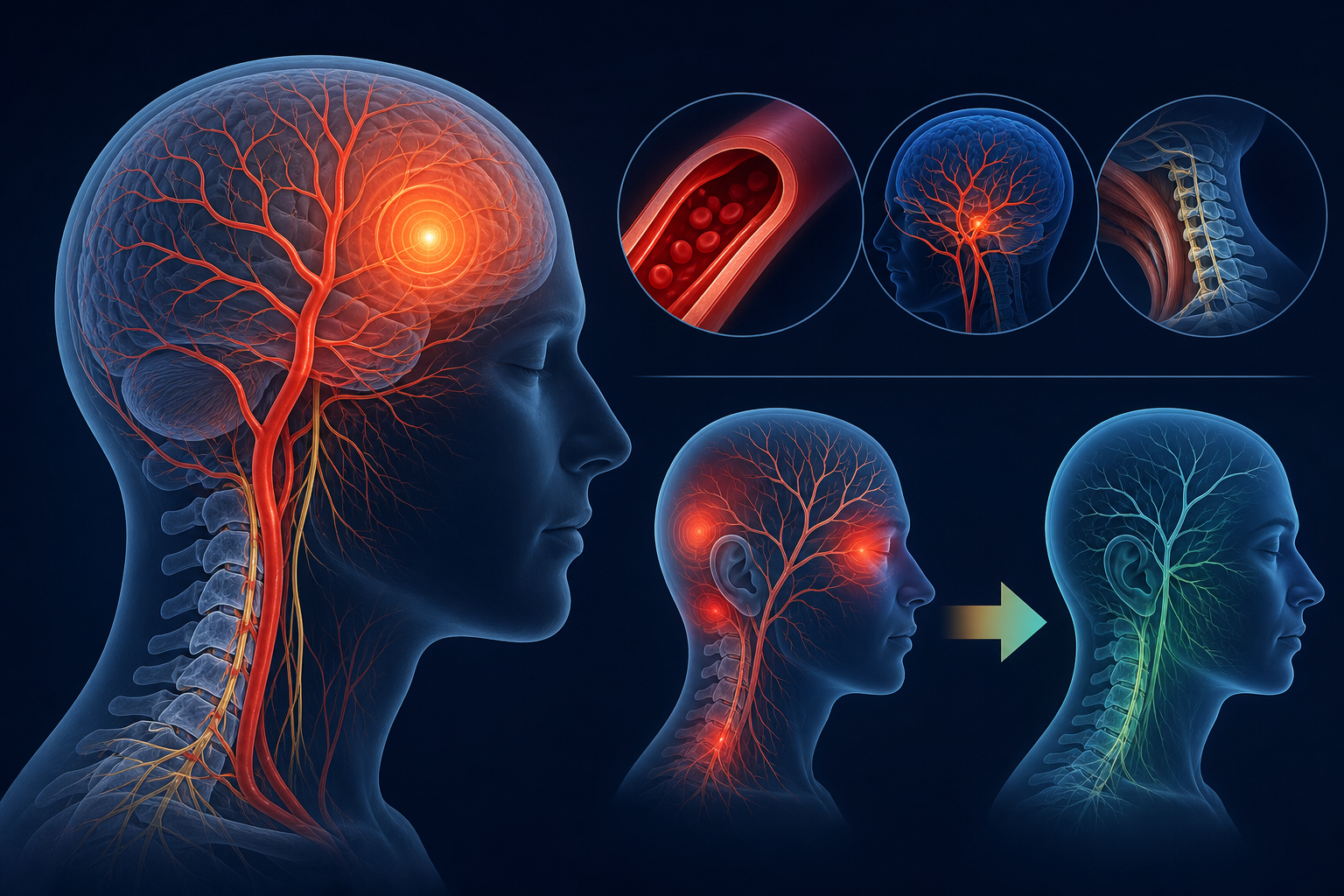
Jaw-driven symptoms often overlap with neck-driven symptoms because the trigeminal system, upper cervical nerves, and surrounding muscle chains interact. If your symptoms also include base-of-skull pain, review occipital neuralgia and chiropractic care and why neck injuries should be taken seriously for more detail on related patterns.
Why Jaw Tension, Neck Dysfunction, and Dizziness Sometimes Overlap
Can TMJ cause dizziness and nausea? Sometimes, yes. The overlap usually comes from a combination of jaw muscle overactivity, upper cervical joint restriction, altered head posture, and sensory mismatch between your neck, jaw, eyes, and balance system. That is why someone may say, “I cant turn neck without dizziness,” even though the original problem started with clenching or jaw pain.
Is it normal for TMJ to cause vertigo? It is not rare, but it should not be assumed without an exam. True spinning vertigo can come from several causes, and not all are musculoskeletal.
Mechanical Links That Commonly Show Up Together
- Jaw clenching overloads the masseter and temporalis. That increases compression around the TMJ and can refer pain toward the ear.
- Forward head posture overloads the suboccipitals and SCM. Those muscles are heavily involved in position sense and can contribute to dizziness when irritated.
- Upper cervical restriction alters proprioception. C1-C2 dysfunction can make head movement feel off, especially during quick rotation.
- Poor breathing mechanics increase neck tension. Mouth breathing and elevated ribs often keep the upper trapezius and SCM overactive.
This is also why treatment may include the jaw and neck at the same time. A provider may work on TMJ mechanics, then retrain cervical rotation, deep neck flexor endurance, and scapular support so the improvement holds between visits.
Clinical studies on cervicogenic dizziness report that dizziness can be reproduced or worsened by neck movement in a meaningful subset of patients, especially when ROM is limited and headaches or suboccipital pain are present.
If tension patterns extend beyond the jaw, how chiropractors treat muscle knots gives a useful explanation of trigger-point driven pain and referral.
What a Chiropractor May Assess During Your First Visit
Your first visit should answer three questions: is this likely mechanical, is it safe to begin conservative care, and do your symptoms suggest a referral. A good exam for TMJ plus dizziness is more detailed than a standard neck pain visit.
- History: onset, jaw clicking, ear pressure, recent dental work, clenching, headaches, screen time, sleep position, prior dizziness episodes
- Jaw mechanics: opening range, deviation to one side, closing pattern, tenderness over the TMJ capsule
- Neck mechanics: flexion, extension, side-bending, rotation, symptom reproduction with motion
- Palpation: masseter, temporalis, SCM, upper trapezius, medial pterygoid access point if trained and appropriate, suboccipitals
- Posture and breathing: rib flare, chin poke, rounded shoulders, mouth-breathing pattern
- Neurological screen: reflexes, sensation, strength, eye movement checks when indicated
What You Should Expect the Provider to Explain
You should leave with a working impression, not vague reassurance. The provider should tell you whether your pattern looks more like TMJ dysfunction, cervicogenic dizziness, mixed jaw-neck dysfunction, or something that needs a different type of evaluation first.
What the First 1 to 2 Weeks Often Look Like
Visit phase What happens Expected response Typical timeline Initial exam Jaw, neck, posture, dizziness triggers, balance screen Clear plan and home instructions Visit 1 Early care Manual care plus ROM correction and activity changes Less stiffness, fewer symptom triggers Visits 2-4 over 1-2 weeks Reassessment Retest opening, rotation, dizziness frequency Objective change or referral if limited progress Week 2-3If you are comparing providers, simple steps to find the right chiropractor for you can help you decide what credentials, communication style, and exam process matter most.
What conservative care options may be used?
TMJ dizziness treatment without surgery usually combines manual care, movement retraining, and habit correction. No single technique works for every case. The best plans target the aggravating mechanics you actually have.
Common Conservative Options
- TMJ-focused manual therapy: gentle work to the masseter, temporalis, and surrounding joint structures to reduce guarding
- Cervical manual therapy: treatment directed to upper cervical restriction and mid-neck stiffness when exam findings support it
- Soft tissue work: SCM, upper trapezius, levator scapulae, and suboccipital release
- Postural retraining: reducing forward head position and improving thoracic extension
- Jaw control drills: symmetrical opening and closing without deviation
- Vestibular-informed movement progression: gradual head turns and visual fixation drills when dizziness is movement-sensitive
How to fix jaw tension and dizziness at home often starts with reducing overload, not stretching aggressively. Try this basic protocol once or twice daily unless your provider tells you otherwise:
- Sit upright with your tongue resting lightly on the roof of your mouth just behind the front teeth.
- Keep teeth slightly apart and lips together. Hold 30 seconds while breathing through your nose.
- Place one finger at the center of your chin. Open slowly in a straight line 8 times. Stop if the jaw deviates sharply or clicks painfully.
- Tuck your chin gently without looking down. Hold 5 seconds for 8 reps.
- Turn your head 30 degrees right, then left, while keeping your eyes fixed on one point. Perform 5 reps each side slowly.
- Apply a warm compress to the masseter area for 10 minutes if muscle tightness is the main issue.
This routine is low-load by design. Forcing wide opening or aggressive neck circles often makes irritable cases worse.
When should you see a provider for diagnosis or medical evaluation?
You should seek prompt evaluation when dizziness is new, severe, persistent, or paired with symptoms that do not fit a simple jaw-neck pattern. TMJ vertigo vs inner ear dizziness is not always easy to sort out on your own. Mechanical dizziness often changes with neck position, clenching, posture, or manual pressure on irritated muscles. Inner-ear patterns more often involve true spinning attacks, stronger nausea, and clear positional triggers independent of jaw load, though overlap exists.
How long does TMJ vertigo last? Mild flare-ups may settle in several days to 2 weeks when the trigger is reduced. More persistent cases with chronic clenching, postural strain, or recurrent neck restriction can last 6 to 12 weeks without targeted care.
Seek urgent evaluation if you have:
- Sudden severe headache unlike your usual pattern
- Double vision, facial droop, slurred speech, arm or leg weakness
- Fainting or near-fainting
- Sudden hearing loss
- New dizziness after significant trauma
- Inability to walk steadily
Book a routine evaluation soon if you have:
- Jaw pain lasting more than 2 weeks
- Clicking with limited opening
- Dizziness that keeps returning with chewing or neck turning
- Ear pressure plus temple headaches and neck stiffness
- Morning jaw soreness from clenching or grinding
A provider should reassess quickly when symptoms do not change within the first few visits. Lack of objective progress is a reason to broaden the workup, not continue the same plan indefinitely.
Finding TMJ and Vertigo Support in Santa Clarita
If you are looking for a chiropractor for tmj and vertigo near me, focus on providers who assess both jaw and cervical mechanics rather than offering a generic neck pain visit. In Santa Clarita, that means asking whether the provider regularly evaluates TMJ motion, upper cervical ROM, muscle trigger points, posture, and dizziness triggers in one exam. Searches for the best chiropractor for jaw pain Santa Clarita should lead you to a provider who explains what they found, what they are treating, and when they would refer out.
- Ask whether they examine jaw opening, deviation, and chewing mechanics
- Ask whether they treat upper cervical dysfunction and cervicogenic dizziness
- Ask how they measure progress: pain, opening range, rotation ROM, dizziness frequency
- Ask whether they coordinate with PT, dental, or balance-focused providers when needed
Santa Clarita patients often search by neighborhood or nearby areas such as Valencia, Saugus, Canyon Country, Newhall, and Stevenson Ranch. A local provider match matters because dizziness care often works best with short follow-up intervals in the first 2 to 3 weeks.
Use Medximity to find a chiropractor near you, browse providers, or explore more health topics if you are still comparing care options.
Related care options for ongoing symptom support
Some cases improve with chiropractic care alone. Others need a broader conservative plan. That is common when jaw clenching, neck dysfunction, and balance symptoms have been present for months rather than days.
- Physical therapy: useful for deep neck flexor training, scapular control, vestibular-informed progression, and TMJ motor control
- Dental co-management: useful when clenching, grinding, or bite-related loading is a major driver
- Massage or myofascial work: useful for masseter, temporalis, SCM, and upper trapezius overactivity
- Ergonomic correction: useful when symptoms rise after laptop use, driving, or phone posture
Your provider may also review sleep posture, chewing habits, gum use, unilateral chewing, and breathing pattern. Those details sound small, but they often keep the jaw overloaded.
For more context on dizziness-focused care, review Vertigo Solution with Chiropractic treatment. If your symptoms appear tied to upper neck mechanics, Natural Upper Cervical Care can be successful for Vertigo conditions explains why C1-C2 function is frequently assessed in balance-related complaints.
FAQ
Can TMJ really cause dizziness?
TMJ dysfunction can contribute to dizziness in some people, especially when jaw pain overlaps with neck stiffness, ear pressure, temple headache, or clenching. The mechanism is usually mechanical and sensory, involving the jaw muscles, upper cervical spine, and balance system rather than a single isolated cause.
What is TMJ related vertigo?
TMJ related vertigo usually means dizziness, rocking, imbalance, or motion sensitivity that appears with TMJ symptoms such as jaw clicking, facial tension, ear fullness, or pain near the joint. It may not be true spinning vertigo in every case.
Can TMJ cause dizziness and nausea?
Yes, it can in some cases. Nausea is more likely when the dizziness is stronger, when neck rotation aggravates symptoms, or when the jaw-neck pattern also affects visual or balance input. Persistent or severe nausea needs a more complete evaluation.
How long does TMJ vertigo last?
Mild flare-ups may improve within days to 2 weeks if the trigger is reduced early. More persistent patterns involving clenching, postural strain, and cervical restriction often last 6 to 12 weeks without targeted conservative care.
What helps jaw pain, ear pressure, and dizziness at home?
Start with a low-load plan: keep teeth slightly apart at rest, avoid gum and hard chewing, use a warm compress for 10 minutes, practice straight-line jaw opening, and reduce prolonged forward-head posture. If symptoms are frequent, book an evaluation instead of trying random stretches.
How do I find the right chiropractor for TMJ and vertigo in Santa Clarita?
Choose a provider who examines both the TMJ and cervical spine, explains what they found, tracks progress with objective measures, and is willing to coordinate with PT or dental providers when the case requires it. Medximity can help you compare local options efficiently.
What to Do Next
If your main symptoms are jaw clicking, facial tension, ear pressure, neck stiffness, or dizziness with head movement, start with a conservative provider who evaluates both TMJ mechanics and the cervical spine. A chiropractor experienced with jaw dysfunction, upper cervical complaints, and balance-related symptoms is often an appropriate first step. In some cases, PT or dental co-management makes sense from the start.
At your first visit, expect a history, ROM testing, jaw opening assessment, muscle palpation, posture review, and a discussion of whether your symptom pattern looks mechanical. Expect home instructions on day one. Expect a reassessment plan within the first few visits.
- Seek urgent care now for severe new dizziness, fainting, facial droop, double vision, sudden hearing loss, marked weakness, or symptoms after significant trauma.
- Book a routine evaluation soon for recurring jaw pain, clicking, ear pressure, headaches, or dizziness linked to chewing, clenching, posture, or neck movement.
- Use Medximity to find local support in Santa Clarita and nearby areas including Valencia, Saugus, Newhall, Canyon Country, and Stevenson Ranch.
Find a chiropractor near you and compare local providers who offer conservative care for jaw pain, neck dysfunction, and dizziness-related complaints.