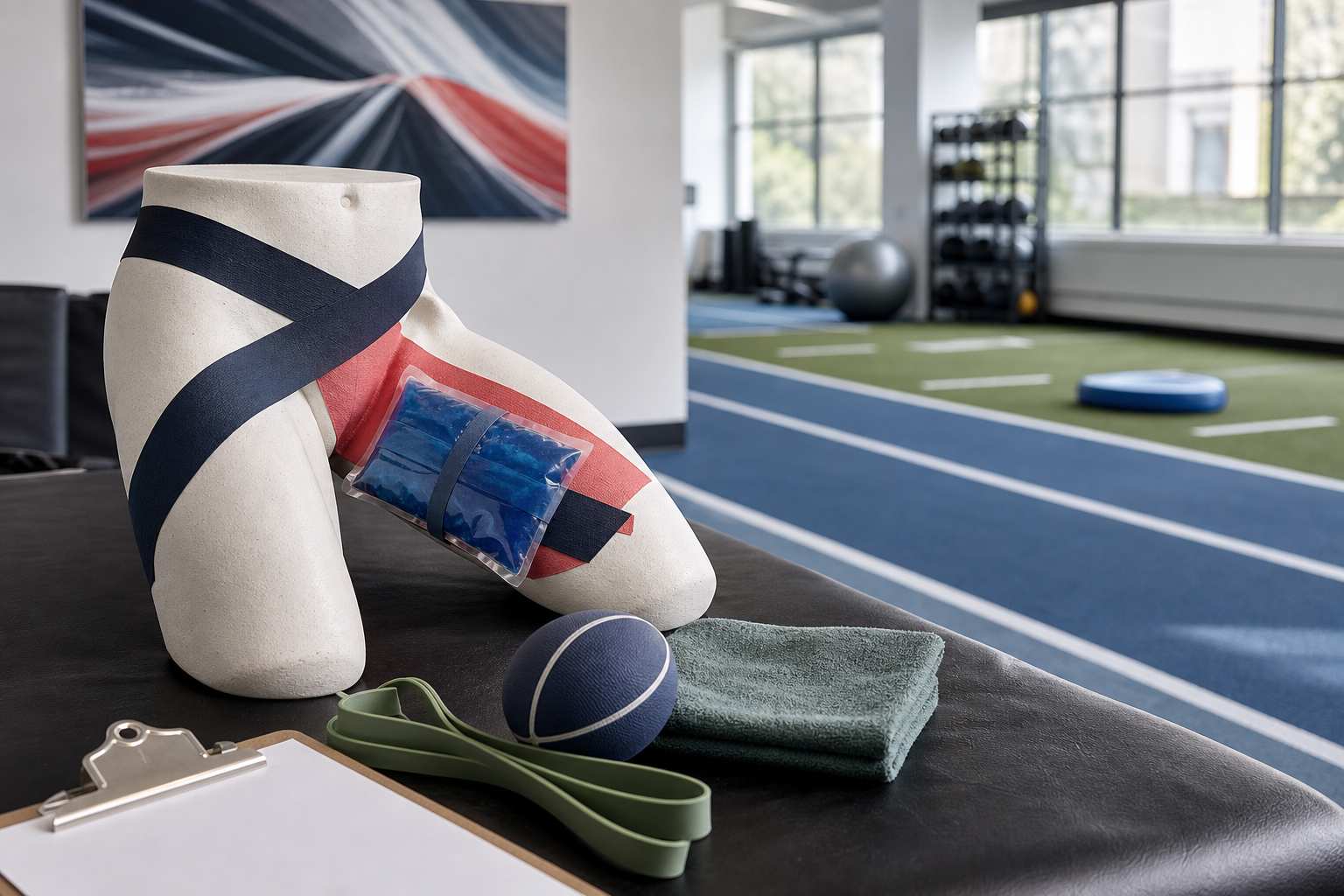
Treatment options for an adductor muscle tear in the thigh usually start with activity modification, guided rehab, manual therapy, and progressive strengthening rather than rest alone. Most mild to moderate adductor injuries improve with a structured plan that protects the torn fibers early, restores hip ROM, rebuilds strength in the adductor longus, gracilis, and adductor magnus, and then retrains walking, cutting, and pivoting.
An adductor tear affects more than your inner thigh. These muscles help pull your leg inward, stabilize the pelvis, and control force when you change direction, step sideways, or push off to walk faster. That is why pain often shows up with walking, lunging, getting in and out of a car, and sports that require sprinting or kicking.
What Is an Adductor Muscle Tear in the Thigh?
What is an adductor muscle tear. It is an overstretch or tear in one or more of the inner-thigh muscles that attach from the pelvis to the femur. The adductor group includes the adductor longus, adductor brevis, adductor magnus, gracilis, and pectineus. These muscles pull the leg toward midline and help control the hip during deceleration, pivoting, and single-leg balance.
A mild strain means only a small number of fibers are damaged. A more significant tear involves more fibers, greater weakness, and more pain with resisted movement. You do not need to diagnose the grade yourself. What matters is whether pain limits normal walking, stairs, side-stepping, or sport-specific movement.
Why this injury changes how you move
The adductors work with the gluteus medius, lower abdominals, and pelvic stabilizers. If the adductors cannot absorb force, your body compensates by shortening your stride, rotating your trunk, or shifting weight away from the injured side.
- Walking: the adductors help control the leg as it swings and lands.
- Cutting and pivoting: they slow side-to-side motion and resist unwanted hip abduction.
- Kicking: they help generate force and control follow-through.
- Single-leg stance: they assist pelvic stability with the glutes and core.
Sports medicine data consistently show groin strains are common in soccer, hockey, football, and court sports because these activities load the adductors during sprinting, change of direction, and powerful hip rotation.
If your pain overlaps the buttock or runs down the leg, compare it with sciatica treatment and common nerve-related pain patterns because inner thigh pain is not always an isolated muscle problem.
What are the common signs and symptoms of an adductor injury?
Inner thigh muscle tear symptoms usually include localized pain high on the inner thigh or near the groin crease, pain when squeezing the knees together, and tenderness along the muscle belly or tendon attachment. Pain in inner thigh when walking is common, especially with longer steps, stairs, side steps, or quick turns.
Some soreness after hard exercise can be normal. Sharp pain, bruising, a pulling sensation, or limping is not normal and should be evaluated if it does not settle quickly.
Common symptom pattern
- Pain during sudden acceleration or change of direction
- Pain when lifting the leg into a car or bed
- Tenderness near the pubic bone or upper inner thigh
- Weakness with resisted adduction, such as squeezing a ball or pillow
- Reduced ROM with side lunges or hip abduction stretch
- Bruising or swelling in more significant tears
When symptoms suggest a larger problem
Seek urgent care if you have any of these red flags:
- Severe pain after a pop with immediate inability to bear weight
- Rapid swelling or extensive bruising spreading through the groin or thigh
- Fever, unexplained swelling, or calf pain with shortness of breath
- Numbness, marked weakness, or pain after a fall or collision that could involve a fracture
If you are asking, is it normal to have groin pain after exercise, the answer is this: mild muscle soreness that improves within 24 to 48 hours can be normal. Focal groin pain that persists beyond a few days, worsens with walking, or returns every time you train needs a provider assessment.
Treatment Options for an Adductor Muscle Tear in the Thigh
Treatment options for adductor tear focus on protecting the tissue early, restoring normal movement, and loading the muscle in stages. Adductor strain treatment without surgery typically includes activity modification, physical therapy, chiropractic or manual care for related hip and pelvic restrictions, soft-tissue treatment, and a progressive strengthening plan.
Treatment What It Helps Expected Timeline Relative rest and load reduction Reduces further fiber irritation in the first phase Usually 3-7 days for mild strains, longer for larger tears Manual therapy and soft-tissue work Improves ROM, reduces guarding, helps surrounding muscles work more normally Often used during weeks 1-4 Physical therapy exercise progression Restores adductor strength, balance, gait, and return-to-sport capacity Typically 2-8 weeks depending on severity Chiropractic assessment of hip, SI joint, and lumbar mechanics Addresses movement restrictions that may overload the groin Used alongside rehab as needed Progressive isometrics, then eccentrics and lateral loading Builds tendon and muscle tolerance for walking, cutting, and pivoting Usually starts within days to 2 weeks, progresses for 4-8 weeksRest alone rarely fixes the full problem. Pain may calm down while the adductors remain weak, the pelvis stays unstable, and symptoms return as soon as you sprint or side-step.
- Early phase: reduce aggravating activity, shorten stride, avoid deep lateral lunges.
- Middle phase: restore pain-free adductor squeeze strength and hip mobility.
- Late phase: retrain acceleration, deceleration, crossover steps, and directional change.
For patients comparing conservative options across conditions, Medximity also covers medication free treatment for tension headaches and other noninvasive care pathways.
How long does an adductor tear take to heal?
How long does an adductor tear take to heal depends on tear size, tendon involvement, prior groin injury, and whether you start progressive rehab early. Mild strains often improve in 2 to 4 weeks. Moderate tears commonly take 6 to 8 weeks. More stubborn cases with recurrent symptoms or tendon-related pain can take 10 to 12 weeks or longer to return to full-speed sport.
Rehabilitation phases
- Protection phase: days 1-7 in many mild injuries. Goal: calm pain, maintain gentle ROM, avoid re-tearing.
- Early loading phase: about week 1-3. Goal: start pain-limited isometrics and controlled walking mechanics.
- Strength phase: about week 3-6. Goal: build adductor, glute, and core strength through larger ranges.
- Return-to-activity phase: about week 4-8 or later. Goal: lateral movements, jogging progressions, cutting, and sport drills.
Step-by-step home exercise protocol
Physical therapy for inner thigh strain usually starts with simple loading, not aggressive stretching.
- Lie on your back with knees bent.
- Place a pillow or rolled towel between your knees.
- Squeeze gently at about 30-40% effort for 5 seconds.
- Rest 5 seconds.
- Repeat 8-10 reps, 1-2 sets, 1-2 times daily if pain stays mild.
- When this is easy, progress to 10-second holds, then side-lying adduction and supported lateral lunges.
Add a short-stride walk for 5 to 10 minutes if your limp is minimal and symptoms do not spike later that day. If pain rises above a mild level or lingers into the next morning, reduce load.
Patients recovering from movement-related conditions often benefit from the same graded approach described in vestibular disorders treatment: restore baseline function first, then add complexity.
How do hip, pelvis, and core mechanics affect recovery?
Hip weakness and adductor pain often occur together. The adductors do not work alone. If the gluteus medius is weak, the pelvis drops during single-leg stance and the inner thigh works harder to stabilize the leg. If the sacroiliac joint, lumbar spine, or hip capsule is stiff, force shifts into the groin during stride and rotation.
This is why some people keep re-straining the same side even after resting.
- Weak glutes: increase inward collapse of the knee and pelvic drift.
- Poor core control: reduces load transfer between trunk and hip.
- Limited hip internal rotation: changes cutting and pivot mechanics.
- Stiff thoracolumbar or pelvic motion: can increase strain at the groin attachment.
A provider may also look above and below the groin. Nerve-related pain from the low back can mimic thigh symptoms, which is why resources like Sciatica Treatment – Understanding the Pain are useful when pain patterns are unclear.
What happens at a groin injury evaluation?
What happens at a groin injury evaluation is usually straightforward. A conservative care provider will take a history, examine your walking pattern, test hip ROM, and check whether your pain is reproduced by resisted adduction, stretching, or single-leg loading.
What your provider may assess
- Location of tenderness along the adductor tendon or muscle belly
- Pain with adductor squeeze testing at different hip angles
- Hip flexor, hamstring, and abdominal involvement
- Pelvic alignment and SI joint motion
- Lumbar referral patterns and nerve tension if symptoms spread
- Balance, squat pattern, and lateral movement control
The goal is not just to confirm an adductor strain. The goal is to identify why it happened and what still limits recovery.
Conservative care may include manual therapy, soft-tissue treatment, guided exercise, gait correction, and a return-to-activity plan. If the exam suggests a different cause of groin pain, your provider may recommend imaging or co-management. Similar structured evaluations are used for other complex symptoms, including treating post-concussion syndrome by natural means, where symptom location alone does not explain the full problem.
When should you see a provider for inner thigh pain?
When should I see a provider for inner thigh pain. See a provider if pain changes your gait, lasts more than 7 to 10 days, recurs with every workout, or blocks normal exercise progression. If you are searching for the best treatment for groin strain near me, look for a provider who evaluates hip strength, pelvic mechanics, and return-to-sport function rather than telling you to simply stop activity.
- See care routinely for persistent soreness, weakness, or repeated strains.
- See care promptly for limping, bruising, or inability to side-step without pain.
- Seek urgent evaluation for inability to bear weight, major swelling, numbness, or symptoms after trauma.
Choose a provider when:
- You cannot walk normally within a few days.
- You still have pain with squeezing your knees together after 1 week.
- You return to training and symptoms come back immediately.
- You have concurrent low-back, hip, or pelvic pain.
You can find a physical therapy provider near you, find a chiropractor near you, or browse providers on Medximity.
Tips to Help Prevent Another Adductor Injury
Prevention depends on load tolerance, not just flexibility. Adductor strains recur when you return to sprinting, kicking, or lateral movement before the tissue can handle force.
- Build adductor strength 2 times per week with squeezes, Copenhagen progressions, and side lunges.
- Train glute strength and single-leg stability.
- Increase sprint and cutting volume gradually over 2 to 3 weeks, not all at once.
- Warm up with lateral shuffles, hip swings, and progressive acceleration drills.
- Do not stretch aggressively into pain during the first healing phase.
- Restore hip internal rotation and trunk control before full return to sport.
Research on groin injury prevention regularly points to adductor strength deficits as a modifiable risk factor, especially in field and court athletes.
For more conservative care education, you can explore more health topics on Medximity, including conditions that involve balance, nerve irritation, and movement-based rehab such as vertigo solutions with chiropractic treatment.
What to Do Next
If you suspect an adductor tear, reduce cutting, sprinting, and deep side lunges for now. Start gentle adductor isometrics, walk with a shorter stride, and schedule an evaluation if you limp, bruise, or still have inner thigh pain after several days.
The right provider is usually a physical therapist, sports chiropractor, or rehabilitation-focused provider who treats hip and pelvic mechanics as well as the adductor itself. At the first visit, expect questions about how the injury happened, a movement exam, strength testing, ROM testing, and a home exercise plan with a timeline for progression.
- Seek urgent care: severe swelling, inability to bear weight, numbness, major bruising, or pain after significant trauma.
- Book routine care soon: persistent groin pain, pain in inner thigh when walking, weakness with adductor squeeze, or repeat injury during training.
- Find a provider: find a physical therapy provider near you or find a chiropractor near you.
A well-managed adductor injury usually responds to progressive conservative care. The key is loading the tissue at the right time, correcting the hip and pelvis mechanics that contributed to the strain, and returning to activity in stages instead of guessing when the groin is ready.
Frequently Asked Questions
Can you walk with an adductor tear?
Yes, many people can still walk with a mild tear, but they often shorten the stride or limp. If normal walking remains painful after a few days, get evaluated.
What is the fastest way to calm an inner thigh strain?
The fastest safe approach is load reduction, short-stride walking, gentle adductor isometrics, and avoiding painful lateral movement for a few days. Aggressive stretching early often makes symptoms worse.
How do I know if it is a strain or something else?
Adductor injuries usually hurt with squeezing the knees together, side lunges, and pivoting. Pain that radiates below the knee, causes numbness, or starts in the back may point to a different source.
Does physical therapy help an adductor tear?
Yes. Physical therapy for inner thigh strain helps restore strength, ROM, pelvic control, and return-to-sport capacity. It also lowers reinjury risk better than rest alone.
Should I stretch a groin strain every day?
Not in the early phase if stretching reproduces sharp pain. Start with gentle isometric loading first, then add mobility and longer-range strengthening as symptoms improve.


