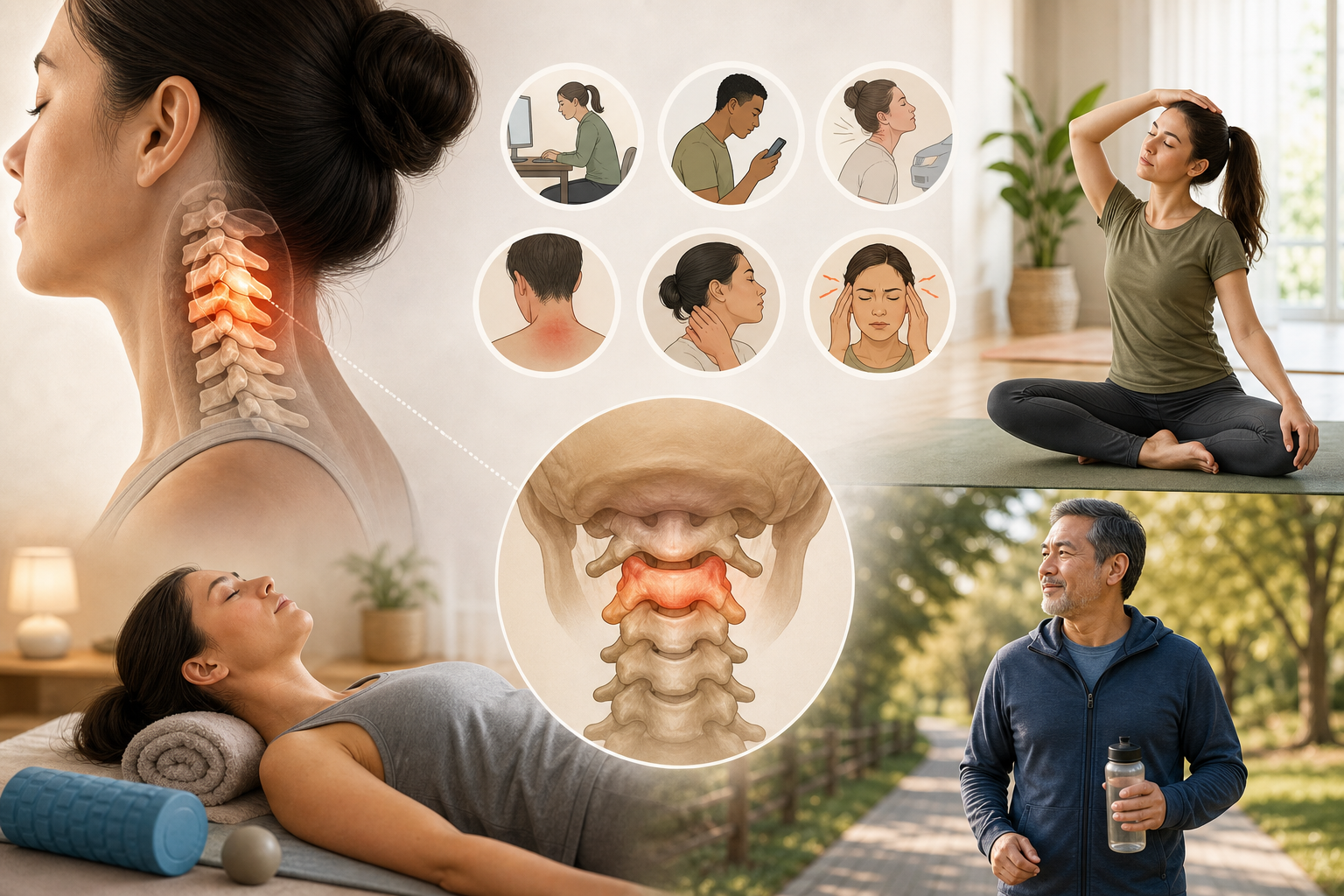
Neck Vertebra Subluxation: What Patients Need to Know starts with one clear point: the term usually describes altered motion or position in the cervical spine, not a diagnosis that automatically explains every symptom in the body. In chiropractic care, a neck vertebra subluxation often refers to restricted or irritated joints in the neck; in medical imaging language, subluxation can mean a partial joint displacement that may require urgent evaluation. The right next step depends on your symptoms, exam findings, trauma history, and whether nerves or spinal cord signs are present.
What Neck Vertebra Subluxation Means
Neck vertebra subluxation has two common meanings, and mixing them up leads to confusion. In chiropractic settings, the term usually describes cervical joint dysfunction: a segment of the neck that is not moving well, is tender on exam, or changes how nearby muscles and nerves respond. In medical radiology, subluxation can mean a partial displacement between bones, which is a different and more urgent finding when linked to trauma, instability, fracture, or spinal cord symptoms.
When patients ask, “what is neck vertebra subluxation,” the safest answer is: it is a clinical description that needs context. A provider should examine how your neck moves, whether your symptoms follow a nerve pattern, and whether imaging is needed.
Chiropractic use versus medical use
- Chiropractic use: restricted motion, joint irritation, altered muscle tone, or tenderness around a cervical segment.
- Medical imaging use: partial displacement of one vertebra relative to another, sometimes seen on X-ray, CT, or MRI.
- Patient takeaway: a subluxation label should not replace a proper exam, especially after a fall, crash, sports hit, or new neurological symptom.
A balanced provider will not claim that every headache, dizzy spell, or body symptom comes from a neck subluxation. Neck joint irritation can contribute to local pain, stiffness, headaches, and muscle guarding, but symptoms still need a differential exam. For a deeper explanation of the upper neck, read what an upper cervical subluxation means.
How Does the Cervical Spine Work?
The cervical spine is the seven-vertebra structure from C1 to C7 that supports your head, protects the spinal cord, and allows rotation, bending, and extension. C1, also called the atlas, sits under the skull. C2, the axis, has a bony peg called the dens that helps the head rotate. C3 through C7 provide stability, nerve exits, and attachment points for muscles and ligaments.
Understanding how cervical spine alignment works requires more than looking at posture from the side. The neck depends on coordinated motion between facet joints, intervertebral discs, ligaments, and muscles such as the upper trapezius, levator scapulae, sternocleidomastoid, and deep neck flexors.
Key structures patients should know
- Facet joints: small paired joints that guide neck motion and often become painful with extension or rotation.
- Cervical discs: cushions between vertebrae that help absorb load and create space for nerve roots.
- Nerve roots: branches exiting the spine that can refer symptoms into the shoulder, arm, hand, or fingers.
- Suboccipital muscles: small muscles at the base of the skull that can contribute to head pain when overloaded.
Population studies consistently rank neck pain among the most common causes of years lived with disability worldwide, with annual prevalence estimates often ranging from 15% to 50% depending on age, work demands, and study methods.
Good cervical motion is not the same as perfectly straight posture. A functional neck rotates about 70 to 90 degrees each direction, bends side-to-side about 20 to 45 degrees, and extends enough to look upward without sharp pain or arm symptoms.
What Symptoms and Causes Point to Cervical Joint Dysfunction?
Cervical joint dysfunction commonly causes neck stiffness, reduced range of motion, pain at the base of the skull, shoulder tension, and neck pain when turning head. Symptoms may stay local or refer into the upper back, jaw region, temple, or shoulder blade. If symptoms travel below the shoulder with numbness, tingling, or weakness, the exam should screen for nerve root irritation.
Waking up and thinking “I can’t move neck after sleeping” usually points to acute joint irritation, muscle spasm, or a sustained sleeping position that overloaded the facet joints and levator scapulae. In many uncomplicated cases, sharp stiffness improves within 3 to 7 days, but limited motion that persists beyond 10 to 14 days deserves an exam.
Common patterns
- Facet irritation: sharp pain with turning or looking up, often one-sided.
- Muscle guarding: tight upper trapezius, levator scapulae, and suboccipital muscles, often worse after desk work.
- Cervicogenic headache pattern: pain starting in the upper neck and referring toward the back of the head or temple.
- Nerve irritation: arm symptoms, grip changes, or tingling into a specific finger region.
Common triggers include long screen time, sudden rotation, a recent auto collision, overhead work, poor lifting mechanics, clenched jaw habits, and reduced thoracic spine mobility. Headaches that seem neck-related should still be evaluated carefully; Medximity has additional patient education on common head pain patterns and migraine-related symptoms.
Seek prompt evaluation if neck pain follows trauma or comes with fever, severe headache, changes in balance, fainting, facial droop, slurred speech, new weakness, or numbness spreading into the arm or hand.
What May a Conservative Chiropractic Exam Include?
A conservative chiropractic exam should identify whether your neck pain is likely joint-related, muscle-related, nerve-related, trauma-related, or part of a broader medical condition. A gentle chiropractic exam for neck pain does not require forceful movement at the first visit. The provider should start with history, symptom behavior, and safety screening before any hands-on care.
The history matters. A provider should ask when symptoms started, whether trauma occurred, what motions reproduce pain, whether pain travels into the arm, and whether you have numbness, weakness, balance changes, fever, or severe headache. The exam then checks motion, posture, tenderness, strength, reflexes, and sensation.
Typical exam components
- Range-of-motion testing: flexion, extension, rotation, and side-bending measured visually or with a device.
- Posture review: head position, shoulder height, thoracic curve, workstation habits, and breathing pattern.
- Orthopedic tests: movements that help distinguish facet pain, muscle strain, or nerve root irritation.
- Neurological screening: strength, reflexes, sensation, coordination, and upper motor neuron signs when indicated.
- Palpation: assessment of joint tenderness, muscle tone, and segmental motion from upper cervical to lower cervical regions.
Imaging is not needed for every stiff neck. Referral for X-ray, MRI, or other testing may be appropriate after significant trauma, suspected instability, progressive neurological findings, history of cancer, unexplained fever, severe unrelenting pain, or symptoms that fail to improve with appropriate conservative care. For more on chiropractic evaluation and treatment options, see neck pain treated by chiropractic providers.
Which Non-Invasive Care Options Help Neck Motion and Comfort?
Treatment for cervical joint dysfunction usually combines manual care, exercise, posture training, and load management. A neck adjustment may help some patients improve motion and reduce joint irritation, but it is not the only tool. A complete plan often includes soft tissue work for the upper trapezius and levator scapulae, deep neck flexor strengthening, thoracic mobility drills, and workstation changes.
A typical uncomplicated neck stiffness plan lasts 2 to 6 weeks. Some patients improve after 2 to 4 visits, while recurring stiffness from desk posture, poor sleep position, or low strength often needs 6 to 10 sessions plus daily home work. The goal is not to “put a bone back in place” as a one-time event. The goal is better motion, less guarding, stronger support, and fewer repeated flare-ups.
Care option What it targets Expected response Typical timeline Gentle cervical mobilization or adjustment Facet joint stiffness, restricted rotation, local tenderness Improved ROM and reduced guarding in appropriate patients Often reassessed after 2 to 4 visits Soft tissue therapy Upper trapezius, levator scapulae, suboccipital muscle tension Less muscle guarding and better tolerance to movement 1 to 3 weeks for acute stiffness Deep neck flexor training Longus colli, longus capitis, forward-head control Better endurance during desk work and driving 4 to 8 weeks for measurable strength change Thoracic mobility exercises Upper back stiffness that overloads the neck Easier rotation and less neck compensation 2 to 6 weeks with daily practice Ergonomic coaching Screen height, chair support, keyboard position, driving posture Fewer repeated triggers during work and home tasks Changes begin immediately; habits take 2 to 4 weeksNatural treatment for neck stiffness works best when care matches the exam findings. If pain is mostly joint-related, manual therapy may be useful. If symptoms appear after 30 minutes at a laptop, endurance and ergonomics need equal attention. If symptoms follow a collision or head impact, screening should come first; review what to do after a possible concussion if head trauma occurred.
What Can You Do at Home for a Stiff Neck?
Home care for neck stiffness should calm irritated tissues without forcing painful end-range motion. Aggressive stretching during the first 24 to 48 hours can increase guarding. Use controlled movement, heat or cold based on preference, and short posture resets instead of long static positions.
Stop any drill that causes arm numbness, spreading tingling, dizziness, double vision, severe headache, or loss of coordination. Those symptoms need evaluation before more exercise.
Five-minute neck reset protocol
- Seated posture reset: sit tall with feet flat, ribs stacked over pelvis, and shoulders relaxed. Hold for 20 seconds.
- Chin nods: gently nod as if saying “yes” without pushing the head forward. Perform 8 slow reps.
- Pain-free rotation: turn your head right until the first mild restriction, return to center, then turn left. Perform 5 reps each side.
- Scapular setting: draw shoulder blades slightly down and back without shrugging. Hold 5 seconds, repeat 8 times.
- Levator scapulae stretch: turn your nose 30 degrees toward the armpit, gently look downward, and hold 15 to 20 seconds. Repeat once per side if symptoms stay local.
- Walking break: walk 2 minutes to restore arm swing, thoracic rotation, and blood flow.
Use this protocol 2 to 4 times daily for the first week. Acute “slept wrong” stiffness often improves within 3 to 7 days. If pain remains sharp after one week, ROM keeps worsening, or headaches intensify, schedule a provider exam.
Desk workers should also use a 30-2 rule: after 30 minutes of sitting, take 2 minutes for standing, walking, or shoulder blade movement. The cervical spine tolerates load better when the thoracic spine, shoulder blades, and deep neck flexors share the work.
Is Neck Subluxation Serious? Common Questions
Neck subluxation may be minor or serious depending on the meaning, mechanism, and symptoms. A chiropractic finding of restricted cervical motion is often managed conservatively. A traumatic partial displacement seen on imaging, or any neck pain with neurological changes, needs prompt medical evaluation.
FAQ
-
Is neck subluxation serious?
It can be. Stiffness and restricted motion without red flags are often evaluated conservatively. Neck pain after trauma, new weakness, numbness, balance changes, fever, severe headache, or bowel or bladder control changes needs urgent assessment.
-
How long does neck stiffness last?
Simple neck stiffness often improves in 3 to 7 days. More persistent cervical joint dysfunction may take 2 to 6 weeks of conservative care, especially when posture, strength, work demands, or repeated irritation contribute.
-
What is the difference between neck subluxation vs pinched nerve?
Neck subluxation in chiropractic language usually refers to joint motion dysfunction. A pinched nerve means a cervical nerve root is irritated or compressed, often causing arm pain, numbness, tingling, or weakness in a pattern linked to C5, C6, C7, or C8 nerve roots.
-
Can a chiropractor help neck vertebra subluxation?
A chiropractor may help when exam findings point to mechanical neck dysfunction, restricted ROM, muscle guarding, or facet joint irritation. Care should include safety screening, a working diagnosis, and referral when symptoms suggest trauma, nerve injury, or another condition.
-
What happens at the first visit?
The first visit typically includes a history, posture review, ROM testing, orthopedic tests, palpation, and neurological screening when needed. Hands-on care may begin the same day if the exam supports conservative treatment and no red flags appear.
-
Should I look for a chiropractor for neck subluxation near me or a neck alignment chiropractor near me?
Search terms can help you find providers, but choose based on exam quality, clear explanations, conservative care options, and willingness to refer when needed. You can find a chiropractor near you through Medximity.
Neck-related symptoms sometimes overlap with head pain, jaw tension, dizziness, or ear symptoms. If ringing or ear pressure appears with neck stiffness, review Medximity’s article on tinnitus that may be linked with neck dysfunction, then get a proper exam to rule out non-neck causes.
What Should You Track During Conservative Care?
Track function, not just pain intensity. Pain can change day to day, but function shows whether care is improving your neck’s capacity. Useful measures include rotation while driving, sleep interruption, headache frequency, work tolerance, exercise tolerance, and arm symptoms.
Most conservative plans should include measurable reassessment. If cervical rotation starts at 45 degrees to the right and improves to 70 degrees after two weeks, that is meaningful progress. If pain drops from 7/10 to 3/10 but arm weakness increases, that is not a simple improvement and needs a different clinical decision.
Simple tracking targets
- ROM: note whether you can turn your head far enough to check blind spots without rotating your trunk.
- Headache days: count days per week with head pain that begins in the neck or base of skull.
- Work tolerance: record how long you sit, drive, or use a laptop before symptoms start.
- Arm symptoms: track numbness, tingling, grip changes, or pain below the shoulder.
- Recovery time: note whether flare-ups settle within hours, one day, or several days.
A practical conservative-care benchmark: uncomplicated mechanical neck pain should show some measurable change in ROM, pain behavior, or function within 2 to 4 weeks. No change warrants reassessment of diagnosis, care plan, workload, or referral needs.
Care should not depend on indefinite passive visits. Manual therapy can help create a window for better movement, but exercise and daily habit changes make that improvement more durable. If you want to compare provider types, you can browse providers by location and specialty.
What to Do Next
Schedule an exam if neck stiffness limits normal motion for more than 7 to 10 days, keeps returning, follows trauma, or comes with headaches, shoulder symptoms, numbness, tingling, or weakness. Choose a provider who explains the difference between joint dysfunction, nerve irritation, muscle strain, and imaging-defined instability.
Seek urgent care now if neck pain comes with any of the following:
- New arm or hand weakness
- Numbness spreading into the arm, hand, face, or leg
- Loss of balance, fainting, confusion, or trouble speaking
- Severe headache that is sudden or unlike your usual pattern
- Fever with neck stiffness
- Neck pain after a fall, collision, sports impact, or direct blow
- Loss of bowel or bladder control
For routine mechanical neck pain, start with a chiropractor, physical therapist, or rehabilitation provider who performs a full exam before treatment. Expect the first visit to include history, ROM testing, posture and movement review, orthopedic screening, neurological checks when indicated, and a clear plan. Conservative care may include cervical mobilization or adjustment, soft tissue work, strengthening, stretching, ergonomic coaching, and a home program.
If you are searching for a neck alignment chiropractor near me, use provider quality as the filter: careful exam, clear safety screening, measurable goals, and practical home care. You can find a physical therapist near you or search for chiropractic care through Medximity. For more patient guides on spine, rehab, and wellness topics, explore more health topics.
This article is for general education and does not replace a diagnosis, exam, or individualized care plan from a licensed healthcare provider. Seek urgent evaluation for red-flag symptoms or neck pain after trauma.