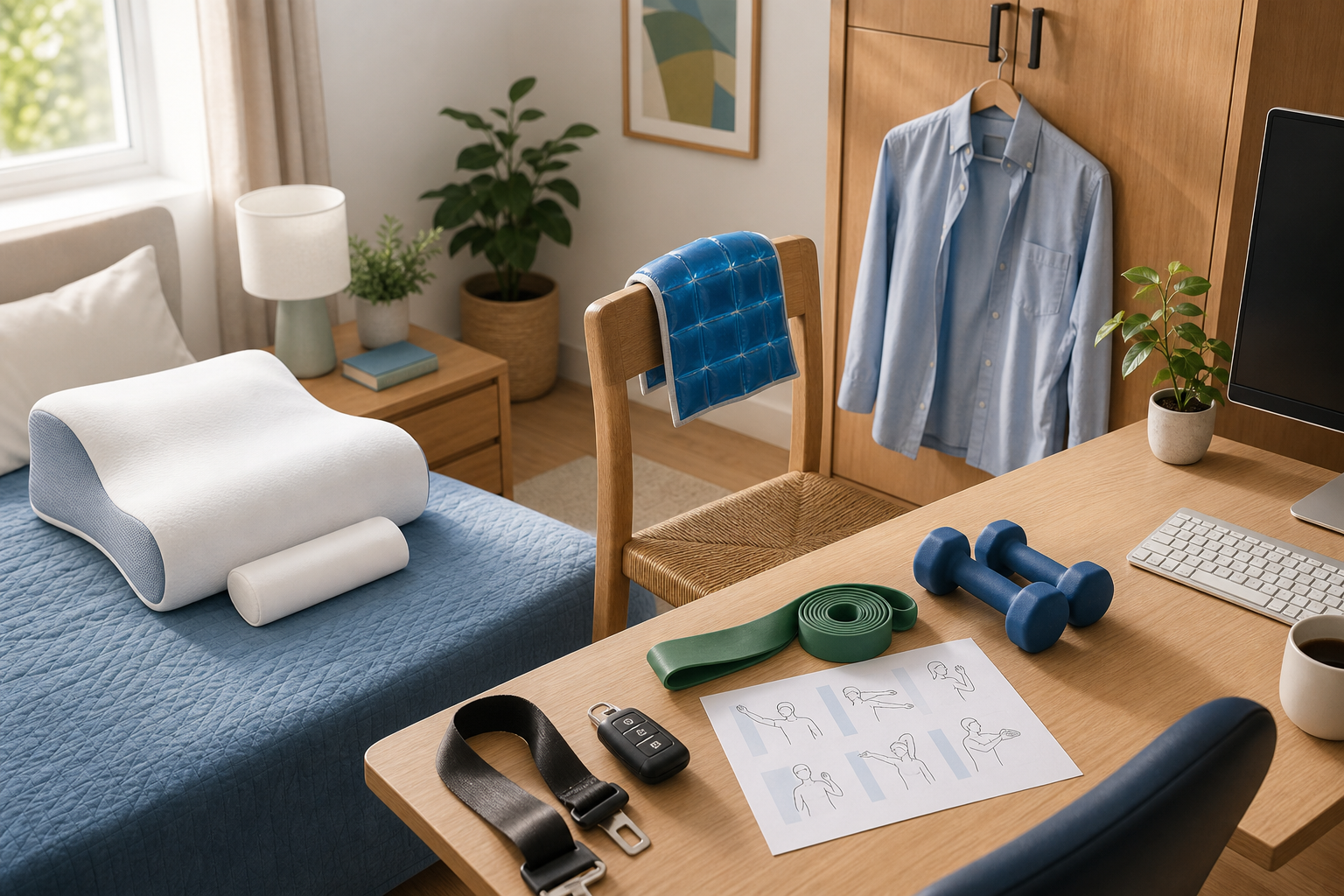
Living with a Rotator Cuff Strain: A Comprehensive Guide starts with knowing what the injury usually is, what movements aggravate it, and what you can safely change right now. A rotator cuff strain often improves with activity modification, targeted rehab, and the right provider support, but sharp weakness, loss of motion, or sudden deformity means you should get assessed promptly.
The rotator cuff is not one structure. It is a group of four muscles and their tendons that help center the ball of your shoulder in the socket: supraspinatus, infraspinatus, teres minor, and subscapularis. When one or more of these tissues is strained, routine tasks like reaching into a cabinet, washing your hair, fastening a seat belt, or carrying groceries can become mechanically difficult.
What Is a Rotator Cuff Strain?
What is a rotator cuff strain? It is an overload injury to the muscle-tendon unit of the rotator cuff, usually from repeated overhead use, an awkward lift, a sudden pull, or poor shoulder mechanics over time. A strain can involve small fiber disruption, inflammation, and protective muscle spasm without a full tendon rupture.
The cuff works with the deltoid, scapula, and shoulder blade stabilizers to keep the humeral head centered while you lift your arm. If that timing breaks down, the tendon can get compressed under the acromion, especially during reaching and lifting. Desk work can contribute just as much as sports if you spend hours with rounded shoulders and reduced thoracic extension.
Common ways a strain starts
- Lifting a box away from your body
- Painting, stocking shelves, or repeated overhead work
- Returning to pull-ups, presses, or throwing too quickly
- Sleeping for hours with the arm overhead
- Poor scapular control during daily activity or exercise
Research on shoulder pain consistently shows that most nontraumatic rotator cuff problems respond well to conservative care over weeks to months when load is modified early and motion is maintained.
Mild strains may settle within 2 to 6 weeks. Moderate strains often take 6 to 12 weeks, especially if overhead work continues during recovery.
How a Rotator Cuff Strain Can Affect Daily Life
How shoulder strain affects daily life depends on which tendon is irritated and what positions trigger compression. The most common problem is not constant pain. It is pain plus weakness during specific tasks: reaching up, reaching out, lowering the arm slowly, or holding weight with the elbow away from the body.
Three daily patterns show up repeatedly:
- Overhead reach is limited. Putting dishes away, changing a shirt, and grooming can hurt most between 60 and 120 degrees of elevation.
- Loaded carry is limited. A grocery bag, laundry basket, or briefcase pulls on the shoulder and can provoke pain down the lateral upper arm.
- Endurance drops first. You may manage one lift, but repeated lifting or a full work shift causes increasing soreness and slower arm motion.
Basic tasks often need temporary substitutions. Use both hands for heavier objects. Keep loads close to your ribs. Slide items across a counter instead of lifting them one-handed. At a desk, move the keyboard and mouse closer so the shoulder does not sit in low-grade abduction for hours.
If shoulder symptoms are affecting neck position or causing upper trapezius overuse, you may also benefit from learning how nearby regions contribute to pain patterns. Medximity has broader education on related musculoskeletal issues, including natural fibromyalgia management with chiropractic and vertigo solution with chiropractic treatment when cervical mechanics are part of the picture.
Rotator Cuff Strain vs. Tear: What’s the Difference?
Rotator cuff strain vs tear symptoms overlap, but the degree of weakness and loss of function is often different. A strain usually hurts when you move and may feel weak because pain inhibits muscle output. A tear, especially after a sudden injury, is more likely to cause marked weakness, inability to lift the arm normally, or a clear loss of strength that does not improve after warming up.
Feature Rotator Cuff Strain Rotator Cuff Tear Typical onset Overuse, awkward lift, repeated overhead activity Sudden force, fall, major overload, or chronic degeneration Pain pattern Painful arc, soreness with activity, night discomfort possible Similar pain, often sharper after injury Strength Mild to moderate weakness, often pain-limited More obvious weakness, especially lifting or external rotation ROM Restricted by pain, sometimes improves gradually during movement Active ROM may be significantly limited Typical recovery timeline 2-12 weeks depending on grade and load management Varies widely; requires prompt clinical evaluationSigns that deserve faster evaluation
- Sudden inability to raise the arm after a fall or lift
- Visible deformity or bruising around the shoulder or upper arm
- Arm numbness, hand weakness, or pain traveling below the elbow
- Night pain that is severe and worsening despite reduced activity
If the shoulder is hot, swollen, visibly deformed, or you cannot move the arm after trauma, seek urgent care immediately.
What Activities Tend to Make It Worse?
Why does shoulder pain worsen lifting? Because lifting increases demand on the supraspinatus and deltoid while the cuff must stabilize the humeral head against the socket. If the cuff is irritated, the shoulder can glide upward slightly under load and crowd the subacromial space. That is why a half-full laundry basket can hurt more than a gentle arm swing.
The biggest aggravators are predictable:
- Reaching overhead with the thumb down
- Lifting away from the body instead of close to the torso
- Repetitive front raises, presses, or throwing
- Sleeping on the painful side
- Long desk sessions with rounded shoulders and no breaks
- Sudden return to yard work, swimming, or racket sports
Temporary substitutions that usually help
- Use a step stool so you do not have to fully reach overhead.
- Carry bags with the elbow bent and close to your side.
- Switch from overhead storage to waist-height storage for 2 to 4 weeks.
- For workouts, replace overhead pressing with lower-load rowing patterns only if those are pain-free.
- Set a timer every 30 to 45 minutes during desk work to reset posture and move the shoulder.
Temporary change beats complete shutdown. Resting too long usually stiffens the glenohumeral joint and delays recovery.
What Conservative Care Options May Help?
Rotator cuff strain treatment without surgery usually combines load management, manual care, mobility work, and graded strengthening. The best plan depends on whether the main problem is tendon overload, joint stiffness, scapular control, or neck and thoracic mechanics adding extra stress to the shoulder.
Conservative providers often work together. A chiropractor may address thoracic spine and shoulder girdle mechanics. A PT may progress ROM, isometrics, and scapular control. A rehab or wellness provider may guide exercise form and return-to-activity pacing. If dizziness, neck position, or upper cervical issues are part of your broader presentation, related education may be useful, such as Meniere’s recovery with upper cervical treatment or combating cluster headaches with upper cervical care.
Conservative option What it targets Expected outcome Typical timeline Activity modification Reduces tendon overload Less pain with daily tasks Often within 1-2 weeks Guided PT exercise ROM, cuff strength, scapular control Better motion and function 3-8 weeks Chiropractic/manual therapy Thoracic, rib, scapular, and shoulder mechanics Improved movement tolerance 2-6 weeks Home exercise program Daily mobility and tendon loading Steadier recovery between visits Daily for 4-8 weeks Ergonomic changes Repeated low-grade irritation at work Less end-of-day flare-up Days to 2 weeksIf you are ready for an exam, find a physical therapy provider near you, find a chiropractic provider near you, or browse providers.
Tips for Sleeping, Dressing, Driving, and Working
The best sleeping position for shoulder strain is usually on your back with the forearm supported on a pillow, or on the non-painful side with a pillow hugged in front of your chest to keep the sore shoulder from falling forward. Sleeping directly on the painful side compresses the cuff and commonly increases night symptoms.
Sleeping and dressing
- Back sleeping: place one pillow under the elbow and forearm so the shoulder rests slightly away from the body.
- Side sleeping: lie on the non-painful side and support the top arm on a pillow at chest height.
- To put on a shirt: thread the painful arm in first, then pull the shirt around with the other hand.
- To remove a shirt: take the non-painful arm out first.
How to dress with shoulder pain comes down to reducing abduction and internal rotation. Button-front shirts, front-clasp garments, and jackets one size looser can reduce painful strain for the first 2 to 3 weeks.
Driving and work setup
- Move the seat closer so the elbows stay bent.
- Keep hands lower on the wheel if the top position aggravates symptoms.
- At a desk, keep the mouse close and the forearms supported.
- For manual work, split loads into smaller carries and avoid repeated shelf-height lifts temporarily.
Small mechanical changes often reduce symptoms faster than complete rest because they lower repeated tendon compression while preserving motion.
For more patient education across rehab and wellness topics, explore more health topics.
Exercise, Mobility, and Returning to Activity
Exercises for rotator cuff strain recovery should restore motion first, then tolerance to load, then endurance. The biggest mistake is jumping straight to resisted overhead exercise before the cuff and scapular stabilizers can control the arm smoothly.
A simple home mobility protocol
- Pendulum: lean forward with the non-painful hand on a table. Let the sore arm hang. Make small circles for 30 seconds each direction.
- Table slides: sit facing a table with a towel under your hand. Slide the hand forward until you feel mild stretch, not sharp pain. Hold 2 seconds. Repeat 10 times.
- Scapular set: stand tall and gently draw the shoulder blades down and back without arching the low back. Hold 5 seconds. Repeat 10 times.
- Isometric external rotation: elbow at your side, forearm bent 90 degrees, press the back of your hand gently into a wall or towel roll for 5 seconds. Repeat 8 to 10 times.
Use this once or twice daily if symptoms stay mild during the session and do not spike for hours afterward. Mild soreness is common. Sharp pain, catching, or increasing night pain means the load is too high.
Return to training in stages:
- Stage 1: pain-free ROM and daily tasks
- Stage 2: light resistance below shoulder height
- Stage 3: repeated lifting without flare-up the next day
- Stage 4: controlled overhead work or sport-specific drills
For most mild strains, everyday function improves before sport does. Desk work may normalize in 1 to 3 weeks, while overhead gym work often needs 4 to 8 weeks of graded return.
Common Recovery Mistakes to Avoid
Mistakes that delay shoulder strain healing are usually mechanical, not mysterious. Most people either do too much too early or stop moving the shoulder for too long and get stiff.
- Resting completely for weeks. This reduces ROM and tolerance to load.
- Testing the shoulder every day with painful lifts. Repeated provocation slows progress.
- Returning to overhead presses too soon. Pain-free reaching at home does not equal readiness for loaded overhead work.
- Ignoring posture and thoracic stiffness. A shoulder that moves on a stiff upper back often stays irritated.
- Only treating pain, not mechanics. Symptoms improve faster when strength, scapular control, and work setup are addressed together.
One more mistake: assuming all shoulder pain starts in the shoulder. The neck, upper ribs, and thoracic spine can alter shoulder mechanics. That is why some people with persistent upper-quarter issues also look into broader chiropractic education, including topics like trigeminal neuralgia treatment with chiropractic or asthma treatment with upper cervical care when postural and cervical factors are being reviewed in context.
When to See a Provider and How to Lower the Risk of Future Shoulder Strain
When to see provider shoulder strain is simple: get evaluated if pain lasts more than 1 to 2 weeks, if ROM keeps shrinking, if weakness is obvious, or if work and sleep are still limited despite reducing load. Earlier care is reasonable if you rely on overhead activity for your job or sport.
Get assessed urgently if you have
- Sudden loss of ability to lift the arm
- Significant weakness after a fall or heavy lift
- Numbness, tingling, or hand weakness
- Visible deformity, major bruising, or swelling
- Severe pain that does not ease with rest
How to prevent future shoulder strain starts after symptoms calm down. Keep shoulder mobility, thoracic extension, and cuff endurance in your weekly routine instead of stopping as soon as pain fades.
- Maintain full pain-free ROM in flexion, external rotation, and hand-behind-back motion.
- Train the rotator cuff and scapular stabilizers 2 to 3 times per week.
- Warm up before overhead work or workouts with 5 to 10 minutes of mobility and light activation.
- Store frequently used items between waist and chest height.
- Break up long desk sessions every 30 to 45 minutes.
Prevention is maintenance, not intensity. Consistent low-dose work beats occasional hard sessions.
Rotator Cuff Strain FAQ
Can a rotator cuff strain heal on its own?
Yes, a mild strain often improves with load modification, sleep changes, and progressive exercise over 2 to 6 weeks. If pain, weakness, or ROM loss persists beyond that, get examined.
What are the common signs of rotator cuff strain?
Common signs of rotator cuff strain include pain when reaching overhead, pain lowering the arm, lateral shoulder soreness, night discomfort when lying on that side, and weakness with lifting or external rotation.
Should you stretch a sore rotator cuff right away?
Gentle mobility usually helps. Aggressive stretching into sharp pain does not. Start with pendulums, table slides, and light isometrics, then progress if symptoms stay calm later that day.
Why is night pain common with a shoulder strain?
Night pain is common because side sleeping compresses irritated cuff tissue and unsupported arm positions can strain the shoulder for hours. Support the forearm on a pillow and avoid sleeping directly on the painful side.
How long before you can work out again?
Light lower-body and pain-free non-overhead exercise may continue early. Overhead lifting typically returns later, often after 4 to 8 weeks for mild to moderate cases once ROM, strength, and next-day tolerance improve.
What to Do Next
If your symptoms are mild, start by reducing overhead load, changing your sleep setup tonight, and using the home mobility steps once or twice daily for the next week. If pain is limiting work, driving, dressing, grooming, or exercise, book an evaluation with a conservative provider who treats shoulder mechanics.
- Physical therapy is a good fit if you need ROM testing, guided exercise progression, and return-to-activity planning.
- Chiropractic care may help if thoracic, rib, scapular, or cervical mechanics are contributing to shoulder overload.
- Rehabilitation and wellness providers can support posture, strength maintenance, and ergonomic changes after the initial flare settles.
At your first visit, expect questions about how the injury started, what motions hurt, whether weakness is present, and which daily tasks are limited. A provider will usually check active ROM, resisted strength, shoulder blade control, and whether the neck or upper back is adding to the problem.
Seek urgent care if you cannot raise the arm after an injury, have visible deformity, or notice numbness or major weakness. For routine care, find a rehabilitation provider near you, find a wellness provider near you, or browse providers to get the shoulder assessed and moving in the right direction.