Find chiropractor near me for back pain searches work best when you filter for the type of back problem you have, the services offered, and how quickly you need care. A good local match is not just the closest provider. It is a chiropractor whose exam, treatment style, rehab support, hours, and referral habits fit your lumbar spine, sacroiliac joint, or thoracic pain pattern.
If you want a faster decision, look for a provider who treats your kind of back pain, explains what they are checking, gives a clear timeline, and includes exercise or mobility work instead of relying on adjustments alone. Use Medximity to find a chiropractor near you, compare hours, services, and review summaries, and book with more confidence.
How to Find a Chiropractor Near Me for Back Pain
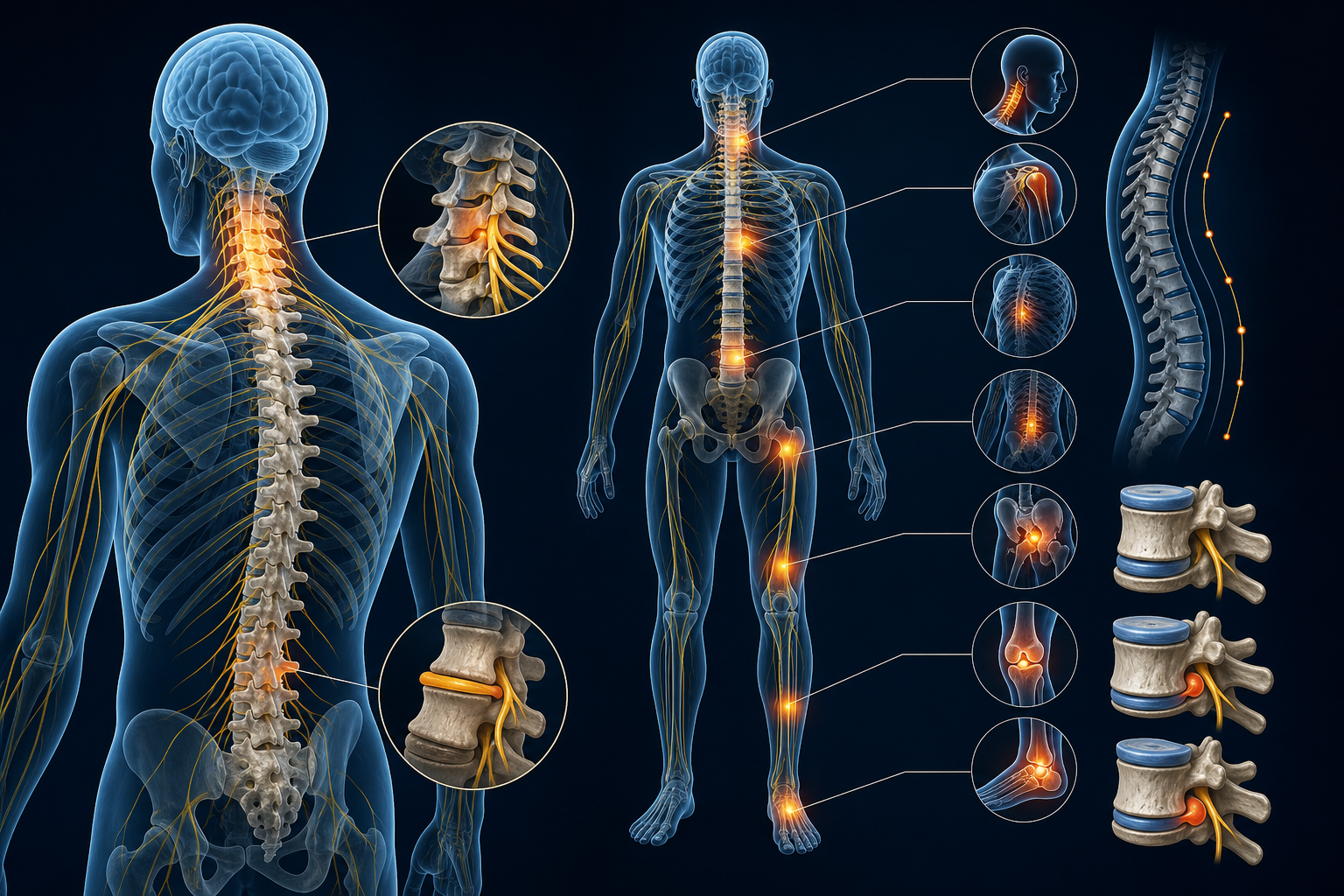
What does a chiropractor do for back pain? A chiropractor evaluates how your spine, joints, muscles, and movement patterns are contributing to pain, then uses conservative care to improve motion and reduce mechanical stress. That often includes spinal manipulation, mobilization, soft tissue work, posture correction, and home exercises for the lumbar spine, sacroiliac joint, and thoracic paraspinals.
Start with symptom-specific filters instead of a generic provider search. If your pain started after lifting, bending, a sports strain, or a car accident, that matters. If your pain shoots into the buttock or leg, that matters too. A directory search should help you sort by services, access, and provider fit rather than forcing you to read through practice marketing pages.
- Search by symptom: lower back pain, mid-back pain, sciatica, post-accident back pain, sports strain.
- Check service mix: spinal manipulation, rehab exercise, myofascial release, cupping, massage, traction, ergonomic coaching.
- Check access: same-day booking, evening hours, weekend hours, walk-in options.
- Check provider fit: sports-focused, chronic pain-focused, auto-injury care, family care, rehab-based care.
- Check practical details: language options, accepted plan types, online forms, location by zip code or neighborhood.
Low back pain is one of the most common musculoskeletal complaints worldwide, and most episodes improve with conservative care over days to weeks. The key is matching the right provider to the right presentation early.
If your pain also includes leg symptoms, review Sciatica Treatment – Understanding the Pain. If work setup may be driving your pain, Ensuring Safety and Preventing Back Pain at Work gives you practical changes you can start today.
What to Look for in a Chiropractor for Back Pain
How to choose a chiropractor for back pain comes down to exam quality, treatment breadth, and whether the provider can explain why your pain happens with specific movements. You want more than “your back is out.” You want a provider who checks ROM, posture, joint loading, hip mobility, and nerve tension, then gives you a plan.
Signs of a strong clinical fit
- They ask where the pain is worst: central low back, one side near the PSIS, rib angle, or pain into the glute.
- They test movement: flexion, extension, rotation, side-bending, hip hinge, single-leg balance.
- They check surrounding structures: gluteus medius, quadratus lumborum, hamstrings, iliopsoas.
- They explain whether pain looks disc-related, facet-related, SI joint-related, or primarily muscular.
- They include a home plan with 1-3 specific exercises from day one.
Signs to be cautious about
- No clear exam before treatment.
- No timeline given for re-checking progress.
- No exercise, mobility, or self-care guidance.
- Very broad promises without explaining your diagnosis or mechanical pattern.
- No discussion of when you should be referred for medical evaluation.
A straightforward back strain often improves within 2 to 6 weeks with conservative care. A recurring lower back problem with stiffness, deconditioning, or desk-related posture faults may need 6 to 12 visits over 4 to 8 weeks, plus a structured home routine. Those numbers are not guarantees, but they are useful benchmarks.
What to Compare Why It Matters for Back Pain What a Good Answer Sounds Like Initial exam Separates muscle strain from joint restriction or nerve irritation “We check ROM, orthopedic tests, posture, hip mobility, and symptoms with bending or sitting.” Treatment options Back pain often needs more than one tool “We use adjustments, mobilization, soft tissue work, and exercise progression.” Rehab support Prevents repeat flare-ups “You will get a home plan for core control, hip mobility, and movement mechanics.” Progress timeline Helps you know when care is working “We reassess after 2-3 weeks or 4-6 visits depending on severity.”For broader self-care strategies, see Low Back Pain – How to Heal Naturally.
What kinds of back pain can chiropractors help manage conservatively?
Chiropractic treatment for lower back pain usually fits mechanical back pain best: pain linked to movement, position, lifting, prolonged sitting, or stiffness after inactivity. That includes many acute strains, posture-related pain, SI joint irritation, facet joint restriction, and some cases of nerve irritation that need conservative monitoring.
Back pain when bending over treatment depends on the pattern. Pain with flexion may point toward disc irritation or hamstring and hip mobility limits. Pain with standing backward may fit a facet or extension-sensitive pattern. Pain at one side near the dimples of the low back often involves the sacroiliac region or the thoracolumbar fascia.
Common patterns chiropractors often manage
- Acute lumbar strain: pain after lifting, twisting, yard work, or sudden overload.
- Posture-related low back pain: worse after desk work, driving, or repeated sitting.
- Facet joint irritation: stiffness with extension, turning, or getting up after rest.
- SI joint dysfunction: one-sided low back or buttock pain, often worse with transitions.
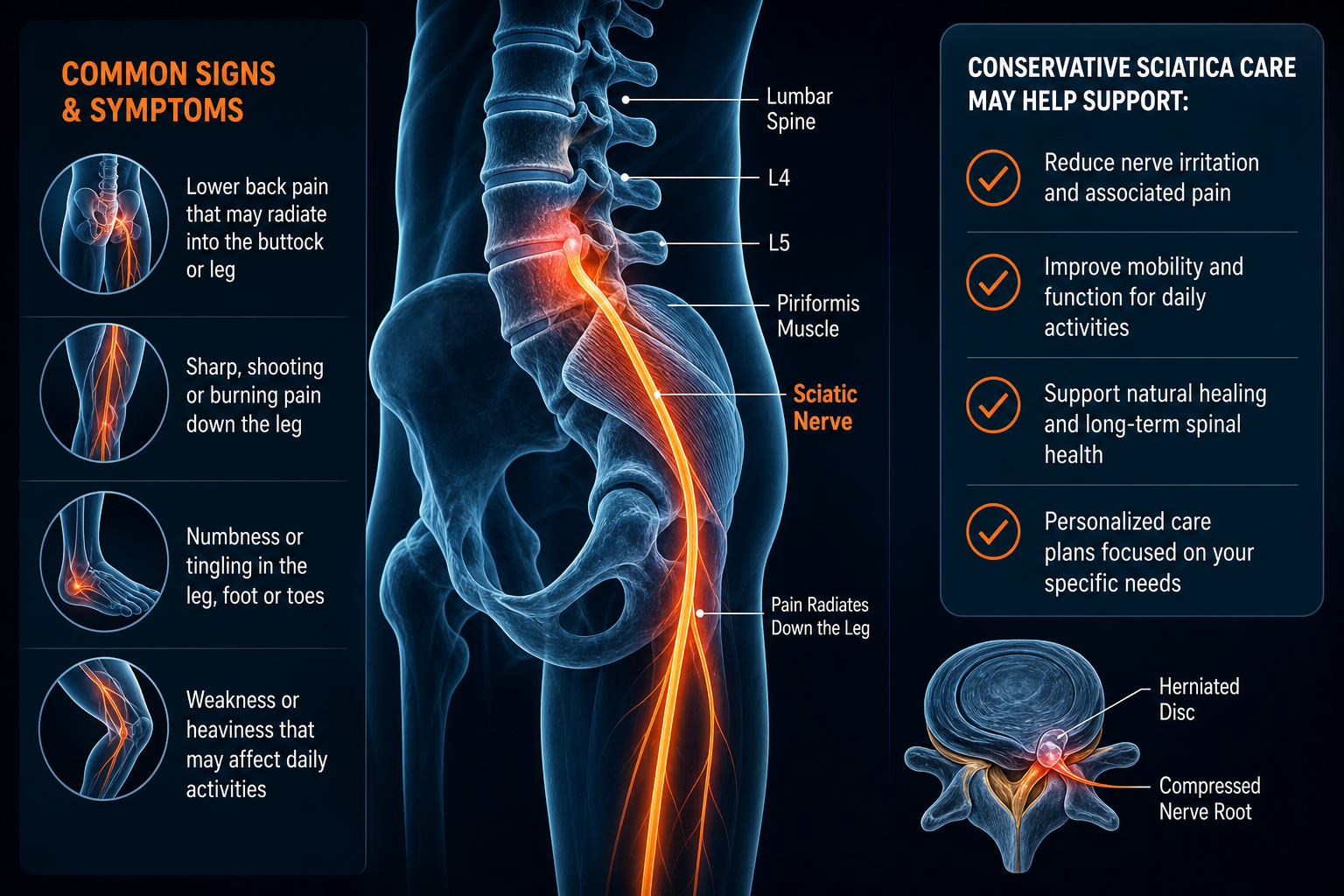
- Sciatic-type symptoms: pain that travels into the glute, posterior thigh, or calf.
- Sports strain: overload of the erector spinae, QL, hip rotators, or lumbopelvic stabilizers.
Typical timeframes vary by irritability. A mild muscular flare may calm in 1 to 3 weeks. A recurring low back problem with leg symptoms may need 4 to 8 weeks of monitored conservative care and exercise progression.
If pain travels below the knee, the provider should assess neural tension, ankle reflexes, strength, and whether coughing or sitting increases symptoms. That changes the plan.
If your pain includes leg burning, numbness, or classic sciatic distribution, read What Can Be Done for Sciatic Pain?. If your pain is tied to training or competition, Sports Therapy – Can a Chiropractor improve my game? covers performance-related care.
What services may help back pain besides adjustments?
Back pain care works better when the provider addresses joints, muscles, and movement together. Adjustments can improve segmental motion, but they do not strengthen the deep trunk stabilizers or correct a poor hip hinge by themselves. The best conservative plans often combine several services.
Service Best Use Expected Short-Term Outcome Typical Timeline Spinal manipulation or mobilization Joint restriction, stiffness, painful movement arcs Improved ROM, less guarding Often noticeable within 1-3 visits Soft tissue therapy Muscle spasm in QL, erector spinae, gluteals Reduced tension, easier movement 1-4 visits for early change Corrective exercise Repeat flare-ups, poor core control, hip stiffness Better load tolerance, fewer recurrences 2-8 weeks Posture and ergonomic coaching Desk work, driving, repetitive bending Less daily aggravation Immediate to 2 weeks Massage or myofascial work Guarding, trigger points, movement avoidance Short-term symptom relief, easier exercise 1-3 sessions for early response Rehab co-management with PT Strength deficits, recurrent instability, return to sport Improved endurance and mechanics 4-10 weeksA stronger plan may include:
- Manual therapy for the lumbar segments and thoracic mobility.
- Hip mobility drills if the hip flexors and piriformis limit motion.
- Core endurance work for the transversus abdominis and multifidus.
- Breathing and bracing drills to control spinal load.
- Workstation changes if your symptoms build through the day.
That combination often separates short-term relief from lasting change.
How do you choose the best chiropractor near me for back pain?
Best chiropractor near me for back pain does not mean the highest ad budget or the closest address. It means the provider who matches your problem. A weekend runner with recurrent right SI pain needs a different skill set than a warehouse worker with acute lifting pain or a commuter with daily flexion intolerance.
Match the provider to your presentation
- Acute strain after lifting: look for same-week availability, movement exam, manual care, and early exercise instruction.
- Recurring lower back discomfort: look for rehab-based care and measurable progress checks.
- Sports-related strain: look for return-to-training planning and loading advice.
- Post-accident pain: look for documentation quality, soft tissue care, and staged recovery planning.
- Desk-related pain: look for ergonomics, thoracic mobility work, and hip mobility coaching.
Review summaries help, but they are not enough. A five-star rating does not tell you whether the provider treats flexion-sensitive low back pain, understands sciatica screening, or offers exercise progression. Service pages, hours, provider bios, and booking options often tell you more.
Use these filters before you book:
- Location by city, zip code, or neighborhood.
- Open today, evening, or weekend hours.
- Rehab exercise offered.
- Massage or soft tissue support available.
- Language preference.
- Request appointment vs. instant booking.
If you also have neck tension or headaches along with back pain, see Link Between Migraine Headaches and Back Pain and Neck Pain treated by Chiropractic Doctors.
What questions should you ask before you book?
Questions to ask chiropractor for back pain should tell you how the provider thinks, not just what the visit costs. Good questions expose whether you will get an exam-based plan or a generic template.
- Do you treat my type of back pain, such as pain with bending, sitting, lifting, or leg symptoms?
- What does the first visit include besides treatment?
- Will you check ROM, strength, posture, and nerve tension?
- Do you provide home exercises at the first visit?
- How many visits do you typically recommend before re-evaluating progress?
- Do you offer soft tissue work, rehab exercise, or co-management with PT when needed?
- What symptoms would mean I need urgent medical evaluation instead of routine chiropractic care?
Strong answers are specific. “We usually reassess after 4 to 6 visits” is useful. “Everyone needs ongoing care” is not. “We will look at your hip mobility, lumbar ROM, and whether symptoms centralize or peripheralize” is useful. Vague answers usually lead to vague treatment.
A provider who can explain why your pain worsens with sitting, bending, or extension is more likely to build a plan that fits your actual mechanics.
What happens at the first chiropractic visit for lower back pain?
First chiropractic visit for lower back pain usually includes history, movement testing, orthopedic assessment, and a first-pass treatment if the exam supports it. The visit should answer three questions: what structures appear involved, what movements aggravate or relieve symptoms, and what should you do between visits?
What the first visit often includes
- History: when the pain started, where it travels, what positions worsen it, prior episodes, work and exercise demands.
- Observation: standing posture, pelvic tilt, trunk shift, guarded movement.
- ROM testing: flexion, extension, rotation, side-bending.
- Orthopedic testing: SI provocation, neural tension, repeated movement testing, hip screening.
- Palpation: checking lumbar segments, QL, gluteals, thoracolumbar fascia.
- Initial care: adjustment, mobilization, soft tissue work, or movement-based pain relief strategy.
- Home plan: 1-3 specific drills with dose and frequency.
How long does chiropractic take for back pain? The first visit often runs 30 to 60 minutes. Early symptom change may happen within 1 to 3 visits for a simple strain. More persistent patterns usually need a few weeks of follow-up and home work.
Simple home protocol often used for mechanical low back pain
If your provider says your symptoms fit a mild mechanical low back flare without red flags, a common starter routine may look like this:
- Walk for 5 to 10 minutes at an easy pace, 2 to 3 times per day.
- Do 10 slow pelvic tilts on your back with knees bent.
- Perform 8 to 10 cat-camel reps without forcing end range.
- Stretch one hip flexor at a time for 30 seconds, 2 rounds each side.
- Finish with 5 brace-and-breathe reps: exhale, lightly tighten lower abdomen, hold 5 seconds, breathe normally.
Stop if pain sharply increases, spreads farther down the leg, or causes weakness.
When should you seek care soon for back pain?
Is it normal to have back pain daily? No. Daily back pain is common, but common does not mean normal. If pain lasts more than 2 to 4 weeks, keeps returning, limits bending or walking, or starts spreading into the leg, you should get evaluated.
Routine chiropractic or rehab care fits many back pain cases. Some symptoms need urgent medical evaluation instead.
- New loss of bowel or bladder control.
- Rapidly worsening leg weakness or foot drop.
- Numbness in the groin or saddle region.
- Major trauma followed by severe spinal pain.
- Unexplained fever with significant back pain.
- Pain that is constant, unrelenting, and not changed by movement or position.
Those are red flags. Do not wait for a routine appointment if they appear.
Less urgent but still prompt reasons to book within days include pain below the knee, repeated episodes every month, pain preventing sleep because you cannot find any tolerable position, or clear loss of function such as trouble standing from a chair or walking more than 5 to 10 minutes.
If your symptoms are mechanical, position-specific, and improve with movement changes, conservative care is often appropriate. If symptoms are progressive and neurologic, speed matters more than convenience.
Explore chiropractors by city, zip code, or neighborhood
Back pain chiropractor near me open now searches usually happen when you need fast answers and do not want to call five practices. The most useful search flow is local first, then symptom fit, then hours. Search by current location if you need same-day care, or search by zip code if you are comparing commute time with appointment availability.
Use location in a practical way:
- City search: best when you want the largest provider list.
- Zip code search: best when commute tolerance is low during a flare.
- Neighborhood search: best in large metro areas where traffic matters.
- Open now / weekend filter: best for acute strains and work-related flare-ups.
Once you have 3 to 5 options, compare these details side by side:
- Hours and appointment access.
- Whether the profile mentions low back pain, sciatica, sports injury, or rehab.
- Manual care plus exercise support.
- Distance from home or work.
- Booking option and response time.
To narrow your options quickly, browse providers, find a chiropractor near you, or explore more health topics while you compare local care options.
Related conservative care options for back pain
Natural treatment for back pain without surgery often means using the right mix of chiropractic care, physical therapy, massage, exercise therapy, and ergonomic change. The best choice depends on whether your problem is mostly joint restriction, muscle overload, poor movement control, or recovery after an injury.
Option Best For Main Focus When to Consider It Chiropractic care Joint restriction, movement-related pain, acute mechanical flares Spinal/joint motion, symptom relief, movement assessment When bending, standing, or turning feels blocked or painful Physical therapy Weakness, deconditioning, recurrent flare-ups Strength, endurance, movement retraining When you need a structured exercise progression Massage therapy Muscle guarding and trigger points Soft tissue tension reduction When tightness limits motion and exercise tolerance Exercise therapy Long-term prevention Core, hips, load tolerance When pain improves but keeps returningPhysical therapy vs chiropractor for back pain is often the wrong question. Many people benefit from both at different stages. Chiropractic care may help restore movement and reduce guarding early. PT may become more central when strength, endurance, and loading capacity are the limiting factors.
What to Do Next
Book routine care if your back pain is mechanical, movement-related, and has no red flags. Start with a chiropractor if your main problem is stiffness, painful bending, or a recent strain. Add PT or rehab support if your pain keeps returning, your core endurance is poor, or you need a graded return to work or sport.
At your first visit, expect an exam, ROM testing, a discussion of what structures may be involved, and a short home plan. Bring a list of what movements hurt most, how long the pain has been present, and whether symptoms travel into the buttock, thigh, or calf. That saves time and improves the exam.
- Seek urgent evaluation now for bowel or bladder changes, saddle numbness, severe trauma, or rapidly worsening weakness.
- Book within days for pain lasting more than 2 to 4 weeks, pain below the knee, repeated flare-ups, or function loss.
- Book routine care for posture-related pain, lifting strains, and stiffness that improves somewhat with movement.
Use Medximity to find a chiropractor near you, compare local providers by service type and availability, and choose care that actually matches your back pain pattern.