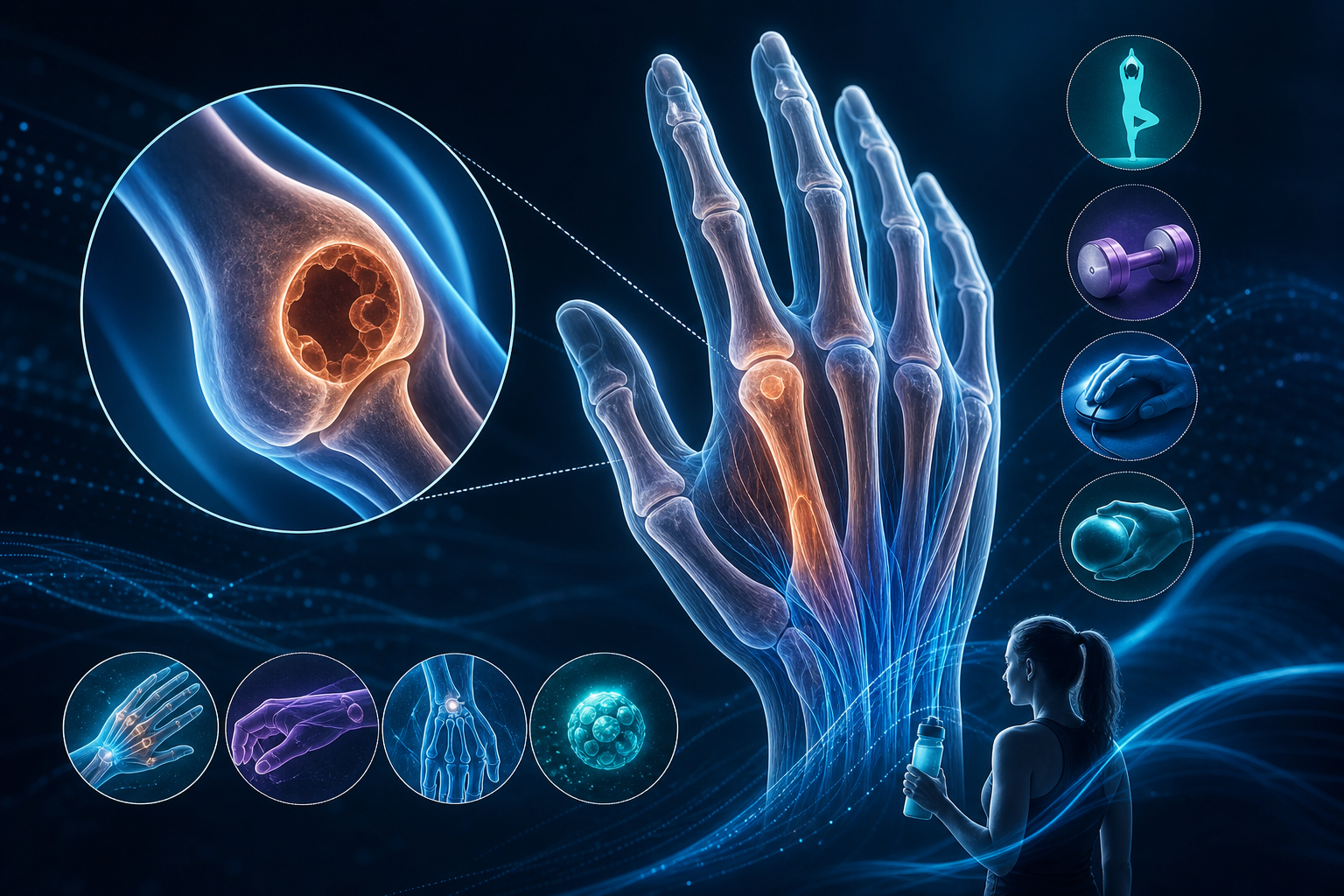
Understanding Bone Cysts in the Hand: Symptoms, Causes, and Treatment starts with one key point: a bone cyst is a fluid-filled or fibrous cavity inside bone, not a surface lump on the skin. In the hand, it may appear in a metacarpal, phalanx, or carpal bone, and care depends on pain, grip strength, X-ray findings, and fracture risk.
Many hand bone cysts cause no symptoms and show up by accident on an X-ray. When symptoms do occur, they usually involve localized aching, swelling, reduced ROM, weaker pinch, or pain with loading activities such as gripping a steering wheel, carrying grocery bags, or pushing up from a chair.
What Is a Bone Cyst in the Hand?
A bone cyst in the hand is an abnormal cavity inside a hand bone that may contain fluid, fibrous tissue, or other non-cancerous material. The cyst forms within the bone rather than in the soft tissue around tendons or skin. This distinction matters because a bone cyst can weaken the structure of the bone even when the hand looks normal from the outside.
The most relevant bones include the metacarpals in the palm, the phalanges in the fingers, and carpal bones such as the scaphoid, lunate, and trapezium. A cyst in a finger phalanx may affect pinch and typing. A cyst near the thumb-side wrist may affect gripping, weight-bearing through the hand, or radial deviation.
Clinical pattern: small hand bone cysts are often incidental, while larger cysts may become symptomatic when they thin the bone cortex or sit near a joint surface.
Common types discussed in hand imaging include unicameral bone cysts, intraosseous ganglion cysts, and cyst-like changes related to joint wear. Your provider may use different terms depending on whether the cavity appears fluid-filled, fibrous, degenerative, or linked to a nearby joint.
- Incidental cyst: found on imaging, no pain, normal grip, normal ROM.
- Symptomatic cyst: causes pain, swelling, tenderness, weakness, or activity limits.
- Higher-risk cyst: large cavity, thin surrounding bone, pain after trauma, or concern for fracture.
If your search is “bone cyst in hand symptoms and treatment,” the practical answer is this: confirm the diagnosis with imaging, measure function, protect the hand if the bone looks weakened, and use hand rehabilitation when pain, stiffness, or weakness affects daily tasks.
Bone Cyst vs. Ganglion Cyst: What Is the Difference?
The main difference between bone cyst and ganglion cyst hand findings is location. A bone cyst sits inside a bone. A ganglion cyst usually sits in soft tissue near a joint capsule or tendon sheath, commonly on the back of the wrist, the palm side of the wrist, or near finger joints.
A ganglion cyst often looks or feels like a lump under the skin. A bone cyst usually does not create a visible lump unless it causes swelling, irritation, or bone expansion. That is why a bone cyst is commonly found after an X-ray for pain, a fall, or unexplained hand swelling.
Feature Bone Cyst in the Hand Ganglion Cyst in the Hand or Wrist Location Inside a metacarpal, phalanx, or carpal bone Soft tissue near a joint capsule or tendon sheath Visible lump Often absent Often present Typical imaging X-ray may show a round or oval cavity inside bone Ultrasound or MRI may show a fluid-filled soft tissue mass Functional concern Possible bone weakening, pain with load, reduced grip Pressure symptoms, tendon irritation, ROM restrictionWhy the distinction changes care
A surface ganglion may change size with activity because joint fluid shifts under pressure. A bone cyst does not behave the same way. It needs assessment of bone integrity, joint involvement, and fracture risk. A provider may compare both hands, test tendon glide, check median nerve and ulnar nerve sensation, and review imaging before recommending activity limits.
Medximity covers conservative spine, extremity, rehabilitation, and wellness topics. For another example of how structure affects symptoms away from the hand, review sciatica treatment and nerve pain patterns.
What Symptoms Do Bone Cysts in the Hand Cause?
A hand bone cyst may cause no symptoms, mild aching, or measurable loss of hand function. “Hand bone cyst no pain is it normal” is a common question, and the answer is yes: painless bone cysts are often found incidentally and monitored when imaging looks stable and function remains normal.
Symptoms become more relevant when pain matches the cyst location. A cyst in the second metacarpal may hurt with index-finger gripping. A cyst in a distal phalanx may hurt with fingertip pressure. A cyst near the scaphoid may hurt with wrist extension, push-ups, or pressing through the palm.
- Localized tenderness: pain when pressing directly over the involved bone.
- Grip weakness: reduced force with a dynamometer or daily tasks.
- Pinch difficulty: trouble with keys, jars, buttons, or writing tools.
- Stiffness: reduced finger flexion, wrist extension, or thumb opposition.
- Swelling: mild fullness around a joint or bone, sometimes after activity.
- Pain after impact: worsening pain after a fall, jammed finger, or direct blow.
Function clue: pain that appears only with load often points to mechanical irritation or bone stress rather than a surface skin problem.
Red flags that need urgent evaluation
Seek urgent care if hand pain follows a fall and you notice deformity, rapid swelling, inability to move a finger, severe tenderness over a bone, blue or pale fingers, fever with spreading redness, or new numbness in the thumb, index, middle, ring, or small finger. These signs may indicate fracture, infection, circulation problems, or nerve compromise and should not be managed with home care alone.
What Causes a Cyst to Form in Hand Bone?
The exact cause depends on cyst type, age, and location. When people search “what causes a cyst to form in hand bone,” the most accurate answer is that several mechanisms can create a cyst-like cavity: developmental bone changes, joint-related fluid pressure, repetitive loading, prior trauma, or degeneration near an articular surface.
Unicameral bone cysts are more common in children and teens, though they are less common in hand bones than in long bones such as the humerus or femur. Intraosseous ganglion cysts are more often described in adults and may occur near joints where pressure, cartilage wear, or microtrauma affects the underlying bone.
- Developmental factors: bone growth patterns may create cystic areas in younger patients.
- Joint mechanics: pressure near a joint may contribute to a cyst-like cavity in a carpal bone.
- Repetitive loading: gripping tools, racquets, weights, or handlebars can irritate sensitive structures.
- Prior trauma: a jammed finger or wrist impact may lead to imaging that reveals a cyst, even if the cyst existed earlier.
- Degenerative change: cartilage thinning near the wrist or finger joints can appear with subchondral cysts.
Bone cysts in children vs. adults
Children need assessment of growth plates, especially near the ends of the phalanges and metacarpals. If a child has bone cyst in hand what to do, start with proper imaging, activity guidance, and follow-up intervals. A provider may monitor growth, compare repeat X-rays after 3 to 6 months, and limit high-impact hand loading if the bone cortex appears thin.
Adults need a different lens. Providers look for joint wear, occupational loading, prior fracture, tendon mechanics, and whether the cyst sits near the cartilage surface. Adults with stable imaging and mild symptoms often start with activity modification and hand therapy before more invasive pathways are discussed.
How Does a Bone Cyst Affect Grip, Motion, and Daily Function?
A bone cyst affects hand function when it changes load tolerance, joint mechanics, or pain signaling during gripping. The phrase “bone cyst in hand affecting grip strength” usually describes pain inhibition: the hand has the muscle capacity to grip, but the nervous system reduces force because loading the involved bone hurts.
Grip depends on coordinated work from the flexor digitorum profundus, flexor digitorum superficialis, thumb muscles, wrist extensors, and intrinsic hand muscles. Wrist position also matters. Grip is strongest when the wrist holds slight extension, often 20 to 35 degrees, because the finger flexors operate at a better length-tension position.
Daily Task Common Limitation Rehab Focus Typical Timeline Opening jars Thumb pinch pain or weak rotational grip Thumb opposition, graded pinch, joint protection 2-4 weeks for improved tolerance Typing or mouse use Finger stiffness or wrist fatigue Ergonomics, tendon gliding, microbreaks 1-3 weeks for reduced irritation Weight-bearing through palm Wrist pain with extension load Modified positions, progressive loading 4-8 weeks depending on imaging Tool or racquet use Impact sensitivity and grip endurance loss Handle modification, grip retraining, pacing 6-12 weeks for graded returnHand rehabilitation should measure progress, not guess. Useful measures include grip dynamometry, pinch testing, wrist ROM, finger total active motion, pain during load, and task-specific tolerance. If grip strength improves but imaging remains unchanged, the cyst may still be present while function improves through better mechanics and load management.
For a broader explanation of how irritated nerves can change strength and function, see Medximity’s overview of trigeminal neuralgia care concepts. The anatomy differs, but the principle is similar: pain signals can alter movement output.
What Should You Expect at Your First Provider Visit?
Your first visit should confirm whether the problem is a bone cyst, a soft tissue cyst, tendon irritation, joint inflammation, fracture, or nerve compression. For hand pain and swelling bone cyst diagnosis, the provider should combine history, physical exam, functional testing, and imaging review rather than relying on one finding.
History and physical exam
The provider should ask when symptoms started, whether pain followed trauma, which tasks aggravate it, and whether the area has changed size. The exam should include palpation over each painful bone, wrist and finger ROM, grip and pinch testing, tendon glide, capillary refill, and sensation testing in the median, ulnar, and radial nerve distributions.
- Location mapping: the provider identifies the exact bone or joint that reproduces symptoms.
- ROM testing: wrist flexion, wrist extension, finger flexion, finger extension, and thumb opposition are measured.
- Strength testing: grip, key pinch, and three-point pinch show functional impact.
- Neurovascular screen: sensation, finger color, temperature, and pulse quality help rule out urgent problems.
- Load testing: modified weight-bearing checks whether the hand tolerates compression safely.
Imaging in plain language
An X-ray may show a well-defined dark area inside bone because the cavity is less dense than normal bone. MRI may clarify fluid content, bone marrow irritation, joint connection, tendon involvement, or nearby soft tissue changes. Repeat imaging after 3 to 6 months may be used when the cyst appears stable and symptoms are mild.
Some patients benefit from working with providers who coordinate conservative musculoskeletal care. You can find a physical therapist near you through Medximity when hand strength, motion, or function needs guided rehabilitation.
Which Conservative Treatment Options Help a Hand Bone Cyst?
Conservative care focuses on symptom control, function, protection, and monitoring. A non-invasive treatment plan for bone cyst in hand symptoms usually includes activity modification, hand therapy, bracing when appropriate, graded strengthening, ergonomic changes, and follow-up imaging if the provider wants to monitor bone stability.
Not every cyst needs active treatment. A painless cyst with normal function may need watchful monitoring only. A painful cyst with reduced grip usually needs a structured plan for 6 to 12 weeks, with changes based on pain response, ROM, and strength testing.
Treatment Option Best Used When Expected Outcome Typical Timeline Watchful monitoring No pain, normal grip, stable X-ray Confirms cyst remains stable while normal activity continues Repeat check often 3-6 months if advised Activity modification Pain with gripping, impact, or weight-bearing Reduces bone stress and flare frequency First improvement often 1-3 weeks Hand or wrist brace Pain with wrist extension, tool use, or repetitive loading Limits irritating motion while tissues settle Usually short blocks of 2-4 weeks Physical therapy or hand rehab Weak grip, stiffness, tendon guarding, task limits Improves ROM, strength, load tolerance, and work capacity Typically 6-8 visits over 4-8 weeks Ergonomic changes Symptoms tied to keyboard, tools, handlebars, or lifting Reduces repeated compression and improves mechanics Changes can help within 1-2 weeksHome exercise protocol: tendon glide plus gentle grip loading
Use this only when your provider has not restricted hand loading and symptoms stay mild during movement.
- Warm the hand for 3 minutes: use warm water or a warm towel, then open and close the hand slowly 10 times.
- Straight hand: hold all fingers straight for 3 seconds.
- Hook fist: bend the middle and end joints while keeping the knuckles straight; hold 3 seconds.
- Full fist: curl all fingers toward the palm without forcing end-range; hold 3 seconds.
- Tabletop position: bend the knuckles to 90 degrees while keeping finger joints straight; hold 3 seconds.
- Gentle towel squeeze: squeeze a folded towel at 30-40% effort for 5 seconds, 8 repetitions.
- Stop rule: stop if pain rises above 3 out of 10, swelling increases, or pain lasts more than 2 hours after exercise.
Perform the sequence once daily for 2 weeks. If symptoms improve, increase the towel squeeze to 10 repetitions and add light functional gripping such as carrying a light bag for 30 to 60 seconds. If symptoms worsen, reduce load and schedule a provider visit.
Medximity also covers conservative care patterns in other regions, including natural care strategies after concussion and vestibular rehabilitation concepts. Different conditions require different exams, but the same rule applies: measure function, progress gradually, and reassess when symptoms do not follow the expected timeline.
What Is the Long-Term Outlook Without an Operation?
The long-term outlook depends on cyst size, location, bone strength, symptoms, and whether the cyst changes over time. If you ask “how long does a hand bone cyst take to heal,” the answer is that symptoms may improve in weeks, but the imaging appearance may remain visible for months or longer.
A hand bone cyst that causes pain from overload may feel better after 2 to 6 weeks of protection and activity modification. Stiffness and weakness often need 4 to 8 weeks of hand rehabilitation. Higher-demand tasks such as racquet sports, climbing, weight training, manual labor, or repetitive tool use may require 8 to 12 weeks of graded return.
- Good prognosis: small cyst, no fracture, stable imaging, normal or improving grip.
- Needs closer monitoring: increasing pain, large cyst, thin bone cortex, pain after impact.
- Rehab priority: restore tendon glide, joint ROM, thumb mechanics, and grip endurance.
- Activity priority: avoid repeated high-load compression until symptoms and provider guidance allow progression.
Can a bone cyst in the hand come back without an operation?
A cyst may persist, enlarge, shrink, or remain stable depending on its type. Some cyst-like changes do not fully disappear on imaging even after symptoms improve. Recurrence language can be misleading because a cyst that never fully resolved is not the same as a new cyst. Follow-up imaging helps separate stable findings from progressive change.
Practical benchmark: function matters. If grip strength, ROM, pain with load, and daily task tolerance improve over 6-12 weeks, conservative care is often working even if the cyst remains visible on imaging.
Protective strategies reduce repeated irritation. Use larger tool handles, padded gloves for vibration, two-hand lifting for heavy objects, neutral wrist positions during typing, and push-up handles or fists instead of flat-palm loading when wrist extension provokes pain. For gym training, start with isometric holds and light farmer carries before returning to heavy gripping.
What to Do Next
Schedule an evaluation if hand pain lasts more than 7 to 10 days, swelling persists, grip strength drops, a cyst was found on imaging, or daily tasks provoke repeat symptoms. Search terms such as “bone cyst in hand near me specialist” usually point to providers with hand, wrist, orthopedic rehab, chiropractic extremity, or physical therapy experience.
Start with routine care when symptoms are mild, stable, and not linked to trauma. Seek urgent care for deformity, severe pain after a fall, rapid swelling, fever with spreading redness, blue or pale fingers, or new numbness or weakness. Those findings need same-day assessment.
At the first visit, expect a provider to review your symptoms, inspect the hand, test ROM, measure grip and pinch, screen nerve and circulation status, and review X-ray or MRI findings if available. If conservative care fits your presentation, your plan may include temporary activity limits, a brace, a home program, and 6 to 8 hand therapy sessions over 4 to 8 weeks.
- See a physical therapist or hand rehabilitation provider for stiffness, weakness, grip loss, or return-to-work planning.
- See a chiropractic provider with extremity experience for wrist, hand, elbow, and upper-quarter mechanics that may affect loading.
- Use follow-up imaging when your provider wants to confirm that the cyst is stable.
- Track function weekly using grip tolerance, pain after activity, swelling, and task performance.
You can find a chiropractor near you, browse providers, or explore more health topics on Medximity.
FAQ
Is a painless bone cyst in the hand normal?
A painless hand bone cyst can be normal as an incidental imaging finding. Monitoring is commonly used when grip, ROM, and bone stability are normal.
Can physical therapy help a bone cyst in the hand?
Physical therapy can help the symptoms and functional limits associated with a bone cyst. PT does not “erase” the cyst, but it can improve ROM, grip strength, tendon glide, joint protection, and safe return to activity.
How long does recovery take?
Mild symptoms often improve in 2 to 6 weeks with protection and activity changes. Weakness, stiffness, and return to heavier gripping commonly take 6 to 12 weeks of graded rehabilitation.
What activities should I avoid while monitoring a hand bone cyst?
Avoid painful heavy gripping, repeated impact, prolonged vibration tools, flat-palm weight-bearing, and high-force twisting until a provider confirms the bone can tolerate those loads.
When should a child with a hand bone cyst be evaluated?
A child should be evaluated when a cyst is seen on imaging, pain persists, swelling appears, grip changes, or symptoms follow trauma. Children need growth plate assessment and follow-up guidance based on bone maturity.