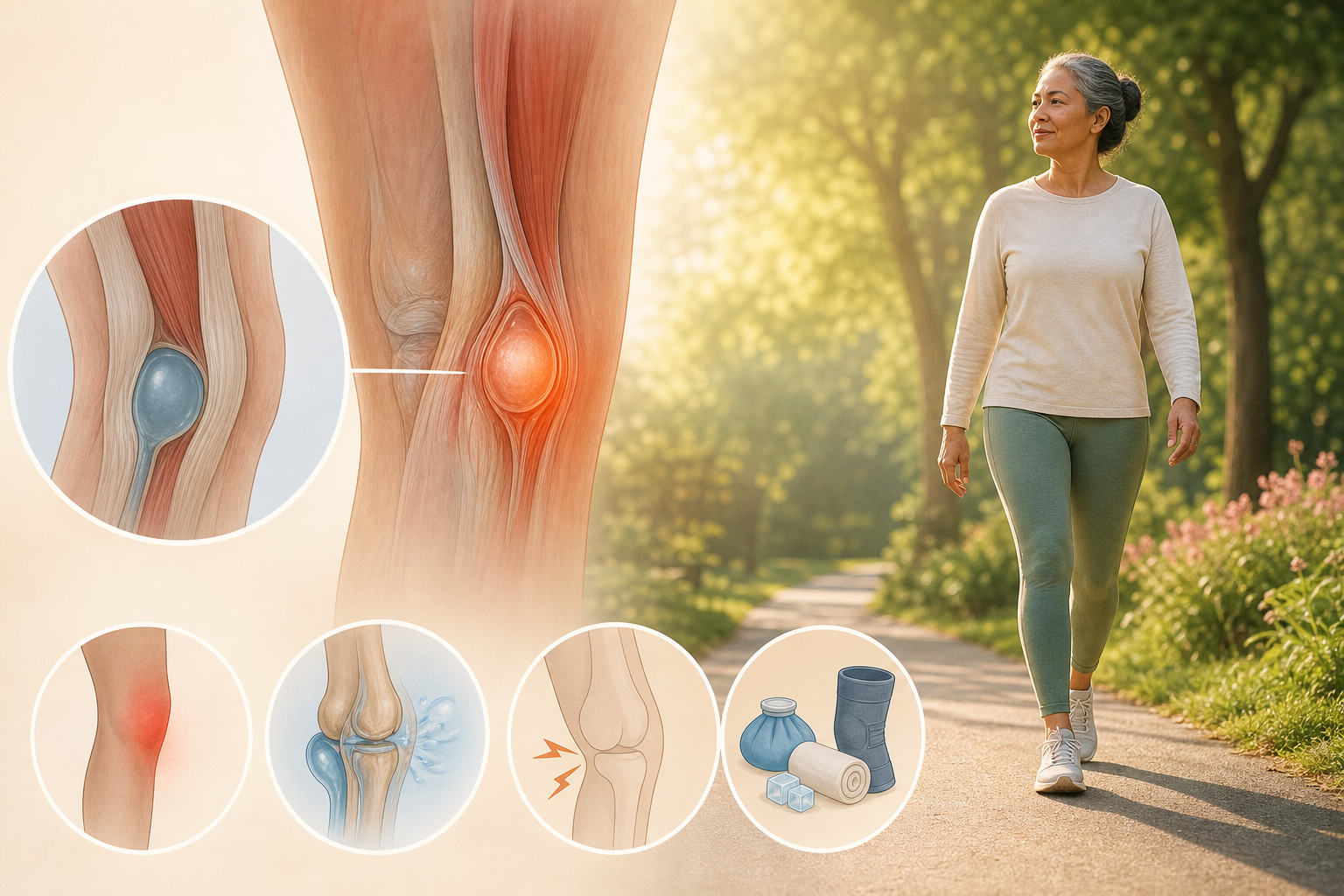
Understanding Baker's Cyst: Symptoms, Causes, and Treatment starts with one key fact: a Baker's cyst is usually a sign that your knee joint is irritated, not a problem that appears on its own. The swelling forms at the back of the knee when extra joint fluid pushes into the popliteal bursa, creating a soft lump that often feels tighter when you bend or straighten the leg.
Most cases improve with conservative care that reduces knee irritation, improves joint mechanics, and helps you avoid repeated flare-ups. The right plan depends on the source of the swelling, how limited your ROM is, and whether your symptoms match a simple cyst or something more urgent.
What Is a Baker's Cyst?
A Baker's cyst, also called a popliteal cyst, is a pocket of joint fluid that collects behind the knee. It usually develops between the semimembranosus tendon and the medial head of the gastrocnemius, where fluid can bulge backward when the knee joint becomes irritated.
If you are asking what is a baker's cyst, the simplest answer is this: it is a fluid-filled swelling caused by pressure inside the knee joint. That pressure often rises when structures such as the meniscus, joint lining, or cartilage are irritated.
Why it forms
The knee makes synovial fluid to lubricate movement. When the joint is inflamed or overloaded, it can produce excess fluid. Instead of staying evenly distributed inside the capsule, that fluid may track into the back of the knee and form a cyst.
- It is often linked to knee overuse, arthritis, meniscus irritation, or poor joint mechanics.
- It may feel small and painless at first, then become more noticeable with squatting, kneeling, stairs, or long walks.
- It can change size from day to day depending on activity level and swelling inside the joint.
Clinical reviews commonly describe Baker's cysts as secondary findings, meaning the cyst often reflects an underlying knee problem rather than serving as the main diagnosis.
That distinction matters. Treating the swelling without addressing the knee irritation often leads to recurrence. If your symptoms also include hip, back, or leg pain, articles such as Sciatica Treatment – Understanding the Pain can help you compare patterns that do and do not come from the knee.
What are the common symptoms of Baker's cyst behind the knee?
The most common symptoms of baker's cyst behind knee are fullness, tightness, and swelling in the crease behind the joint. You may also notice pain behind knee when bending leg, especially with deep knee flexion, fast walking, or prolonged standing.
Typical symptoms
- A soft or firm lump at the back of the knee
- Tightness when fully bending or straightening the leg
- Pressure that worsens after activity
- Stiffness in the knee joint, especially in the morning or after sitting
- Mild calf discomfort if the cyst is large
Some people have swelling with very little pain. Others have pain with stairs, lunges, or getting up from a chair because the underlying knee problem is more active than the cyst itself.
Symptom What it often means Typical pattern Fullness behind knee Fluid collecting in popliteal space More noticeable with standing or extension Pain with bending Compression of swollen tissue Worse with squats, kneeling, stairs Stiff knee ROM Joint irritation or effusion inside knee Often worse after activity or after sitting Calf tightness Large cyst or fluid tracking downward Needs closer evaluation if sudden or severeA small cyst may settle within 2 to 6 weeks if the knee irritation calms down. A larger or recurrent cyst can last several months if the joint keeps producing excess fluid.
What causes a Baker's cyst?
If you want to know what causes a baker's cyst, the answer is usually excess knee joint fluid triggered by irritation inside the joint. The cyst is the result, not the starting point.
Several structures can drive that fluid buildup. Common contributors include irritation of the medial meniscus, cartilage wear under the patella, inflammation in the synovial lining, and repetitive overload through the tibiofemoral joint.
Common causes and flare triggers
- Meniscus irritation: Twisting, pivoting, or deep squatting can irritate the meniscus and increase joint fluid.
- Arthritic change: Degenerative wear can create chronic low-grade swelling.
- Overuse: Repeated stair climbing, kneeling, running hills, or prolonged standing can flare symptoms.
- Poor mechanics: Weak quadriceps, weak gluteus medius, and reduced ankle mobility can change knee loading.
- Previous knee injury: Even an old strain can leave the joint more prone to swelling.
The flare pattern is useful. If your lump gets bigger after loaded knee flexion and shrinks with rest, the knee is likely producing fluid in response to mechanical stress. That is why baker's cyst treatment without surgery usually focuses on controlling the source of irritation instead of only chasing the swelling.
For related conservative care models, Medication Free Treatment for Tension Headaches and Vestibular Disorders Treatment show the same principle: identify the driver, reduce stress on the irritated tissue, then rebuild function.
Baker's cyst vs. other causes of knee swelling
Baker's cyst vs blood clot is one of the most important comparisons because both can create calf discomfort, but they are not managed the same way. A Baker's cyst usually causes fullness behind the knee that changes with movement. A blood clot can cause sudden calf pain, warmth, redness, and swelling that does not behave like a simple mechanical flare.
Condition Common location Typical signs Action Baker's cyst Back of knee Visible or felt lump, tightness with bending, activity-related swelling Schedule routine evaluation Calf muscle strain Gastrocnemius or soleus Pain after push-off, tenderness in muscle belly, worse with heel raise Prompt sports or rehab assessment Blood clot concern Calf or lower leg Sudden swelling, warmth, redness, constant pain Urgent medical assessment General knee effusion Around entire knee Diffuse swelling, stiffness, less distinct lump behind knee Routine evaluation- Seek urgent care if calf pain is sudden, significant, warm, red, or associated with shortness of breath.
- Seek urgent care if you cannot bear weight after injury.
- Seek routine musculoskeletal care for swelling that builds with activity and improves with rest.
This is the red-flag section to take seriously. A painful swollen calf is not something to self-diagnose.
How is a Baker's cyst diagnosed?
How is a baker's cyst diagnosed depends first on the history and physical exam. A provider starts by checking where the swelling sits, whether it changes with knee motion, how your ROM compares side to side, and whether the knee joint itself is also swollen or tender.
What to expect during the evaluation
- Questions about onset, activity triggers, and whether swelling changes during the day
- Observation of standing posture, walking, and squat mechanics
- Palpation of the popliteal area, joint line, patella, and calf
- ROM testing for flexion and extension
- Strength testing for quadriceps, hamstrings, gluteus medius, and calf
- Orthopedic tests to screen for meniscus irritation or ligament involvement
If the exam suggests a straightforward mechanical problem, conservative providers often begin with activity modification and rehab. If the presentation is atypical, severe, or includes red flags, imaging or referral may be recommended.
In many outpatient settings, the physical exam gives the main clinical direction: the goal is to identify the driver of excess knee fluid, not just to confirm that a lump exists.
Expect your first visit to last 30 to 60 minutes. A mild case may improve in 2 to 4 weeks of modified loading and exercise therapy. If the knee has persistent meniscal or arthritic irritation, progress may take 6 to 12 weeks.
What conservative treatment options help a Baker's cyst?
Natural treatment for baker's cyst starts by reducing stress inside the knee joint. The best conservative plan usually combines load modification, mobility work, strengthening, and treatment aimed at the structures that are creating excess fluid.
Treatment Goal Expected outcome Typical timeline Activity modification Reduce joint irritation Less swelling and pressure behind knee 1-2 weeks Physical therapy exercise Improve mechanics and strength Better ROM, less recurrence 4-8 weeks Manual therapy / soft tissue work Improve mobility of knee, calf, hamstrings Reduced stiffness with movement 2-6 visits Chiropractic or rehab-based joint care Address lower-extremity mechanics Improved loading through knee and ankle Varies by irritability Home exercise program Control symptoms between visits Faster functional improvement Daily for several weeksSimple home routine
- Heel slides: Lie on your back, slide the heel toward the hips until you feel mild tightness, then return. Do 10 reps, 1 to 2 times daily.
- Quad sets: Straighten the knee, tighten the front thigh, hold 5 seconds. Do 10 to 15 reps.
- Calf stretch: Stand facing a wall, keep the back knee straight and heel down, hold 30 seconds. Repeat 3 times.
- Bridge: Lie on your back with knees bent, lift hips, hold 3 seconds, lower slowly. Do 8 to 12 reps.
- Short-arc knee extension: Place a rolled towel under the knee and straighten from that position, 10 reps.
Keep movements in a low-irritation range. If a drill sharply increases swelling behind the knee later that day, reduce depth, reps, or load.
Patients who respond well to guided conservative care often do best with 6 to 8 sessions over 3 to 6 weeks, plus a daily home program.
Why does the underlying knee problem matter?
The underlying knee problem matters because a Baker's cyst often comes back if the joint keeps making excess fluid. You can calm the lump temporarily, but recurrence is common when the meniscus, cartilage, or movement pattern remains irritated.
That is why providers look beyond the visible swelling. Weakness in the quadriceps, poor control at the hip abductors, limited ankle dorsiflexion, and stiff hamstrings can all increase compressive load through the knee.
- If stairs flare your knee, you may need quadriceps and glute strengthening.
- If squats flare your knee, you may need depth modification and ankle mobility work.
- If walking distance causes swelling, your provider may adjust stride, footwear, and pacing.
Recurrence rates are hard to predict because they depend more on the driver than the cyst size. A small cyst with ongoing meniscus irritation can persist for months. A moderate cyst with corrected mechanics may settle much faster.
This same treat-the-source logic shows up across conservative care. See Treating Post-Concussion Syndrome By Natural Means and Vertigo Solution with Chiropractic treatment for examples of symptom relief tied to correcting the underlying mechanical issue.
When should you see a provider for knee swelling treatment near me?
You should seek knee swelling treatment near me when swelling lasts more than 1 to 2 weeks, keeps returning, limits knee flexion, or interferes with walking, stairs, exercise, or sleep position. Routine evaluation is also smart if you keep noticing a lump behind the knee after activity.
- Book a routine visit for repeated swelling, stiffness, or pain behind the knee when bending.
- Book sooner if you have reduced ROM, limping, or a recent knee twist.
- Seek urgent assessment for sudden calf swelling, warmth, redness, severe pain, or trouble breathing.
The best provider for baker's cyst depends on the pattern. A physical therapist, chiropractor with musculoskeletal rehab training, or rehabilitation provider can assess movement, load tolerance, joint mechanics, and soft tissue restrictions. If the presentation is not typical, they can help direct next steps.
You can find a physical therapist near you, find a chiropractor near you, or browse providers on Medximity.
What to Do Next
If you have a lump or tight swelling behind the knee, start by reducing aggravating movements for several days. Cut back on deep squats, kneeling, repetitive stairs, and long walks that increase pressure behind the knee. Keep the joint moving with gentle heel slides, quad sets, and calf stretching unless those motions clearly increase swelling.
Schedule a conservative musculoskeletal evaluation if the swelling persists, recurs, or limits your ROM. Your first visit usually includes a movement exam, strength testing, knee palpation, and a plan for activity modification plus home exercise. Expect the provider to check the knee, calf, hamstrings, ankle motion, and hip control rather than focusing only on the lump.
- Choose a chiropractor or rehab provider if you want assessment of joint mechanics, lower-extremity loading, and hands-on care.
- Choose a physical therapist if your main goal is exercise progression, mobility restoration, and strength rebuilding.
- Choose urgent medical assessment for sudden hot swollen calf, rapid swelling, inability to bear weight, or breathing symptoms.
To move forward, find a rehabilitation provider near you or explore more health topics on Medximity.
Frequently Asked Questions About Baker's Cyst
How long does a Baker's cyst last?
How long does a baker's cyst last depends on what is driving the extra joint fluid. Mild cases sometimes improve in 2 to 6 weeks with load reduction and exercise. Recurrent cases tied to chronic knee irritation can last for months.
Is it normal for knee swelling behind knee?
Is it normal for knee swelling behind knee is common to ask, but swelling is still a sign that the knee needs attention. Activity-related fullness behind the knee may fit a Baker's cyst, but persistent or unexplained swelling should be evaluated to rule out other causes.
What makes a Baker's cyst flare up?
Deep knee bending, repetitive stair climbing, kneeling, twisting, and long periods on your feet commonly increase joint fluid and make the cyst feel larger. Weak quadriceps and poor hip control can also raise knee load and trigger symptoms.
Can exercise help?
Yes, if the exercise reduces joint stress instead of increasing it. Gentle ROM work, quadriceps activation, glute strengthening, and calf mobility often help. High-load flexion, aggressive lunges, or painful squats usually need to be limited early on.
What is the best provider for Baker's cyst?
The best provider for baker's cyst is usually the one who can identify the source of knee irritation and guide conservative care. That often includes a physical therapist, chiropractor, or rehabilitation provider experienced with knee mechanics and exercise-based recovery.
Can a Baker's cyst cause calf pain?
Yes. A larger cyst can create pressure that feels like calf tightness or fullness. Sudden severe calf pain, heat, redness, or marked swelling needs prompt medical assessment because that pattern does not always behave like a simple cyst.


