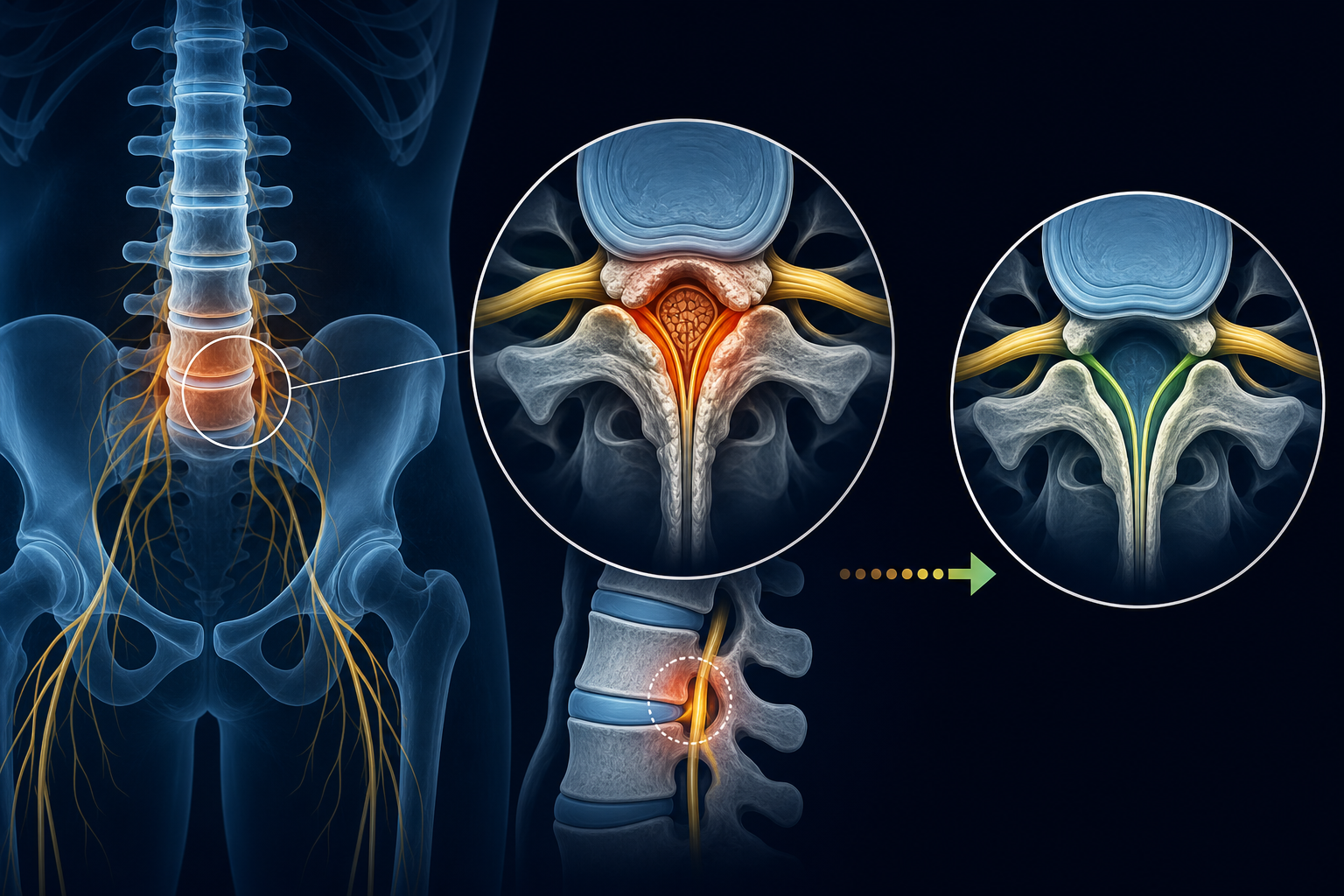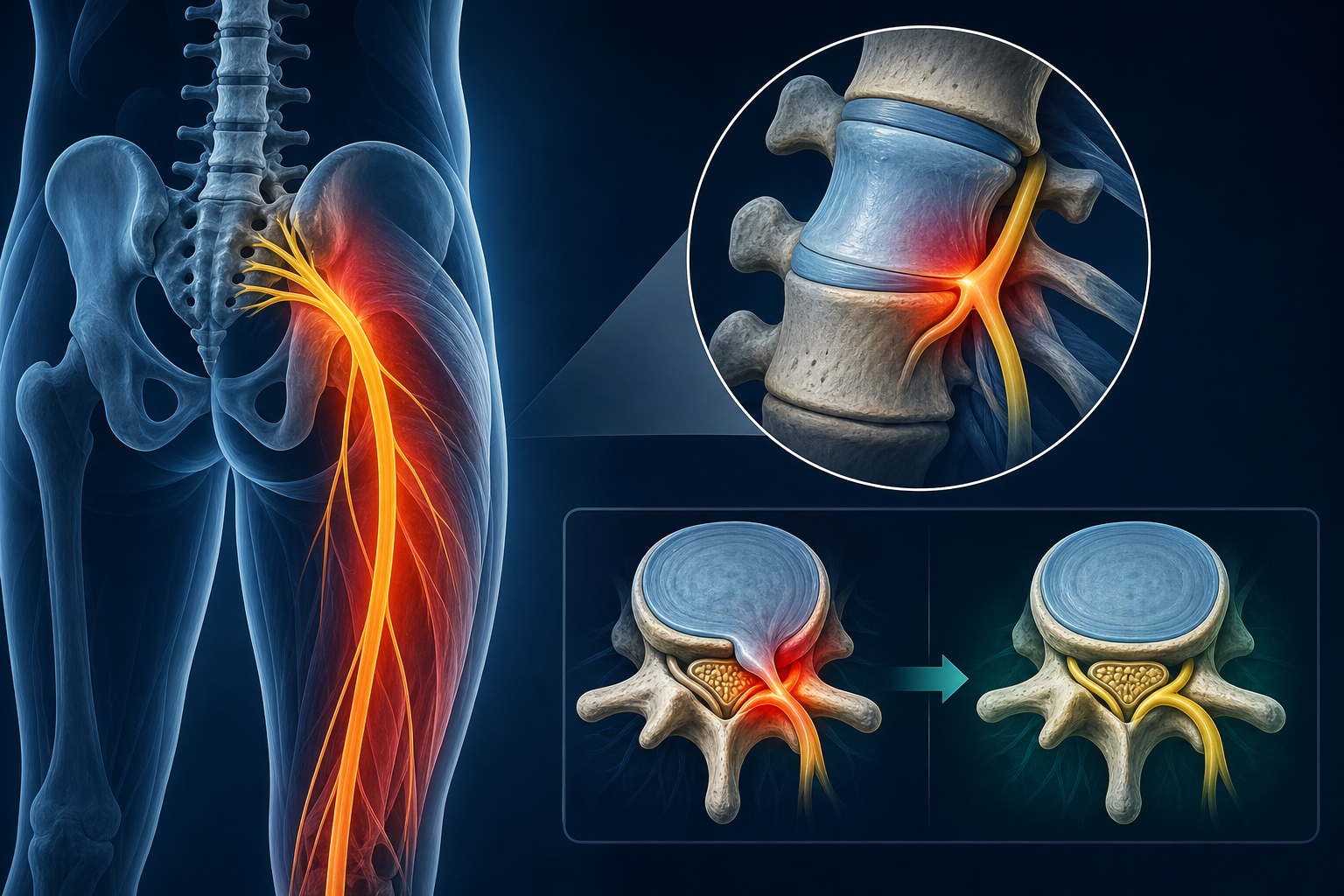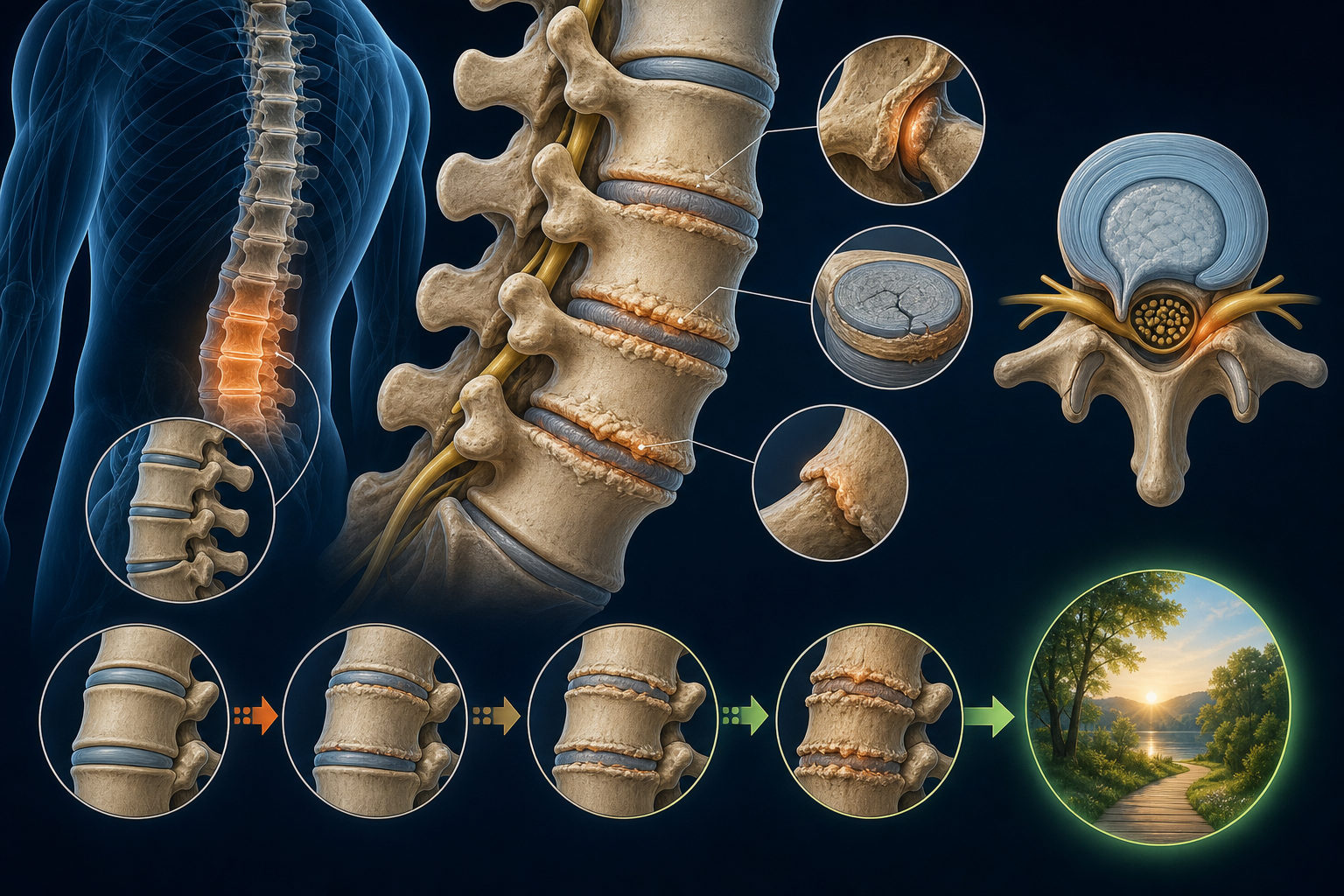
Chiropractor for sciatica near me searches should lead you to a local provider who can evaluate whether your leg symptoms are coming from the sciatic nerve, the low back, the hip, or another structure. The right chiropractor will check your lumbar ROM, leg strength, reflexes, nerve tension, posture, and daily movement patterns before starting care.
Sciatica is not just “back pain.” It usually means nerve irritation involving the L4, L5, or S1 nerve roots, often producing pain, tingling, numbness, or weakness that travels from the low back or buttock into the thigh, calf, or foot.
Find a Chiropractor for Sciatica Near Me
A good local sciatica provider should be close enough for consistent visits and specific enough in their services to treat low back and leg symptoms conservatively. Most uncomplicated sciatic-type symptoms improve over 4-8 weeks with the right mix of spinal care, mobility work, nerve-friendly exercise, and activity changes.
Use Medximity to find a chiropractor near you and compare providers by location, services, appointment access, ratings, and profile details. For sciatica, do not rely on star ratings alone. Look for clear experience with low back pain, radiating leg symptoms, disc-related irritation, posture coaching, rehabilitative exercise, and return-to-work or return-to-sport planning.
Local access matters because sciatica care often requires a short block of visits, not a single appointment. A common starting plan is 2 visits per week for 2-3 weeks, followed by reassessment. If symptoms are improving, care may shift toward strengthening and self-management. If symptoms are not changing, the provider should adjust the plan or recommend further medical evaluation.
- Distance: choose a practice you can reach without flaring symptoms from long drives.
- Scheduling: look for early, late, or same-week appointments if sitting and walking are limited.
- Services: prioritize providers offering spinal manipulation, soft tissue work, mobility drills, and exercise rehab.
- Insurance and pricing: check verified insurance details or call before booking.
- Reviews: scan for themes about communication, follow-up, scheduling, and treatment explanation.
For a broader provider-selection checklist, use Medximity’s guide to finding the right chiropractor for you before scheduling.
What Does Sciatica Feel Like?
Sciatica typically feels like pain, tingling, numbness, burning, or electric-like discomfort traveling from the low back or buttock into one leg. The path often follows the sciatic nerve, which runs from the lower spine through the buttock, behind the thigh, and into branches that reach the calf and foot.
The exact pattern can give useful clues. L5 nerve root irritation may affect the outside of the leg and top of the foot. S1 nerve root irritation may affect the back of the calf, heel, or outside of the foot. The piriformis muscle, lumbar discs, sacroiliac joint, and facet joints can all contribute to symptoms that look or feel similar.
Research on low back pain with leg symptoms commonly shows that many cases improve within 6-12 weeks, but persistent numbness, worsening weakness, or loss of bladder or bowel control requires urgent evaluation.
Common sciatica patterns include:
- Lower back pain going down leg: often linked to lumbar nerve root irritation or referred pain from the low back.
- Sharp leg pain when sitting: may occur when sitting increases pressure around irritated lumbar discs or tensions the sciatic nerve.
- Buttock pain with tingling: may involve the piriformis, deep hip rotators, or nerve sensitivity.
- Calf or foot numbness: may suggest nerve involvement rather than a simple muscle strain.
- Leg weakness: needs careful strength testing, especially ankle raise, toe raise, and big-toe extension.
For a deeper patient guide, read Sciatica Treatment – Understanding the Pain.
Is It Sciatica, Lower Back Pain, or Referred Leg Discomfort?
True sciatica involves nerve irritation, while referred leg discomfort can come from muscles, joints, ligaments, or discs without clear nerve compression. The difference matters because nerve symptoms require more precise testing and a more cautious progression of stretching and strengthening.
Low back pain alone usually stays near the lumbar spine, beltline, or sacroiliac region. Referred pain may travel into the buttock or thigh but often does not create numbness, tingling, reflex changes, or measurable weakness. Sciatic-type pain can travel below the knee into the calf, ankle, or foot.
Quick symptom comparison
Symptom Pattern Common Source Typical Clue Care Focus Low back stiffness only Lumbar joints, paraspinal muscles, facet joints Worse after bending, lifting, or prolonged sitting Spinal mobility, posture change, core control Buttock and thigh ache SI joint, gluteal muscles, piriformis Usually above the knee, often sore with stairs or standing Hip mobility, soft tissue work, glute strength Pain below the knee with tingling L4, L5, or S1 nerve root irritation May worsen with sitting, coughing, or forward bending Nerve assessment, directional exercise, graded rehabMuscle knots in the gluteals, quadratus lumborum, or hamstrings can mimic nerve pain. Medximity’s guide on how chiropractors treat muscle knots explains why soft tissue pain can refer into nearby areas without being the same as sciatica.
A practical rule: symptoms below the knee, numbness, tingling, or weakness deserve a provider evaluation. Pain that centralizes from the leg toward the back during movement testing is often a better sign than pain spreading farther down the leg.
How Do Chiropractors Check for Sciatica?
Chiropractors check for sciatica by combining history, orthopedic testing, neurological screening, movement assessment, and response to repeated motions. The goal is to identify whether your symptoms behave like nerve irritation, joint restriction, muscle referral, or another condition that needs additional evaluation.
What the evaluation usually includes
- History: onset, pain location, leg symptoms, sitting tolerance, walking tolerance, sleep position, work demands, and prior episodes.
- ROM testing: lumbar flexion, extension, side-bending, hip rotation, and hamstring length.
- Neurological screen: reflexes, light-touch sensation, heel walk, toe walk, and big-toe extension strength.
- Nerve tension tests: straight leg raise, seated slump test, and crossed straight leg raise when appropriate.
- Joint and soft tissue exam: lumbar segments, SI joint motion, piriformis tone, glute medius strength, and hip mobility.
Patients searching “how chiropractors check for sciatica” should expect more than a quick back check. A careful provider will compare the right and left legs, test symptoms in more than one position, and document whether symptoms move up or down the leg during the exam.
A neurological screen is especially useful when leg pain includes numbness, foot symptoms, or weakness, because pain level alone does not show how well a nerve is functioning.
X-ray or MRI is not required for every case. Imaging may be considered when symptoms follow a significant injury, do not improve with appropriate care, or include red flags such as progressive weakness, fever, unexplained weight loss, or bladder or bowel changes. If symptoms started after a vehicle crash or rapid impact, review Medximity’s guide to finding a whiplash trauma specialist near you, since spine trauma often needs a more detailed assessment.
What Conservative Chiropractic Care Options Help Sciatic Nerve Pain?
Conservative chiropractic care for sciatic nerve pain usually combines spinal manipulation, flexion-distraction or decompression-style positioning, soft tissue therapy, nerve mobility drills, ergonomic changes, and progressive exercise. The exact plan depends on whether flexion, extension, sitting, walking, or lifting changes your symptoms.
Chiropractic treatment for sciatic nerve pain should not be one-size-fits-all. If bending forward sends pain farther down the leg, repeated flexion may not be the right starting point. If gentle extension centralizes symptoms from the calf toward the buttock or low back, a McKenzie-style extension progression may be used. If extension worsens symptoms, hip mobility, unloading positions, and neutral-spine stabilization may come first.
Common conservative care options and timelines
Treatment Option What It Targets Expected Outcome Typical Timeline Spinal manipulation or mobilization Lumbar and SI joint motion Less stiffness, improved movement tolerance Often reassessed after 2-4 visits Flexion-distraction positioning Low back sensitivity and disc-related loading Reduced leg irritation during early care Typically 2-3 sessions per week for 2-3 weeks Nerve glides Sciatic nerve mobility Improved sitting and walking tolerance Daily home work for 2-4 weeks Hip and glute strengthening Glute medius, glute maximus, deep hip rotators Better pelvic control and load tolerance 4-8 weeks for measurable strength gains Posture and lifting coaching Daily triggers Fewer flare-ups with sitting, bending, and work tasks Immediate changes, refined over 2-6 visitsPhysical therapy may be useful when weakness, balance, gait, or return-to-sport goals require more structured rehab. You can also find a physical therapy provider near you if your care plan needs exercise progression, gait retraining, or work conditioning.
Home sciatic nerve glide: step-by-step
This drill should feel like mild tension, not sharp pain. Stop if symptoms travel farther down the leg or numbness increases.
- Sit tall on the edge of a firm chair with both feet flat.
- Slowly straighten the affected knee until you feel light tension behind the thigh or calf.
- At the same time, look slightly upward to reduce nerve tension.
- Lower the foot back down while gently tucking the chin.
- Repeat 10 times, 1-2 sets daily, staying below a 3 out of 10 symptom level.
Natural treatment for sciatica pain works best when self-care matches the exam findings. Random stretching can aggravate symptoms if the sciatic nerve is already sensitive.
What Should You Expect at Your First Visit?
Your first chiropractic visit for sciatica should include a focused consultation, physical exam, working diagnosis, care plan, and clear explanation of what to do between visits. You should leave knowing which movements to avoid temporarily, which exercises to start, and what signs require follow-up.
The provider may ask when symptoms started, whether pain travels below the knee, what positions worsen symptoms, and whether coughing, sneezing, or sitting changes leg pain. They may test hip ROM, lumbar ROM, reflexes, strength, and nerve tension. If your exam suggests symptoms are not appropriate for conservative chiropractic care, the provider should explain the next referral step.
Typical first-visit flow
- Intake: symptom map, health history, activity limits, work demands, and prior imaging if available.
- Exam: lumbar, hip, pelvic, neurological, and functional movement checks.
- Report of findings: likely pain generator, contributing factors, and care goals.
- Initial care: may include gentle spinal mobilization, soft tissue work, positioning, or home exercise instruction.
- Plan: visit frequency, expected milestones, and reassessment date.
Mild post-treatment soreness can occur for 24-48 hours, but spreading numbness, new weakness, or loss of bladder or bowel control is not a normal response.
A reasonable early goal is improved walking or sitting tolerance within 2-3 weeks. A larger recovery window is often 6-12 weeks, depending on symptom duration, nerve sensitivity, job demands, sleep, and whether symptoms are centralizing. If pain has been present for more than 3 months, progress may still occur, but strength and endurance work usually become more important.
How Do You Compare Nearby Chiropractors for Sciatica Care?
The best chiropractor for sciatic pain near me is the provider who evaluates nerve signs carefully, explains the care plan clearly, and offers services that match your symptom pattern. Proximity matters, but clinical fit matters more.
Medximity provider pages are designed to help you compare local options without opening ten tabs. When available, review provider details such as services, distance, appointment options, accepted coverage information, ratings, review count, and practice focus. Review themes are more useful than isolated comments. Look for patterns about clear explanations, scheduling access, follow-up, staff communication, and low back or leg pain care.
Questions to ask before scheduling
- Do you evaluate leg numbness, tingling, reflexes, and strength before treatment?
- Do you treat sciatica with exercise rehab in addition to spinal care?
- How many visits are usually needed before reassessment?
- Do you provide home exercises in writing or through a patient portal?
- What symptoms would make you refer out for urgent evaluation?
- Do you coordinate with physical therapy or rehabilitation providers when needed?
- Can you verify coverage or provide self-pay pricing before the first visit?
These questions to ask chiropractor about sciatica help you avoid vague care plans. A provider should be able to explain what they are testing, why they recommend a treatment, and how progress will be measured.
If you want to compare provider options beyond one specialty, you can browse providers across chiropractic, rehabilitation, physical therapy, and wellness categories. For more condition guides and practical patient education, explore more health topics on Medximity.
Frequently Asked Questions About Chiropractic Care for Sciatica
Can a chiropractor help sciatica? A chiropractor may help sciatic-type symptoms when they are related to lumbar joint restriction, disc irritation, nerve sensitivity, pelvic mechanics, or muscle guarding. Care should start with an exam that checks nerve function, not just back stiffness.
What does a chiropractor do for sciatica? A chiropractor may use spinal manipulation, mobilization, flexion-distraction, soft tissue work, nerve glides, posture coaching, and rehab exercises. The plan should change if symptoms spread farther down the leg or strength declines.
Chiropractor vs physical therapy for sciatica: which is better? Chiropractic care often focuses on spinal and pelvic mechanics plus symptom relief, while physical therapy often emphasizes progressive exercise, gait, balance, and strength. Many patients benefit from both when care is coordinated around the same exam findings.
How long does sciatica last? Many acute cases improve within 4-8 weeks, while more persistent cases may take 8-12 weeks or longer. Symptoms lasting more than 2-3 weeks, worsening leg pain, numbness, or weakness should be evaluated.
Is it normal for sciatica to worsen before it improves? Mild soreness after treatment or exercise can happen, but worsening leg pain, spreading numbness, foot drop, or new weakness is not a normal goal. Contact a qualified provider promptly if symptoms move farther down the leg or daily function declines.
What to Do Next
Schedule an evaluation if lower back pain travels into the buttock, thigh, calf, or foot for more than a few days, especially if sitting, bending, coughing, or walking changes the symptoms. Choose a chiropractor, physical therapy provider, or rehabilitation provider who can test nerve function and give you a written plan.
Seek urgent care now if you have loss of bladder or bowel control, numbness in the saddle area, progressive leg weakness, fever with severe back pain, or major trauma such as a fall or crash. These red flags need immediate medical evaluation before routine chiropractic or rehab care.
Book routine care when symptoms are stable but persistent, pain keeps returning, sitting tolerance is limited, or you notice tingling that does not resolve with position changes. At the first visit, expect a history, lumbar and hip exam, nerve screen, movement testing, and a plan that explains visit frequency, home care, and reassessment timing.
- For sciatic-type leg pain: start with a chiropractor experienced in low back and radiating leg symptoms.
- For weakness, balance changes, or deconditioning: consider physical therapy or rehabilitation support.
- For work-related sitting or lifting triggers: ask for ergonomic coaching and graded return-to-activity planning.
- For recurring episodes: request a prevention plan focused on hip strength, core endurance, and movement habits.
Use Medximity to find a chiropractor for sciatica near you, compare local providers, and schedule with a practice that gives you clear answers before care begins.