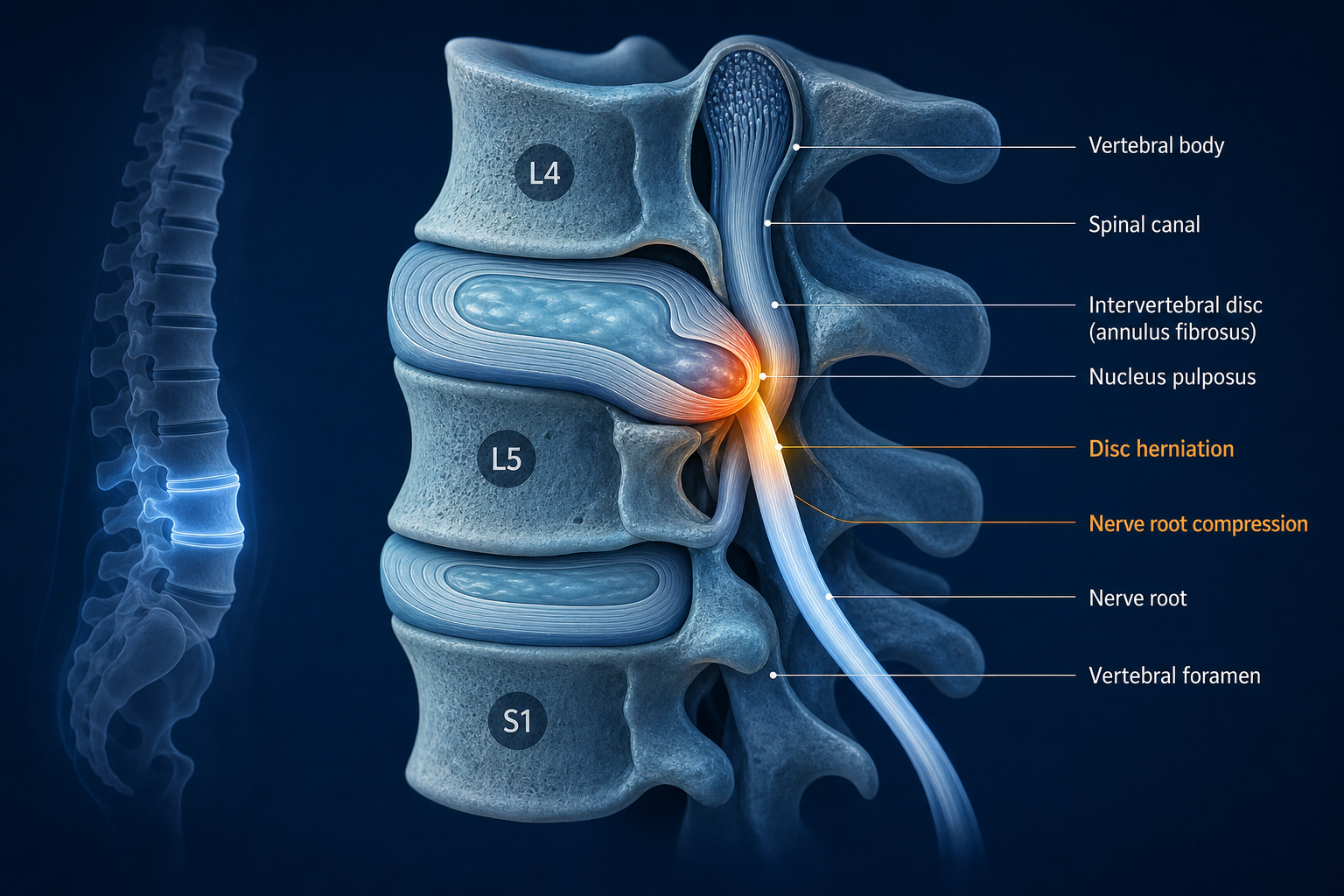
Lower back pain that radiates down your leg, numbness in your foot, or a sharp ache that flares every time you sit at a desk — these are the kinds of symptoms that bring millions of people to chiropractors, physical therapists, and spine specialists every year. In many cases, the source turns out to be a lumbar disc disorder. Understanding what that means, and what your options are, is the first step toward getting the right care.
What Is a Lumbar Disc Disorder?
Your lumbar spine — the five vertebrae of your lower back, labeled L1 through L5 — is supported and cushioned by intervertebral discs. Each disc acts like a shock absorber: a tough, fibrous outer ring called the annulus fibrosus surrounds a soft, gel-like inner core called the nucleus pulposus. These discs allow your spine to flex, extend, and rotate while distributing load between vertebrae.
A lumbar disc disorder is a general term for any condition in which one or more of these discs changes shape, loses integrity, or presses on surrounding nerves. The three most common types are disc bulges, disc herniations, and degenerative disc disease.
Disc Bulge vs. Disc Herniation: What Is the Difference?
Patients and even some online resources use these terms interchangeably, but they describe distinct findings — and the difference between a disc bulge and herniation on MRI matters for understanding severity and treatment.
- Disc bulge: The outer wall of the disc remains intact but expands outward beyond its normal boundary — imagine gently pressing down on a burger so the edges spread out. The nucleus has not broken through the annulus. Bulges are often age-related and may be present without causing any symptoms at all.
- Disc herniation: Part of the nucleus pulposus pushes through a tear or weak point in the annulus, protruding into the spinal canal or toward a nerve root. A herniation is generally considered a more significant structural change than a bulge, and it is more likely to produce nerve-related symptoms. What is a lumbar disc herniation symptom? The classic presentation is sharp or burning lower back disc pain shooting down one leg — a pattern known as radiculopathy, commonly called sciatica when it follows the sciatic nerve.
- Degenerative disc disease (DDD): Despite the word "disease," this is largely a wear-and-tear process in which discs gradually lose hydration and height over time. DDD does not always cause pain, but when it does, symptoms tend to be chronic and may worsen with sustained sitting or bending forward.
Common Causes of Lumbar Disc Problems
No single factor causes a lumbar disc disorder, but several well-established contributors increase the likelihood:
Age-Related Changes
After about age 30, discs begin to lose water content naturally, making them less resilient under load. This gradual process underlies most cases of disc bulging and degenerative disc disease. It does not mean pain is inevitable — many people with significant disc degeneration on imaging report little or no discomfort — but it does raise susceptibility to injury.
Mechanical Stress and Lifting Mechanics
Repeated heavy lifting, especially with a flexed spine and rotational forces, places significant compressive and shear load on lumbar discs. A single high-load event — lifting something heavy with poor technique — can trigger an acute herniation in an already stressed disc.
Prolonged Sitting and Sedentary Work
Sustained sitting increases intradiscal pressure, particularly in the L4–L5 and L5–S1 segments. People who spend long hours at a desk often notice that lumbar disc pain when sitting or bending forward is their primary complaint.
Genetics and Body Weight
Research suggests that genetics plays a meaningful role in disc degeneration, independent of occupational or lifestyle factors. Excess body weight increases mechanical load on lumbar structures and may accelerate degenerative changes.
Smoking
Smoking is associated with reduced blood supply and nutrient delivery to avascular disc tissue, which may accelerate breakdown and impair healing.
Recognizing the Symptoms
Symptoms vary considerably depending on which disc is affected, how much structural change has occurred, and whether nerve tissue is involved.
Local Lower Back Pain
Dull, aching pain centered in the lower back that intensifies with movement, prolonged sitting, or forward bending is among the most common presentations. Some patients describe a catch or spasm when rising from a chair.
Radicular Pain — Lower Back Disc Pain Shooting Down the Leg
When a herniated or bulging disc compresses a nerve root, pain can travel along the path of that nerve — typically down the buttock, thigh, calf, and sometimes into the foot. This is what most people call sciatica. The pain may feel sharp, burning, or electric, and it may be accompanied by muscle weakness in the affected leg.
Numbness and Tingling in the Legs From a Disc Problem
Nerve compression can produce numbness, tingling, or pins-and-needles sensations anywhere along the distribution of the affected nerve root. Numbness and tingling in the legs from a disc problem most commonly affects one side of the body and may be intermittent at first.
Muscle Weakness
Significant nerve root compression may cause weakness in specific muscle groups — difficulty raising the foot (foot drop), weakness pushing off the toes, or reduced grip in the thigh. Noticeable or progressive weakness warrants prompt evaluation.
When Symptoms Require Urgent Care
Bowel or bladder changes, numbness in the groin or inner thighs (saddle anesthesia), or sudden severe weakness in both legs can indicate cauda equina syndrome — a rare but serious condition that requires emergency medical evaluation. If you experience these symptoms, seek care immediately.
How Is a Lumbar Disc Disorder Diagnosed?
Diagnosis begins with a thorough history and physical examination. A provider will assess your posture, range of motion, reflexes, and neurological status. Specific orthopedic tests — such as the straight-leg raise — help identify nerve root involvement.
Imaging adds detail when clinical findings suggest it is warranted. MRI is the most informative tool for evaluating disc morphology, nerve root compression, and the difference between a disc bulge and herniation. X-rays show bone alignment and disc height loss but cannot visualize soft tissue directly. CT scanning is sometimes used when MRI is unavailable or contraindicated.
It is worth noting that imaging findings do not always correlate with symptoms — a significant-looking disc herniation on MRI may cause no pain in one person, while modest degenerative changes may be quite symptomatic in another. Clinical correlation is essential.
Conservative Treatment Options: Can a Herniated Disc Heal Without Surgery?
The encouraging answer for most people is yes — research consistently suggests that the majority of lumbar disc herniations improve substantially with conservative care over time, without surgery. The nucleus material that herniates can be reabsorbed by the body through a process called phagocytosis, and nerve root inflammation tends to resolve as that pressure decreases. How long does a bulging disc take to heal? For many patients, meaningful improvement occurs within six to twelve weeks; full recovery may take several months and varies considerably by individual, severity, and adherence to care.
Conservative care is typically the first line of management and includes the following approaches:
Chiropractic Treatment for Lumbar Disc Herniation
Chiropractors who manage lumbar disc conditions typically employ spinal manipulation and mobilization techniques tailored to each patient's presentation. Rather than high-velocity adjustments directly at the acutely herniated level — which may not be appropriate in all cases — many practitioners use low-force techniques, flexion-distraction therapy, or instrument-assisted methods that aim to reduce nerve root pressure, restore segmental mobility, and address muscular guarding around the affected segment.
Flexion-distraction, in particular, is a technique involving a specialized table that gently distracts and flexes the lumbar spine; it is commonly used for disc-related radiculopathy and is generally well tolerated. Chiropractic treatment for lumbar disc herniation often integrates soft tissue work and postural guidance alongside manual therapy.
If you are looking for a chiropractor experienced in disc conditions, search for a chiropractor near you on Medximity to find providers who specialize in spinal care.
Physical Therapy Exercises for Degenerative Disc Disease and Herniation
Physical therapy addresses the muscular and movement-pattern contributors to lumbar disc pain. A therapist will typically design a program that progresses through several goals: reducing acute pain and inflammation, restoring range of motion, rebuilding core and lumbar stabilization strength, and correcting movement mechanics that place excessive load on the disc.
Physical therapy exercises for degenerative disc disease and herniation often begin with gentle movements and pain-free range-of-motion work, then progress toward stabilization exercises targeting the deep core musculature — including the transversus abdominis and multifidus — that provide segmental support to lumbar vertebrae. Neural mobilization techniques may be used to reduce nerve tension along the sciatic pathway.
Find a physical therapist who works with lumbar disc conditions by browsing physical therapists on Medximity.
Is Walking Good or Bad for a Herniated Disc?
This is one of the most common questions patients ask — and the answer for most people is that walking is beneficial, not harmful. Low-impact, upright movement encourages circulation, promotes disc nutrition through gentle loading and unloading, and helps prevent the muscular deconditioning that comes with bed rest. Most conservative care guidelines suggest staying gently active rather than resting completely.
That said, the right amount and pace of walking depends on your specific presentation. Some patients find that longer distances aggravate leg symptoms initially; shorter, more frequent walks may be better tolerated. A chiropractor or physical therapist can help you find the appropriate activity level for your stage of recovery.
Natural Treatment for Degenerative Disc Disease Lower Back
Natural and lifestyle-based approaches can complement professional care meaningfully. Options commonly incorporated into conservative management include:
- Heat and cold therapy: Cold packs may help reduce acute inflammation; heat can relax muscle guarding and improve circulation in subacute and chronic stages.
- Ergonomic adjustments: Optimizing your workstation — chair height, lumbar support, monitor position — can meaningfully reduce sustained disc pressure during a workday.
- Weight management: Reducing excess body weight decreases compressive load on lumbar discs and may slow degenerative progression.
- Smoking cessation: Given smoking's association with reduced disc nutrition, cessation is a modifiable factor worth addressing.
- Mind-body approaches: Chronic pain has well-documented psychological dimensions. Mindfulness-based practices and pain education approaches have shown associations with improved pain coping in some research contexts.
For a deeper look at conservative approaches, see our related article on lower back pain treatment without surgery.
Medication and Injections
Over-the-counter anti-inflammatory medications and muscle relaxants are commonly recommended by physicians for short-term symptom management during the acute phase. Epidural steroid injections may be considered for severe radicular pain when conservative measures have not provided sufficient relief. These are medical decisions that fall outside the scope of chiropractic or physical therapy practice and should be discussed with a physician or spine specialist.
What About Surgery?
Surgical intervention — most commonly microdiscectomy for herniation or spinal fusion for instability — is generally reserved for patients who have not responded to several months of conservative care, or for those experiencing progressive neurological deficits or the rare emergency of cauda equina syndrome. The decision to pursue surgery is a highly individual one and should involve a thorough conversation with a spine surgeon about risks, expected outcomes, and alternatives. Conservative care remains the recommended starting point for the vast majority of lumbar disc presentations.
Working With a Chiropractor and Physical Therapist for Disc Pain
Chiropractic care and physical therapy are often complementary rather than competing approaches. Some patients benefit from working with both providers: a chiropractor addressing spinal mechanics and joint mobility while a physical therapist focuses on strengthening and movement retraining. Coordinated care — particularly when both providers communicate about a shared plan — tends to produce better outcomes than either approach in isolation.
If you are searching for a chiropractor and physical therapist for disc pain near you, Medximity's provider directory makes it easy to find credentialed professionals in your area. Search for providers near you and filter by specialty, location, and insurance to find the right fit for your care.
You can also explore our guide to chiropractic care for back pain and our article on physical therapy for lower back pain for more detail on what each specialty offers.
When to See a Provider
You do not need to wait until pain is unbearable to seek evaluation. Consider scheduling an appointment with a chiropractor or physical therapist if:
- Lower back pain has persisted for more than a few days without improvement
- Pain is radiating into your buttock, thigh, or leg
- You are experiencing numbness, tingling, or weakness in your lower extremity
- Symptoms are limiting your ability to work, sleep, or perform daily activities
- You have had imaging that shows a disc bulge or herniation and want guidance on conservative options
Earlier intervention is generally associated with faster recovery — prolonged guarding and inactivity can allow secondary problems like muscle weakness and altered movement patterns to develop, complicating the recovery process.
Key Takeaways
- Lumbar disc disorders include bulges, herniations, and degenerative disc disease — each with distinct characteristics on imaging and in symptoms.
- The most recognizable symptom is lower back disc pain shooting down the leg, but local back pain, numbness, tingling, and muscle weakness are also common presentations.
- Most lumbar disc herniations can heal without surgery through consistent conservative care.
- Chiropractic treatment and physical therapy are well-established first-line approaches with complementary roles in recovery.
- Walking is generally beneficial for disc recovery; staying active within a pain-appropriate range supports healing better than bed rest.
- Seek emergency care immediately if you experience bowel or bladder changes, saddle numbness, or sudden bilateral leg weakness.
Frequently Asked Questions About Lumbar Disc Disorders
What is a lumbar disc herniation and what are its symptoms?
A lumbar disc herniation occurs when the inner gel-like material of a spinal disc pushes through a tear in its outer wall and compresses nearby nerve tissue. Common symptoms include sharp or burning lower back pain that radiates down one leg, numbness or tingling in the leg or foot, and sometimes muscle weakness in the affected limb.
What is the difference between a disc bulge and a herniation on MRI?
A disc bulge means the outer wall has expanded beyond its normal boundary but remains intact, while a herniation means disc material has pushed through a tear in the outer wall. Herniations are generally considered more significant structurally and are more likely to cause nerve compression symptoms, though both findings may or may not produce pain depending on the individual.
Can a herniated disc heal without surgery?
In many cases, yes. Research suggests that herniated disc material can be reabsorbed by the body over time, and the majority of patients see substantial improvement with conservative care — including chiropractic treatment, physical therapy, and activity modification — without requiring surgery. Recovery timelines vary, but meaningful improvement often occurs within six to twelve weeks.
How long does a bulging disc take to heal?
Recovery varies depending on the severity of the bulge, the presence of nerve involvement, age, and adherence to conservative treatment. Many patients notice significant improvement within six to twelve weeks. Full resolution or adaptation may take several months. Consistent engagement with chiropractic care, physical therapy, and appropriate activity tends to shorten recovery time.
Is walking good or bad for a herniated disc?
For most people, walking is beneficial. It promotes circulation, supports disc nutrition through gentle mechanical loading, and prevents deconditioning. Short, frequent walks are often better tolerated than longer distances during the acute phase. A chiropractor or physical therapist can advise you on an appropriate activity level for your specific situation.
What are physical therapy exercises for degenerative disc disease?
Physical therapy for degenerative disc disease typically includes gentle range-of-motion movements, core stabilization exercises targeting deep lumbar muscles, hip strengthening, and movement retraining to reduce excessive load on the spine. A therapist will tailor the program to your current pain level and functional limitations and progress it as you improve.
Why does my lumbar disc pain get worse when sitting or bending forward?
Sitting — especially in a slouched or unsupported position — increases intradiscal pressure in the lower lumbar segments, which can aggravate a bulge or herniation and irritate adjacent nerve tissue. Forward bending creates similar loading patterns. Adjusting your seated posture, using lumbar support, and taking regular movement breaks can help reduce this aggravation.
Should I see a chiropractor or physical therapist for disc pain?
Both are well-suited to managing lumbar disc disorders, and many patients benefit from working with both. Chiropractors focus on spinal alignment, joint mobility, and manual therapy; physical therapists focus on exercise, strength, and movement mechanics. The best choice depends on your specific presentation — a provider evaluation will help determine the most appropriate starting point. You can search for both specialties on Medximity's provider directory.


