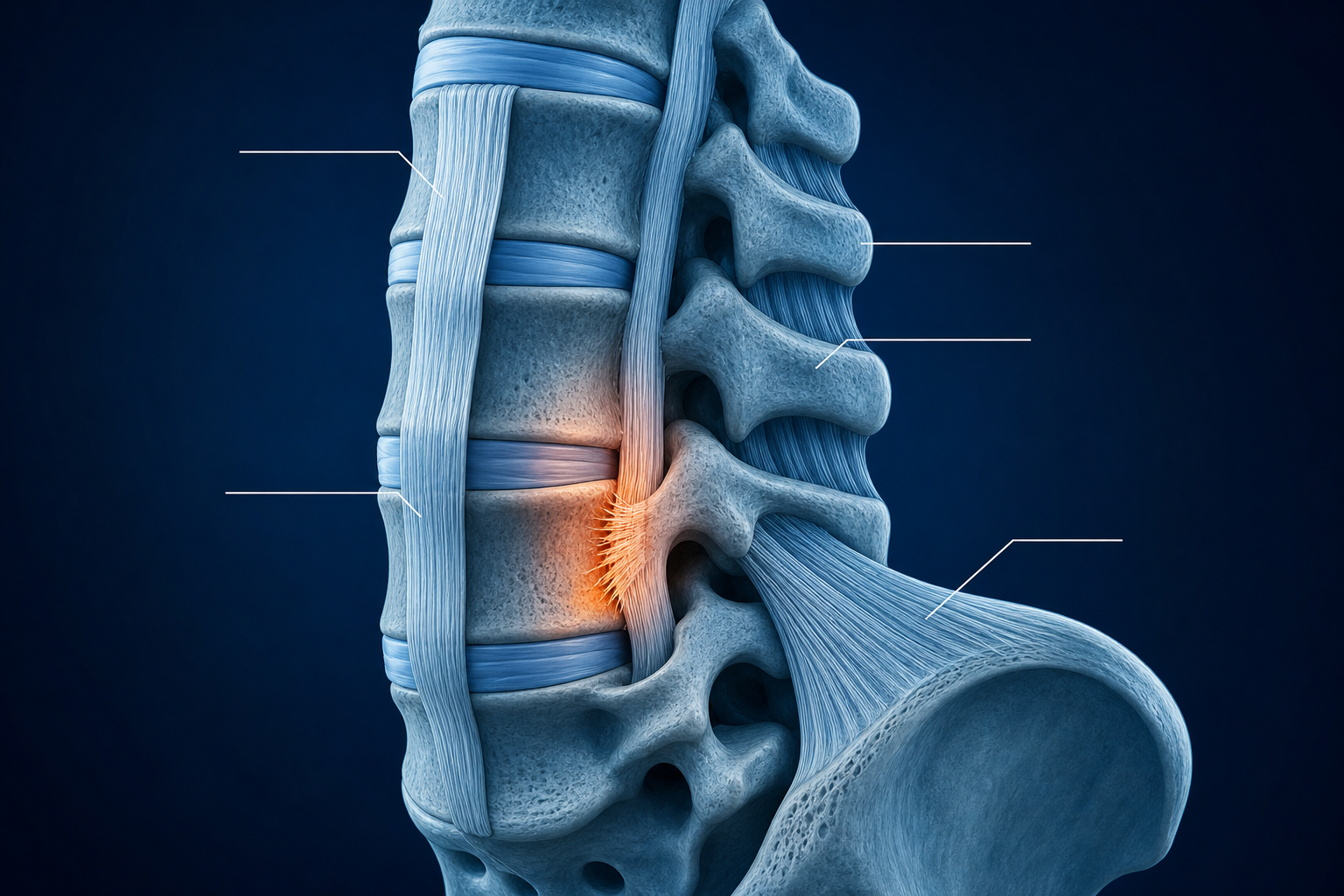
Lower back pain is something most people experience at some point, but not all lower back pain is the same. When the ligaments supporting your lumbar spine are stretched or partially torn — rather than the surrounding muscles — the injury is called a lumbar spine ligament sprain. Understanding the difference matters, because the right care approach can meaningfully affect how quickly and completely you recover.
Whether your pain started after a car accident, a slip and fall, or simply bending down to pick something up, this guide will help you understand what may be happening in your lower back, what conservative treatment options look like, and when it makes sense to connect with a provider.
What Is a Lumbar Spine Ligament Sprain?
Ligaments are tough, fibrous bands of connective tissue that link bones to one another. In the lumbar spine — the five vertebrae of your lower back — several ligaments work together to stabilize each spinal segment, limit excessive movement, and protect the surrounding nerves and discs. When these ligaments are forced beyond their normal range of motion, the fibers can stretch, micro-tear, or, in more severe cases, partially rupture. That is a sprain.
The Difference Between a Back Muscle Strain and a Ligament Sprain
The terms are often used interchangeably, but they describe two different tissue injuries. A muscle strain involves the muscle fibers or tendons — the structures that generate and transmit movement. A ligament sprain involves the passive stabilizers — the bands that hold the spine's joints in proper alignment. Sprains can feel similar to strains (localized pain, stiffness, tenderness), but ligament injuries sometimes take longer to heal because ligaments have a comparatively limited blood supply.
The iliolumbar ligament — which connects the lower lumbar vertebrae to the pelvis — is one commonly injured structure. Patients with an iliolumbar ligament sprain often describe pain that radiates into the hip, buttock, or groin alongside classic lower back pain, which can make it easy to confuse with other conditions. If you're experiencing pain in both the hip and lower back, a thorough evaluation by a qualified provider is an important first step. You can search for chiropractors and physical therapists near you on Medximity to get that evaluation started.
Common Causes of Lumbar Ligament Sprains
- Motor vehicle accidents — The sudden forces involved in a collision can overload lumbar ligaments even at relatively low speeds. Lower back ligament injury after a car accident is a frequently reported complaint among patients seen in post-accident care settings.
- Slip and fall injuries — Landing on a hard surface or catching yourself awkwardly can force the lumbar spine into extreme positions that stress the ligaments.
- Lifting and bending mechanics — Lower back pain when bending or lifting something heavy, especially with a rounded spine, is a hallmark setup for lumbar ligament stress.
- Sports and physical activity — Rotational sports, contact sports, and high-impact activities all present opportunities for lumbar ligament overload.
- Repetitive microtrauma — Accumulated stress from poor posture, sedentary work habits, or repeated awkward movements can weaken ligament integrity over time.
Recognizing the Symptoms
Lumbar spine ligament sprain symptoms and treatment needs vary depending on severity, but some patterns appear consistently:
- Localized aching or sharp pain across the lower back, sometimes radiating to the hips or buttocks
- Pain that worsens with bending, twisting, or prolonged sitting or standing
- A sensation of instability or "giving way" in the lower back
- Muscle guarding or spasm around the injured area — the body's natural attempt to protect the joint
- Stiffness that is typically worse in the morning or after periods of inactivity
- Tenderness to touch along the lumbar spine or at the sacroiliac joint region
Because symptoms can overlap with disc injuries, nerve irritation, and other spinal conditions, a clinical examination is generally needed to narrow down the source of your pain. See our overview of lower back pain causes and treatment options for a broader look at what may be contributing to your discomfort.
How Long Does a Lumbar Ligament Sprain Take to Heal?
Healing time depends on injury severity, which is typically classified in three grades:
- Grade I (mild): Minor ligament fiber stretching. Many patients notice meaningful improvement within two to four weeks with appropriate conservative care.
- Grade II (moderate): Partial tearing of ligament fibers. Recovery may range from six to twelve weeks, and guided rehabilitation is usually beneficial.
- Grade III (severe): Complete or near-complete ligament rupture. These injuries are less common in the lumbar spine and may require more intensive management, though conservative care is still the first-line approach in most cases.
Can a lumbar ligament sprain heal on its own? Mild sprains often improve with rest, activity modification, and time. However, research and clinical experience suggest that guided rehabilitation — including targeted exercise and manual therapy — is generally associated with better functional outcomes and a lower likelihood of chronic pain development than passive rest alone. Leaving a moderate or severe sprain unmanaged can sometimes allow compensatory movement patterns to take hold, which may create longer-term problems.
Lower Back Ligament Sprain Treatment Without Surgery
The good news is that the vast majority of lumbar ligament sprains respond well to non-surgical, conservative care. Surgery is rarely indicated for ligament sprains alone. Typical conservative treatment approaches include:
Chiropractic Care
Chiropractors are trained to assess lumbar spine mechanics and address joint mobility restrictions that often accompany ligament sprains. Chiropractic adjustments — also called spinal manipulation — may help restore motion to stiffened segments, reduce muscle guarding, and support the spine's overall function during the healing process. Soft tissue techniques, instrument-assisted mobilization, and therapeutic modalities are also commonly used alongside adjustments. If you're looking for a chiropractor for lumbar ligament sprain near you, Medximity's directory makes it simple to find and compare providers in your area.
Physical Therapy
Physical therapists design progressive rehabilitation programs aimed at restoring strength, flexibility, and neuromuscular control around the lumbar spine. Physical therapy exercises for lower back ligament injury typically progress through phases: early pain management, then gentle mobility work, then core stabilization and functional movement retraining. Strengthening the muscles that support the lumbar spine can help reduce ongoing stress on the healing ligament and lower the risk of re-injury. Find a physical therapist near you on Medximity to start a personalized rehab program.
Activity Modification and Ergonomics
In the early phase of recovery, modifying activities that provoke pain — particularly heavy lifting, prolonged bending, and high-impact movement — gives injured tissue the best environment for healing. Ergonomic adjustments at work or home, such as changing chair height or repositioning a workstation, can meaningfully reduce cumulative spinal loading during recovery.
Ice, Heat, and Therapeutic Modalities
In the acute phase, ice application may help manage local inflammation and discomfort. As the injury transitions into the subacute phase, moist heat can support tissue relaxation and circulation. Therapeutic modalities such as ultrasound, electrical stimulation, and low-level laser therapy are sometimes incorporated by chiropractors and physical therapists as part of a broader care plan.
Lumbar Ligament Sprains After Car Accidents and Falls
Lower back pain after a car accident or a ligament injury from a slip and fall deserves prompt attention for several reasons. First, post-traumatic lumbar sprains can be obscured in the immediate aftermath by adrenaline, making it easy to underestimate the injury's severity. Second, documented clinical evaluation and treatment records are often important in personal-injury or workers' compensation contexts — though how those records are used in any legal matter is a question best directed to a licensed attorney familiar with your state's laws.
Seeking evaluation soon after a traumatic event is generally in your interest both medically and practically. Natural treatment for lumbar sprain after a slip and fall is most effective when started early rather than after weeks of unmanaged pain. Learn more about auto accident injuries and conservative care or what to expect after a slip and fall injury.
Is a Lower Back Ligament Sprain Serious Long Term?
For most patients, a lumbar ligament sprain does not become a permanent problem when it receives appropriate care. However, some patients — particularly those with more severe injuries, those who delay treatment, or those who return to full activity before healing is adequate — may experience lingering instability, chronic pain, or recurring episodes. Patients with pre-existing spinal conditions may also find that a ligament sprain exacerbates underlying issues.
The strongest protective factors are early, appropriate clinical care and a rehabilitation program that addresses both the injury and the movement patterns that may have contributed to it. If you are concerned about long-term outcomes, discussing your specific situation with a qualified chiropractor or physical therapist will give you a clearer picture than general information alone can provide.
When to See a Provider
You should seek evaluation promptly if:
- Your pain followed a traumatic event such as a car accident or fall
- Pain is severe, constant, or getting worse rather than gradually improving
- You notice numbness, tingling, or weakness in one or both legs
- You are having difficulty with bladder or bowel function (seek emergency care immediately in this case)
- Pain has persisted for more than a few days without any sign of improvement
Search Medximity's provider directory to connect with a chiropractor or physical therapist experienced in lumbar spine injuries near you.
Frequently Asked Questions
What is the difference between a back muscle strain and a ligament sprain?
A muscle strain involves injury to muscle fibers or tendons, while a ligament sprain involves the connective bands that stabilize spinal joints. Both can cause lower back pain, but they involve different tissues and may respond somewhat differently to treatment. A clinical evaluation is the best way to determine which type of injury — or combination of injuries — you are dealing with.
Can a lumbar ligament sprain heal on its own?
Mild (Grade I) sprains often improve with rest and activity modification over a few weeks. Moderate or more significant sprains generally benefit from guided conservative care — such as chiropractic treatment or physical therapy — to support proper healing, restore function, and reduce the risk of chronic pain or re-injury.
How long does a lumbar ligament sprain take to heal?
Mild sprains may show notable improvement in two to four weeks. Moderate sprains often require six to twelve weeks of recovery with appropriate care. Severe sprains may take longer. Individual factors such as age, overall health, injury severity, and adherence to a rehabilitation program all influence recovery timelines.
What does an iliolumbar ligament sprain feel like?
Iliolumbar ligament sprains often produce pain in the lower back that may radiate into the hip, buttock, or groin on one or both sides. Because this pattern can resemble hip joint problems or sacroiliac joint dysfunction, evaluation by a trained provider is important for accurate identification of the pain source.
Is lower back ligament sprain treatment possible without surgery?
Yes — the large majority of lumbar ligament sprains are managed successfully with conservative, non-surgical care. Chiropractic adjustments, physical therapy, activity modification, and therapeutic modalities are all commonly used approaches. Surgery is rarely indicated for isolated ligament sprains and is typically considered only when conservative care has not produced adequate results over an extended period.
Should I see a chiropractor or a physical therapist for a lumbar ligament sprain?
Both chiropractors and physical therapists are trained to evaluate and treat lumbar spine injuries, and many patients benefit from care that incorporates elements of both disciplines. Your choice may depend on the specific nature of your injury, your provider's training and approach, and your personal recovery goals. Medximity's directory can help you find and compare providers in your area.
Does lower back pain after a car accident mean I have a ligament injury?
Not necessarily — post-accident lower back pain can involve muscles, ligaments, discs, facet joints, or some combination. A clinical examination, and sometimes imaging, is needed to identify the involved structures. What is clear is that post-traumatic lower back pain warrants prompt evaluation rather than a wait-and-see approach.