Understanding Your Samaritan Healthy Kids (KID) Benefits for Physical Therapy starts with four basics: whether your child needs a referral, whether the practice is in network, how many visits are allowed, and whether prior authorization is required after the first evaluation. Most plans cover medically necessary pediatric physical therapy, but the exact rules, costs, and visit limits depend on the child’s specific benefit documents and the provider’s billing status.
If you want the shortest answer, call the member services number on the ID card before scheduling and ask about evaluation coverage, follow-up visit limits, authorization, and out-of-pocket cost. Then confirm that the physical therapy practice treats pediatric conditions such as gait delay, balance deficits, weakness, or limited ROM at the ankle, hip, and knee.
What Samaritan Healthy Kids (KID) Benefits for Physical Therapy Usually Include
What does Samaritan Healthy Kids cover for PT? In most cases, pediatric physical therapy benefits are built around evaluation, a defined number of treatment visits, and medical review if care extends beyond the initial plan. Coverage usually applies when PT is used to improve function such as walking, stair climbing, balance, coordination, transfer ability, posture, or strength in structures like the Achilles tendon, quadriceps, and gluteus medius.
Covered services often focus on restoring or improving measurable function, not general wellness.
- Initial PT evaluation: assessment of strength, ROM, gait, posture, and functional limitations
- Follow-up treatment visits: therapeutic exercise, neuromuscular re-education, gait training, balance work, and home exercise progression
- Periodic re-evaluation: repeat measurements to document progress and ongoing need
- Condition-specific treatment plans: developmental delay, toe walking, sports overuse, torticollis, scoliosis-related movement deficits, or recovery after injury
What is usually not covered under the PT benefit is just as important. Plans commonly separate medically necessary care from services considered wellness, maintenance, fitness, or convenience. If your child needs movement care related to sport or spine mechanics, you can also learn how sports therapy may support performance and recovery.
Plans commonly pay for treatment that documents a measurable functional goal such as better gait symmetry, improved single-leg balance, or increased ankle dorsiflexion, while non-diagnostic wellness sessions may not fall under the same benefit.
How does pediatric physical therapy coverage often work?
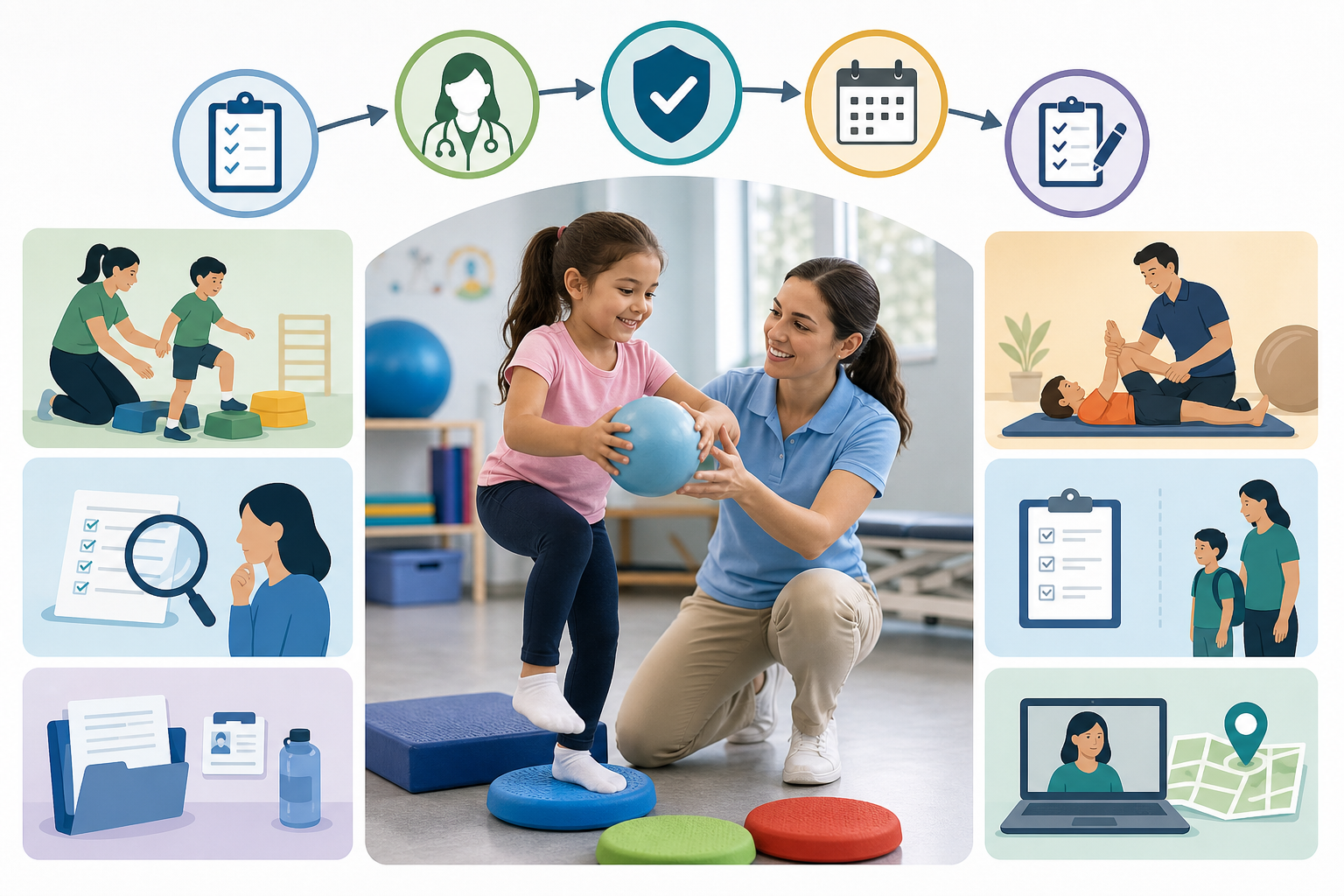
Pediatric physical therapy covered by insurance usually follows a sequence: referral if required, evaluation, treatment plan, follow-up visits, progress review, and possible reauthorization. The evaluation is the key visit because it establishes diagnosis-related deficits and creates objective baselines such as ROM, strength grade, gait pattern, or tolerance for standing and running.
Common reasons a child is referred to PT
- Delayed gross motor milestones
- Frequent falls or poor balance
- Toe walking or abnormal gait
- Sports injury affecting the hamstrings, patellar tendon, or ankle ligaments
- Postural deficits or trunk weakness
- Neck tightness that affects head position and upper body alignment
What the practice may measure at the first visit
- ROM at the hip, knee, ankle, shoulder, or cervical spine
- Strength of the core, gluteals, calf, and scapular stabilizers
- Balance time, hop quality, stair pattern, and gait symmetry
- Pain triggers with squatting, jumping, walking, or sports drills
Timelines vary by condition. A mild ankle sprain with gait changes may improve over 4 to 6 visits across 2 to 4 weeks. A motor coordination or balance program may run 8 to 12 visits over 6 to 10 weeks, especially when home exercise compliance is good.
If your child also has nerve-type symptoms, radiating leg pain, or posture-related pain, you may want to review how referred pain patterns are assessed and see how neck dysfunction can affect symptoms below the neck.
Does physical therapy need referral, and what counts as medical necessity?
Does physical therapy need referral? Sometimes yes, sometimes no. Some plans allow direct access for PT evaluation, while others require a referral from the child’s primary care provider or another authorized provider before the first covered visit. Physical therapy coverage without referral can exist, but you should not assume it applies to your child’s plan.
Physical therapy prior authorization for kids is also common. Authorization may be required before treatment starts, after the evaluation, or once a certain visit threshold has been reached.
What is medical necessity for therapy?
Medical necessity usually means the treatment is needed to diagnose or improve a functional problem caused by illness, injury, developmental condition, or neuromuscular impairment. The practice must show that skilled PT is required and that home exercise alone is not enough at that stage.
- The child has a measurable deficit such as weak hip abductors, limited ankle dorsiflexion, or asymmetrical gait
- The treatment plan has specific goals such as running without limping or improving stair ascent
- Progress is tracked with repeat measures, not vague notes
- Care requires a licensed PT’s clinical skill
Medical necessity becomes harder to prove if visits continue with no measurable progress. That is why practices often re-test ROM, gait speed, squat mechanics, and balance every few visits.
Parents should expect the practice to submit objective findings, visit frequency, and goal-based progress when authorization or reauthorization is requested.
What may be covered and what may not be?
Covered PT services usually target function. Non-covered services are often wellness-based, educational-only, or not billed under the child’s PT benefit. The exact answer depends on plan language, but this comparison helps parents ask the right questions.
Service Often Covered Expected Outcome Typical Timeline Initial pediatric PT evaluation Usually yes, if medically necessary Diagnosis-related findings, baseline ROM/strength/gait measures 1 visit Therapeutic exercise and neuromuscular re-education Often yes Improved balance, strength, coordination, movement quality 4-12 visits depending on condition Gait training Often yes Better walking pattern, reduced limp, improved endurance 2-8 weeks Periodic re-evaluation Often yes when documented Updated goals and continued necessity Every few weeks or per authorization cycle General fitness or wellness sessions Often no Conditioning without medical diagnosis support Varies Missed visits or late cancellation fees Usually no Administrative cost, not treatment Not applicableA child with neck-related posture issues, headaches, or upper-back tension may need a broader movement assessment. For context, you can review how movement-based care is used around headache patterns or learn how neck dysfunction may contribute to ear and head symptoms.
Does insurance cover physical therapy evaluation, and how many physical therapy visits are covered?
Does insurance cover physical therapy evaluation? Usually yes when the service is medically necessary and any referral rule has been met. The evaluation is different from a follow-up visit. It is longer, includes testing, and creates the treatment plan that the insurer may review.
How many physical therapy visits covered is the question that drives scheduling. Some plans use a fixed number per year. Others approve an initial block and require reauthorization for more.
Evaluation vs. follow-up visits
- Evaluation: one-time comprehensive visit with exam findings, ROM, strength grades, gait analysis, and goals
- Follow-up treatment: exercise progression, balance drills, manual techniques, movement retraining, and home program review
- Re-evaluation: repeat testing to justify continued care
A straightforward overuse problem around the patellofemoral joint or Achilles may respond within 6 to 8 sessions over 3 to 6 weeks. A child with balance deficits, trunk weakness, or developmental coordination issues may need 10 to 16 sessions over 2 to 4 months.
- Ask if visit limits apply per calendar year or per condition
- Ask whether the evaluation counts toward the visit maximum
- Ask whether telehealth PT, if offered, counts the same as in-person care
- Ask what happens when the approved visits run out
How to verify physical therapy benefits before you schedule
How to verify physical therapy benefits is simple when you use a checklist. Call the number on the insurance card and have the child’s member ID, the provider name, and the PT practice tax ID or NPI if the practice gives it to you. The goal is to confirm coverage before the first appointment so the evaluation is billed correctly.
- Ask whether pediatric physical therapy is covered under the child’s plan.
- Ask whether the practice is in network.
- Ask whether a referral is required for the evaluation or for all visits.
- Ask whether prior authorization is required before treatment starts or after the evaluation.
- Ask the exact copay, coinsurance, or deductible amount.
- Ask how many visits are allowed and whether the limit includes the evaluation.
- Ask what diagnosis codes or service categories are excluded.
Write down the date, time, representative name, and reference number for the call. If the insurer later processes a claim differently, that record helps you dispute errors faster.
To start your search, you can find a physical therapy provider near you, browse providers, or explore more health topics while you compare options.
What to bring to the first physical therapy visit and what should you ask?
What to bring to therapy appointment depends on the child’s condition, but the paperwork is usually predictable. Missing documents can delay billing or force the practice to reschedule if referral or authorization rules were not met.
Bring these items
- Insurance member ID card
- Referral, if required
- Prescription or order, if required by the plan or practice
- Imaging reports or prior therapy notes if available
- A list of current symptoms, movement limits, and when they started
- Comfortable clothing and shoes that allow gait testing
Questions parents should ask pediatric physical therapist
- What functional problem are you measuring first: gait, balance, ROM, strength, or coordination?
- How many visits do you expect if the child follows the home program?
- What changes should we see by week 2, week 4, and week 8?
- Will you request authorization, or do we need to contact the plan first?
- What home exercises should be done on non-visit days?
A basic home program may start with one mobility drill and two strength drills. Example:
- Calf stretch at wall: 30 seconds each side, 3 rounds, twice daily
- Bridge: 2 sets of 10 reps, slow lift and 3-second hold
- Sit-to-stand from chair: 2 sets of 8 reps with knees tracking over the toes
Stop and contact the practice if exercise causes sharp pain, visible swelling, new limping, or numbness.
What to Do Next
Start with verification, not guessing. Call the plan, confirm referral and authorization rules, then schedule with an in-network pediatric physical therapy practice that treats your child’s specific problem. If the issue involves balance, gait, sports movement, posture, or spine mechanics, choose a provider who measures function at the cervical spine, lumbar spine, hip, knee, and ankle rather than offering generic exercise only.
- Seek routine care for limping, recurrent falls, weakness, reduced ROM, toe walking, poor posture, or delayed motor skills
- Seek urgent medical evaluation for sudden inability to bear weight, major deformity after injury, rapidly increasing swelling, new loss of bowel or bladder control, severe night pain, fever with joint pain, or progressive numbness and weakness
- Expect the first visit to include history, movement testing, strength and ROM exam, gait analysis, and a home program
Use Medximity to find an in-network pediatric physical therapy provider near you and compare practices before you book. Benefits vary by plan documents, network status, and authorization rules, so confirm coverage directly with Samaritan Healthy Kids (KID) and the practice before the first appointment.
FAQ: Samaritan Healthy Kids (KID) and Physical Therapy Coverage
Does Samaritan Healthy Kids cover physical therapy for children?
Most plans cover medically necessary pediatric physical therapy, including evaluation and follow-up treatment, when plan rules are met. Coverage can depend on referral requirements, authorization status, visit limits, and whether the practice is in network.
Does physical therapy need referral under Samaritan Healthy Kids (KID)?
Some plans require a referral from the child’s primary care provider or another authorized provider. Others may allow direct access for the evaluation. Always confirm before scheduling because a missing referral can delay claim payment.
What is physical therapy prior authorization for kids?
Prior authorization is plan approval for PT services before treatment starts or after the evaluation. The practice may need to send exam findings such as ROM loss, weakness, gait deficits, and treatment goals to show medical necessity.
Does insurance cover physical therapy evaluation separately from treatment visits?
Usually yes. The evaluation is commonly billed as a separate service because it includes testing, diagnosis-related findings, and a care plan. Ask whether that evaluation counts toward the total visit limit.
How many physical therapy visits are usually covered?
That depends on the benefit design. Some plans allow a fixed annual number. Others approve a smaller initial set, then require reauthorization if the child still has measurable deficits. Common treatment courses range from 4 to 12 visits, but the approved amount can be lower or higher.
Can I get physical therapy coverage without referral?
Physical therapy coverage without referral may be available on some plans, but you should verify it directly. Even if a referral is not required, prior authorization or in-network rules may still apply.