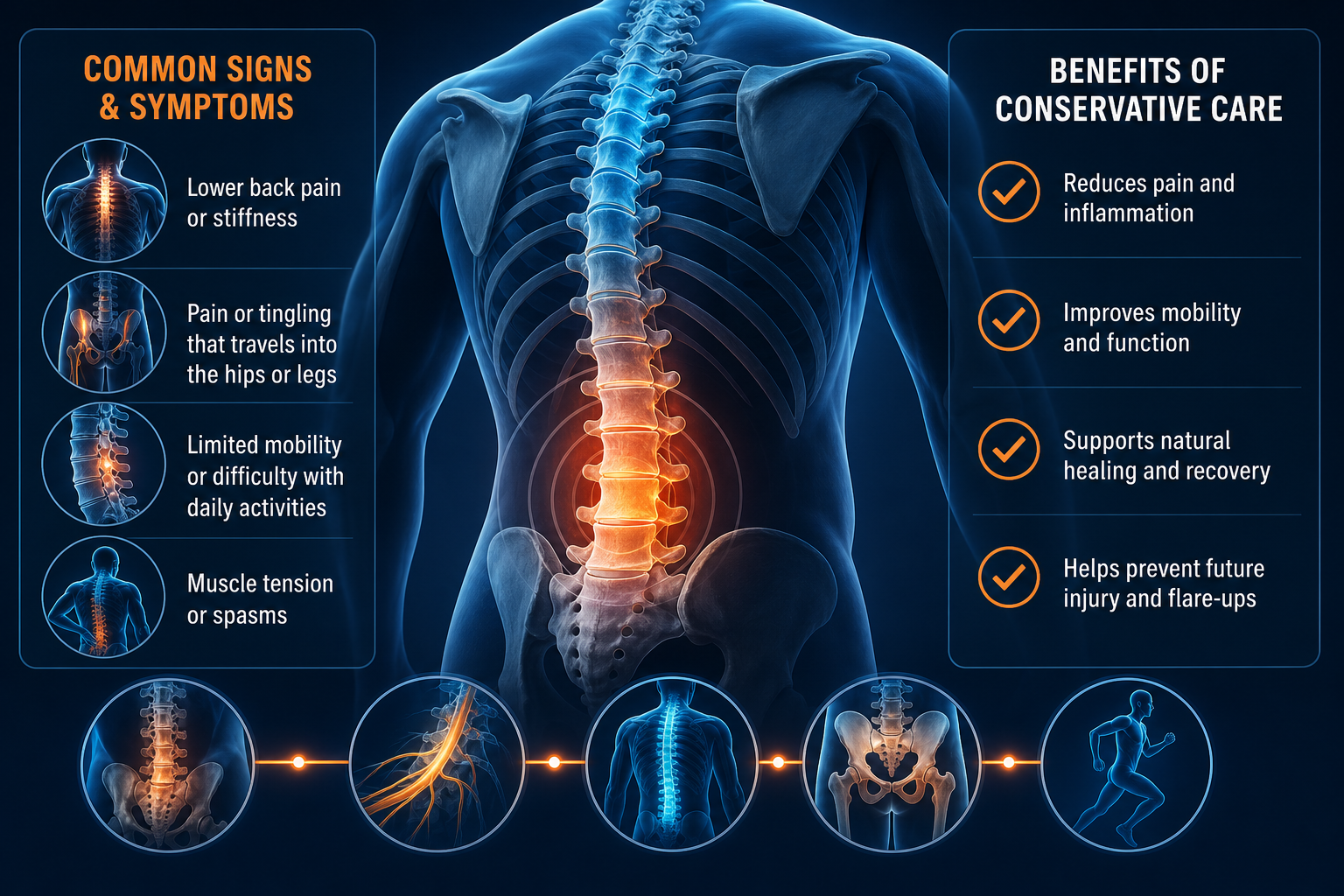
A Sioux Falls chiropractor can address far more than a stiff back. From sciatica radiating down the piriformis and into the leg, to chronic tension headaches originating at the suboccipital muscles, chiropractic care targets the musculoskeletal source of pain — not just the symptoms. Whether you need relief after a rear-end collision on I-229 or your desk job has your thoracic spine locked up by 2 p.m., this guide covers what to look for, what to expect, and how to find the right provider in the Sioux Falls area.
What a Chiropractor in Sioux Falls Can Help With
If you are searching for a chiropractor in Sioux Falls for back pain, you are in the majority — low back pain is the single most common reason for a chiropractic visit. But the scope goes well beyond the lumbar spine.
Conditions That Respond Well to Chiropractic Care
- Lumbar disc herniation and sciatica — irritation of the L4-L5 or L5-S1 nerve roots causing pain, numbness, or tingling into the buttock and leg. Research from the Journal of Manipulative and Physiological Therapeutics shows roughly 60% of sciatica patients who failed other conservative treatment improved with spinal manipulation.
- Cervical radiculopathy — pinched nerves in the neck causing arm pain, often at the C5-C6 or C6-C7 segments.
- Tension-type and cervicogenic headaches — originating from restricted cervical facet joints and tight trigger points in the upper trapezius and levator scapulae.
- SI joint dysfunction — common in postpartum patients and runners in the Sioux Falls area.
- Extremity complaints — shoulder impingement, lateral epicondylitis (tennis elbow), and plantar fasciitis.
For those looking for a natural treatment for sciatica without surgery in Sioux Falls, chiropractic spinal manipulation combined with targeted stretching and nerve flossing exercises typically produces measurable improvement within 4–6 visits over 2–3 weeks.
What to Expect at Your First Chiropractic Visit
A first appointment typically runs 45–60 minutes. Here is the usual sequence, so you know exactly what to expect at your first chiropractic appointment.
- Health history intake — you fill out forms covering your symptoms, past injuries, family history, and daily activities. Bring any imaging (X-rays, MRI reports) you already have.
- Examination — orthopedic tests (straight leg raise for lumbar radiculopathy, Spurling's test for cervical nerve compression), range-of-motion measurements, palpation of the spine and paraspinal muscles, and neurological screening (reflexes, dermatome sensation, myotome strength).
- Diagnosis and treatment plan — the provider explains what is causing your pain, recommends a visit frequency, and gives you a timeline. A typical acute low back pain case: 6–12 visits over 2–4 weeks, then reassessment.
- First adjustment (if appropriate) — many Sioux Falls chiropractors treat on the first visit after the exam. Some prefer to review imaging first, especially for neck complaints.
So how long does it take chiropractic care to work? Most patients report noticeable relief within 2–3 visits for acute issues. Chronic conditions — pain lasting more than 3 months — may require 8–12 sessions with a structured home exercise program before meaningful progress.
Common Chiropractic Techniques Used in Sioux Falls Practices
Not every adjustment is the same. If you have wondered whether a chiropractic adjustment is safe for neck pain, the answer depends partly on which technique is used and your individual risk profile.
Technique What It Involves Best For Force Level Diversified Manual high-velocity, low-amplitude thrust General spinal stiffness, joint fixation Moderate to high Gonstead Specific contact, precise line of drive based on X-ray analysis Disc-related pain, targeted correction Moderate to high Activator Method Handheld spring-loaded instrument delivers a small impulse Elderly patients, acute pain, cervical spine Low Flexion-Distraction (Cox) Motorized table gently distracts and flexes the lumbar spine Disc herniation, spinal stenosis, sciatica Very low Thompson Drop Segmental drop pieces in the table assist the thrust Pelvic misalignment, SI joint problems Low to moderateFor cervical adjustments specifically, the Activator and upper cervical toggle techniques apply less force than a manual diversified adjustment. A 2017 systematic review in the European Spine Journal found cervical manipulation performed by a trained chiropractor carries a serious adverse event rate of approximately 1 per 1 million manipulations. If you have a history of vertebral artery dissection, recent cervical fracture, or are on blood thinners, tell your provider — they will modify or avoid cervical manipulation accordingly.
How Do You Choose the Right Sioux Falls Chiropractor?
Knowing how to choose a chiropractor in Sioux Falls saves you time and money. Here is what actually matters — and what does not.
What to Prioritize
- Condition-specific experience — if you have a disc issue, ask whether the provider uses flexion-distraction. For sports injuries, look for a provider with sports chiropractic training (CCSP or DACBSP credential).
- Evidence-based approach — the provider should use outcome measures (pain scales, ROM tracking) and give you a clear reassessment date, not an open-ended treatment plan with no exit criteria.
- Insurance and payment transparency — if you need a Sioux Falls chiropractor that accepts insurance, confirm your plan is accepted before booking. Most SD health plans cover chiropractic, but visit limits vary (typically 20–30 visits per year). Ask about out-of-pocket cost per visit upfront.
- Referral network — a good chiropractor co-manages with PTs, orthopedists, and primary care. If they never refer out, that is a red flag.
What Matters Less Than You Think
Online reviews with perfect 5.0 scores (no practice is perfect for everyone), years in practice alone (technique and continuing education matter more), and fancy office decor. The provider's clinical skill and communication style are what determine your outcome.
Chiropractic Care After a Personal Injury or Auto Accident
Rear-end collisions — even at 10–15 mph — generate enough force to cause whiplash-associated disorder (WAD), straining the anterior longitudinal ligament, sternocleidomastoid, and scalene muscles of the neck. If you are experiencing pain in your neck and shoulders after an auto accident, chiropractic treatment after a car accident in Sioux Falls typically follows this protocol:
- Acute phase (weeks 1–2) — gentle mobilization, ice/heat, soft tissue therapy. No high-velocity adjustments to an acutely inflamed cervical spine.
- Subacute phase (weeks 2–6) — introduce spinal manipulation, begin isometric neck strengthening (chin tucks, cervical retraction holds).
- Recovery phase (weeks 6–12) — progressive loading, proprioceptive training, return-to-activity planning.
Most WAD grade I–II injuries resolve within 8–12 weeks of consistent care. If symptoms worsen after 2 weeks, or you develop arm weakness, difficulty gripping, or bladder changes, seek emergency evaluation — these are signs of spinal cord compromise.
South Dakota is a fault state for auto insurance, meaning the at-fault driver's liability coverage pays for your treatment. Your chiropractor's office should be familiar with personal injury documentation requirements — detailed visit notes, functional outcome tracking, and narrative reports for the insurance adjuster. Neck injuries after a collision should always be evaluated promptly, even if pain does not appear for 24–72 hours.
When Should You See a Chiropractor vs. Another Provider?
The question of chiropractor or physical therapist for lower back pain comes up constantly. The honest answer: it depends on the problem.
Scenario Best Starting Provider Why Acute low back stiffness, no radiating pain Chiropractor Joint manipulation restores mobility faster than exercise alone for acute locked joints Post-operative rehab (after spinal procedure) Physical therapist PT specializes in progressive loading and surgical rehab protocols Sciatica with leg numbness Chiropractor or PT — either is appropriate Both use nerve mobilization; chiropractors add spinal manipulation targeting the involved segment Chronic low back pain with deconditioning Both — co-management ideal Manipulation for pain relief + PT for core stability and long-term reconditioning Chest pain, sudden severe headache, loss of bowel/bladder control Emergency room — immediately These suggest cardiac, vascular, or cauda equina emergencies, not musculoskeletal problemsSo when should you see a chiropractor vs. your doctor? If your pain is clearly musculoskeletal — it changes with movement, you can point to it, and it started after a physical activity or postural strain — a chiropractor is an appropriate first contact. If you have progressive leg numbness, unexplained weight loss, fever with back pain, or a history of cancer, see your primary care provider first to rule out non-musculoskeletal causes.
A Home Exercise to Start Today
McGill Curl-Up (for lumbar stability):
- Lie on your back. Bend one knee with that foot flat on the floor. Keep the other leg straight.
- Place both hands under the natural arch of your low back — do not flatten it.
- Brace your core as if someone is about to poke your stomach.
- Lift only your head and upper shoulders off the floor about 1–2 inches. Hold for 10 seconds.
- Perform 3 sets: 6 reps, then 4 reps, then 2 reps. Rest 30 seconds between sets.
This builds transverse abdominis and multifidus endurance without loading the spine. It is one of the three exercises in the McGill Big 3 protocol, which has strong evidence for reducing recurrent low back pain episodes.
What to Do Next
If you are dealing with back pain, neck stiffness, post-accident pain, or sciatica in the Sioux Falls area, a chiropractor is a reasonable first step. Here is how to move forward:
- For routine musculoskeletal pain — find a chiropractor near you and book an initial evaluation. Expect to spend about an hour at your first visit.
- For auto accident injuries — get evaluated within 72 hours of the collision, even if pain is mild. Delayed treatment weakens both your recovery and your insurance claim.
- For ongoing or complex pain — look for a provider who co-manages with physical therapists and primary care. Ask about this at your first visit.
- Not sure which provider type you need? — browse providers on Medximity by specialty, location, and insurance accepted to compare your options in Sioux Falls.
You can also explore more health topics on the Medximity blog for condition-specific guides on everything from post-concussion care to the best time to schedule your appointment.