Nontraumatic muscle separation in the ankle and foot occurs when muscle fibers partially or fully separate from their connective tissue attachments without a specific accident, fall, or acute injury. If you have ankle and foot muscle pain with no accident or fall, this condition may explain your symptoms. It develops gradually — often from repetitive microtrauma, biomechanical imbalance, or chronic overuse — and responds well to conservative care when identified early.
What Is Nontraumatic Muscle Separation in the Ankle and Foot?
Nontraumatic muscle separation describes a condition where the muscle belly detaches or pulls away from the surrounding fascia, tendon, or adjacent muscle compartment without a single traumatic event. Unlike a sudden tear during a basketball game, this separation happens incrementally. Microscopic fiber damage accumulates over weeks or months until the tissue reaches a failure threshold.
Is it normal to have muscle pain in the foot without trauma? It is more common than most patients realize. The foot and ankle contain over 30 muscles working across multiple planes of motion with every step. When one muscle group is overloaded — due to poor footwear, altered gait, or structural misalignment — the fibers can progressively separate without any obvious moment of injury.
This condition falls under a broader category of overuse soft tissue injuries and is distinct from acute muscle strains, contusions, or ruptures. The clinical significance is that patients often delay seeking care because they cannot identify a triggering event, which allows the separation to progress. Conditions affecting the foot and ankle often coexist with imbalances further up the kinetic chain — similar to how sciatic pain can alter gait patterns and redistribute load to the lower extremities.
How Does Nontraumatic Muscle Separation Differ From a Traumatic Muscle Injury?
The difference between muscle strain and muscle separation in the ankle comes down to mechanism, onset, and tissue behavior.
Traumatic Muscle Injury
- Single identifiable event: a twist, fall, or forceful contraction
- Immediate pain, often with audible pop or snap
- Rapid swelling and bruising within hours
- Graded I–III based on percentage of fibers torn
- Clear timeline for onset
Nontraumatic Muscle Separation
- No identifiable single event
- Gradual onset over days to weeks
- Diffuse aching that worsens with activity, eases with rest
- Minimal or no visible bruising initially
- Often discovered on imaging after conservative assessment
Traumatic injuries are easier to diagnose because of the clear cause-and-effect. Nontraumatic separations require a provider who understands repetitive stress patterns and can evaluate biomechanical contributors that standard emergency imaging might miss.
Anatomy of the Ankle and Foot: The Muscles Involved
Understanding which structures are at risk helps you make sense of your symptoms. The ankle and foot have two muscle categories: extrinsic muscles (originating in the lower leg, crossing the ankle via long tendons) and intrinsic muscles (originating and inserting entirely within the foot).
Extrinsic Muscles Most Prone to Nontraumatic Separation
- Peroneus longus and peroneus brevis — run along the outer (lateral) ankle. They evert the foot and stabilize the arch. Repetitive lateral loading, such as walking on uneven surfaces, makes these muscles prone to spontaneous tearing or separation at the musculotendinous junction.
- Tibialis posterior — the primary arch support muscle, running behind the medial malleolus (inner ankle bone). Chronic overloading in flat-footed individuals can cause progressive separation at its navicular insertion.
- Flexor hallucis longus (FHL) — controls big toe flexion and push-off. Dancers and runners are particularly susceptible to FHL separation behind the ankle.
Intrinsic Muscles at Risk
- Abductor hallucis — along the medial arch; overworked in patients with bunions or collapsed arches
- Flexor digitorum brevis — central foot sole; vulnerable to chronic strain from high-impact activities
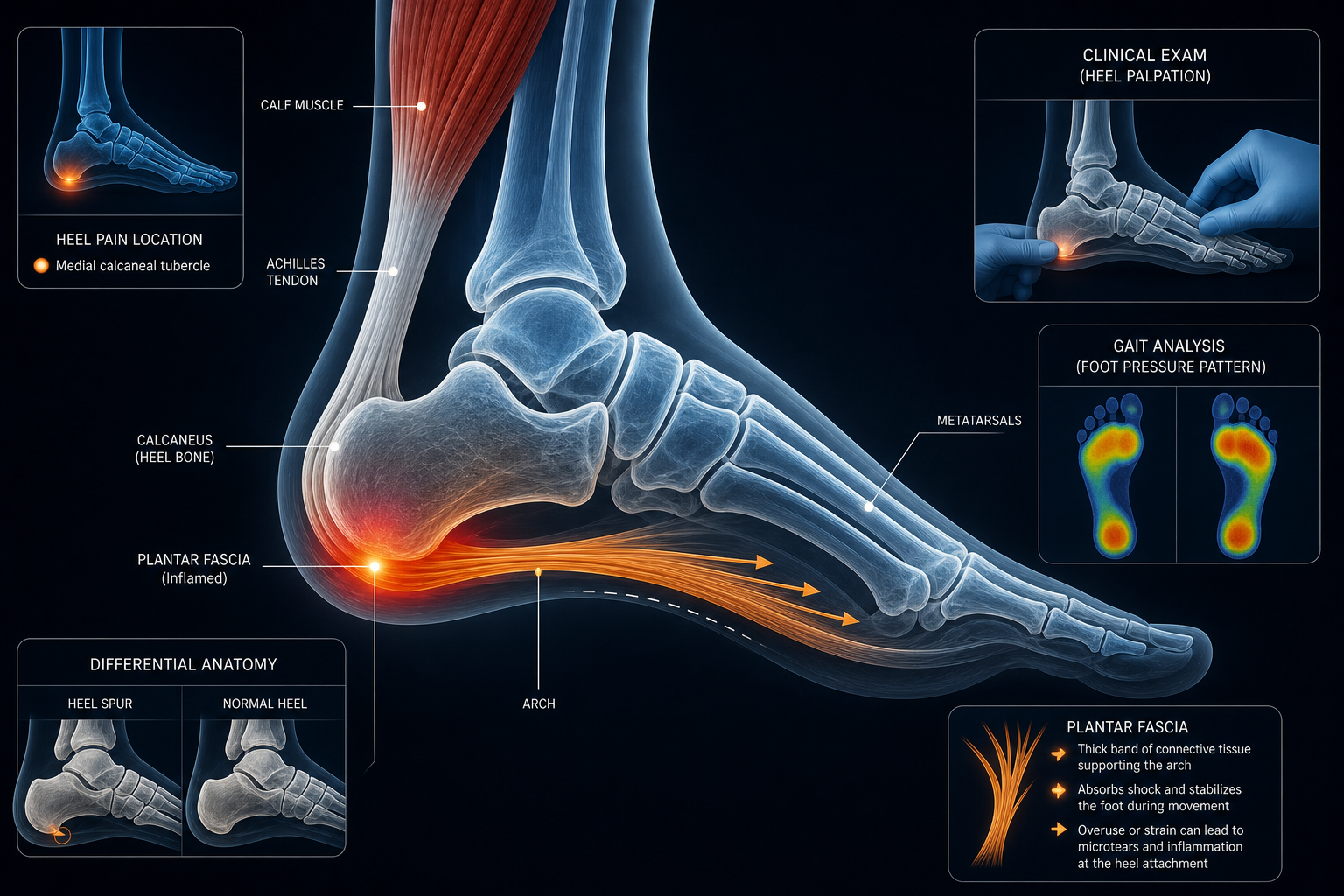
- Quadratus plantae — assists toe flexion; often involved when patients report deep plantar aching. Foot pain from intrinsic muscle dysfunction can mimic plantar fasciitis, so accurate assessment matters.
What muscles in the ankle are prone to spontaneous tearing? The peroneals and tibialis posterior are the most frequently affected in nontraumatic presentations, according to musculoskeletal imaging studies, because of their constant engagement during weight-bearing activities.
Common Causes and Risk Factors
What causes muscle separation in the foot without injury? The answer is rarely a single factor — it is usually a combination of biomechanical and lifestyle contributors compounding over time.
Risk Factor How It Contributes Who It Affects Most Repetitive overuse Cumulative microtrauma exceeds tissue repair capacity Runners, warehouse workers, retail staff Poor footwear Inadequate arch support shifts load to vulnerable muscles Patients wearing flat shoes, worn-out sneakers Biomechanical imbalance Overpronation, supination, or leg length discrepancy alters muscle recruitment patterns Patients with untreated spinal or pelvic misalignment Age-related tissue changes Decreased collagen density reduces tendon-muscle junction strength Adults over 40 Chronic deconditioning Weak intrinsic foot muscles fatigue rapidly under normal loads Sedentary individuals resuming activity Systemic conditions Diabetes, thyroid disorders, and connective tissue conditions weaken soft tissue integrity Patients with metabolic or autoimmune conditionsBody-wide musculoskeletal imbalance is a frequently overlooked contributor. A misaligned pelvis or upper cervical subluxation can alter your gait enough to overload ankle and foot muscles over months. Conditions like fibromyalgia can also lower your pain threshold and mask early warning signals of tissue fatigue.
What Are the Symptoms of Nontraumatic Muscle Separation in the Ankle?
Nontraumatic muscle tear ankle symptoms develop gradually, which is exactly why so many patients dismiss them until the condition worsens. Watch for this progression:
- Early stage: Dull ache along the lateral or medial ankle after activity, relieved fully by rest. Onset is often 30+ minutes into walking or standing.
- Middle stage: Pain begins earlier in activity, takes longer to resolve. You may notice mild swelling along the muscle belly or behind the ankle bone. Stiffness is worst in the morning or after sitting.
- Advanced stage: Pain at rest. Visible asymmetry or a palpable gap in the muscle. Weakness during push-off, difficulty with single-leg balance, and compensatory limping.
Red flag symptoms requiring urgent evaluation: sudden loss of ability to bear weight, rapidly expanding bruising, numbness or tingling in the toes, or a visible deformity. These suggest a complete rupture or vascular compromise and warrant same-day assessment.
Conservative Treatment Options
Foot muscle separation treatment without surgery is the standard first-line approach and resolves the majority of nontraumatic cases. Natural treatment for muscle separation in the ankle focuses on reducing tissue stress, promoting healing, and correcting the underlying mechanical faults that caused the separation.
Chiropractic Care
- Extremity adjustments — restoring proper joint mechanics in the ankle, subtalar, and midfoot joints reduces abnormal muscle loading
- Pelvic and lumbar alignment — correcting upstream biomechanical dysfunction that altered gait
- Soft tissue techniques — instrument-assisted soft tissue mobilization (IASTM) and myofascial release to address adhesions around the separation site
Physical Therapy and Rehabilitation
- Eccentric strengthening — controlled lengthening exercises for the peroneals and tibialis posterior, typically starting at week 2-3 post-diagnosis
- Proprioceptive training — single-leg balance progressions on unstable surfaces to retrain neuromuscular control
- Gait retraining — correcting compensatory patterns before they create secondary injuries
Supportive Measures
- Custom or semi-custom orthotics to redistribute plantar pressure
- Kinesiology taping to offload the affected muscle during early recovery
- Activity modification — not complete rest, but structured load management
Rehabilitation and Return to Activity
How long does ankle muscle separation take to heal? Most nontraumatic separations recover within 4 to 8 weeks with consistent conservative care. Mild cases involving the intrinsic foot muscles may resolve in 3-4 weeks. Separations of the peroneal or tibialis posterior tendons at the musculotendinous junction typically require 6-8 weeks before full activity clearance.
Return to walking after ankle muscle separation follows a staged protocol:
- Weeks 1-2: Protected weight-bearing with supportive footwear. Gentle ROM exercises — ankle circles, towel scrunches, and alphabet tracing with the foot. Ice for 10-15 minutes after activity.
- Weeks 2-4: Progressive loading. Begin eccentric heel drops (3 sets of 12, twice daily): stand on a step with the ball of your foot on the edge, slowly lower your heel below the step over 3 seconds, then return to neutral. Add single-leg balance holds for 30 seconds, 3 times per side.
- Weeks 4-6: Sport- or activity-specific training. Walking on varied terrain, gradual return to running (if applicable) using a 10% weekly volume increase rule.
- Weeks 6-8: Full activity with ongoing maintenance exercises 3 times per week.
Research published in the Journal of Foot and Ankle Research indicates that patients who complete a structured eccentric loading program return to full activity 40% faster than those who rely on rest alone.
How Is Muscle Separation in the Foot Diagnosed and Documented?
How is muscle separation in the foot diagnosed? Diagnosis typically involves a clinical examination combined with imaging when needed.
Clinical Assessment
- Palpation — identifying tenderness, gaps, or thickening along the affected muscle
- Resistance testing — pain or weakness during specific muscle contractions (e.g., resisted eversion for peroneals)
- Functional testing — single-leg heel raise, tandem walking, and hop tests to assess real-world capacity
Imaging
- Musculoskeletal ultrasound — first-line imaging for soft tissue separation; dynamic evaluation shows the separation under load
- MRI — used for complex cases or when ultrasound findings are inconclusive
- X-ray — rules out fracture or bony avulsion but does not visualize soft tissue separation directly
Clinical documentation is particularly relevant for patients whose condition relates to occupational demands or chronic repetitive exposure. Detailed records of functional limitations, treatment rendered, and measurable progress (ROM, pain scales, functional scores) create a clear recovery timeline that providers, employers, and insurers can reference.
What to Do Next
If you have persistent ankle or foot muscle pain with no clear injury, take these steps:
- Stop guessing. Nontraumatic muscle separation mimics several other conditions — tendinitis, plantar fasciitis, stress fracture. A qualified provider can differentiate within a single visit.
- See a chiropractor or physical therapist. These providers specialize in the biomechanical assessment and conservative rehabilitation this condition requires. Find a chiropractor near you for foot muscle injury or search for a physical therapist through the Medximity directory.
- Expect 1-2 visits for assessment, followed by a treatment plan of typically 8-12 sessions over 4-6 weeks for moderate cases.
- Start the eccentric heel drop exercise today — it is safe for most patients and begins the recovery process while you wait for your appointment.
Nontraumatic muscle separation responds exceptionally well to early conservative intervention. The longer you wait, the more compensatory patterns develop — and those secondary issues often take longer to resolve than the original separation. Browse providers on Medximity to get started.
Frequently Asked Questions
What causes muscle separation in the foot without injury?
Repetitive microtrauma from overuse, poor footwear, biomechanical imbalance (overpronation, leg length discrepancy), age-related tissue weakening, and chronic deconditioning all contribute. The separation develops gradually as cumulative fiber damage exceeds the tissue's ability to repair between loading cycles.
How long does ankle muscle separation take to heal?
Most nontraumatic muscle separations heal within 4-8 weeks with conservative care. Mild intrinsic foot muscle separations may resolve in 3-4 weeks. Peroneal or tibialis posterior involvement typically requires 6-8 weeks before returning to full activity.
Can muscle separation in the ankle be treated without surgery?
Yes. Foot muscle separation treatment without surgery is the standard first-line approach for nontraumatic cases. Chiropractic adjustments, physical therapy, eccentric strengthening, orthotics, and activity modification resolve the majority of cases. Imaging-confirmed complete ruptures are the rare exception.
What is the difference between a muscle strain and muscle separation in the ankle?
A strain is a stretch or tear of muscle fibers from a single acute event. A nontraumatic muscle separation is a gradual detachment of the muscle belly from its fascial or tendon attachment due to cumulative overuse. Strains cause immediate pain; separations develop over days to weeks with progressively worsening symptoms.
How is muscle separation in the foot diagnosed?
Providers use a combination of palpation, resisted muscle testing, and functional assessment. Musculoskeletal ultrasound is the preferred first-line imaging tool because it can show the separation dynamically under load. MRI is used for complex or inconclusive cases.
Is it normal to have muscle pain in the foot without trauma?
Foot muscle pain without a specific injury is common and often points to overuse conditions like nontraumatic muscle separation, chronic tendinopathy, or intrinsic muscle fatigue. It is not something to ignore — progressive pain during weight-bearing activity warrants evaluation by a chiropractor or physical therapist.