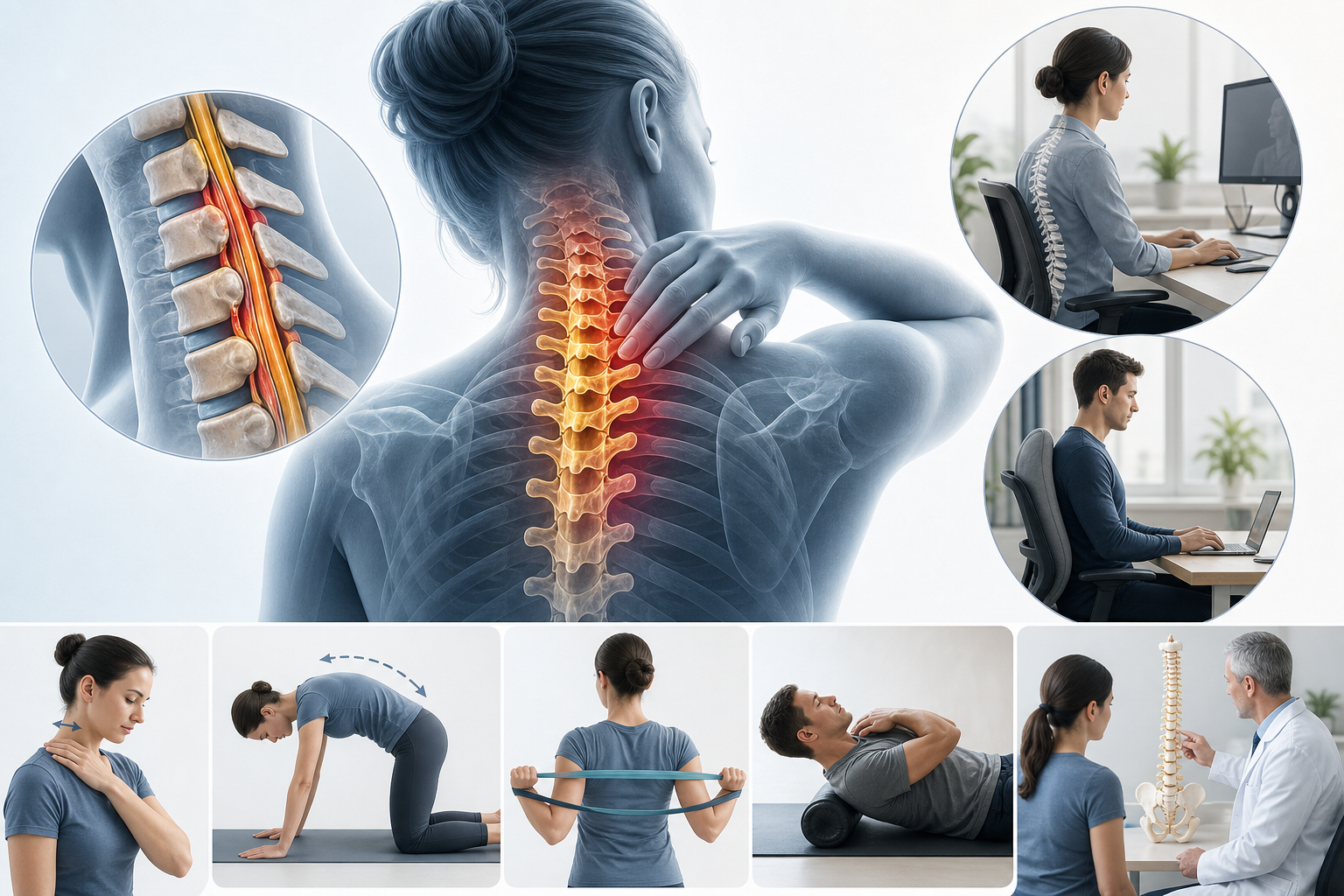
Living with Spinal stenosis, cervicothoracic region: A Comprehensive Guide starts with two priorities: protect your spinal cord and keep your neck–upper back moving without repeatedly loading the canal. Most people do best with a plan that combines posture changes, targeted mobility and strength work, and hands-on conservative care (PT and chiropractic) while watching for neurologic red flags.
If you want help deciding what fits your symptoms today, use the check your symptoms tool and bring the results to your next visit.
Understanding cervicothoracic spinal stenosis
Spinal stenosis means the space for nerves is narrowed. In the cervicothoracic region (roughly C7–T2), narrowing can affect the spinal cord and/or exiting nerve roots that travel toward the shoulder, arm, and upper trunk. Common contributors include disc height loss, joint (facet) arthritis, thickened ligaments, and posture-related load over time. Imaging (X-ray, MRI) can show narrowing, but your day-to-day function is guided by your neurologic exam: strength, reflexes, sensation, gait, and coordination.
What symptoms fit this region?
- Neck-to-upper back pain around the base of the neck and between the shoulder blades (often near T1–T3).
- Arm symptoms (tingling, numbness, heaviness) that may follow a dermatome pattern into the hand.
- Stiffness and limited ROM with looking up or turning.
- Balance or hand coordination changes (dropping objects, clumsy fingers) can suggest spinal cord involvement and needs prompt evaluation.
Red flags: when to seek urgent care
Get urgent medical evaluation the same day (ER/urgent care) if you develop any of the following, because they can signal cervical myelopathy or significant neurologic compromise:
- New or rapidly worsening weakness in the arm or hand (can’t grip, can’t lift the wrist, can’t raise the arm).
- New trouble walking, frequent tripping, or sudden balance decline.
- New loss of bowel or bladder control.
- Numbness spreading quickly or affecting both arms/legs.
Degenerative cervical myelopathy is a spinal cord condition where early recognition matters; neurologic changes (gait, hand dexterity, weakness) warrant prompt assessment. Source: National Institute of Neurological Disorders and Stroke (NINDS), Cervical Spondylosis.
Is cervicothoracic stenosis the same as a “pinched nerve”?
No. A “pinched nerve” usually means radiculopathy (a nerve root irritated/compressed). Cervicothoracic stenosis can cause radiculopathy, but it can also narrow space for the spinal cord, which is a different risk category. Your self-management should be more conservative if you have cord-type signs (balance/coordination changes) versus isolated arm symptoms.
Pattern What’s irritated Typical symptoms Common exam findings What you do first Radiculopathy Nerve root (C8/T1 often near cervicothoracic junction) Arm/hand tingling, numbness, shooting pain; may worsen with certain neck positions Dermatome sensory change, myotome weakness, reflex changes Posture + nerve-friendly ROM, scapular strength, PT/chiro evaluation Myelopathy Spinal cord Balance changes, hand clumsiness, diffuse numbness, weakness in multiple areas Gait change, hyperreflexia, coordination deficits Prompt medical assessment; conservative care only after clearance Referred pain Facet joints, discs, muscles Ache between shoulder blades; stiff neck; no clear nerve pattern Local tenderness, ROM limits; neuro exam normal Ergonomics, mobility, manual therapy, progressive strengtheningNeck pain and related disorders often respond to exercise and manual therapy when matched to the clinical presentation. Source: American Physical Therapy Association (APTA) clinical practice guidance for neck pain, summarized in the Orthopaedic Section CPG (JOSPT). See: JOSPT Neck Pain CPG.
Daily posture and ergonomic adjustments (the “canal-friendly” setup)
Your goal is to reduce repeated end-range neck loading, especially prolonged extension (looking up) and sustained forward head posture. At the cervicothoracic junction, the lower neck (C6–C7) and upper thoracic spine (T1–T3) often take the brunt when your thoracic spine is stiff and your shoulder blades don’t upwardly rotate well.
- Screen height: Put the top third of your monitor at eye level so you don’t crane your neck. Use a laptop stand + external keyboard if needed.
- Chin position: Keep a “long neck” (gentle chin tuck) rather than a forward head. Think: ears stacked over shoulders.
- Thoracic support: Use a small towel roll at mid-back (T6–T8) to reduce slump that forces the neck to compensate.
- Break schedule: Every 30–45 minutes, stand up for 60–90 seconds and do 3–5 slow neck turns each direction without forcing end range.
- Phone rule: Don’t pin the phone between ear and shoulder. Use speaker or earbuds.
Sleep positioning that usually helps
- Side-lying: Pillow height fills the space from shoulder to ear so your neck stays neutral (not bent down or up).
- Back-lying: Use a pillow that supports the curve of your neck without pushing your head forward; a small towel roll under the neck can help.
- Avoid: Stomach sleeping if it forces your neck into rotation for hours.
Ergonomic positioning and frequent movement breaks reduce sustained spinal loading, which is a consistent recommendation across occupational health guidance. Source: CDC/NIOSH ergonomics resources: NIOSH Ergonomics.
Gentle mobility and strengthening exercises (step-by-step)
Exercise should create a “better after” effect within 24 hours: less stiffness, easier ROM, fewer arm symptoms. If symptoms spike and stay elevated into the next day, reduce range, reps, or frequency. Most people start with 6–8 sessions of guided PT over 3–6 weeks, then shift to a home plan 4–5 days/week.
Home protocol: 10–12 minutes, 5 days/week
- Chin tuck (deep neck flexor activation): Sit tall. Glide your chin straight back (not down). Hold 3 seconds. Do 8–10 reps. You should feel light work in the front of the neck, not pain.
- Thoracic extension over a towel roll: Place a rolled towel horizontally under mid-back (not the neck). Support your head with hands. Gently extend over the roll 5–8 times, staying comfortable.
- Scapular retraction + depression: Stand with arms at sides. Pull shoulder blades “back and down” (toward back pockets). Hold 2 seconds. Do 10–12 reps.
- Wall slide (serratus anterior + upward rotation): Forearms on wall, elbows bent. Slide arms upward while keeping ribs down. Do 8–10 reps. Stop if you get arm tingling that increases with each rep.
- Nerve glide (only if your provider confirms radicular pattern): With arm out to the side at shoulder height, gently extend wrist and then relax; keep it small and smooth. Do 5–8 reps. This should not reproduce sharp pain.
Key anatomy you’re training: deep neck flexors (longus colli/capitis), serratus anterior, and lower trapezius. These muscles unload the cervicothoracic junction by improving head position and shoulder blade mechanics.
Exercise focus Primary structures Expected change Typical timeline Chin tucks + endurance Deep neck flexors; cervical segments C4–C7 Less forward head load; improved ROM tolerance Noticeable control change in 2–3 weeks with 5x/week practice Thoracic mobility T1–T8; costovertebral joints Less compensatory neck extension Stiffness reduction often within 1–2 weeks Scapular strength Serratus anterior, lower trap, rhomboids Less upper trap overuse; better posture endurance Strength gains typically 4–8 weeksConservative pain management techniques that fit chiropractic and PT care
Conservative care aims to improve motion where you’re stiff, build capacity where you’re weak, and calm irritable tissues without provoking neurologic symptoms. The best plan depends on whether your main driver is joint stiffness, disc-related irritation, or nerve sensitivity.
- Physical therapy: progressive exercise (deep neck flexor endurance, scapular control), graded exposure to ROM, and symptom-guided nerve mobilization when appropriate.
- Chiropractic care: targeted manual therapy to cervicothoracic and thoracic segments to improve joint mobility; technique selection should match your neurologic status. If you have signs of cord involvement, your provider should coordinate medical evaluation before high-velocity techniques.
- Soft tissue work: manual therapy to upper trapezius, levator scapulae, and scalenes can reduce protective tone that restricts ROM.
- Heat vs. ice: heat often helps stiffness (10–15 minutes), while ice can help after activity flare-ups (10 minutes). Pick the one that improves your ROM afterward.
Exercise therapy and manual therapy are commonly recommended conservative strategies for mechanical neck pain and related disorders when tailored to classification and irritability. Source: JOSPT Neck Pain CPG: .
When should you consult a spinal health provider?
Consult a provider if your symptoms last more than 2–4 weeks despite consistent home care, if you have arm numbness/tingling that doesn’t centralize (move out of the arm toward the neck) with position changes, or if strength is declining. Earlier evaluation is smart if your work requires overhead tasks, driving, or lifting, because small ergonomic changes can prevent repeated flare-ups.
What to expect at a first visit
- Neurologic screen: myotomes (strength), dermatomes (sensation), reflexes, coordination, and gait.
- ROM testing: cervical rotation/side-bend/extension, plus thoracic mobility.
- Provocation tests: to differentiate radiculopathy vs referred pain patterns.
- Plan with dosage: an actual schedule (example: 2 visits/week for 3 weeks, then reassess) plus a home program with reps and stop rules.
Bring these details so your provider can move faster:
- Which fingers go numb (thumb/index vs ring/small finger matters for nerve level).
- What position changes symptoms fastest (looking up, turning, sitting, driving).
- Any balance changes or hand clumsiness (don’t minimize this).
What to Do Next
Start with a 14-day trial: fix workstation height, take movement breaks every 30–45 minutes, and perform the 10–12 minute home protocol 5 days/week. If you improve within 2 weeks, keep progressing (more reps, better control, longer posture endurance). If you do not improve, schedule an evaluation to confirm whether you’re dealing with radiculopathy, myofascial overload, or possible cord involvement.
- Routine care: For persistent stiffness, posture intolerance, or intermittent arm tingling without weakness, book a visit with a PT or chiropractor. Use Medximity to find a physical therapy near you or find a chiropractor near you.
- Urgent care today: New weakness, worsening balance, new coordination problems, or bowel/bladder changes need urgent medical evaluation.
- Keep learning: explore more health topics and browse providers if you want to compare specialties and visit types.
If you want a fast triage before booking, use the check your symptoms tool and bring the summary to your appointment.
FAQ: Living with cervicothoracic spinal stenosis
How many PT visits are typical for cervicothoracic stenosis?
Many plans start with 6–8 PT sessions over 3–6 weeks, then reassess ROM, strength, and neurologic signs. If you’re improving, visits often taper while you continue home exercise 4–5 days/week.
Which exercises should you avoid with cervicothoracic stenosis?
Avoid repeated end-range neck extension (sustained looking up), heavy overhead pressing, and any movement that reliably increases arm numbness or weakness. Modify first by reducing range and load; if symptoms persist, stop and get evaluated.
Can posture changes really affect stenosis symptoms?
Yes. Posture doesn’t “reverse” narrowing, but it changes mechanical load on cervical segments and can reduce nerve irritation. Forward head posture increases demand on the lower cervical spine and often aggravates C7–T1 mechanics.
What does it mean if numbness moves out of your arm and closer to your neck?
That pattern is often called “centralization” and can be a good sign that nerve irritation is calming with the right direction of movement. A provider can confirm whether the pattern matches radiculopathy and adjust your home program.
When is cervicothoracic stenosis an emergency?
It’s urgent if you develop new or worsening weakness, walking/balance changes, hand clumsiness, or bowel/bladder control changes. Those signs can indicate spinal cord involvement and require same-day medical evaluation.