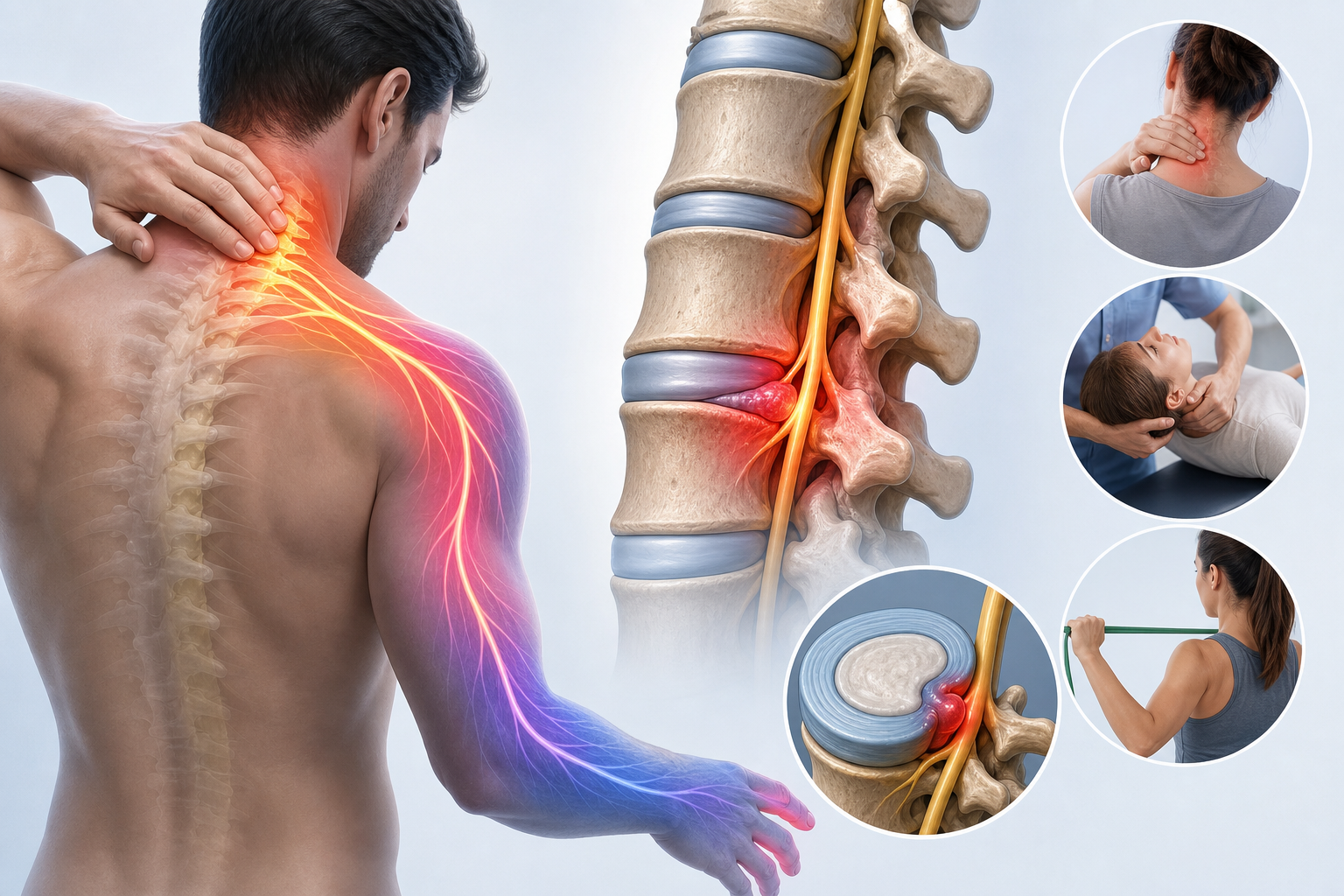
Understanding Cervical disc disorder with radiculopathy: Symptoms, Causes, and Treatment starts with one core fact: a cervical disc in your neck irritates or compresses a nerve root, so pain, tingling, numbness, or weakness can travel from the neck into the shoulder, arm, or hand. Most cases improve with structured rehab, activity modification, and time, but you need to recognize red flags and match treatment to the exact nerve pattern. This guide explains what radiculopathy is, how to tell it from other problems, and what conservative care typically looks like.
What is cervical disc disorder with radiculopathy?
Cervical disc disorder with radiculopathy means the disc between two neck vertebrae (commonly C5–C6 or C6–C7) is contributing to nerve root irritation, producing symptoms along that nerve’s distribution. The disc can irritate the nerve through a bulge/herniation, inflammation, or reduced disc height that narrows the exit tunnel (foramen). The nerve root is the key structure: when it’s sensitized, symptoms often “shoot” or radiate beyond the neck.
Three anatomical structures drive most symptom patterns: the intervertebral disc, the cervical nerve root, and the neural foramen. Symptoms can also be influenced by the facet joints and the spinal cord (cord involvement changes the urgency; see red flags below).
- Disc: the annulus (outer ring) can fissure; the nucleus (inner material) can bulge outward.
- Nerve root: carries sensation and motor signals to specific muscles (myotomes) and skin zones (dermatomes).
- Foramen: the bony tunnel where the nerve exits; it can narrow with posture, disc height loss, or arthritic change.
Population data suggests cervical radiculopathy occurs on the order of ~80–100 per 100,000 people per year in classic epidemiology studies, with many cases improving without invasive care (e.g., Radhakrishnan et al., epidemiology of cervical radiculopathy, Spine).
If you want to sanity-check whether your symptoms fit a nerve pattern before booking, use check your symptoms.
What symptoms should you expect (and which nerve level is involved)?
Cervical radiculopathy symptoms follow a repeatable map: neck pain plus arm symptoms that match a specific nerve root. The most common findings are radiating pain, pins-and-needles, numbness, and measurable weakness in certain muscle groups.
Typical symptom patterns by nerve root
- C5: pain into the lateral shoulder; weakness with shoulder abduction (often deltoid); sensory changes over the lateral upper arm.
- C6: pain into the lateral forearm and thumb; weakness with elbow flexion or wrist extension; sensory changes in thumb/index side.
- C7: pain into the middle finger; weakness with elbow extension (triceps) or wrist flexion; sensory changes in the middle finger.
- C8: pain into the ring/small finger; weakness with finger flexors/hand grip; sensory changes in the ulnar hand.
What makes it more likely to be radiculopathy than a “neck strain”
- Symptoms travel below the elbow (common with C6–C8 involvement).
- Coughing/sneezing/straining spikes arm symptoms (increases pressure and nerve sensitivity).
- Specific positions change symptoms fast (for example, looking up/turning toward the painful side can worsen; gentle traction or unloading can ease).
Clinical practice guidelines for neck pain with radiating pain emphasize using symptom distribution, neurologic testing (strength/reflex/sensation), and provocation/relief tests to classify radicular presentations (APTA/JOSPT Neck Pain CPG). Source: JOSPT 2017 Neck Pain Clinical Practice Guidelines.
Expect day-to-day variability early on. A common timeline is that arm pain is sharper in the first 1–3 weeks, then gradually centralizes (moves back toward the neck) over 4–8 weeks with the right loading and posture strategy.
What causes cervical disc-related radiculopathy?
Cervical disc-related radiculopathy usually comes from one of two mechanisms: an acute disc injury (often flexion/rotation load) or gradual degenerative change that narrows space for the nerve root. Both can coexist.
- Acute disc herniation: a sudden increase in disc pressure (heavy lifting with neck flexion, awkward sleep posture, impact) can irritate the annulus and provoke chemical inflammation around the nerve root.
- Disc height loss + foraminal narrowing: reduced disc height and joint changes can decrease foraminal space, especially with extension/rotation postures.
- Posture and sustained positions: prolonged forward head posture can increase load on lower cervical segments (often C5–C7) and irritate sensitized tissues.
- Repeated micro-load: frequent end-range neck extension (overhead work) can aggravate foraminal narrowing patterns.
Degenerative changes in the cervical spine (disc height loss, uncovertebral/facet changes) are common with age, and imaging findings do not always match symptoms. Use imaging to answer specific questions, not to “grade pain.” Source: NIAMS: Cervical spondylosis.
Disc-related radiculopathy is mechanical and inflammatory. That’s why treatment focuses on reducing nerve irritation, restoring motion without provoking symptoms, and re-loading the neck/shoulder girdle progressively.
How do you know it’s radiculopathy and not shoulder, carpal tunnel, or something more serious?
You confirm radiculopathy by matching symptoms to a nerve root pattern and reproducing/relieving symptoms with specific tests, then ruling out major mimics. A clinician typically combines history, neurologic exam, and provocation tests rather than relying on one test.
Common clinical tests used in conservative care
- Spurling’s test: extension/side-bend/rotation with gentle compression may reproduce arm symptoms (suggests nerve root irritation).
- Distraction test: gentle traction may reduce symptoms (supports radicular involvement).
- Upper limb tension tests (median/radial/ulnar bias): may reproduce neural symptoms when the nerve is sensitized.
- Myotomes/reflexes: triceps reflex (often C7), biceps reflex (often C5–C6), strength testing of deltoid, wrist extensors, triceps, and hand intrinsics.
Red flags: seek urgent evaluation now if you have any of the following:
- New or rapidly worsening weakness (dropping objects, wrist/finger “giving out”) over 24–72 hours
- Loss of balance, clumsy hands, or new bowel/bladder control changes (possible spinal cord involvement)
- Severe pain with fever, unexplained weight loss, or recent significant trauma
Progressive neurologic deficit and signs of myelopathy warrant urgent medical evaluation. Source: AANS: Cervical radiculopathy.
What conservative treatments work best (PT, chiropractic, traction, exercise)?
Effective conservative care targets three levers: reduce nerve root sensitivity, restore cervical/thoracic motion that you can control, and build endurance in the neck and shoulder girdle so symptoms don’t keep flaring. Most people start with 6–12 visits over 4–8 weeks, then taper as home work takes over.
- Physical therapy: directional preference exercises (often repeated retraction/extension variants, adjusted to your response), neural mobilization, scapular stabilization, deep neck flexor endurance, and graded return to lifting.
- Chiropractic care: joint-specific mobilization/manipulation when appropriate, often combined with exercise prescription and ergonomic changes. A good plan avoids repeatedly provoking arm symptoms.
- Mechanical or manual traction: can reduce symptoms in select cases, especially when distraction relieves pain during exam. Dosage varies; a common clinic starting point is short bouts (e.g., 10–15 minutes) paired with exercise.
- Manual therapy for thoracic spine: improving upper thoracic extension can reduce neck load during desk work and overhead tasks.
Neck pain with radiating pain responds best to a combined approach: exercise plus manual therapy, with traction considered for some patients. Source: APTA/JOSPT Neck Pain CPG.
To find the right clinician for this mix of care, use find a physical therapy near you or find a chiropractor near you.
Which home program reduces arm symptoms without flaring them?
A home program works when it changes symptoms within minutes (centralization, less tingling, less arm pain) and keeps you functional between visits. Stop any drill that makes symptoms spread farther down the arm and does not settle back to baseline within 15–20 minutes.
Home protocol: “Unload → reset → reinforce” (10–12 minutes, 2–4x/day)
- Unload the nerve (2 minutes): sit tall with forearms supported on armrests or pillows. Keep the neck neutral (not flexed). Take 6 slow breaths. Goal: reduce baseline arm symptoms.
- Cervical retraction (2 sets of 10): slide your head straight back (make a “double chin”) without tilting up or down. Hold 1 second each rep. If arm symptoms reduce or move closer to the neck, you’re on the right track.
- Scapular setting (2 sets of 8): gently pull shoulder blades back and slightly down (think “back pockets”), keep ribs down, hold 3 seconds. This targets mid/lower trapezius and reduces upper trap overwork.
- Nerve glide (1 set of 8 each side, gentle): with your arm out to the side, slowly open/close the elbow or wrist while keeping symptoms mild (0–3/10). This is not a stretch; it’s a glide. Stop if tingling ramps up and lingers.
- Chin-tuck endurance (3 holds of 10 seconds): lie on your back, small chin tuck, hold without shaking or holding your breath. This trains deep neck flexors.
- Desk rule: every 30–45 minutes, stand up and do 10 retractions.
- Sleep rule: keep the neck neutral; avoid stomach sleeping if it forces rotation/extension.
- Car rule: raise the seat back more upright; bring the steering wheel closer so your shoulders don’t round forward.
Self-management strategies that reduce sustained end-range loading and emphasize repeated movements matched to symptom response are commonly used in evidence-based PT for neck-related arm pain. Source: JOSPT CPG (link above).
If you want more condition guides and self-care checklists, explore more health topics.
How long does recovery take, and what predicts a slower course?
Most cervical radiculopathy episodes improve with conservative care, but the timeline depends on how irritable the nerve is and whether you can consistently avoid the positions that provoke it. Two practical timelines help you plan:
- Early improvement window: you should usually see a measurable change (less distal tingling, better sleep positioning tolerance, improved ROM) within 2–4 weeks of a matched plan.
- Functional recovery window: strength and endurance commonly take 6–12 weeks to rebuild, especially for grip, triceps, and scapular stabilizers.
Expect weakness to lag behind pain relief. Nerves calm down faster than muscles recondition.
Finding What it often means How you adjust the plan Symptoms centralize (arm pain retreats toward neck) Nerve irritation is decreasing Continue directional exercises; progress strengthening Symptoms peripheralize (spread farther down the arm) Too much loading or wrong direction Reduce intensity/range; emphasize unloading and gentle resets Persistent objective weakness after 4–6 weeks Motor involvement needs closer monitoring Re-test myotomes weekly; consider medical referral for further evaluation Signs of myelopathy (balance/hand dexterity changes) Possible spinal cord involvement Urgent medical evaluationMany cases of cervical radiculopathy improve over time with nonoperative management; monitoring neurologic status is essential. Source: AANS.
If you’re unsure whether your pattern is neck-driven or peripheral nerve-driven, start with browse providers and look for clinicians who document dermatomes/myotomes, reflexes, and objective outcome measures.
FAQ: Cervical disc disorder with radiculopathy
Can a cervical disc cause tingling in your hand?
Yes. A sensitized cervical nerve root can create tingling or numbness in the hand in a dermatomal pattern (commonly thumb/index for C6, middle finger for C7, ring/small finger for C8). If tingling changes quickly with neck position, radiculopathy becomes more likely.
Is an MRI always needed?
No. Many cases are diagnosed clinically with a neurologic exam and symptom behavior. Imaging is most useful when symptoms are severe, not improving after a reasonable trial of conservative care (often 4–6 weeks), or when red flags are present. Imaging findings can appear in people without symptoms, so results must match your exam.
What movements should you avoid?
Avoid repeated end-range neck extension/rotation toward the painful side if it peripheralizes symptoms (arm pain moves farther down). Avoid prolonged forward head posture if it increases tingling. Replace “avoid forever” with “avoid during irritability,” then reintroduce gradually as symptoms centralize.
Does traction help cervical radiculopathy?
Traction helps a subset of people, especially when your symptoms reduce during a distraction test or when unloading positions reliably ease arm pain. Use traction to create a window for exercise, not as a stand-alone plan.
When is weakness an emergency?
Seek urgent evaluation if weakness is new and rapidly worsening over 24–72 hours, if you cannot extend the wrist/fingers, if you’re dropping objects suddenly, or if weakness comes with balance problems or clumsy hands.
What to Do Next
Start with a conservative evaluation that includes dermatomes, myotomes, reflexes, ROM, and symptom response to repeated movements. A plan should give you a home protocol on day one and a clear re-test schedule for strength and sensation.
- Best provider types to start with: physical therapist, chiropractor, or rehabilitation-focused provider experienced in neck-related arm pain.
- What to expect at the first visit: neurologic screen (strength/reflex/sensation), provocation/relief testing (e.g., Spurling/distraction), a directional exercise trial, and a written home plan with dosage.
- Seek urgent care: rapidly worsening weakness, new balance/coordination problems, bowel/bladder changes, fever with severe pain, or major trauma.
- Routine follow-up: stable symptoms that improve week to week, even if slowly, usually stay in conservative care with progressive loading.
Find local help here: find a physical therapy near you and find a chiropractor near you. If you want to compare options and availability across specialties, browse providers. For more rehab-focused education, explore more health topics or check your symptoms.