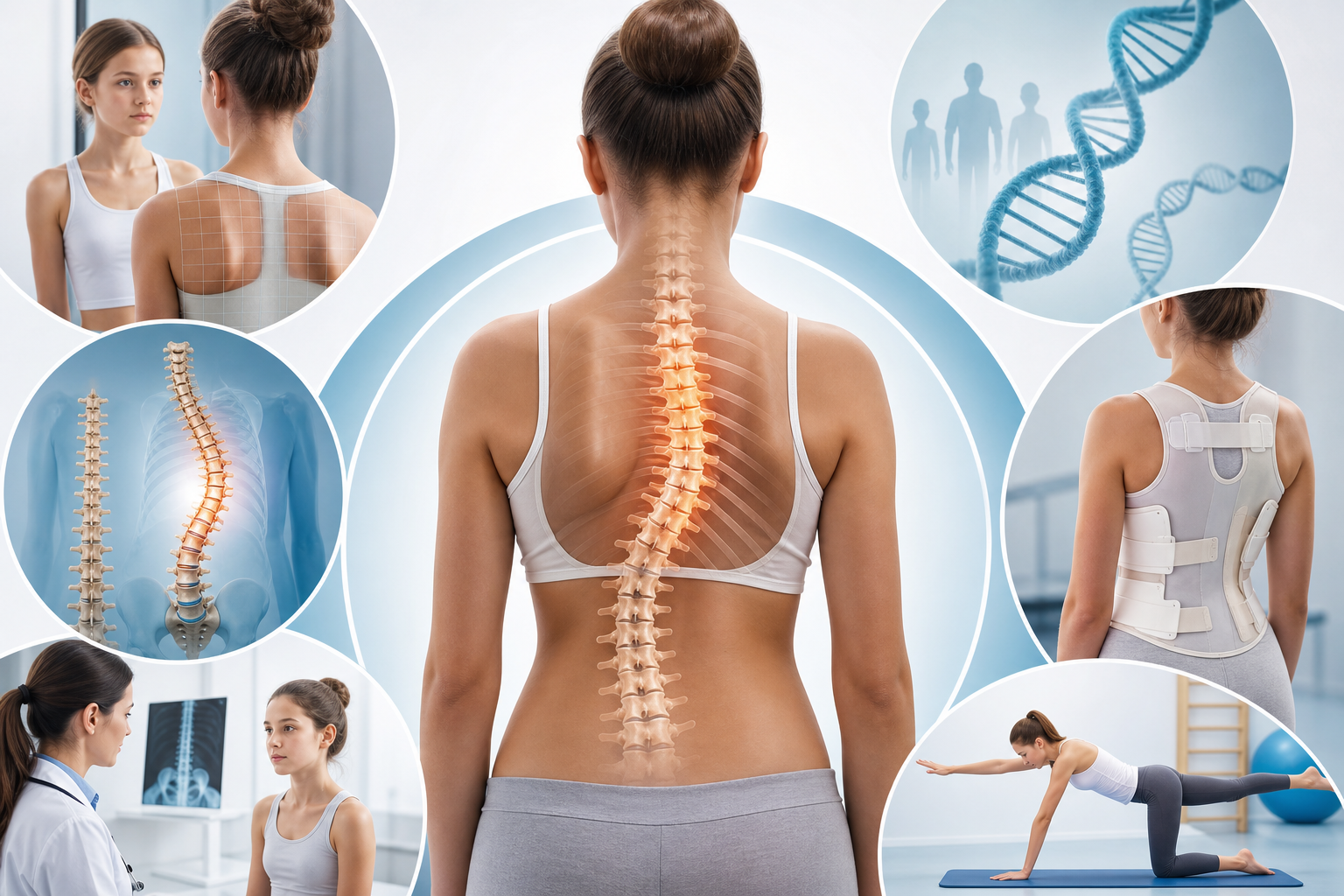
Understanding Adolescent idiopathic scoliosis, thoracic region: Symptoms, Causes, and Treatment starts with one key fact: this is a side-to-side spinal curve in the mid-back (thoracic spine) that appears in otherwise healthy adolescents, most often during growth spurts. You can’t “stretch it out” overnight, but early identification plus the right conservative plan can slow progression, improve posture mechanics, and reduce activity-related discomfort. Most care focuses on measurement (Cobb angle), growth risk, and targeted exercise-based rehab rather than quick fixes.
What Is Adolescent Idiopathic Scoliosis (AIS) in the Thoracic Region?
Adolescent idiopathic scoliosis (AIS) means a spinal curve that develops after age 10 with no single known cause; thoracic scoliosis means the main curve is in the mid-back, typically between T4–T12 vertebrae. Clinically, scoliosis is defined as a curve of ≥10 degrees on an upright X-ray measured by the Cobb angle. This definition and the Cobb method are standard in orthopedic and spine guidelines. Source: Scoliosis Research Society (SRS), patient and professional education materials ().
- Thoracic spine: the rib-bearing portion of your spine; curves here can create rib prominence because ribs rotate with the vertebrae.
- Scapula (shoulder blade): may look more prominent on one side due to trunk rotation and shoulder girdle positioning.
- Ribs: may form a “rib hump” on forward bend because the thoracic vertebrae and ribs rotate together.
AIS is common enough that school or sports physicals sometimes pick it up, but the gold standard for diagnosis remains a clinical exam plus imaging when indicated. Prevalence estimates vary by curve size; small curves are more common than larger ones. Source: U.S. National Library of Medicine/NIH overview and epidemiology summaries ().
How Do You Recognize the Signs? Common Symptoms and “Look Test” Clues
Early thoracic AIS often has no pain; the most reliable early clues are visual asymmetries and changes during growth. You can screen at home, but a provider should confirm findings and decide whether imaging is needed.
Visual signs you can check in 60 seconds
- Uneven shoulders or one shoulder blade sticking out more.
- Uneven waistline or one side of the ribcage appearing more prominent.
- Shirt hang: clothing drifts to one side or hems look uneven without a clear reason.
Movement-based sign: Adam’s forward bend test
- Stand with feet hip-width apart.
- Bend forward slowly as if touching toes; keep knees straight but not locked.
- Look from behind: a rib hump or one side of the mid-back higher suggests trunk rotation.
Symptoms that can occur (especially with larger curves or heavy training loads) include mid-back fatigue, shoulder blade area tightness, or reduced endurance with prolonged sitting. If pain is severe, constant, or waking you at night, don’t assume AIS is the cause; get assessed.
Curves are tracked by Cobb angle on standing X-ray; progression risk is tied to growth remaining and curve magnitude. Source: AAOS OrthoInfo on scoliosis ().
What Causes Thoracic AIS? Known Risk Factors and What “Idiopathic” Actually Means
“Idiopathic” means there isn’t a single identifiable trigger like a fracture or congenital vertebral anomaly. Research supports a multi-factor model involving genetics, growth, and neuromuscular control of posture, but you can’t point to one sport, one backpack, or one sleeping position as “the cause.” Source: Scoliosis Research Society (SRS) ().
- Growth spurts: curves most often appear or progress during rapid height changes (commonly early-to-mid adolescence).
- Family history: AIS tends to run in families, suggesting genetic contribution.
- Sex: mild curves occur in all sexes, but clinically significant progression is more common in females in many cohorts.
Thoracic curves also tend to show more visible rib prominence because of vertebral rotation and rib mechanics. That’s anatomy, not a “posture habit.” Posture training still matters, but it’s not the root cause.
What Conservative Treatments Help Thoracic AIS?
Conservative care for thoracic AIS targets three outcomes: (1) reduce progression risk when possible, (2) improve trunk control and function, and (3) manage discomfort from muscle imbalance and loading. Your plan depends on Cobb angle, skeletal maturity (growth remaining), curve pattern, and how fast the curve is changing. Source: AAOS OrthoInfo; SRS guidance ().
Physical therapy and scoliosis-specific exercise (PSSE)
- Goal: train active self-correction, breathing mechanics, and endurance for spinal stabilizers (including multifidus, erector spinae, and abdominal wall).
- Common protocols: Schroth-based methods and other PSSE systems used internationally; evidence supports improved posture control and quality-of-life measures, and may help in some cases when combined with other management.
- Typical timeline: 6–12 PT visits over 6–10 weeks to learn technique, then a home program 4–6 days/week for 10–20 minutes.
Chiropractic care (supportive, not “curve erasing”)
- Goal: improve thoracic and rib mobility, address mechanical stiffness, and support better movement patterns for sport and daily activity.
- Best use: paired with exercise therapy and posture retraining; use objective re-checks (ROM, strength, function) rather than promises about angle changes.
- Typical timeline: 4–8 visits over 4–6 weeks for mobility + exercise coaching, then re-check.
Bracing (non-invasive, often used when curves are moderate and growth remains)
Bracing is conservative care and is commonly recommended when a curve reaches a moderate range and the adolescent is still growing. The goal is to reduce progression risk during growth, not to “fix it forever” in a few weeks. Source: NIH-funded BrAIST trial (NEJM) showing bracing reduced progression to severe thresholds in many participants ().
- Typical wear: often many hours/day depending on prescription and curve risk (your orthotist/provider sets this).
- Typical follow-up: re-check every 4–6 months during growth, sooner if rapid height changes occur.
Home Program: A Simple Thoracic Self-Correction Routine (10 Minutes)
This routine trains mid-back extension control, scapular positioning, and breathing mechanics. Stop if symptoms spike, and get coached by a PT or scoliosis-trained provider for curve-specific corrections.
- Wall posture reset (2 minutes): Stand with heels 2–3 inches from a wall. Lightly tuck chin (don’t jam neck). Reach the crown of your head up. Exhale fully, then inhale into the sides/back of the ribcage. Do 6 slow breaths.
- Thoracic extension on a rolled towel (3 minutes): Lie on your back with a towel roll across the mid-back (not the low back). Support head with hands. Take 6–8 slow breaths, letting the ribs expand without flaring the low ribs.
- Scapular control: prone “Y” and “T” (3 minutes): Lie face down. Lift arms into a “Y” for 6 reps, then a “T” for 6 reps. Keep shoulders away from ears. Move slowly.
- Side plank modification (2 minutes): Knees bent, elbow under shoulder. Hold 2 sets of 15–25 seconds each side, focusing on a straight line from shoulder to knee.
Re-check point: if you can’t maintain form by week 2, reduce holds by 25% and focus on breathing and alignment first.
Treatment Comparison Table: What to Expect and How Long It Takes
Treatment Best for Expected outcomes Typical timeline Observation + re-checks Small curves, low progression risk Track Cobb angle and growth; intervene if progression occurs X-ray/clinical re-check often every 4–6 months during growth (AAOS) PT with PSSE (e.g., Schroth-based) Posture control, function, mild-to-moderate curves Better trunk control, endurance, symptom management; may support stabilization 6–12 visits over 6–10 weeks + home program 10–20 min, 4–6 days/week Bracing Moderate curves with growth remaining Reduced progression risk during growth (BrAIST/NEJM) Often months to years during growth; follow-ups every 4–6 months Chiropractic care + exercise Mobility limits, mechanical stiffness, sport-related loading issues Improved ROM, movement tolerance, and adherence to exercise plan 4–8 visits over 4–6 weeks, then re-check and taperWhen Should You See a Provider (and What Are Red Flags)?
See a provider promptly if you notice asymmetry plus active growth, or if a screen suggests trunk rotation. Earlier assessment matters because progression risk is highest while growth plates are still open.
- Routine appointment (within 2–4 weeks): uneven shoulders/waist, rib prominence on forward bend, or a prior mild curve that hasn’t been checked in 6+ months during a growth spurt.
- Faster appointment (within 48–72 hours): rapid visible change over weeks, new limitation in sport due to back fatigue, or persistent pain with training that doesn’t improve after 7–10 days of load reduction.
Red flags (urgent evaluation today): new leg weakness, numbness spreading down the legs, loss of balance, or bowel/bladder control changes. These are not typical AIS findings and need urgent assessment. Source: NIH/NINDS and major orthopedic guidance on neurologic warning signs ().
AIS management decisions typically use Cobb angle plus skeletal maturity (growth remaining) because those two factors predict progression risk. Source: AAOS OrthoInfo ().
What to Do Next
Start with an exam that measures posture, trunk rotation, shoulder/scapular position, thoracic ROM, and core endurance, then match care to curve risk.
- If you want conservative care coaching: find a physical therapy near you for PSSE-style training, strength progression, and a home program you can actually follow.
- If you need mobility + movement tolerance support: find a chiropractor near you for thoracic/rib mechanics work paired with exercise instruction.
- If you’re not sure what you’re seeing: use check your symptoms to organize what you’ve noticed (asymmetry, growth changes, activity limits) before booking.
- If you want to compare local options: browse providers and look for scoliosis-specific rehab experience (PSSE/Schroth training listed, adolescent spine focus, clear re-check intervals).
- If you want more related guidance: explore more health topics on posture, back mechanics, and rehab basics.
Bring two data points to the first visit: (1) when the asymmetry was first noticed, and (2) whether height has changed in the last 3–6 months. Ask for a clear plan with re-check timing (often 4–6 months during growth) and objective milestones (ROM, plank time, scapular control, and adherence targets).