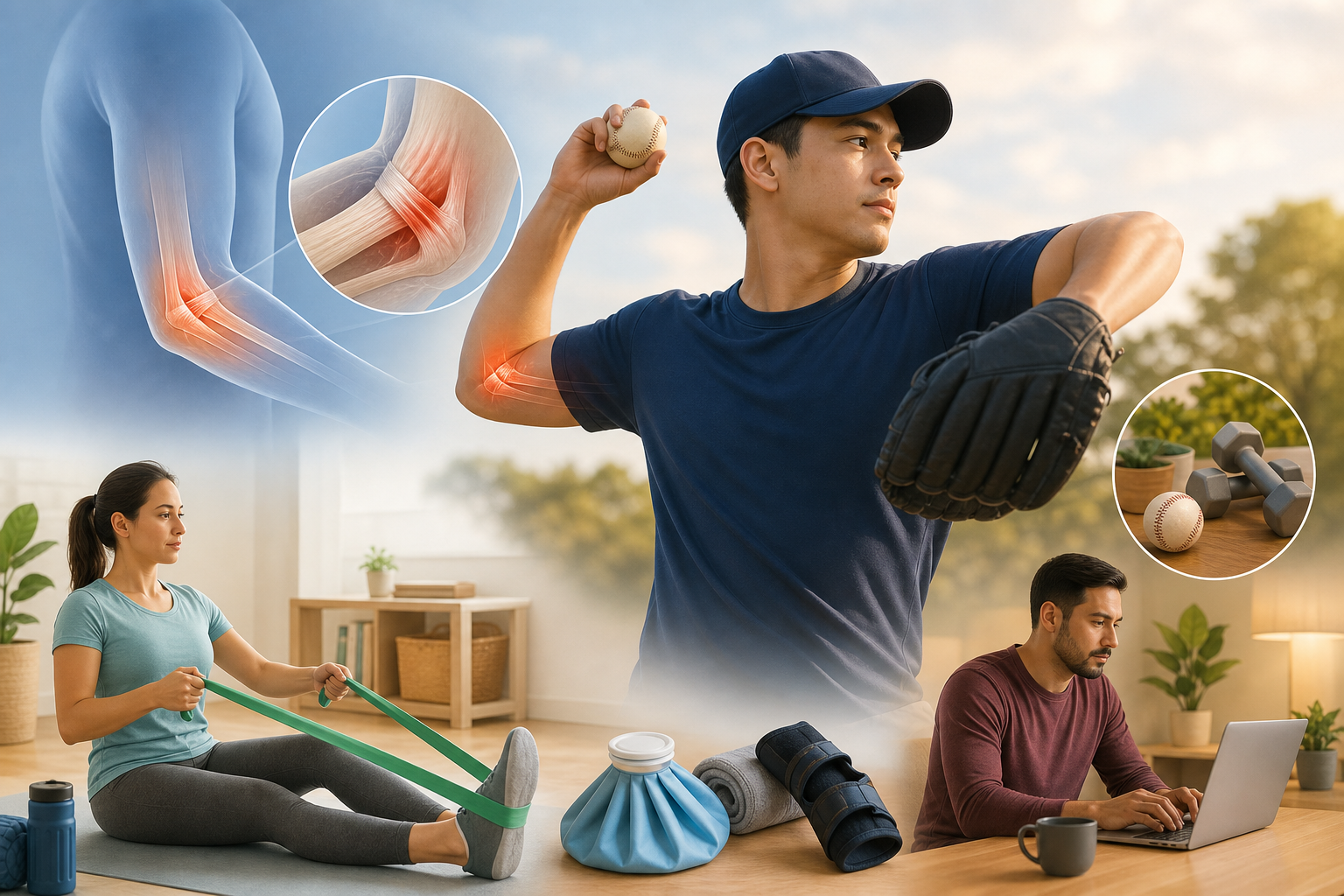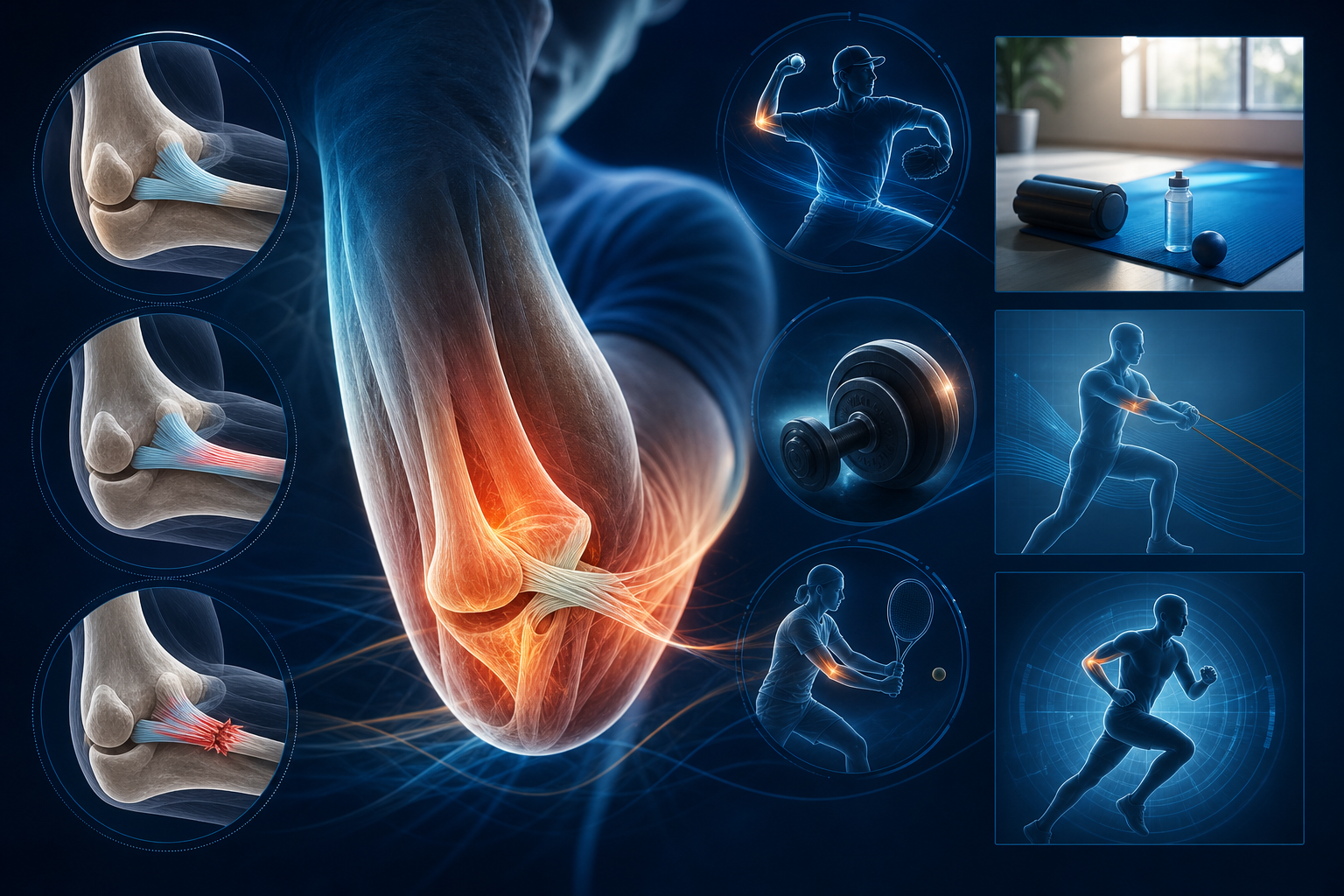
Right Elbow Ulnar Collateral Ligament Tear: What Patients Need to Know starts with one key fact: the UCL is the main ligament that stabilizes the inner side of your elbow during throwing, lifting, gripping, and pushing. A tear means the ligament fibers on the inside of the right elbow are stretched, partially disrupted, or fully disrupted, which can cause inner elbow pain, weakness, loss of throwing control, or a feeling that the elbow is not stable.
You need an in-person exam to confirm the injury. Mild sprains often improve with relative rest and progressive rehab over 2–6 weeks, while partial tears commonly require 8–12 weeks or longer of structured physical therapy, strength work, and return-to-activity planning.
What Is a Right Elbow Ulnar Collateral Ligament Tear?
A right elbow ulnar collateral ligament tear is an injury to the ligament complex on the inside, or medial side, of the right elbow. The UCL connects the medial epicondyle of the humerus to the ulna, including the sublime tubercle near the coronoid process. Its main job is to resist valgus stress, which is the force that pushes the forearm away from the body while the upper arm stays fixed.
If you searched “what is elbow UCL tear,” think of it as a stabilizer failure at the inner elbow. The ligament may be stretched, partially torn, or fully disrupted. The injury is common in throwing athletes, but it also occurs with lifting strain, falls, repetitive work tasks, and sudden traction to the elbow.
- Location: inner elbow between the humerus and ulna.
- Main stress: valgus load during throwing, pushing, or bracing.
- Common symptoms: medial elbow pain, grip weakness, throwing loss, or instability.
- Common tissues involved: UCL, flexor-pronator mass, ulnar nerve, joint capsule.
A UCL tear is different from tennis elbow pain, which usually affects the outer elbow near the lateral epicondyle. Inner elbow pain needs a different exam because ligament stability, nerve symptoms, and throwing mechanics matter.
What Does the Elbow UCL Do and Why Does It Matter?
The elbow UCL keeps the ulna from gapping away from the humerus when force crosses the elbow. During a throw, the shoulder externally rotates, the forearm lags behind, and the inner elbow absorbs high valgus load before ball release. The UCL works with the flexor carpi ulnaris, flexor digitorum superficialis, pronator teres, and joint capsule to control that force.
The UCL has 3 main parts
- Anterior bundle: the primary restraint during throwing and overhead activity.
- Posterior bundle: contributes more when the elbow is flexed deeply.
- Transverse bundle: provides limited valgus stability because it runs between points on the ulna.
The anterior bundle matters most for patients with pain inside elbow when throwing. If this section loses tension or tears, the elbow may feel loose during acceleration, follow-through, loaded carries, or push-up positions.
Biomechanics research on overhead throwing shows that the medial elbow can experience valgus forces near or above the estimated strength of the native UCL during high-velocity pitching, which explains why fatigue and poor mechanics increase injury risk.
The ulnar nerve also runs close to the medial elbow in the cubital tunnel. A UCL injury can irritate this nerve, causing tingling into the ring finger and small finger. Nerve symptoms change the urgency of evaluation because they suggest more than a simple muscle strain.
What Causes a Right Elbow UCL Tear?
Most right elbow UCL tears happen from either repetitive valgus loading or one sudden overload. Throwing is the classic cause, but the same ligament can be stressed by heavy lifting, gripping under load, bracing during a fall, or repetitive work with the forearm turned outward.
Common causes by activity
- Baseball and softball: pitching, long throws, high pitch counts, fatigue, and poor trunk-hip sequencing.
- Javelin, tennis, volleyball, and football: rapid arm acceleration with valgus stress at the elbow.
- Weight training: heavy pressing, pull-ups, cleans, farmer carries, and loaded positions with elbow drift.
- Work tasks: repeated gripping, tool use, pulling, lifting, or pushing with the wrist flexors overactive.
- Falls or sudden traction: landing on an outstretched hand or having the arm pulled away from the body.
Fatigue changes mechanics. When the rotator cuff, scapular stabilizers, trunk, and hips stop sharing load, the elbow absorbs more force. The latissimus dorsi, lower trapezius, serratus anterior, and gluteal muscles influence elbow stress because throwing and lifting are full-chain movements, not isolated elbow motions.
You should not assume the ligament is torn only because the elbow hurts. Medial epicondyle irritation, flexor-pronator strain, cubital tunnel irritation, cervical referral, and joint stiffness can mimic UCL symptoms. A provider exam separates likely ligament injury from other sources of inner elbow pain.
How Do You Know If Symptoms Point to an Elbow UCL Injury?
Elbow UCL symptoms usually cluster around inner elbow pain, instability, and loss of performance under load. Pain inside elbow when throwing is the most common complaint, especially during the acceleration phase. Some patients describe a pop, a sharp medial elbow pain, or loss of velocity and control.
Patient-friendly symptom checklist
- Pain on the inside of the right elbow during throwing, lifting, pushing, or gripping.
- Tenderness near the medial epicondyle or just below it on the ulna.
- A feeling that the elbow opens, shifts, or cannot hold force.
- Loss of throwing velocity, accuracy, or endurance.
- Grip weakness with carries, pulling, or sports equipment.
- Tingling or numbness into the ring finger or small finger.
- Swelling, bruising, or warmth after a sudden pop.
- Can't straighten elbow after throwing, especially when swelling or guarding appears.
Seek urgent evaluation if you have visible deformity, rapidly increasing swelling, a cold or pale hand, severe bruising after a pop, new hand weakness, spreading numbness, or inability to actively bend or straighten the elbow. Those findings can signal fracture, dislocation, nerve involvement, or vascular compromise.
For symptom overlap outside the elbow, cervical and neurologic screening may be appropriate. Medximity’s guide on when neurologic symptoms need prompt attention explains why weakness, numbness, and coordination changes should not be ignored.
UCL Sprain vs. Partial Tear vs. Complete Tear: What Is the Difference?
UCL sprain vs tear symptoms overlap, so you should not self-grade the injury from pain alone. The grade depends on ligament fiber damage, joint gapping, strength loss, and functional instability during exam and imaging when indicated.
Injury Type What It Means Typical Symptoms Common Rehab Timeline Sprain / Grade 1 Ligament fibers are stretched but remain structurally intact. Inner elbow soreness, mild tenderness, pain with high-load activity, usually no clear instability. Often 2–6 weeks with relative rest, mobility, and progressive strengthening. Partial tear / Grade 2 Some fibers are disrupted, but the ligament is not fully separated. Sharper medial elbow pain, reduced throwing capacity, pain with valgus stress, possible weakness. Often 8–12 weeks or longer before higher-load return, depending on sport and exam findings. Complete tear / Grade 3 The ligament is fully disrupted or functionally incompetent. Pop, swelling, marked instability, major performance loss, possible ulnar nerve symptoms. Requires specialist-level evaluation and individualized planning; return timelines vary widely.A mild sprain may hurt during throwing but settle quickly when load is reduced. A partial tear may feel better at rest yet return immediately with acceleration, heavy gripping, or valgus load. A complete tear often causes more obvious instability, but some patients can still move the elbow, which is why movement alone does not rule out a serious ligament injury.
Diagnosis should combine history, physical exam, and functional testing. Online symptom matching cannot measure joint gapping, end-feel, nerve irritability, or strength symmetry.
How Do Providers Evaluate an Elbow Ligament Tear?
Qualified providers evaluate a suspected elbow ligament tear by checking history, ROM, strength, tenderness, nerve symptoms, and ligament stress tolerance. The first visit should identify whether the pain behaves like UCL injury, flexor-pronator strain, joint irritation, nerve irritation, or referred pain from the neck or shoulder.
What an evaluation may include
- Activity history: throwing volume, lifting changes, work demands, recent falls, and the exact moment symptoms started.
- ROM testing: elbow flexion, extension, forearm pronation-supination, wrist motion, and shoulder rotation.
- Palpation: medial epicondyle, sublime tubercle, flexor-pronator mass, cubital tunnel, olecranon, and radial head.
- Strength testing: grip, wrist flexion, wrist pronation, shoulder external rotation, scapular control, and trunk control.
- Ligament stress tests: valgus stress testing and moving valgus stress testing when appropriate.
- Nerve screen: ulnar nerve sensitivity, hand strength, sensation in the ring and small fingers, and neck contribution.
X-ray or MRI may be discussed when the exam suggests fracture, significant instability, major swelling, a traumatic pop, or symptoms that do not match a simple strain. Imaging decisions depend on severity, sport demands, age, and response to initial care.
Because elbow symptoms can overlap with wrist, shoulder, and neck mechanics, some patients benefit from a broader musculoskeletal assessment. If you need help choosing a provider, Medximity’s guide on finding the right chiropractor for your needs explains what to check before scheduling.
What Conservative Treatment Helps an Elbow UCL Tear?
Conservative treatment for elbow UCL tear focuses on reducing valgus load, restoring pain-free ROM, strengthening dynamic stabilizers, and rebuilding sport or work tolerance. Rest alone may reduce pain, but it usually does not correct weakness, throwing mechanics, grip deficits, shoulder stiffness, or poor load management.
Common non-invasive care options
- Relative rest: stop throwing, heavy pressing, or painful gripping while keeping nonpainful motion.
- Bracing or taping: limits valgus stress during daily tasks or early return phases.
- Mobility work: restores elbow extension, forearm rotation, wrist mobility, and shoulder internal rotation.
- Progressive strengthening: targets wrist flexors, pronators, grip, rotator cuff, scapular stabilizers, and trunk.
- Physical therapy: progresses ROM, load tolerance, manual therapy, neuromuscular control, and return-to-throwing.
- Chiropractic-supported extremity care: may address elbow, wrist, shoulder, thoracic spine, and cervical mechanics when appropriate.
- Massage or soft tissue work: reduces guarding in the flexor-pronator mass and forearm when paired with active rehab.
If you are searching for elbow UCL rehab near me, start with a provider who routinely treats upper-extremity injuries and return-to-sport progressions. You can find a physical therapy provider near you through Medximity.
Which Elbow UCL Tear Rehab Exercises Can You Start Safely?
Early elbow UCL tear rehab exercises should reduce stiffness without recreating medial elbow pain. Use this starter protocol only for mild symptoms, no deformity, no major swelling, no new numbness, and no severe loss of motion. Stop if pain sharpens, tingling increases, or the elbow feels unstable.
Home protocol: 10 minutes, 1–2 times daily
- Pain-free elbow ROM: bend and straighten the elbow slowly for 15 reps. Do not force the last few degrees.
- Forearm rotation: keep the elbow at your side, bent to 90 degrees. Turn palm up, then palm down for 15 reps.
- Wrist flexor isometric: palm up, press the hand gently into the opposite hand for 5 seconds. Perform 8 reps at 30–40% effort.
- Pronation isometric: hold the forearm still while trying to turn the palm down against light resistance for 5 seconds. Perform 8 reps.
- Scapular set: gently draw shoulder blades back and down without shrugging. Hold 5 seconds for 10 reps.
- Grip reset: squeeze a towel at low effort for 3 seconds. Perform 10 reps without inner elbow pain.
This is not a return-to-throwing program. Throwing progression usually starts only after pain-free ROM, normal daily grip, no tenderness spike after strengthening, and provider clearance. A common interval throwing program takes 6–12 weeks once the elbow tolerates foundational strengthening, and competitive return may take 3–6 months in higher-demand athletes.
For broader musculoskeletal symptoms that may affect training tolerance, Medximity’s article on natural treatment considerations for widespread pain explains why load progression must match the individual, not a generic schedule.
How Should You Modify Sports, Work, and Daily Activity?
Activity modification works when it removes the specific stress that irritates the UCL while preserving safe movement. The key decision is physical therapy vs rest for elbow symptoms: rest reduces load, but PT builds the capacity needed to tolerate throwing, lifting, or work again.
Modify the exact stressor
- Throwing sports: stop pitching, long toss, hard throws, and max-effort drills until pain-free baseline strength returns.
- Weight training: pause heavy pressing, dips, cleans, pull-ups, and loaded carries if they cause medial elbow pain.
- Work tasks: reduce repetitive gripping, pulling, twisting tools, and lifting with the elbow away from the body.
- Daily tasks: keep loads close to the torso, use two hands, and avoid pushing up from a chair with the painful arm.
- Sleep position: avoid prolonged elbow flexion if ring-finger or small-finger tingling appears.
Return-to-activity should use objective checkpoints, not the calendar alone. Better signs include full pain-free elbow ROM, no next-day swelling, grip strength near the other side, negative or improved stress testing, and sport-specific drills at submaximal intensity without symptom rebound.
A practical return rule: increase throwing, lifting, or work volume by no more than 10–20% per week when symptoms remain 0–2 out of 10 during activity and do not increase the next day.
Chiropractic and rehabilitation providers may also assess the wrist, shoulder, thoracic spine, and neck because poor shoulder rotation or scapular control can shift force to the medial elbow. For spine-related mechanics and upper-body function, see Medximity’s guide to upper cervical subluxation concepts.
FAQ: Right Elbow UCL Tear Recovery and Daily Activity
How long does elbow UCL heal?
Mild UCL sprains often improve in 2–6 weeks with relative rest and progressive rehab. Partial tears commonly need 8–12 weeks or longer before heavier lifting or throwing progression. Higher-level throwers may need 3–6 months of staged rehab before full sport intensity.
Is elbow instability after throwing normal?
No. Elbow instability after throwing is not a normal training response. Stop throwing and schedule an evaluation if the elbow feels loose, shifts, gives way, or loses control during acceleration or follow-through.
How do I know if my elbow ligament is torn?
You cannot confirm a torn elbow ligament from symptoms alone. Warning signs include medial elbow pain, a pop, swelling, throwing loss, pain with valgus stress, grip weakness, and tingling into the ring or small finger. A provider exam checks ligament stability, ROM, strength, and nerve involvement.
Can rest alone fix inner elbow pain?
Rest can calm irritation, but it may not restore ligament load tolerance, forearm strength, shoulder mechanics, or throwing control. If symptoms return as soon as you lift or throw, you likely need structured rehab rather than more rest.
Should I wear a brace for an elbow UCL injury?
A brace may reduce valgus stress during daily tasks or early activity phases, but it should not replace strengthening and movement retraining. Use bracing as a support tool while a provider guides ROM, loading, and return-to-activity steps.
What to Do Next
Schedule an evaluation if right inner elbow pain lasts more than 7–10 days, returns every time you throw or lift, limits elbow extension, causes grip weakness, or creates a loose feeling under load. Seek urgent care the same day for deformity, severe swelling, major bruising after a pop, a cold or pale hand, new hand weakness, spreading numbness, or inability to actively move the elbow.
Choose a provider who evaluates the elbow, wrist, shoulder, neck, and activity demands together. Physical therapists commonly guide elbow UCL rehab, progressive strengthening, and return-to-throwing plans. Chiropractors with extremity training may support elbow, wrist, shoulder, and spine mechanics. Rehabilitation providers can coordinate sport-specific or work-specific conditioning.
What to expect at the first visit
- Review of throwing, lifting, work tasks, and symptom timeline.
- ROM testing for elbow flexion-extension and forearm pronation-supination.
- Strength testing for grip, wrist flexion, pronation, shoulder rotation, and scapular control.
- Ligament stress testing when appropriate and tolerated.
- Screening for ulnar nerve irritation and neck or shoulder contribution.
- A written plan for activity modification, home exercise, follow-up, and return-to-activity milestones.
If you are searching for an elbow ligament specialist near me, start with a conservative musculoskeletal provider who treats upper-extremity injuries. Use Medximity to find a rehabilitation provider near you, find a chiropractor near you, or browse providers by location and specialty.