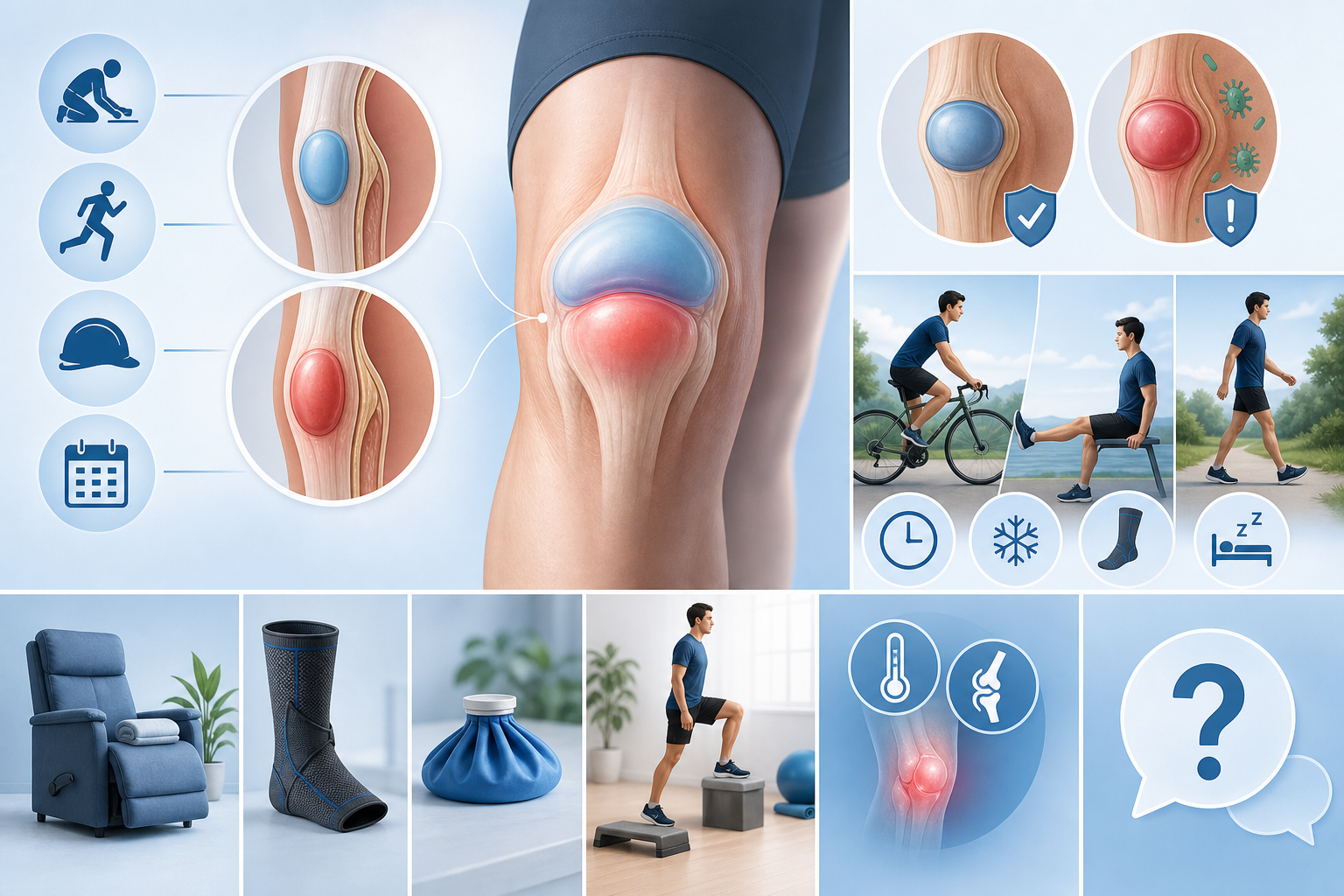
Prepatellar bursitis is inflammation of the prepatellar bursa — a small fluid-filled sac sitting directly in front of the kneecap (patella). It causes visible swelling, tenderness, and sometimes warmth at the front of the knee, typically without deep joint pain. Most cases resolve with conservative care in 2–6 weeks.
What Is Prepatellar Bursitis?
The knee contains roughly a dozen bursae — thin sacs lined with synovial membrane that reduce friction between moving structures. The prepatellar bursa sits between the skin and the anterior surface of the patella. When this sac becomes irritated, it fills with excess fluid, producing the characteristic soft, dome-shaped swelling you can see and feel directly over the kneecap.
Prepatellar bursitis is sometimes called housemaid's knee — a term dating to the era when domestic workers spent hours scrubbing floors on all fours. The nickname reflects the single most common cause: sustained or repetitive pressure on the anterior knee.
Unlike conditions that originate inside the joint — such as knee osteoarthritis or a meniscal tear — prepatellar bursitis is an extra-articular problem. The joint space itself is typically unaffected, which is why most patients retain full or near-full range of motion even when swelling is significant.
Why the Prepatellar Bursa Is Vulnerable
Anatomy explains the risk. The prepatellar bursa has almost no soft-tissue buffer between it and the outside world — just skin. Every time you kneel, the entire weight of your upper body transmits through that thin layer directly onto the bursa. Repeated compression triggers an inflammatory response; the bursa produces excess synovial fluid in an attempt to protect itself, and swelling follows.
Structures Involved
- Patella (kneecap): The bony surface the bursa rests against
- Prepatellar bursa: The sac itself, normally paper-thin and containing only a few milliliters of fluid
- Patellar tendon: Runs just below; not directly involved in prepatellar bursitis but can be confused as the pain source
- Quadriceps tendon: Attaches at the superior pole of the patella; inflammation here is a separate condition
- Infrapatellar fat pad: Sits below the patella; distinct from the prepatellar bursa but can co-irritate with direct trauma
The location also makes the bursa vulnerable to direct blows — a fall onto a hard surface, a collision in sport, or repeated minor impacts can all trigger acute inflammation.
Common Causes and Who Gets It
Kneecap swelling from kneeling too much is the textbook presentation, but several distinct mechanisms produce prepatellar bursitis.
Occupational and Activity-Related Causes
- Repetitive kneeling: Plumbers, roofers, carpet layers, gardeners, and tile setters are at highest occupational risk — studies estimate bursitis affects up to 10% of workers in kneeling-intensive trades
- Direct trauma: A single hard impact to the front of the knee — common in wrestling, basketball, and cycling falls — can produce acute bursitis within hours
- Prolonged kneeling on hard surfaces: Even one session of extended kneeling without padding can trigger an acute episode
- Gout or rheumatoid arthritis: Crystal deposition or systemic inflammation can seed the bursa independently of mechanical loading
- Skin infection spreading inward: A cut or abrasion near the knee can introduce bacteria into the bursa, causing septic bursitis (discussed below)
Age and BMI are secondary risk factors. Excess body weight increases compressive load on the knee during kneeling, and the bursal tissue becomes less resilient with age.
Symptoms: What Does Prepatellar Bursitis Feel Like?
If your knee is swollen and warm to the touch with no obvious injury, prepatellar bursitis is a primary suspect. The symptom pattern is distinctive enough to differentiate it from most other knee conditions before imaging is even needed.
- Soft, fluctuant (fluid-filled) swelling directly over the kneecap — not behind it, not below it
- Tenderness to direct pressure on the anterior patella
- Warmth over the swollen area
- Full or near-full knee ROM in most non-septic cases
- Pain that worsens with kneeling or direct pressure, less so with walking
- Skin over the bursa may appear stretched or shiny when swelling is significant
Compare this to patellar tendinitis, which produces pain at the inferior pole of the patella (below the kneecap) with no visible swelling, and knee osteoarthritis, which causes diffuse joint-line pain, morning stiffness, and crepitus with movement. If swelling is behind the knee rather than in front, a Baker's cyst is more likely.
Septic vs. Non-Septic Bursitis: A Critical Distinction
Knowing how to tell if knee bursitis is infected could prevent a serious complication. Septic (infected) bursitis requires medical intervention — it cannot be managed with rest and ice alone.
Feature Non-Septic Bursitis Septic Bursitis Cause Mechanical irritation, trauma, gout Bacterial infection (often Staphylococcus aureus) Skin temperature Mildly warm Hot, intensely red Systemic symptoms None Fever, chills, malaise Onset Gradual or after identifiable trauma Rapid, often after skin break Pain severity Moderate, pressure-dependent Severe, constant, worsening Management Conservative care Requires prompt medical evaluationRed flag: If your knee is intensely red, hot, and you have a fever above 38°C (100.4°F), seek urgent medical evaluation the same day. Septic bursitis can progress to cellulitis or septic arthritis if untreated.
Conservative Treatment Options for Prepatellar Bursitis
Natural treatment for prepatellar bursitis without surgery is effective in the majority of non-septic cases. The goal is to reduce bursal inflammation, offload the knee, and restore normal tissue mechanics.
Immediate Self-Care (Week 1–2)
- Ice: Apply a cold pack wrapped in cloth to the anterior knee for 15–20 minutes, 3–4 times daily. Do not apply ice directly to skin.
- Compression: A knee sleeve or elastic bandage reduces fluid accumulation. Wear during activity; remove at night.
- Activity modification: Eliminate kneeling entirely. Use a kneeling pad if occupational demands make avoidance impossible. Reduce stair climbing and squatting volume.
- Elevation: When resting, keep the leg elevated above heart level to assist fluid drainage.
Physical Therapy
PT for prepatellar bursitis typically begins in week 2–3 once acute inflammation subsides. A structured program targets the quadriceps (specifically the vastus medialis oblique), hip abductors, and hip external rotators — all of which influence patellar tracking and reduce compressive load on the anterior knee.
- Straight-leg raises: 3 sets of 15 daily to maintain quad strength without compressing the bursa
- Terminal knee extensions using a resistance band
- Clamshells and lateral band walks for hip stabilization
- Soft tissue mobilization of the quadriceps and iliotibial band
Chiropractic Soft Tissue Techniques
Chiropractors trained in soft tissue and extremity work use techniques such as Graston Technique, myofascial release, and instrument-assisted soft tissue mobilization (IASTM) to address the surrounding quadriceps and patellar retinaculum. These approaches reduce muscular tension that contributes to abnormal patellar loading — a common perpetuating factor in chronic cases. If you're dealing with other musculoskeletal issues alongside knee pain, such as sciatic pain or neck injuries, a chiropractor can address multiple regions in a single treatment plan.
What to Expect During Recovery
How long does knee bursitis take to heal depends on the cause and how consistently you offload the knee. Realistic timelines:
- Acute traumatic bursitis (single impact): 2–4 weeks with consistent ice, compression, and activity modification
- Chronic occupational bursitis (repetitive kneeling): 4–8 weeks; longer if the provocative activity cannot be fully stopped
- Bursitis with secondary soft tissue involvement: 6–10 weeks including PT
Swelling is typically the last symptom to resolve — the bursa may remain visibly enlarged for several weeks after pain has subsided. This is normal and does not indicate ongoing active inflammation.
Recurrence is common in occupational cases if kneeling mechanics are not modified. Knee pads rated for your specific work surface (hard tile vs. soft soil) reduce recurrence risk by approximately 60% in trades workers, according to occupational health research.
What to Do Next
Most non-septic prepatellar bursitis cases respond well to the self-care protocol above. If swelling has not decreased after 2 weeks of consistent ice, compression, and activity modification, or if you have any of the red-flag symptoms listed below, schedule an evaluation.
Seek urgent care today if you have:
- Fever alongside knee swelling
- Rapidly spreading redness beyond the kneecap
- Inability to bear weight
- A recent skin break or wound near the knee
Schedule a routine provider visit if you have:
- Swelling persisting beyond 2–3 weeks without improvement
- Pain that wakes you at night
- Recurrent episodes despite activity modification
- Uncertainty about whether your diagnosis is correct
A physical therapist or chiropractor with extremity experience can assess patellar mechanics, identify contributing muscle imbalances, and build a structured rehabilitation plan. Find a physical therapist near you or find a chiropractor near you through the Medximity provider directory. You can also browse all providers by specialty and location.
For related musculoskeletal conditions, see our guides on chiropractic care for plantar fasciitis and natural treatment approaches for fibromyalgia — both conditions that often co-present with chronic musculoskeletal pain.
Frequently Asked Questions
Is prepatellar bursitis the same as housemaid's knee?
Yes. "Housemaid's knee" is the common name for prepatellar bursitis, referring to the swelling that develops in front of the kneecap from repetitive or prolonged kneeling. The clinical term is prepatellar bursitis; both names describe the same condition.
Can I still walk with prepatellar bursitis?
In most non-septic cases, yes. Walking is typically well-tolerated because it does not compress the prepatellar bursa directly. Avoid kneeling, squatting deeply, and climbing stairs repeatedly until swelling subsides. If walking is painful, the diagnosis may need to be reconsidered.
Can knee bursitis go away on its own at home?
Mild to moderate non-septic prepatellar bursitis often resolves with consistent home management — ice, compression, and eliminating the provocative activity. Cases caused by a single traumatic event tend to resolve faster (2–3 weeks) than chronic occupational cases. Septic bursitis does not resolve on its own and requires medical treatment.
How long does prepatellar bursitis last?
Acute cases typically resolve in 2–4 weeks. Chronic cases driven by ongoing occupational kneeling may take 6–10 weeks and are prone to recurrence if the underlying mechanical cause is not addressed. Persistent swelling beyond 8 weeks warrants further evaluation.
Do I need an X-ray or MRI for prepatellar bursitis?
Imaging is not required to diagnose straightforward prepatellar bursitis — the presentation is usually clinically obvious. An X-ray may be ordered to rule out a patellar fracture after direct trauma. MRI is reserved for cases where the diagnosis is unclear or when internal joint pathology (meniscal tear, cartilage damage) is suspected alongside the bursitis.
What is the difference between prepatellar bursitis and patellar tendinitis?
Prepatellar bursitis causes swelling directly over the kneecap with tenderness on the anterior patellar surface. Patellar tendinitis (jumper's knee) produces pain at the inferior pole of the patella — just below the kneecap — with no visible swelling and pain that worsens with jumping and running rather than kneeling. Location of tenderness is the key distinguishing feature on physical examination.