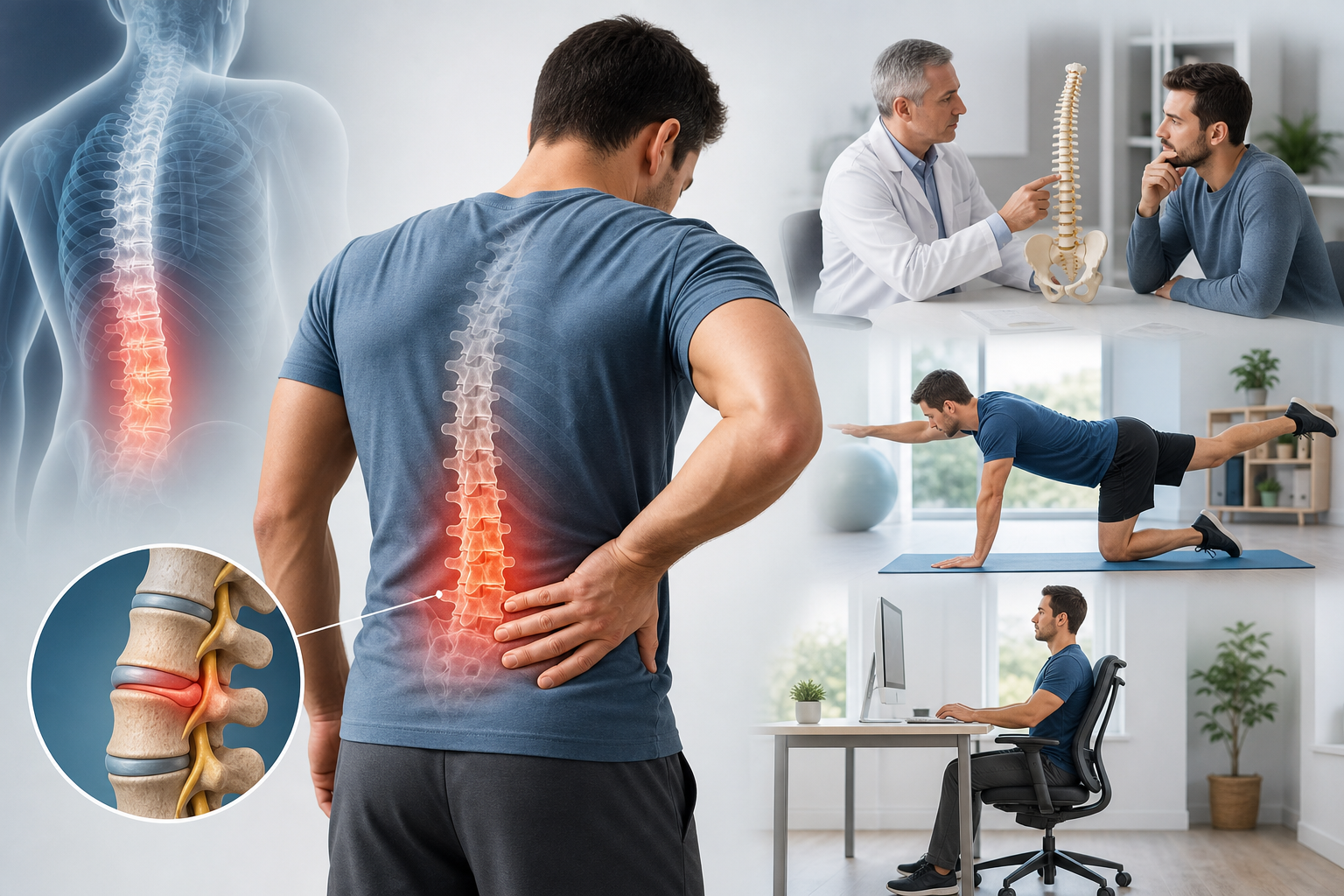
Living with Low back pain: A Comprehensive Guide starts with a simple goal: reduce daily flare-ups and keep your lumbar spine moving without provoking symptoms. Most low back pain improves with consistent activity, targeted exercise, and smart load management rather than bed rest, according to public health guidance from the CDC and NINDS (CDC; NINDS). Use the checklists below to track patterns, choose the right conservative care, and build a plan you can repeat.
If your pain lasts under 4 weeks, treat it like acute pain and prioritize motion and symptom control; if it lasts 12 weeks or longer, treat it like chronic back pain and prioritize strength, endurance, and habits you can maintain.
Why Managing Low Back Pain Properly Matters
Low back pain management works best when you treat it as a “load + tissue tolerance” problem: your spine and surrounding tissues (like the intervertebral discs, multifidus, and erector spinae) need the right amount of movement and strength to tolerate your day. When you stop moving, stiffness increases, your hip flexors and hamstrings lose length, and your trunk muscles decondition, which often makes symptoms easier to trigger.
- Movement is usually safer than rest: Public health guidance supports staying active as tolerated for most non-specific low back pain (CDC).
- Track time-based milestones: many uncomplicated episodes improve in 2–6 weeks with conservative care and progressive activity (NINDS).
- Chronic pain needs a training plan: when symptoms persist beyond 12 weeks, you typically need progressive strengthening (glutes, trunk endurance, hip mobility) and a repeatable routine, not just “avoid what hurts.”
CDC guidance emphasizes conservative, non-invasive care and staying active for most low back pain (CDC).
Before Seeking Treatment: Essential Preparation Checklist
Preparation improves your first visit because it helps the provider match your symptoms to likely pain drivers (disc, joint, nerve, muscle) and choose the right exam. Bring data that changes decisions.
1) Symptom pattern checklist (7 days is enough)
- Location: midline low back, one-sided SI region, or buttock/leg path that could match sciatica along the sciatic nerve.
- Behavior: worse with sitting, bending, coughing/sneezing (can fit disc irritation); worse with standing/walking and better sitting (can fit spinal stenosis patterns); worse with twisting or rolling in bed (often facet/SI patterns).
- 24-hour pattern: morning stiffness minutes, midday tolerance, evening flare-ups.
- Functional limits: walking distance before symptoms, sitting tolerance (minutes), and sleep positions that aggravate.
2) “Load history” checklist (what your back has been asked to do)
- Work demands: lifting frequency, awkward postures, driving time, standing time.
- Training demands: running mileage, squats/deadlifts, new classes, recent spikes in volume.
- Recent “one big day”: yard work, moving furniture, long travel, new mattress.
3) Records checklist (only what changes the plan)
- Prior imaging reports if you already have them (X-ray/MRI report text is more useful than the disc images for a first visit).
- Past injuries: prior disc bulge/herniation history, hip injury, ankle sprain (changes gait mechanics).
- Prior care tried: PT, chiropractic adjustments, massage, acupuncture, what helped, and what flared symptoms.
During Your Visit: What Should You Expect?
A good low back pain exam identifies whether your symptoms look like non-specific mechanical pain, herniated disc-type irritation, or a nerve root pattern that needs closer monitoring. Expect a focused history plus movement testing of the lumbar spine, hips, and sometimes the thoracic spine because stiffness above or below the painful segment can overload the low back.
Physical exam checklist (common components)
- ROM testing: flexion, extension, side-bending, rotation, and which direction centralizes vs. peripheralizes symptoms.
- Neurologic screen: strength (ankle dorsiflexion, big-toe extension), reflexes, and sensation if leg symptoms are present.
- Special tests: straight leg raise (often used when sciatica is suspected), hip screening (FABER), and SI provocation tests when indicated.
- Movement control: hip hinge, squat pattern, single-leg stance, and trunk endurance (often the missing link in recurrent flare-ups).
What conservative care planning should include
- A working diagnosis: “mechanical low back pain with extension intolerance” is more actionable than “back pain.”
- Short plan: typically 6–8 PT visits over 3–6 weeks for guided exercise progression and self-management skills, then fewer check-ins as you transition to independence (frequency varies by irritability and function).
- Home program: 2–4 exercises you can do in 10–15 minutes, with clear rules on when to progress or back off.
Clinical practice guidelines recommend non-invasive, non-pharmacologic care options such as exercise therapy, spinal manipulation, and other conservative approaches for many cases of low back pain (AAFP guideline summary).
After Your Appointment: Action Steps for Success
Results depend on what you do between visits: you need daily inputs that calm symptoms and build capacity in the trunk and hips. Use a “minimum effective dose” routine you can repeat even on busy days.
Home protocol: 12-minute spine-friendly routine (do once daily for 14 days)
- Heat or brisk walk (3 minutes): choose one. Heat can reduce stiffness; a short walk lubricates the hips and lumbar segments.
- McKenzie-style prone press-ups (2 minutes): lie on your stomach, hands under shoulders, press up while hips stay down. Do 10 reps. Stop if leg pain increases or spreads farther down the leg. If symptoms move out of the leg and toward the back, that is usually a good sign.
- Hip hinge drill (2 minutes): stand with a dowel along your spine (head–mid-back–tailbone contact). Push hips back without rounding the low back. Do 2 sets of 8.
- Side plank (modified) (2 minutes): knees bent, elbow under shoulder. Hold 2 x 20–30 seconds each side. This targets lateral trunk endurance (often undertrained).
- Glute bridge (3 minutes): feet hip-width, squeeze glutes, lift pelvis without arching. Do 2 sets of 10 with a 2-second hold at the top.
- Progress rule: if next-day soreness is mild and you can do normal activities, add 1–2 reps per exercise every 3 days.
- Back-off rule: if pain spikes and stays elevated for >24 hours, cut volume by 30–50% and keep walking.
Expect a meaningful trend change (better walking/sitting tolerance or fewer flare-ups) within 2–4 weeks when you follow a progressive plan consistently. For chronic back pain, expect strength and endurance gains to compound over 8–12 weeks of progressive loading.
Action step What it targets Typical timeline to notice change Daily walking (10–30 minutes, broken into bouts) Circulation, stiffness reduction, graded exposure 3–14 days Progressive trunk + glute strengthening 3x/week Multifidus, glute max/med, trunk endurance 4–8 weeks Ergonomic changes (sit-stand, hip hinge, lifting plan) Lower daily irritation load Same day to 2 weeksWhich Conservative Treatments Help Most for Low Back Pain?
Best outcomes usually come from combining active care (exercise therapy) with hands-on care when needed, then tapering visits as your self-management improves. Systematic reviews support several non-pharmacologic options for low back pain, including spinal manipulation and exercise-based care (Journal of Manipulative and Physiological Therapeutics, 2022).
- Physical therapy: targets strength, mobility, and movement strategy (hip hinge, trunk endurance, gait). Best for recurrent episodes and chronic back pain because it builds capacity.
- Chiropractic spinal manipulation: can reduce pain and improve ROM in some mechanical low back pain presentations, especially when paired with exercise and activity guidance.
- Massage therapy: can reduce muscle tone and improve short-term comfort, which helps you tolerate exercise progression.
- Acupuncture: can be useful for symptom modulation in some people, especially when pain limits sleep or activity tolerance.
National guidance and clinical recommendations commonly prioritize conservative, non-invasive care and active rehabilitation for low back pain (NINDS; AAFP).
Essential Questions to Ask Your Provider (Use This Script)
Ask questions that force a clear plan: what structures are likely involved, what should change first, and what you should do daily. You are looking for specific instructions, not general reassurance.
- Working diagnosis: “Does this look more like disc irritation, facet/SI joint pain, or a nerve root pattern like sciatica?”
- Plan metrics: “What should improve in 2 weeks: sitting tolerance, walking distance, sleep position tolerance, or ROM?”
- Activity rules: “Should I bias toward flexion or extension right now? What movements should I limit for 10–14 days?”
- Home program dose: “Which 2–4 exercises are mandatory, and how many reps/sets?”
- Visit frequency: “How many visits over the next month is typical for my presentation, and what would make you taper sooner?”
- Workouts: “Can I keep lifting or running in a modified way? What substitutions do you want (trap-bar deadlift vs. conventional, split squat vs. back squat)?”
- Red flags: “Which symptoms mean I should seek urgent evaluation the same day?”
Quick Reference: Daily Low Back Pain Management Checklist
Use this as your repeatable routine for living with low back pain while you build strength and tolerance.
- Every morning (5 minutes): 1–2 minutes easy walking + 10 prone press-ups or 10 knee-to-chest reps (choose the direction that reduces symptoms).
- Every 30–45 minutes of sitting: stand up for 60–90 seconds, do 5 hip hinges, then sit again.
- Training (3 days/week): glute bridges, side planks, and a hinge pattern. Progress reps slowly for 8–12 weeks.
- Flare-up plan (48 hours): reduce bending/twisting volume, increase walking bouts, keep the home routine but cut reps by 30–50%.
If pain radiates below the knee with numbness/tingling, track it daily. Centralization (leg symptoms shrinking toward the back) is often a useful sign during conservative care.
What to Do Next
Choose the provider type based on your main limitation: function (PT), stiffness/mechanical restriction (chiropractic), or soft-tissue tolerance (massage). If you are unsure, start with a PT or chiropractor who builds an exercise plan and measures progress.
- For a structured exercise plan: find a physical therapy near you.
- For mechanical low back pain and ROM limits: find a chiropractor near you.
- To compare local options: browse providers.
- If you want to self-screen first: check your symptoms.
- For related guides: explore more health topics.
Seek urgent medical evaluation the same day if you have new loss of bowel or bladder control, numbness in the saddle area, rapidly worsening leg weakness (foot drop), fever with severe back pain, or major trauma. Otherwise, book a routine visit if pain persists beyond 2–3 weeks, keeps returning, or limits walking, sitting, sleep, or work tasks.