overuse 유발 조직 질환은 근육,腱, ligament 또는 fascia가 과도한 반복적이고 기계적인 스트레스로 손상되면서 스스로 치유할 수 없게 되었을 때 발생합니다 — 이로 인해 통증, 경직 및 기능 손실이 생겨나지만 단일 traumatic 사건 없이 발생하지 않습니다. 과도한 사용성 질환과 비정형적인 부상을 비교하면 그 차이는 주로 동기와 시간에 관한 것이며, 구조는 아닙니다.
overuse 유발 조직 질환은 무엇인가?
overuse 유발 손상은 반복적이고 기준치 이하의 스트레스로 인해 발생하는 tissue 손상입니다 — 단일 강도를 초과하는 tissue의 tolerance에 의해 발생한 것 대신. overuse 질환과 비정형적인 부상을 비교하면 주요 차이는 동기와 시간에 관한 것이며, 구조는 아닙니다.
비정형적인 부상 — 라틴 밴드 손상, 근육 손상 등 — 단일 강도 사건으로 발생하는 통증, swelling 및 종종 출혈을 produces. tissue가 한 번의 강도로 실패합니다. overuse 질환은 증상을 점진적으로 produces. 각 반복에서 세포 수준에서 미세 손상이 발생하고 회복 사이에 있는 틈새가 부족하면 미세 타는 것이 축적되고 collagen 재조립이 혼란스럽고 tissue는 chronic degenerative cycle을 sometimes enters — 종종 tendinosis (과acute tendinitis와 구별되는)이라고 불리는 것.
overuse 질환은 또한 osteoarthritis 또는 구조적인 joint 손상과 다른 것으로 differs. arthritis는 X-ray에서 관절 cartilage의 degradation 및 bony changes를 보여줍니다. 대부분의 soft tissue overuse 질환은 myotendinous unit, bursa 또는 fascial envelope에 영향을 받으며 — 이러한 구조가 standard X-ray에서 표시되지 않으므로 많은 환자들이 "정상" 이미지 결과를 받았음에도 불구하고 지속적인 통증이 있습니다.
overuse 유발 조직 질환의 가장 흔한 질환
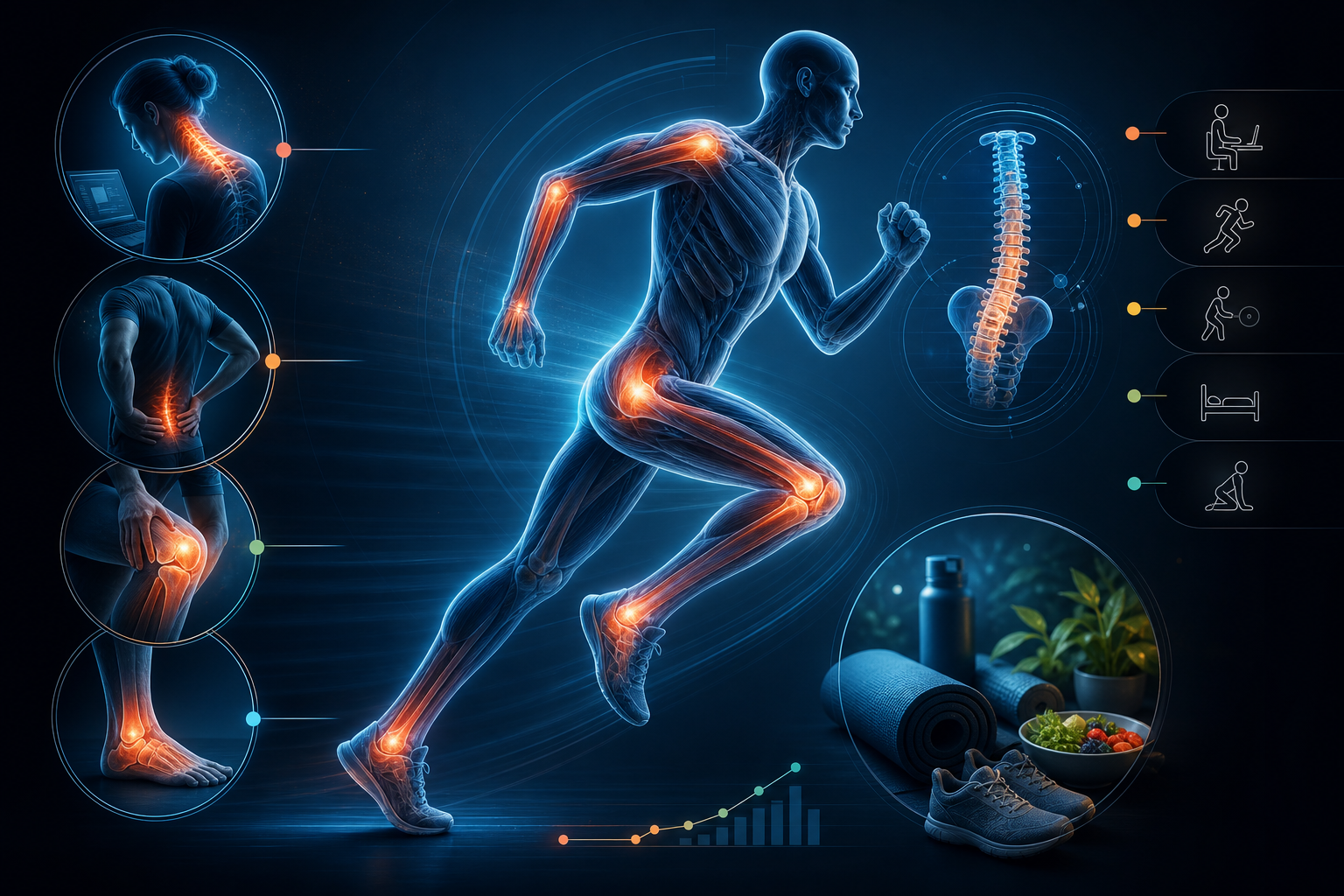
성인의 반복적 손상 질환은 tendons 및 fascial 구조에 고주파 스트레칭이 적용되는 지역에서 집중됩니다. 이들에는:
- 라테일 에피콘디올 레알리아일 알라니움 (tennis elbow): 허벅지의 라테일 에피콘디올에 있는 extensor carpi radialis brevis tendon의 degeneration. 키보드 사용자, 그림가 및 스포츠 경기장에서 사용하는 선수들.
- 로터 캐우트 tendinopathy: supraspinatus 또는 infraspinatus tendon의 cummulative damage, 일반적으로 greater tuberosity 근처에 위치합니다.
- 파틀라인 텔린토피 ( jumper 's knee): 립스 패트란 tendon의 proximal degeneration, 달리기 및 스포츠 경기장에서 사용하는 선수들 사이에서 흔합니다.
- 플antar fasciitis: 플antar fascia의 calcaneal insertion에 대한 microtearing이 가장 일반적인 발목 통증의 원인 — 성인 생활 동안 약 10%의 인구가 이러한 질환을 경험합니다.
- 데 쿠어바인스 센소신비토니티: 패드 토리네이션 병변에서 abductor pollicis longus 및 extensor pollicis brevis 병변의 염증, 신생부모와 조립 작업자에게 종종 나타납니다.
- 아치티론 블랜드 syndrome: 패드 토리네이션 병변에서 lateral femoral condyle에 관련된 IT band의 관절염, 달리기로 인해 가장 often overuse 진단을 받는 거리 경주 선수.
- Achilles tendinopathy: 중간 부분 또는 insertional Achilles tendon의 degeneration, 특히 달리기에서 빠른 강도 증가에 따른 훈련량이 증가하는 선수들 사이에서 발생합니다.
Which body regions are most vulnerable?
which body parts are most affected by overuse injuries reveals a pattern: vulnerability follows load concentration, not just movement frequency. 허약한 혈류와 높은 텐실 드레임이 먼저 실패합니다.
Upper extremity
- shoulder: supraspinatus tendon, subacromial bursa, long head of biceps
- elbow: 라테일 및 내측 에피콘디올 텔레 insertion
- wrist and hand: flexor 및 extensor tendon sheaths, carpal tunnel (median nerve compression from surrounding soft tissue swelling)
Lower extremity and spine
- knee: 팔다인 텔린토피, IT band, pes anserine bursa
- Ankle and foot: Achillis tendon, 플antar fascia, 후방 Tibialis tendon
- Lumbar spine: thoracolumbar fascia, multifidus, quadratus lumborum — 지속적인 overuse sites를 frequently overlooks는 작업자 및 사무직 근로자 사이에서.
Overuse Soft Tissue Disorders What Causes Them?
Three variables drive cumulative tissue damage: load magnitude, repetition frequency, and recovery time. Remove adequate recovery, even moderate loads produce injury over time.
The occupation is the most consistent risk factor. Workers in assembly lines, dental hygienists, hairdressers, and data entry staff endure thousands of nearly identical movement cycles per shift. Construction workers and manual laborers add high-force loading on top of repetition. Desk workers experience lower force but sustained static postures that compress cervical and lumbar soft tissues for hours without the tissue movement needed to circulate fluid and nutrients.
Sport-specific overuse follows training errors: increasing weekly running mileage by more than 10% per week, returning to sport after a layoff without progressive loading, or using improper technique concentrating stress on a single tissue.
Additional contributing factors:
- Inadequate warm-up before high-demand activity
- Insufficient sleep — collagen synthesis peaks during deep sleep
- Nutritional deficiencies, particularly vitamin C and protein, which are required for collagen production
- Previous acute injury creating compensatory movement patterns that overload adjacent structures
- Age-related reduction in tendon vascularity, making the tissue slower to remodel after micro-damage
Symptoms: What Does an Overuse Injury Feel Like?
The defining symptom is pain that gets worse with repetitive movement and improves with rest — at least initially. As the condition progresses, rest pain and morning stiffness appear, signaling that the tissue is no longer recovering between loading cycles.
Patients frequently ask why their tendon hurts without any injury. The answer is that the injury occurred incrementally. By the time pain is noticeable, the tissue has typically been accumulating damage for weeks. Common symptom patterns include:
- Dull ache at a specific tendon insertion point, reproducible with palpation
- Stiffness for the first 10–15 minutes of activity that partially resolves with warm-up
- Weakness in the affected movement — grip strength loss in lateral epicondylalgia, push-off weakness in Achilles tendinopathy
- Crepitus (a grating sensation) with movement in tendon sheath disorders like De Quervain's
- Localized swelling without bruising
Red flag — seek urgent care if: you experience sudden sharp pain with a "pop" sensation, complete loss of function, significant swelling within minutes of onset, or numbness/tingling radiating down a limb. These suggest acute rupture or nerve involvement requiring prompt evaluation.
How Spinal Alignment and Biomechanics Contribute to Soft Tissue Stress
Poor posture can absolutely cause tendon pain — this is one of the most underappreciated mechanisms in overuse injury. Altered spinal alignment changes the mechanical environment of every structure connected to the spine, directly or through kinetic chain effects.
Forward head posture — where the head translates anterior to the shoulder line — increases compressive load on the cervical facet joints and shortens the suboccipital muscles, upper trapezius, and levator scapulae. Chronically shortened levator scapulae alter scapular position, which elevates the acromion and reduces subacromial space, predisposing the supraspinatus to impingement-pattern tendinopathy with overhead movement.
Lumbar hyperlordosis or anterior pelvic tilt increases tension on the hip flexors (particularly the iliopsoas and rectus femoris) and reduces the ability of the gluteus maximus to absorb ground reaction force — transferring that load to the patellar tendon and IT band.
Chiropractic care addresses these biomechanical contributors directly. Spinal manipulation restores segmental mobility, which reduces compensatory muscle guarding and allows more normal load distribution through the kinetic chain. If you are managing sciatic nerve pain alongside soft tissue symptoms, spinal alignment is almost always part of the picture.
Conservative Treatment Options for Soft Tissue Overuse Injuries
Effective soft tissue injury treatment without surgery combines load management with active tissue remodeling. Rest alone is insufficient for tendinopathy — tendons require mechanical stimulus to reorganize collagen fibers. The goal is controlled loading, not unloading.
Manual Therapy Approaches
- Active Release Technique (ART): A provider-applied movement technique that breaks down adhesions between muscle layers and restores normal tissue glide. Particularly effective for lateral epicondylalgia and plantar fasciitis.
- Graston Technique / Instrument-Assisted Soft Tissue Mobilization (IASTM): Stainless steel instruments used to detect and treat fibrotic tissue. Research supports 6–8 sessions over 3–4 weeks for measurable improvement in tendon structure.
- Myofascial release: Sustained pressure into fascial restrictions, useful for thoracolumbar fascia tightness and IT band syndrome.
- Chiropractic spinal manipulation: Addresses segmental dysfunction contributing to abnormal loading patterns upstream and downstream of the injured tissue.
재활 기반 운동
역학적 부하 프로토콜는 허리 통증 질환의 가장 증거가 지지된 치제입니다. 아킬레스 통증 질환에 대한 알프란드스 프로토콜 — 12주 동안 매일 2회, 총 3 세트의 15 개의 역학적 허리 떨어짐을 수행하여 — 대부분의 경우 통증 감소와 구조적 개선이 있습니다. 팔꿈치 통증 질환에 대한 디클라이언 스쿼트 역학 프로토콜은 유사한 구조를 따릅니다.
비 활동적인 조응용
- 활동 후 10–15 분 동안 활동을 통해 관절염을 관리하기 위해 얼음으로 적용하여 지역 염증을 관리합니다.
- 치료적 초음파를 사용하여 재활 진행 중에 틀린 조직의 기능성을 개선하기 전에 사용합니다.
- 근육을 부담에서 해제하는 체형 테이핑을 사용하여 활동 중에 틀린 근육을 관리합니다.
비 활동적 vs. 활동적 재활: 차이 이해하기
overuse 부상의 활동적 재활 vs. 완전한 휴식에 대한 질문에는 명확한 증거 기반 답변이 있습니다 — 활동적 재활은 거의 모든 골격 조직 overuse 조건에서 연구된 약간의 장기적인 결과를 produces.
비 활동적 재활 — 완전한 휴식, 얼음, 축소 —는急性 발작 초기에 염증을 관리하고 통증을 제어합니다. 이는 48–72 시간 동안 적절히 적용됩니다. 그 이후의 시간은 활동이 중단되면 근육이 약해지고, 틀린 조직이 더 복잡하게 변형되고, 주변 근육이 소모되는 것을 허용합니다.
활동적 재활은 통증 수준 내에서 유지하고 이차적으로 부상을 받은 조직을 재로딩하는 것입니다. 이것은 역학적 mechanotransduction— 척추 세포 (tenocytes)가 부하를 반응하여 콜라겐 생산을 증가시키는 과정을 나타냅니다. 그에 대한 이 유발은 조직이 정상 구조로 재조직되지 않음을 나타냅니다.
방법 적합 사용 제한 사항 완전한 휴식 발작의 첫 48–72 시간 동안 만약 지속되면 건강 상태 개선 및 더 느린 근육 재조직을 초래합니다. 비 활동적 모달 (얼음, 초음파, 테이핑) 활동적 재활과 함께 증상 관리에 사용됩니다. 기본 구조를 해결하지 않습니다. 역학적 부하 / 전략적인 운동 1주 이상의 주로 훈련으로 시작합니다. 전문가의 지도가 필요하며 과부하를 피하도록 합니다. 손상 관리 (ART, 그라스톤, 조절) 운동과 결합하여 기계적 원인을 해결하는 데 사용됩니다. 집에서 운동 프로그램과 함께 가장 효과적입니다.복구 시간은 얼마나 걸립니까?
tendonitis가 완치되는 기간은 특정 구조에 따라, 치제 시작 전에 증상이 얼마나 오래 지속되었는지에 따라, 활동적 재활이 사용되었는지에 따라 다릅니다. 일반 조건별 시간표:
- 측두부 통증 : 6–12 주 동안 일관된 역학적 부하와 손상 관리로 회복; 지속적인 치제는 4–6 개월이 걸릴 수 있는 만성 조건 (증상이 6개월 이상 지속됨)에 대해 요구됩니다.
- 플antar fasciitis : 80%의 환자가 10 개월 이내에 보수적 인 치제로 회복; 초기 치제는 만성 조건이 아닌 경미한 및 중등도의 증상으로 시작되는 경우 6–8 주가 걸립니다.
- 아킬레스 틀린증 (중부) : 아킬레스 프로토콜을 포함하여 최소 12주 동안 치제를 사용해야 합니다. insertional 아킬레스는 더 느리게 회복되며, 종종 16–20 주가 걸립니다.
- 로터 쿠퍼 틀린증 : 정형 외과 PT를 포함하여 6–12 주 동안 구조적 재활을 사용합니다. 스케라 폴리스 stabilization이 해결되지 않으면 재발률이 높습니다.
- IT 테니스 선수 부상 : 4–8 주 동안 활동 감소, 골반 강화 및 ITF와 gluteus medius에 대한 체형 테이핑을 사용하여 회복합니다.
치료 시작 전에 조건이 만성적이 되지 않아야 하는 가장 신뢰할 수 있는 예측자 중 하나는 치제가 3개월 이하의 증상 지속 기간 동안 더 빠르게 회복됩니다. 틀린 조직이 6+ 개월 이상의 지속적인 노화에 직면하는 경우.
예방: 사무실, 전자적 스트레스 부상을 방지하기 위한 엔고노미카, 체육관 준비 및 부하 관리
직장에서 반복적 인 스트레스 부상의 예방는 세 가지 변수를 해결해야 합니다: 사무실 설정, 움직임 준비, 훈련 부하 진행.
엔고노미카
- monitor 높이: 화면은 또는 약간 아래의 눈 레벨을 유지하여 지속적인 척추 flexion을 방지합니다.
- 키보드 위치: 엘bows는 90°로, 손가락은 중립 — 아니면 왼쪽 또는 ulnar-deviated하지 않습니다.
- 스티션 높이: 허리와 발목 수준에 약간 높게 유지되거나, 척추 지원을 통해 중립적인 lordosis를 유지합니다.
- 휴식 횟수: 45–50 분의 지속적 사무 작업 후 2분 동안 휴식을 취하는 2분 간의 움직임 휴식을 설정하여 매 45–50 분마다 수행합니다.
체육관 준비 프로토콜 (활동 전 5 분)
- 30 초 동안 가벼운 근육 운동 (걸음, 자전거)을 통해 지역 조직의 온도를 증가시키는 데 사용합니다.
- 목표 근육 그룹에 대한 동적 테이핑 — 달리기의 경우 다리 스윙, 작업 중 overhead workers의 경우 어깨 회전
- 2–3 세트의 최대 부하를 사용하여 활동적인 운동을 준비하는 부분적 부하 운동을 사용합니다.
부하 관리
10% 규칙은 스포츠 및 직업 설정에서 적용됩니다 — 매주 10% 이상의 반복적 인 부하 증가를 피하는 것입니다. 활동이 줄어든 기간 (질병, 휴가, 부상) 후에는 60–70%의 전자적 부하로 복구합니다. 2–3 주 동안 재건을 수행합니다.
颈椎过度使用引起的张力头痛遵循相同的生物力学逻辑 —如果您同时管理这两个问题,请阅读 无药物治疗紧张性头痛涵盖了重叠的颈部软组织贡献者。
그 다음에 무엇을 해야 하나요
만약 증상이 2주 이상 지속되고, 계속된 활동으로 악화하거나 일상 생활이나 운동 수행 능력을 방해하는 경우, 근육 또는 천공 조직 문제를 전문적으로 치료받을 수 있는 의사에게 진료 요청하세요. 통증이 만성화되지 않도록 기다리지 마세요 — 적시의 조치는 빠른 회복을 일관되게 보장합니다.
첫 방문에서 기대할 것: 체계적인 동작 검사, 영향받은 근육 또는 천공 조직에 대한 팔라피테이션, 그리고 유기체 구조 요인(예: 척추 정렬 및 인접 관절의 움직임)을 평가합니다. 대부분의 의사들은 첫 방문에서 치료를 시작하며, 황소 신호가 있는 경우 이미지 검사에 우선적으로 대비할 것입니다.
급히 의료 조치를 받으실 것을 권장하는 증상: 완전한 기능 손실이 발생하거나 천공 조직에서 palpable gap을 발견, 빠른 onset으로 acute swelling이 나타나거나 radiating numbness와 약점이 있는 경우 — 이는 rupture 또는 신경 보호가 필요한 상황을 시사하며, 즉시 평가가 필요합니다.
근육 및 천공 조직 문제에 대한 경우, 척추치유의사는 당신의 주요 의료 제공자입니다. 두 모두는 체계적인 치료 기술과 전진적 부하 프로토콜을 가르친 전문가들로서, 수술 없이 조직 재형성을 촉진하는 방법을 알고 있습니다. 네arest chiropractor 찾기 또는 nearest physical therapist 찾기를 통해 Medximity 디렉토리에서 근육 및 척추 치유와 재활을 전문적으로 제공하는 의사에게 연결하세요.
만약 오버사용 증상이 허리나 함께 어지럼증, 두통 또는 전신 증상을 동반한다면, 상단 허리 치유 전문가의 도움이 필요할 수 있습니다 — 상기 치과목에서 척추치유로 트리지멘널 신경염 치유에 대해 논의된 유기체 구조 원칙이 적용됩니다. 더 많은 근육 및 척추 건강 주제를 탐색하십시오 Medximity 블로그.