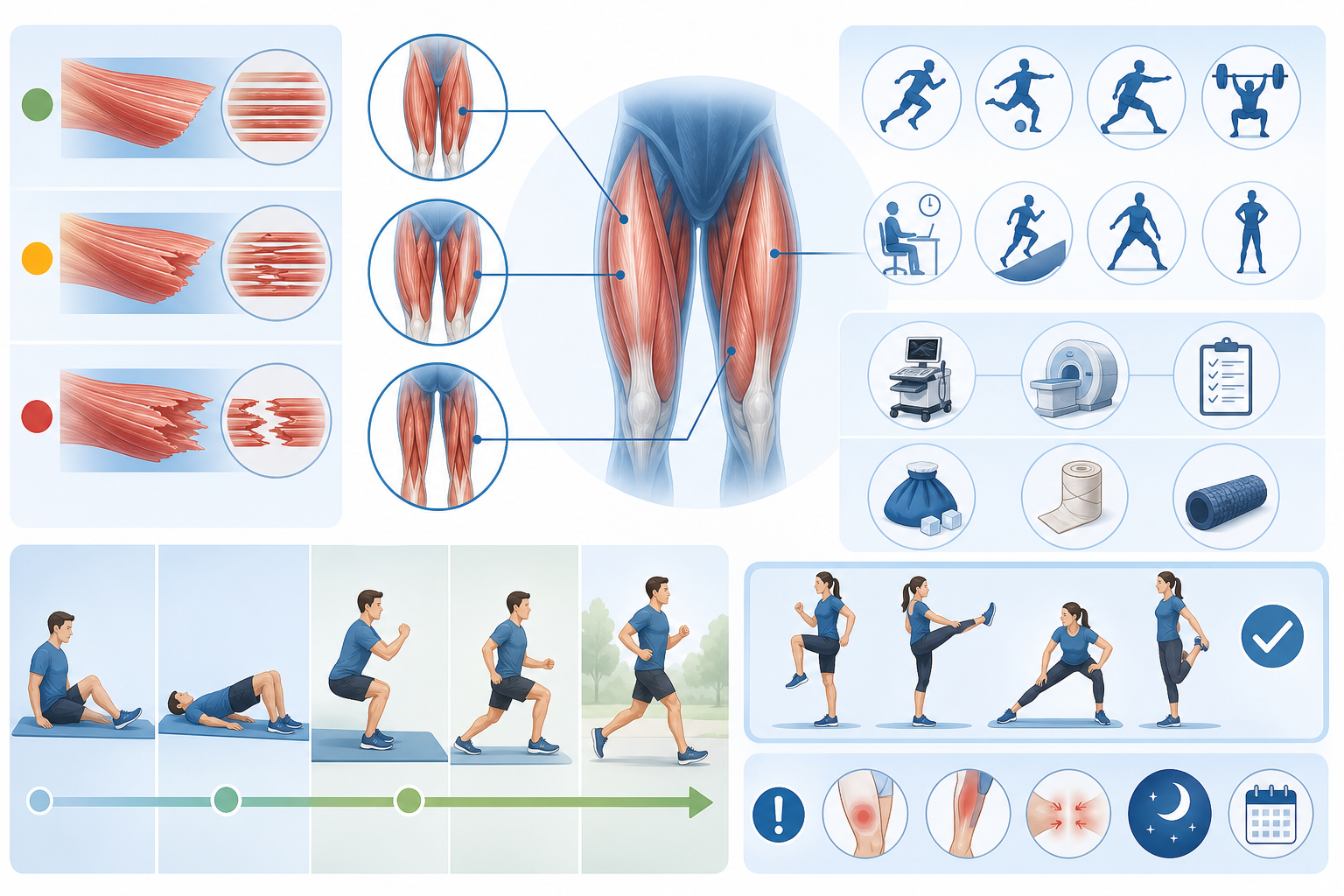
Thigh muscle injuries — involving the quadriceps, hamstrings, or adductors — are among the most common soft tissue injuries in both athletes and active adults. Most heal fully with conservative care, but the right treatment depends on which muscle group is injured, how severely, and how quickly you act.
Understanding Thigh Muscle Anatomy
The thigh contains three distinct muscle groups, each with a different function and a different injury pattern.
Quadriceps
The quadriceps femoris is a group of four muscles — rectus femoris, vastus lateralis, vastus medialis, and vastus intermedius — running along the front of the thigh. They extend the knee and flex the hip. The rectus femoris is the most commonly strained because it crosses both the hip and knee joints.
Hamstrings
Three muscles form the hamstrings: biceps femoris, semitendinosus, and semimembranosus. They run along the back of the thigh, flexing the knee and extending the hip. The proximal attachment at the ischial tuberosity (sitting bone) is a frequent injury site, especially during sprinting or sudden deceleration.
Adductors
The adductor longus, adductor magnus, and gracilis run along the inner thigh and pull the leg toward the midline. Adductor strains — commonly called groin pulls — typically occur during lateral cutting movements or sudden changes of direction.
Common Types of Thigh Muscle Injuries
Thigh muscle strain symptoms and treatment vary significantly depending on which group is involved. A pulled quad muscle vs hamstring injury can feel similar initially — sudden pain, stiffness, difficulty walking — but the location, mechanism, and rehab approach differ.
- Quadriceps strain: Pain at the front of the thigh, worsened by knee extension or stair climbing. Common in sprinters and cyclists.
- Hamstring strain: Pain at the back of the thigh or deep in the buttock near the ischial tuberosity. Triggered by explosive acceleration or high-speed running.
- Adductor strain: Sharp pain along the inner thigh, reproduced by resisted hip adduction. Common in soccer, hockey, and martial arts.
- Quadriceps contusion: Direct impact injury — a blow to the front of the thigh causing muscle bruising. Different from a strain; the mechanism is external force, not stretch or contraction.
If you are also experiencing radiating pain down the leg, numbness, or tingling, the sciatic nerve may be involved. Read more about what can be done for sciatic pain to understand whether your symptoms extend beyond the thigh muscle itself.
Strain Grades Explained: Grade I, II, and III
Muscle strains are classified into three grades based on the extent of fiber damage. The grade determines recovery time, treatment intensity, and return-to-activity expectations.
Grade Fiber Damage Symptoms Typical Recovery Grade I Less than 10% of fibers torn Mild tightness, minimal swelling, full ROM with discomfort 7–14 days Grade II Partial tear (10–90% of fibers) Moderate pain, swelling, bruising, reduced strength and ROM 3–8 weeks Grade III Complete or near-complete rupture Severe pain, significant bruising, palpable defect, inability to contract muscle 3–6 monthsGrade 2 hamstring strain recovery time is typically 4–6 weeks with structured physical therapy, though return to full sport often takes 6–8 weeks. Rushing this timeline is the leading cause of re-injury.
Yes, bruising after a thigh injury is normal — and expected with Grade II and III strains. Bruising after thigh injury indicates blood pooling from torn muscle fibers and may appear 24–48 hours after the initial injury, sometimes tracking downward toward the knee due to gravity.
What Are the Symptoms by Muscle Group?
Location is your first diagnostic clue. Sharp pain in the upper thigh when walking points to the proximal hamstring or hip flexor, not the mid-belly of the quadriceps. Knowing which structure hurts helps your provider target treatment more precisely.
How to Tell If You Tore a Thigh Muscle
Signs that suggest a significant tear rather than a mild strain:
- A sudden "pop" or snapping sensation at the moment of injury
- Immediate inability to continue activity
- Visible deformity or bunching of the muscle (especially in the quadriceps)
- Extensive bruising appearing within 2–4 hours
- Complete inability to contract the muscle against resistance
Symptom Location by Muscle Group
- Quadriceps: Pain at the front of the thigh, mid-belly or just above the kneecap (patella). Worsened by resisted knee extension.
- Hamstrings: Pain at the back of the thigh or deep under the gluteal fold. Worsened by resisted knee flexion or straight-leg raise.
- Adductors: Pain along the inner thigh, groin, or medial knee. Worsened by squeezing the knees together against resistance.
Red flag — seek urgent care if: you have numbness or weakness in the leg below the injury, loss of bladder or bowel control, or the leg gives way completely. These may indicate nerve involvement or a proximal hamstring avulsion fracture.
Common Causes of Thigh Muscle Injuries
Most thigh muscle injuries fall into two categories: acute (sudden onset) or chronic (gradual overuse).
- Sudden acceleration or deceleration: Sprinting, jumping, or cutting — the most common mechanism for hamstring strains in sport.
- Overstretching: Splits, high kicks, or slipping — stretches the muscle beyond its elastic limit.
- Fatigue: Muscles are most vulnerable in the final stages of exercise when contractile capacity drops.
- Inadequate warm-up: Cold muscle tissue has lower extensibility and higher injury risk.
- Previous injury: Scar tissue from an earlier strain reduces tensile strength. Re-injury at the same site is 2–6 times more likely without complete rehabilitation.
- Muscle imbalance: Weakness in the gluteus maximus forces the hamstrings to compensate during hip extension, increasing strain load.
Athletes recovering from workout injuries often underestimate how much surrounding muscle weakness contributed to the original injury. Chiropractic care for workout injuries can address both the strain itself and the biomechanical factors that caused it.
Conservative Treatment Options for Thigh Muscle Injuries
Thigh muscle injury treatment without surgery is effective for the vast majority of cases — including most Grade II strains. The treatment approach shifts depending on the phase of healing.
Acute Phase (Days 1–5)
- POLICE protocol: Protection, Optimal Loading, Ice, Compression, Elevation. Replace the old RICE protocol — complete rest is no longer recommended after the first 48 hours.
- Ice 15–20 minutes every 2–3 hours for the first 48 hours to limit secondary inflammation.
- Compression wrap to reduce swelling and support the muscle.
- Gentle pain-free range of motion within 48–72 hours to prevent excessive scar tissue formation.
Subacute and Rehabilitation Phase (Week 2 Onward)
- Soft tissue therapy: Instrument-assisted soft tissue mobilization (IASTM) and myofascial release target adhesions in healing muscle tissue, improving extensibility and reducing re-injury risk.
- Chiropractic care: Spinal and pelvic adjustments address compensatory movement patterns that develop after a thigh injury. Altered hip mechanics and lumbar loading are common secondary findings.
- Progressive loading: Eccentric strengthening exercises — such as Nordic hamstring curls and single-leg Romanian deadlifts — are the most evidence-supported interventions for hamstring strain recovery.
- Dry needling: Targets trigger points in the injured muscle belly, reducing pain and restoring neuromuscular activation.
Patients with chronic thigh pain or recurring strains may also benefit from evaluating whether referred pain from the lumbar spine is contributing. Sciatic nerve involvement can mimic or accompany hamstring injuries, particularly when pain extends below the knee.
What to Expect During Recovery
How long a pulled thigh muscle takes to heal depends on the grade of injury, the specific muscle group, and whether treatment begins promptly.
- Grade I strain: Return to light activity in 1–2 weeks. Full sport in 2–3 weeks.
- Grade II strain: Return to light activity in 3–4 weeks. Full sport in 6–10 weeks depending on the muscle group.
- Grade III strain: Conservative management takes 3–6 months. Proximal hamstring avulsions may require orthopedic consultation.
Thigh strain exercises that speed up recovery include:
- Prone hamstring curls: Lying face down, slowly bend the knee to 90° and lower with control. Start with bodyweight, progress to resistance band. 3 sets of 10–15 reps.
- Standing quad sets: Standing with support, tighten the quadriceps without moving the knee. Hold 5 seconds, release. 3 sets of 15.
- Side-lying hip adduction: Lying on your side, raise the bottom leg 12–18 inches against gravity. 3 sets of 12 reps. Targets adductor recovery.
- Nordic hamstring curl (late-stage): Kneeling with feet anchored, lower your torso toward the floor using hamstring control. Reintroduce at weeks 4–6 for Grade II injuries only.
How to Prevent Thigh Muscle Strains During Exercise
Prevention of thigh muscle strains centers on three evidence-based strategies: targeted warm-up, eccentric strengthening, and load management.
- Dynamic warm-up: 8–10 minutes of leg swings, walking lunges, hip circles, and high-knee marching before any high-intensity activity. Static stretching before exercise does not reduce injury risk and may temporarily reduce muscle power.
- Eccentric hamstring training: Nordic hamstring curls performed 2x/week during pre-season reduce hamstring strain incidence by approximately 50% in team sport athletes, according to multiple controlled trials.
- Glute activation: Weak gluteus maximus and gluteus medius force the hamstrings to overwork. Include hip thrusts, clamshells, and single-leg deadlifts in your training program.
- Progressive load increase: Follow the 10% rule — increase weekly training volume by no more than 10% to allow connective tissue adaptation.
- Cool-down and post-exercise stretching: 5–10 minutes of static stretching after activity, holding each stretch 30–45 seconds, supports tissue extensibility over time.
What to Do Next
A Grade I thigh strain can often be managed with the POLICE protocol and progressive home exercise. Anything more severe — significant bruising, inability to bear weight, a palpable defect in the muscle, or pain that does not improve within 5–7 days — warrants a clinical assessment.
A physical therapist or chiropractor can confirm the grade of injury, rule out avulsion fractures or nerve involvement, and build a structured rehab program that returns you to full activity without re-injury. If you experienced a direct blow to the thigh with severe swelling, rule out compartment syndrome — a pressure buildup in the muscle compartment that requires urgent evaluation.
For chronic thigh pain, recurring strains, or pain that radiates into the hip or knee, consider whether spinal mechanics are contributing. Providers who address both the injury site and the biomechanical chain tend to produce faster, more durable outcomes. You may also find it useful to read about how chiropractic care supports workout injury recovery and non-invasive soft tissue treatment approaches used across musculoskeletal conditions.
Seek care urgently (same day) if: the leg is numb below the injury, you cannot move the knee or hip at all, or the thigh is rapidly swelling and becoming hard to the touch.
Find a physical therapist near you or find a chiropractor near you for thigh muscle pain through the Medximity directory. Filter by specialty, location, and insurance to connect with a provider who can assess your injury and start you on a structured recovery plan.
Explore more musculoskeletal health topics on the Medximity blog for condition guides, treatment comparisons, and provider education.
Frequently Asked Questions
How long does a pulled thigh muscle take to heal?
A Grade I thigh muscle strain typically heals in 7–14 days. A Grade II strain takes 3–8 weeks depending on severity and treatment. A Grade III (complete tear) may require 3–6 months of conservative rehabilitation. Starting structured physical therapy within the first week significantly reduces total recovery time.
How can I tell if I tore a thigh muscle or just strained it?
A mild strain produces tightness and soreness with maintained function. Signs of a significant tear include a sudden pop at the moment of injury, immediate inability to continue activity, visible bruising within 2–4 hours, a palpable gap or deformity in the muscle, and complete inability to contract the muscle against resistance. If you have any of these signs, seek a clinical assessment within 24–48 hours.
Is bruising normal after a thigh muscle injury?
Yes. Bruising indicates blood from torn muscle fibers pooling under the skin. It is expected with Grade II and Grade III strains and may not appear until 24–48 hours after the injury. Bruising that tracks toward the knee is normal — it follows gravity. Bruising that spreads rapidly and is accompanied by a hard, tense thigh warrants urgent evaluation to rule out compartment syndrome.
What is the difference between a hamstring strain and a quadriceps strain?
Hamstring strains cause pain at the back of the thigh or deep under the gluteal fold, typically triggered by sprinting or sudden deceleration. Quadriceps strains cause pain at the front of the thigh, worsened by knee extension. Hamstring injuries are more common in running sports; quadriceps injuries more commonly involve direct impact (contusion) or explosive kicking. Treatment protocols differ — hamstring rehab emphasizes eccentric loading, while quad rehab prioritizes progressive knee extension strength.
Can a chiropractor treat a thigh muscle injury?
Yes. Chiropractors address both the local muscle injury through soft tissue therapy, dry needling, and instrument-assisted mobilization, and the contributing biomechanical factors — particularly pelvic alignment and lumbar mechanics — that increase strain risk. Many thigh injuries involve compensatory movement patterns that persist after the muscle heals, and chiropractic care targets these directly.
When should I see a provider for thigh pain?
See a provider if: pain does not improve within 5–7 days of home care, you have significant bruising or swelling, you cannot bear weight normally, the pain is accompanied by numbness or tingling in the leg, or you felt or heard a pop at the time of injury. Seek same-day urgent care if the thigh is rapidly swelling and becoming hard, or if you have any loss of sensation below the injury.