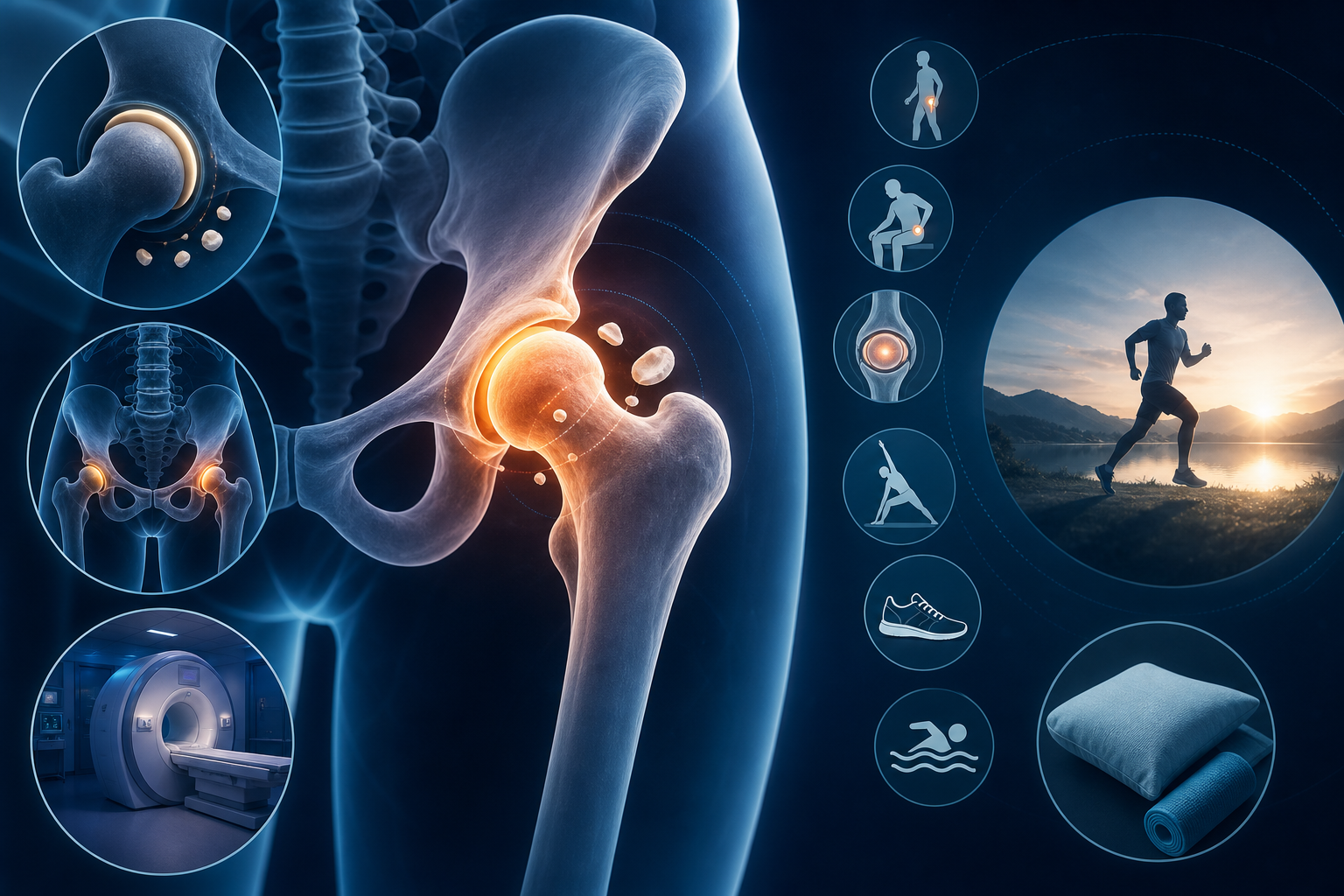
A loose body in the hip is a fragment of bone, cartilage, or both that has broken free inside the hip joint and moves unpredictably through the synovial fluid. When it drifts into the wrong position, it can lock the joint mid-stride, cause sharp catching pain, or produce a grinding sensation that stops you in your tracks. Most patients describe hip pain that comes and goes suddenly — fine one moment, mechanically blocked the next.
What Is a Loose Body in the Hip?
The hip is a ball-and-socket joint where the femoral head (ball) sits inside the acetabulum (socket). Both surfaces are covered by articular cartilage — smooth, dense tissue that allows near-frictionless movement. A loose body forms when a fragment separates from either of these surfaces and floats freely within the joint capsule.
Loose bodies range from a few millimeters to over a centimeter. Smaller fragments may stay suspended in synovial fluid without causing symptoms. Larger ones, or those that migrate into the joint space between the femoral head and acetabulum, create mechanical interference — the hip equivalent of a pebble caught in a hinge.
The clinical term is intra-articular loose body. They are distinct from extra-articular hip problems (bursitis, tendinopathy) because the fragment is physically inside the joint cavity.
How Do Hip Loose Bodies Form?
Understanding the origin matters because it determines how the hip responds to conservative care and how quickly the condition is likely to progress.
Primary Causes
- Osteochondral defects: A direct impact or shear force damages the cartilage-bone interface, causing a plug of cartilage with attached subchondral bone to detach. Common after falls, sports collisions, or motor vehicle incidents.
- Osteoarthritis: As cartilage degrades, fragments chip off the joint surfaces. This is the most common cause in adults over 50. The femoral head and the acetabular rim are the typical source sites.
- Femoroacetabular impingement (FAI): Abnormal bony contact between the femoral head and acetabular rim generates repetitive microtrauma that eventually shears off cartilage fragments. Cam-type FAI is particularly associated with loose body formation.
- Synovial chondromatosis: A less common condition where the synovial membrane produces multiple cartilaginous nodules that calcify over time. Can generate dozens of loose bodies simultaneously.
- Osteonecrosis of the femoral head: Disrupted blood supply causes bone tissue to collapse, releasing fragments into the joint.
Why Some Fragments Cause Symptoms and Others Don't
Fragment position is everything. A loose body resting in the acetabular fossa (the non-weight-bearing central recess) may be completely asymptomatic. The same fragment migrating to the weight-bearing zone between the articular surfaces produces immediate mechanical symptoms. This explains why hip pain that comes and goes suddenly is the defining complaint — the fragment moves.
Symptoms: What a Loose Body in the Hip Feels Like
Hip loose body symptoms are mechanical in character. They differ from inflammatory hip pain (which is constant and aching) or nerve pain (which radiates down the leg).
Why does my hip feel like something is catching? That catching sensation is the fragment being momentarily trapped between the femoral head and the acetabular cartilage during movement. It is not a metaphor — something literally is catching.
- Catching or locking: The hip joint locks up when walking, going up stairs, or rotating the leg. The lock resolves when the fragment shifts position, sometimes with a clunk.
- Clicking or clunking: An audible or palpable click during hip flexion or internal rotation. Distinct from the soft snapping of iliopsoas tendinopathy.
- Sharp, intermittent groin pain: Typically felt in the anterior groin or deep hip, not the lateral hip or buttock. Comes on suddenly during weight-bearing activities.
- Reduced range of motion: Internal rotation and hip flexion past 90° are most commonly restricted. Many patients notice difficulty tying shoes or getting in and out of a car.
- Giving way: The hip briefly gives out under load, particularly on single-leg stance.
Symptoms are typically worse with prolonged walking, squatting, pivoting, and climbing stairs. Rest usually resolves the pain — until the fragment moves again.
Is It a Loose Body — or Something Else?
Several hip conditions share overlapping symptoms. Accurate identification determines whether conservative care will be sufficient or whether further workup is needed.
Condition Key Symptom Differences Imaging Finding Conservative Care Response Loose Body Sudden locking, intermittent catching, variable pain location Calcified fragment on X-ray; confirmed on MRI or CT Moderate — symptoms may persist if fragment is large Labral Tear Deep groin pain, clicking, pain with prolonged sitting Visible on MRI arthrogram; no fragment Good — PT and activity modification often effective FAI (Cam or Pincer) Pain at end-range flexion/internal rotation, young active adults Bony prominence on X-ray; no fragment unless advanced Good for mild-moderate cases Hip Flexor Snapping (Coxa Saltans) Audible snap over anterior hip, no locking, no pain in many cases Normal imaging; dynamic ultrasound shows tendon snap Excellent — stretching and manual therapy resolve most cases Iliopsoas Bursitis Anterior groin ache, worse with stairs, no mechanical locking Bursal distension on ultrasound or MRI Good — responds to manual therapy and exerciseThe loose body in hip vs labral tear difference is clinically important: labral tears produce consistent pain with specific movements, while loose bodies produce variable, position-dependent symptoms. Both can coexist — a loose body can cause a secondary labral tear if it repeatedly impacts the labrum. If you are unsure which applies to you, a physical therapist or chiropractor experienced in hip conditions can perform a clinical screen before you pursue imaging.
How Is a Loose Body in the Hip Diagnosed?
Diagnosis combines clinical examination with imaging. No single test is definitive on its own.
Clinical Examination
- FADDIR test (Flexion, Adduction, Internal Rotation): Reproduces anterior hip pain in FAI and loose body cases.
- FABER test (Flexion, Abduction, External Rotation): Assesses posterior hip and SI joint involvement.
- Log roll test: Passive internal/external rotation in supine. Reproduction of deep groin pain suggests intra-articular pathology.
- Gait analysis — providers observe for antalgic gait, Trendelenburg sign, and any observable catching during the gait cycle.
Imaging
- X-ray: First-line. Identifies calcified loose bodies and underlying joint changes (osteoarthritis, FAI morphology). Purely cartilaginous fragments are invisible on X-ray.
- MRI or MRI arthrogram: Gold standard for soft tissue detail. Identifies cartilaginous fragments, labral tears, and osteochondral defects. An arthrogram (contrast injected into the joint) improves sensitivity for small fragments.
- CT scan: Better than MRI for characterizing bony fragment size, shape, and exact location. Often used pre-procedure to map fragment position.
Providers will typically start with weight-bearing X-rays. If symptoms are strongly mechanical but X-rays are negative, MRI arthrogram is the next step.
Non-Invasive Treatment Options for Hip Loose Bodies
Hip clicking and locking without surgery is achievable for many patients, particularly when the loose body is small, the underlying joint is not severely arthritic, and symptoms are intermittent rather than constant.
Physical Therapy
Physical therapy targets the muscular environment around the hip to reduce mechanical stress on the joint. Strengthening the gluteus medius, gluteus maximus, and deep external rotators (piriformis, obturator internus, gemelli) improves joint centration — keeping the femoral head properly seated in the acetabulum and reducing the space in which a loose fragment can cause damage.
A typical PT protocol runs 6–8 sessions over 4–6 weeks. Expect manual therapy to the hip capsule, neuromuscular re-education, and progressive loading. Research suggests that patients with mild-to-moderate intra-articular pathology who complete a structured PT program report 40–60% reduction in mechanical symptoms within 8 weeks.
Find a physical therapist near you who specializes in hip rehabilitation.
Chiropractic Care
Chiropractic management focuses on restoring joint mobility in the hip, lumbar spine, and pelvis. Restricted motion at the L4-L5 and L5-S1 segments alters hip loading mechanics and can accelerate intra-articular wear. Manipulation and mobilization of the hip joint itself (grade III-IV joint mobilization) can temporarily reduce capsular tightness and improve ROM. Many patients experience meaningful symptom relief within 4–6 visits.
If your hip symptoms developed after a fall or auto accident, chiropractic evaluation is particularly relevant — the same trauma that caused a loose body may have also created neck injuries or spinal misalignments that compound your overall pain picture.
Activity Modification
- Avoid deep squatting and pivoting on the affected leg during flare-ups.
- Switch from high-impact activities (running, jumping) to low-impact alternatives (cycling, swimming) temporarily.
- Use a walking aid if the hip is locking unpredictably — this reduces fall risk, not just pain.
Natural Treatment for Hip Loose Body: What the Evidence Supports
Anti-inflammatory nutrition (omega-3 fatty acids, reduced refined sugar) supports cartilage health and may slow the progression of underlying osteoarthritis that generates new fragments. Topical ice application (15 minutes, 3× daily) reduces synovial inflammation during acute flares. These are supportive measures, not standalone treatments — they work alongside PT and chiropractic care.
What You Can Do at Home
Exercises to help the hip joint with a loose body focus on decompression and muscular support — not aggressive stretching, which can aggravate an inflamed joint.
Hip Decompression Stretch (Supine)
- Lie on your back with both knees bent, feet flat.
- Cross the affected leg over the opposite knee (figure-4 position).
- Gently pull the uncrossed knee toward your chest until you feel a mild stretch deep in the hip — not sharp pain.
- Hold 30 seconds. Repeat 3 times. Perform twice daily.
This stretch targets the posterior hip capsule and piriformis without compressing the anterior joint space where most loose bodies migrate.
Side-Lying Clamshell
- Lie on your side, hips stacked, knees bent to 45°.
- Keeping feet together, rotate the top knee upward like a clamshell opening. Do not let the pelvis roll back.
- Hold 2 seconds at the top. Lower slowly. Perform 3 sets of 15 repetitions daily.
This activates the gluteus medius, the primary stabilizer of the hip during single-leg loading. Weakness here is consistently associated with abnormal femoral head migration and increased intra-articular pressure.
Stop any exercise that reproduces the catching or locking sensation. Pain during exercise is information — it means the fragment is being compressed, not released.
If you are also managing radiating leg pain alongside hip symptoms, review what can be done for sciatic pain — the two conditions sometimes coexist when hip dysfunction alters lumbar mechanics.
What to Do Next
If your hip is locking up when walking, catching repeatedly, or producing sharp groin pain that comes and goes without explanation, schedule an evaluation within 1–2 weeks. This is not an emergency — but it is not something to ignore for months either.
Routine Care (Schedule Within 2 Weeks)
- Intermittent catching or clicking with no locking
- Hip pain that resolves fully with rest
- Symptoms present for less than 6 weeks
Seek Care Promptly (Within 48–72 Hours)
- Hip joint fully locked — unable to complete ROM in any direction
- Sudden onset after a fall or direct impact
- Significant swelling or bruising around the hip
- Symptoms in a child or adolescent (osteochondritis dissecans requires rapid assessment)
Emergency Care (Go Now)
- Hip locked after trauma with inability to bear weight — rule out fracture or dislocation
- Fever with joint pain — rules out septic arthritis, which is a medical emergency
- Numbness or weakness in the entire leg below the hip
Start with a chiropractor or physical therapist for clinical assessment and conservative management. They can determine whether imaging is warranted, initiate a rehabilitation plan, and coordinate with your primary care provider if the findings suggest a more complex underlying cause.
Hip conditions rarely exist in isolation. Altered hip mechanics frequently contribute to lumbar spine stress — if you are also experiencing back or nerve symptoms, sciatic pain treatment and hip rehabilitation are often addressed together for best outcomes. Explore more musculoskeletal health topics on the Medximity blog, or browse providers in your area to find a specialist today.
Frequently Asked Questions
What is a loose body in the hip?
A loose body in the hip is a fragment of bone, cartilage, or both that has detached from the joint surface and floats freely inside the hip joint capsule. It can migrate into the space between the femoral head and acetabulum, causing mechanical symptoms like catching, locking, and sharp groin pain.
What does a loose body in the hip feel like?
The most characteristic symptoms are a sudden catching or locking sensation during movement, an audible or palpable click, and sharp intermittent groin pain that comes and goes without warning. Symptoms are typically worse with squatting, pivoting, or climbing stairs and resolve when the fragment shifts position.
How is a loose body in the hip different from a labral tear?
A labral tear produces consistent pain with specific movements — particularly deep hip flexion and internal rotation — and is caused by damage to the fibrocartilaginous rim of the acetabulum. A loose body produces variable, position-dependent symptoms because the fragment physically moves within the joint. Both conditions can coexist, and MRI arthrogram is the most reliable way to distinguish them.
Can a loose body in the hip be treated without surgery?
Yes, in many cases. Small loose bodies in patients with minimal underlying joint degeneration often respond to physical therapy, chiropractic joint mobilization, and activity modification. The goal is to reduce mechanical stress on the joint and strengthen the surrounding musculature. Patients with large fragments, progressive locking, or significant cartilage loss may require further evaluation, but conservative care is the appropriate starting point for most.
What exercises help a loose body in the hip?
Exercises that decompress the posterior hip capsule (supine figure-4 stretch) and strengthen the gluteus medius (side-lying clamshell) are well-tolerated and clinically useful. Avoid deep squatting, end-range hip rotation, and any movement that reproduces the catching sensation. A physical therapist can progress your program safely based on symptom response.
When should I see a provider for hip locking pain?
Schedule an evaluation within 1–2 weeks for intermittent catching or clicking without complete joint locking. Seek care within 48–72 hours if the hip locked after a fall, if there is visible swelling, or if you are a parent whose child is experiencing these symptoms. Go to emergency care immediately if the hip is locked after trauma with inability to bear weight, or if joint pain is accompanied by fever.