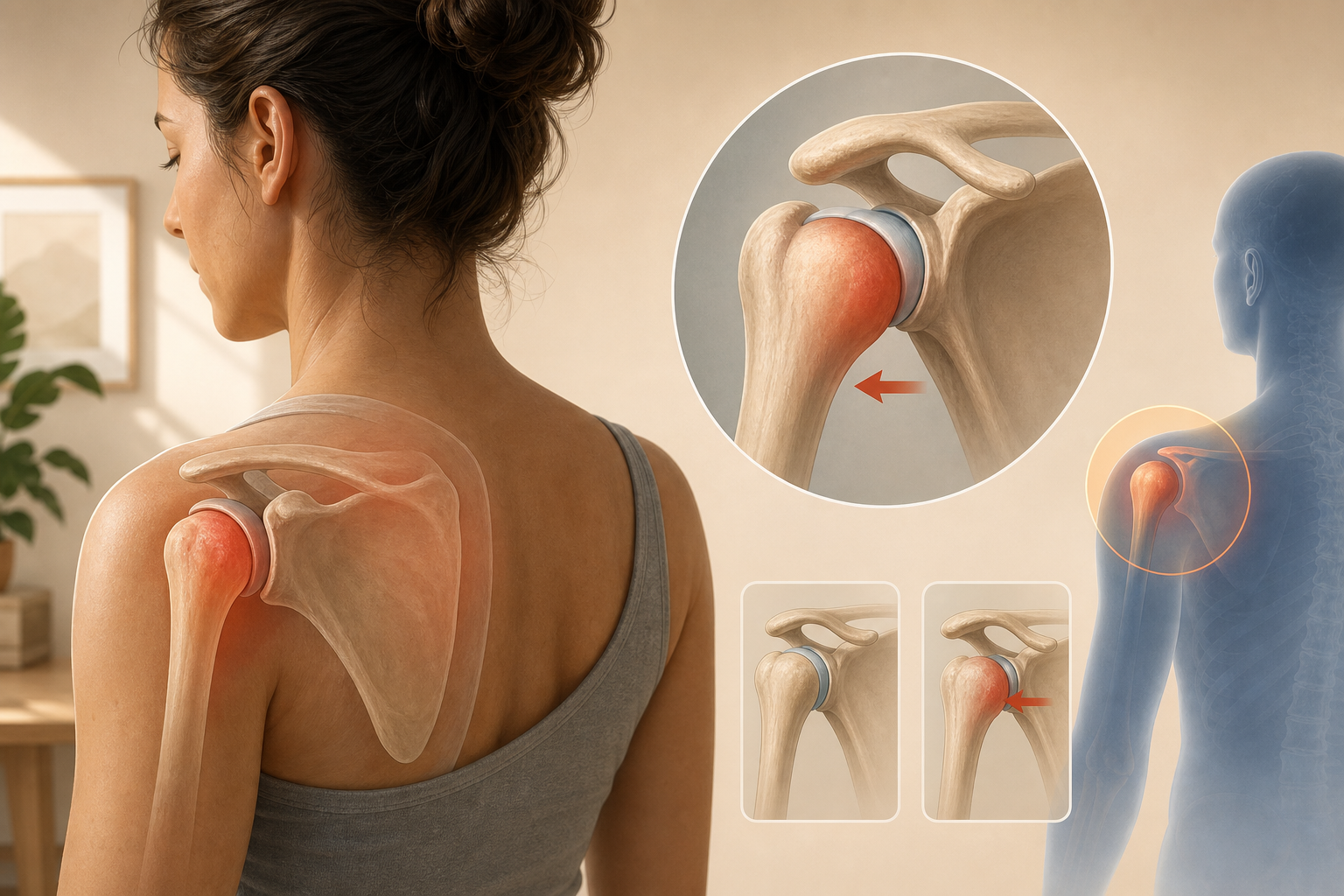
Left Shoulder Partial Dislocation (Posterior Humerus Subluxation): What Patients Need to Know starts with one key fact: the ball of the upper arm bone partially slips backward in the shoulder socket, then either returns on its own or remains slightly off-center. This injury can cause clicking, weakness, limited rotation, pain when reaching across the chest, and a repeated sense that the left shoulder feels loose after injury.
Posterior shoulder subluxation is usually treated first with careful evaluation, activity modification, physical therapy, strengthening, and shoulder-control retraining. Seek prompt medical care after major trauma, visible deformity, arm numbness, a cold or blue hand, seizure activity, or inability to move the shoulder.
What Is a Left Shoulder Partial Dislocation (Posterior Humerus Subluxation)?
Posterior humerus subluxation means the humeral head, the rounded top of the upper arm bone, has shifted backward relative to the glenoid, the shallow socket of the shoulder blade. “Partial dislocation” means the joint surfaces lose normal alignment but do not fully separate the way they do in a complete shoulder dislocation.
The shoulder trades stability for motion. The labrum deepens the socket, the rotator cuff centers the humeral head, and the posterior capsule helps limit excessive backward translation. If one or more of these structures fails to control the joint, the humeral head can slide backward during pushing, reaching, falling, or bracing.
Posterior shoulder dislocations are uncommon compared with anterior shoulder dislocations, often reported at roughly 2% to 5% of shoulder dislocation patterns. Partial posterior instability may be undercounted because the shoulder can slip and reduce before imaging.
If you are asking “what is posterior shoulder subluxation,” the practical answer is this: the shoulder is not staying centered during movement. The care plan should identify why the joint is slipping, which tissues are irritated, and which movements need short-term restriction.
- Humeral head: ball of the shoulder joint.
- Glenoid: shallow socket on the shoulder blade.
- Labrum: cartilage rim that improves socket depth.
- Rotator cuff: supraspinatus, infraspinatus, teres minor, and subscapularis muscles that guide shoulder motion.
- Posterior capsule: back portion of the shoulder joint covering that limits excessive backward glide.
Partial Shoulder Dislocation vs Complete Shoulder Dislocation: What Is the Difference?
A partial shoulder dislocation is a subluxation; a complete shoulder dislocation means the humeral head fully leaves the socket. The difference affects urgency, imaging decisions, rehab timing, and how quickly a provider may allow loaded shoulder activity.
Partial shoulder dislocation vs complete dislocation can be difficult to judge from symptoms alone. A shoulder that “pops out and back in” may feel normal for a few minutes, then become sore, weak, or unstable later. A complete dislocation usually causes more obvious deformity and loss of motion, but posterior injuries can look subtle.
Feature Posterior Subluxation Complete Dislocation Joint position Partially shifted backward, often self-reduces Humeral head fully out of socket Visible deformity May be absent May show clear contour change Motion Often limited in internal rotation, cross-body reach, or loading Often severely restricted Typical first care goal Confirm stability, protect tissue, start controlled rehab Urgent evaluation and joint position confirmationDo not test the shoulder by repeatedly trying to make it pop. Repeated slipping can irritate the posterior labrum, strain the rotator cuff, and increase guarding through the upper trapezius, levator scapulae, and neck muscles. If neck pain or headache followed the same fall or collision, review why neck injuries deserve a careful evaluation.
What Causes Shoulder Slipping Backward?
The main causes of shoulder slipping backward are trauma, falls, contact sports, seizure activity, repetitive pushing, and poor control of the shoulder blade during loaded movement. Posterior instability often occurs when the arm is flexed forward, moved across the body, and internally rotated.
Common injury patterns
- Fall onto an outstretched arm: the force drives the humeral head backward against the glenoid.
- Direct blow to the front of the shoulder: the humeral head can shift posteriorly.
- Contact sports: blocking, tackling, grappling, and falls can overload the posterior capsule.
- Weight training: heavy bench press, dips, push-ups, or overhead pressing can provoke symptoms when scapular control is poor.
- Seizure activity: strong involuntary muscle contraction can force the shoulder backward. If seizure symptoms occurred, see possible causes of seizures and seek medical evaluation.
- Repetitive strain: repeated pushing or closed-chain loading can irritate a vulnerable posterior labrum.
Mechanics that increase risk
The humeral head should rotate and glide while the scapula upwardly rotates, posteriorly tilts, and externally rotates. When the serratus anterior and lower trapezius underperform, the shoulder blade may tip forward. That position narrows safe motion and increases strain on the posterior shoulder.
Rehab usually starts by removing the trigger. For the first 1 to 2 weeks after a mild subluxation, patients are often told to avoid deep push-ups, dips, heavy benching, forceful cross-body reaching, and loaded internal rotation until a provider confirms the shoulder is stable enough for progression.
What Symptoms Suggest Posterior Shoulder Instability?
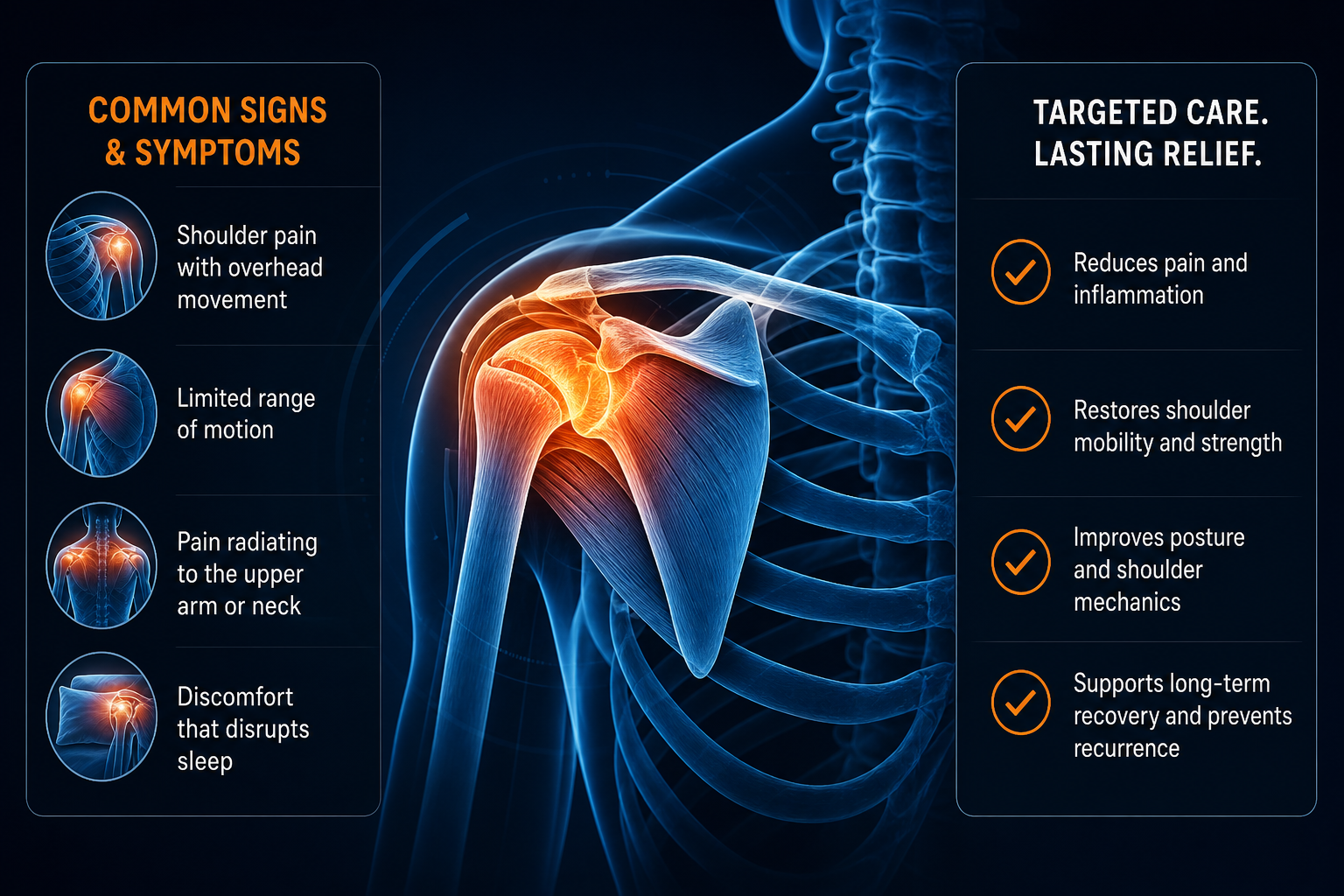
Posterior shoulder instability often causes deep back-of-shoulder pain, weakness, clicking, reduced rotation, and a slipping sensation during pushing or reaching across the chest. A left shoulder that feels loose after injury should be evaluated if the looseness repeats, limits activity, or follows trauma.
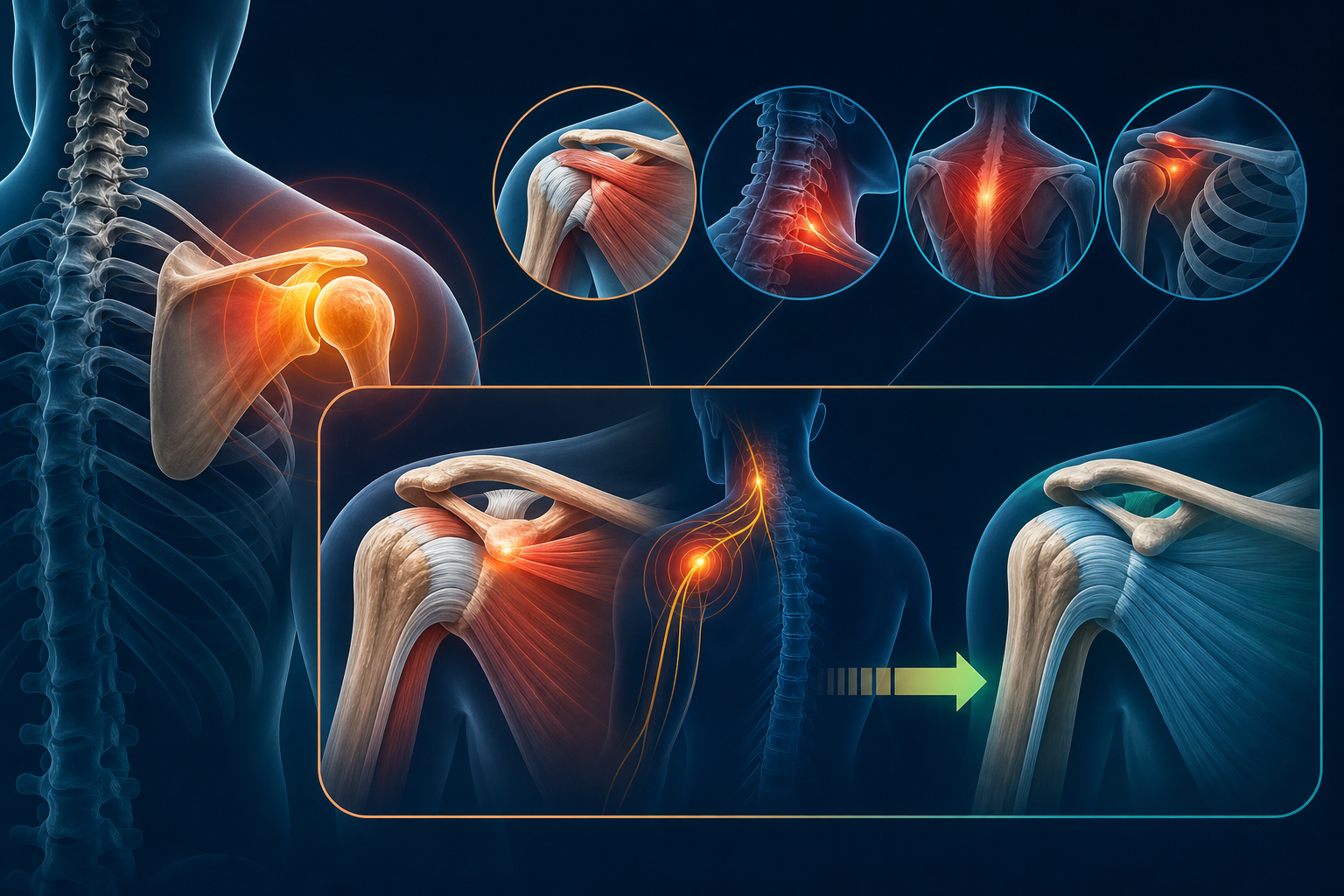
Pain location can mislead you. Posterior instability may create symptoms in the back of the shoulder, outer shoulder, upper arm, shoulder blade region, or neck. The rotator cuff may guard the joint, and the biceps tendon may become irritated because the shoulder is not tracking cleanly.
- Pain when reaching across chest: common with posterior labral irritation or posterior capsule sensitivity.
- Clicking or popping: not always dangerous, but new popping after injury needs evaluation if paired with pain, weakness, or slipping.
- Weakness with pushing: push-ups, opening heavy doors, or pressing movements may feel unstable.
- Loss of rotation: internal rotation or external rotation may be limited compared with the other side.
- Dead-arm feeling: the arm may feel temporarily weak after the shoulder shifts.
- Scapular winging or shrugging: the shoulder blade may move poorly when the rotator cuff and serratus anterior cannot control the joint.
If you are asking “is shoulder popping normal after injury,” use this rule: painless occasional popping during normal motion may be benign; popping with pain, weakness, catching, numbness, or repeated slipping is not a normal finding. If the same injury involved a head impact, dizziness, vision changes, or confusion, review what to do after a possible concussion and seek prompt care.
Why Can Posterior Shoulder Instability Be Missed, and How Do Providers Evaluate It?
Posterior shoulder instability can be missed because the shoulder may not look deformed, standard front-view X-rays may appear unclear, and symptoms can mimic rotator cuff strain, neck referral, or general shoulder impingement. This is why posterior shoulder dislocation is missed more often than anterior instability patterns.
Why it gets confused with other shoulder problems
- The humeral head may reduce before the exam.
- Pain may spread toward the neck, scapula, or outer arm.
- Forward elevation may remain possible, even with instability.
- Internal rotation loss can be mistaken for stiffness alone.
- Muscle guarding can hide the direction of instability.
How providers check shoulder instability
Providers evaluate mechanism of injury, visible posture, active ROM, passive ROM, strength, neurovascular status, and specific instability tests. Common exam components include posterior load-and-shift testing, the jerk test, posterior apprehension positioning, rotator cuff strength testing, and scapular movement assessment.
Imaging may be used when trauma, instability, deformity, severe pain, or repeated slipping is present. X-ray views may include AP, scapular Y, and axillary views. MRI may help assess the posterior labrum, rotator cuff, cartilage surfaces, and bone bruising. CT may be considered when a provider needs more detail about the glenoid or humeral head shape.
Missed posterior shoulder dislocation has been reported in a substantial share of cases in emergency and orthopedic literature, especially when axillary imaging is not obtained or the injury follows seizure activity.
Neck conditions can also refer pain toward the shoulder. If symptoms include headache, upper neck pain, or radiating arm symptoms, upper cervical mechanics may need assessment as part of the broader musculoskeletal exam.
Conservative Care, Physical Therapy, and Rehabilitation
Most first-line care for posterior shoulder subluxation focuses on protecting the joint, restoring pain-free motion, strengthening the rotator cuff, and retraining scapular control. Physical therapy for posterior shoulder instability typically progresses from protection to control, then to strength, then to sport or work-specific loading.
Expected timelines vary by injury severity. Mild subluxation without major tissue damage may calm down over 2 to 6 weeks. Rebuilding strength and trust in loaded movement often takes 6 to 12 weeks. Return to contact sport, heavy lifting, or repetitive overhead work may require 12 to 16 weeks or longer, depending on testing and provider guidance.
Care option Primary goal Typical timeline Expected progress marker Activity modification Reduce posterior joint stress 1 to 3 weeks Less slipping during daily tasks Early ROM Prevent stiffness without forcing instability 1 to 4 weeks Pain-free forward elevation improves Rotator cuff isometrics Improve humeral head control 2 to 6 weeks Better external rotation strength Scapular strengthening Improve shoulder blade position 3 to 8 weeks Less shrugging during arm elevation Closed-chain progression Restore pushing tolerance 6 to 12+ weeks Wall push-up progresses without symptomsHome exercise: pain-free external rotation isometric
- Stand with the injured left elbow bent to 90 degrees and tucked against your side.
- Place a folded towel between the elbow and ribs to keep the shoulder relaxed.
- Press the back of the left hand gently into a wall or doorframe as if rotating the forearm outward.
- Hold 5 seconds at 20% to 40% effort, without pain or slipping.
- Repeat 8 to 10 reps, rest 60 seconds, and complete 2 sets.
- Stop if you feel catching, sharp pain, numbness, or the shoulder shifting backward.
This drill trains the infraspinatus and teres minor without large joint motion. A PT may add serratus wall slides, prone row variations, rhythmic stabilization, and gradual pushing progressions when the shoulder tolerates load.
Chiropractic or integrative musculoskeletal care may help when restricted thoracic spine motion, neck stiffness, rib mechanics, or scapular coordination contribute to abnormal shoulder loading. The goal is not to force the shoulder into range. The goal is to improve the movement system around the shoulder while rehab restores joint control. To compare care options, you can find a physical therapist near you or find a chiropractor near you.
FAQ: Left Shoulder Partial Dislocation and Posterior Humerus Subluxation
These answers cover the questions patients most often ask before scheduling shoulder instability care. They do not replace an exam, imaging decision, or individualized rehab plan.
- What is posterior shoulder subluxation? Posterior shoulder subluxation is a partial backward shift of the humeral head on the glenoid. The shoulder may slip briefly and return on its own, or it may stay slightly off-center until evaluated.
- Can posterior shoulder subluxation heal with rehab? Many mild cases improve with activity modification, rotator cuff strengthening, scapular control training, and gradual loading. The timeline commonly ranges from 6 to 12 weeks for functional improvement, but trauma severity and tissue injury change the plan.
- Is shoulder popping normal after injury? Popping without pain may occur in healthy shoulders. New popping with pain, weakness, catching, numbness, or a slipping sensation after injury should be assessed.
- Why do I have pain when reaching across my chest? Cross-body reaching can compress or stress the posterior shoulder structures, including the posterior labrum and capsule. Avoid forcing that motion until a provider checks stability and ROM.
- What natural treatment for shoulder instability is reasonable? Reasonable conservative care includes guided exercise therapy, soft tissue work, joint mobility work outside the unstable direction, posture and ergonomics changes, and progressive strengthening. Care should match the exam findings.
If shoulder symptoms overlap with widespread pain sensitivity, sleep disruption, or persistent muscle tenderness, natural care options for fibromyalgia-related symptoms may offer additional context for whole-body load management.
What to Do Next
Get evaluated promptly if the left shoulder feels loose after injury, slips more than once, or causes weakness with pushing, reaching, or lifting. A qualified musculoskeletal provider can check joint stability, rotator cuff strength, scapular mechanics, cervical referral signs, and whether imaging is appropriate.
Seek urgent medical care now if you have any red flag symptoms:
- Visible shoulder deformity after trauma
- Inability to move the arm after injury
- Numbness, tingling, or loss of hand strength
- Cold, pale, or blue hand
- Severe pain that does not ease with rest and support
- Shoulder injury linked with seizure activity, fainting, chest symptoms, or major fall
- Head injury symptoms such as confusion, repeated vomiting, worsening headache, or vision changes
Schedule routine care if symptoms are milder but persist beyond 3 to 7 days, if popping continues with pain, or if you cannot return to normal work, training, or daily activity. At a first visit, expect a history of the injury, ROM testing, strength testing, instability screening, neurologic checks, and a plan for safe activity limits.
For shoulder instability specialist near me searches, start with a provider who regularly treats shoulder injuries through rehabilitation, chiropractic musculoskeletal assessment, sports rehab, or manual therapy. You can browse providers on Medximity and compare care options near your city or region.
Medical disclaimer: This article is for educational purposes only and does not diagnose your shoulder condition. A provider should evaluate traumatic shoulder injuries, repeated instability, neurologic symptoms, or symptoms that do not improve with appropriate conservative care.