If you have been waking up at night with numb or tingling hands, or noticing that your grip feels weaker than it used to, carpal tunnel syndrome (CTS) may be worth discussing with a qualified provider. It is one of the most frequently diagnosed nerve conditions in the upper extremity, affecting millions of adults across the United States — and yet it is also one of the most misunderstood. Many people assume surgery is inevitable. In most cases, conservative care is the appropriate first step, and for a significant number of patients, it may be all that is needed.
This guide walks through what carpal tunnel syndrome is, what causes it, how it differs from similar conditions, and what your treatment options look like — from chiropractic care and physical therapy to at-home nerve exercises.
What Is Carpal Tunnel Syndrome?
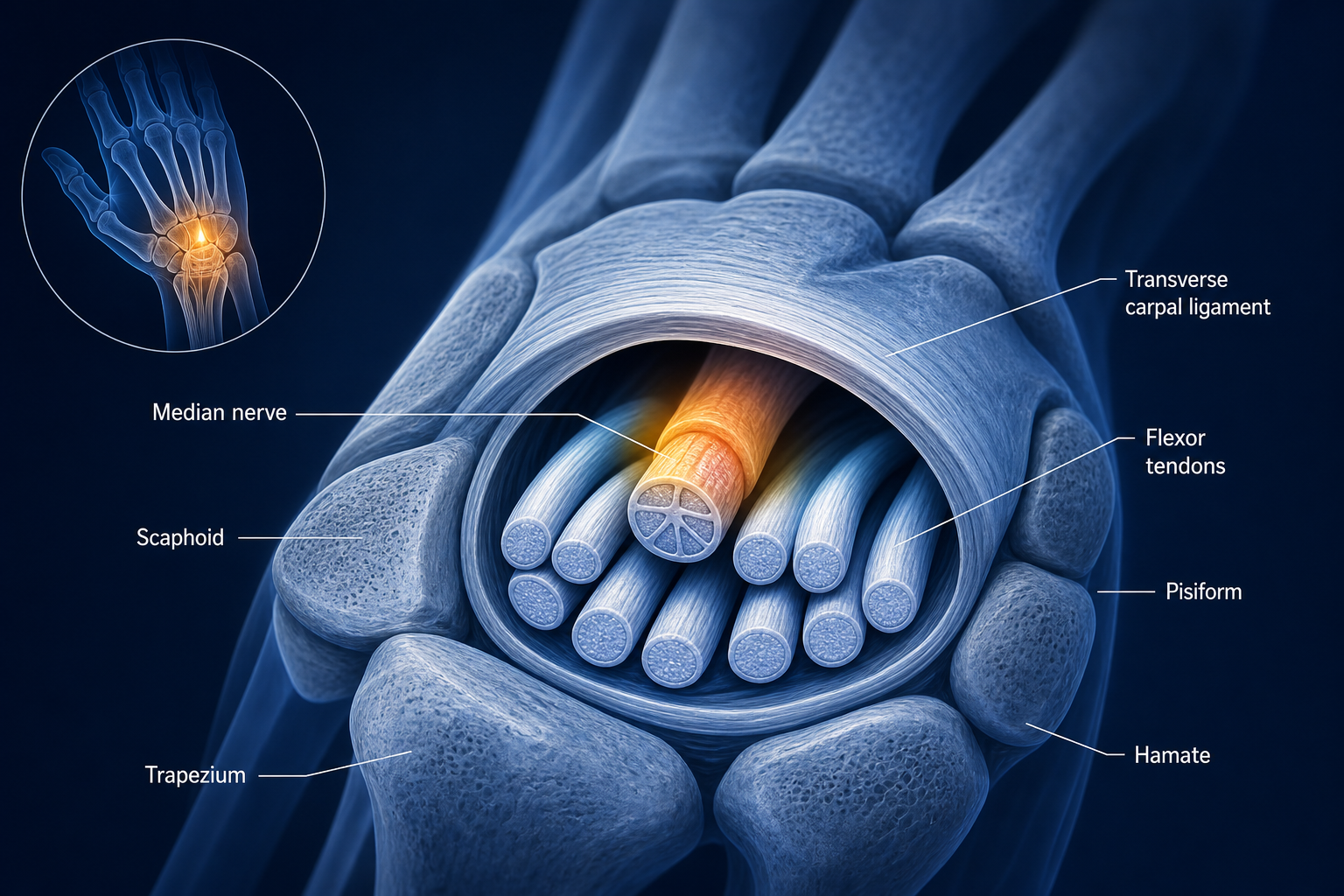
The carpal tunnel is a narrow passageway on the palm side of your wrist, formed by bones and ligament. Running through it is the median nerve, along with tendons that control finger movement. When that tunnel becomes compressed — whether from inflammation, swelling, repetitive stress, or structural changes — the median nerve gets squeezed. That pressure is what produces the hallmark symptoms of carpal tunnel syndrome.
Because the median nerve supplies sensation to the thumb, index finger, middle finger, and part of the ring finger, those are typically the first fingers where symptoms appear. The pinky finger is usually spared, which can help distinguish CTS from other nerve conditions affecting the hand.
What the Carpal Tunnel Actually Does
The carpal tunnel's job is to protect the median nerve and flexor tendons as they travel from the forearm into the hand. Its walls are rigid — the carpal bones on three sides and the transverse carpal ligament across the front — which means there is almost no room for swelling or tissue changes without creating pressure on the nerve. That structural reality is why even modest inflammation can produce noticeable symptoms.
Carpal Tunnel Syndrome Symptoms in Fingers and Wrist
Symptoms of carpal tunnel syndrome tend to develop gradually and may be easy to dismiss early on. Over time, they often become harder to ignore. Common signs include:
- Tingling or numbness in the thumb, index, middle, and part of the ring finger
- Hand or wrist pain that may radiate up the forearm toward the elbow
- Weakness in grip strength, sometimes causing items to be dropped unexpectedly
- A sensation of swelling in the fingers even when no visible swelling is present
- Symptoms that worsen at night or upon waking, often requiring shaking the hand for relief
- Discomfort during sustained wrist positions, such as holding a phone, driving, or typing
What Causes Tingling and Numbness in Hands at Night?
Nighttime symptoms are one of the most recognizable features of carpal tunnel syndrome, and they have a clear mechanical explanation. During sleep, many people naturally flex their wrists — a position that reduces space within the carpal tunnel and increases pressure on the median nerve. Blood flow changes during rest may also play a role. If you consistently wake up needing to shake your hands to restore sensation, that pattern is worth mentioning to a provider who can assess whether CTS is the underlying cause.
What Causes Carpal Tunnel Syndrome?
There is rarely a single cause. Carpal tunnel syndrome most commonly results from a combination of factors that cumulatively increase pressure within the tunnel over time.
Common Contributing Factors
- Repetitive hand and wrist motions — assembly work, keyboard use, tool operation, and other sustained activities that involve repeated wrist flexion or extension
- Anatomical factors — a naturally smaller carpal tunnel, wrist injuries, or bone spurs that narrow the available space
- Inflammatory conditions — rheumatoid arthritis and other inflammatory conditions can cause synovial tissue to swell within the tunnel
- Hormonal changes — fluid retention associated with pregnancy, menopause, or thyroid dysfunction can increase tunnel pressure
- Diabetes — metabolic changes associated with diabetes may increase susceptibility to nerve compression injuries
- Obesity — higher body mass is associated with increased carpal tunnel pressure in some research
Wrist Pain and Hand Numbness During Pregnancy
Pregnancy-related carpal tunnel syndrome is more common than many people realize. Fluid retention — particularly in the second and third trimesters — can increase pressure within the carpal tunnel significantly. Symptoms often appear or worsen overnight and may affect both hands. The good news: for most pregnant patients, symptoms improve substantially after delivery as fluid levels normalize. Conservative management, including splinting and gentle physical therapy, can help manage discomfort in the meantime. If you are experiencing hand numbness during pregnancy, a provider familiar with prenatal musculoskeletal care can help you find safe, appropriate options.
Carpal Tunnel Syndrome vs. Tendinitis: Which Do I Have?
Wrist and hand pain has several possible sources, and the distinction matters because treatment approaches differ. Two commonly confused conditions are carpal tunnel syndrome and wrist tendinitis.
Key Differences
Carpal tunnel syndrome is a nerve compression condition. Its defining symptoms are neurological: tingling, numbness, and weakness in a median nerve distribution (thumb through part of the ring finger). Pain may be present but is secondary to the nerve involvement.
Wrist tendinitis is inflammation of one or more tendons around the wrist. It typically produces localized pain, tenderness along a tendon's path, and sometimes swelling — but without the characteristic finger numbness or tingling pattern of CTS. De Quervain's tenosynovitis, which affects the thumb-side tendons, is one well-known example.
Some patients have both conditions simultaneously, which is part of why a proper clinical examination matters. A chiropractor or physical therapist trained in upper extremity assessment can help differentiate these conditions and guide appropriate care. Search for a provider near you on Medximity to get a professional evaluation.
Double Crush Syndrome: When the Problem Is More Than the Wrist
Not all hand tingling originates at the wrist. Double crush syndrome is a concept in clinical practice describing a situation where a nerve is compressed at two or more points along its path. The median nerve travels from the cervical spine (neck) down through the brachial plexus, across the shoulder and elbow, and into the wrist. Compression at any point along that path — a herniated cervical disc, thoracic outlet syndrome, or pronator teres syndrome near the elbow — can produce symptoms that closely resemble carpal tunnel syndrome, or can make an existing CTS worse.
Neck and Wrist Nerve Compression Symptoms
If you have hand numbness alongside neck pain, shoulder tension, or symptoms that do not fully match the classic CTS pattern, a provider who evaluates the entire kinetic chain — from the cervical spine through the wrist — may identify a contributing double crush component. Chiropractors who assess spinal mechanics alongside extremity function are often well-positioned to evaluate this possibility. Treating only the wrist when the neck is also involved may produce incomplete relief.
Learn more about how cervical spine health connects to upper extremity symptoms in our related article: Neck Pain and Upper Extremity Nerve Symptoms.
Carpal Tunnel Syndrome Treatment Without Surgery
Surgery is not the first step for most people diagnosed with carpal tunnel syndrome. Clinical guidelines generally recommend conservative care as the initial approach, particularly for mild to moderate cases. Several evidence-informed options may help reduce symptoms and support nerve recovery.
Wrist Splinting
Wearing a neutral-position wrist splint — especially at night — keeps the wrist from flexing and reduces pressure within the carpal tunnel while you sleep. Many patients report meaningful symptom improvement with consistent splint use over several weeks.
Activity Modification
Identifying and reducing the specific activities that provoke symptoms is a practical early intervention. Ergonomic adjustments to a workstation, changes to keyboard and mouse positioning, and tool modification for manual workers can meaningfully reduce cumulative stress on the carpal tunnel throughout the day.
Can a Chiropractor Help with Carpal Tunnel Syndrome?
Chiropractic care for carpal tunnel syndrome may include manipulation or mobilization of the wrist and hand joints, soft tissue therapy, and assessment of the cervical spine and upper extremity for contributing compression points. Some research suggests that chiropractic management may be associated with symptom improvement in patients with mild to moderate CTS, particularly when combined with splinting and exercise. Results vary by individual, and a chiropractor who specializes in extremity conditions will be best positioned to assess whether this approach is appropriate for your specific presentation.
Find a chiropractor experienced in carpal tunnel and extremity care on Medximity.
Best Physical Therapy Exercises for Carpal Tunnel Relief
Physical therapy for carpal tunnel syndrome often focuses on reducing nerve irritation, improving tissue mobility, and correcting movement patterns that may be contributing to compression. A physical therapist may use a combination of:
- Manual therapy to address wrist joint stiffness and soft tissue restrictions
- Nerve gliding exercises designed to improve median nerve mobility through the carpal tunnel
- Tendon gliding exercises to reduce adhesion between flexor tendons and surrounding tissue
- Strengthening exercises targeting the wrist stabilizers and intrinsic hand muscles
- Postural and ergonomic education to address sustained positioning habits
Search for physical therapists who treat carpal tunnel syndrome near you.
Nerve Gliding Exercises for Carpal Tunnel at Home
Nerve gliding — sometimes called nerve flossing — involves a series of gentle movements designed to mobilize the median nerve through its full range of motion. The goal is to reduce neural tension, improve circulation to the nerve, and prevent the kind of adhesion that can develop when a nerve stays compressed and relatively immobile over time.
A basic median nerve glide typically involves extending the wrist and fingers while positioning the arm in various postures that progressively place tension on the nerve path. These exercises should be performed gently — the goal is a mild stretch or tingling sensation, not sharp pain — and ideally under the initial guidance of a physical therapist who can confirm proper technique and appropriate progression for your level of irritability.
Do not begin an aggressive self-directed exercise program without provider guidance, particularly if your symptoms are moderate to severe. Exercises that are too aggressive too early can temporarily worsen nerve irritation.
How Long Does Carpal Tunnel Take to Heal Without Surgery?
Recovery timelines vary considerably and depend on several factors: how long you have had symptoms, how severe the nerve compression is, whether contributing factors have been addressed, and how consistently you follow your treatment plan.
For mild cases caught early, some patients notice meaningful improvement within a few weeks of consistent splinting and activity modification. More established cases with moderate nerve involvement may require several months of structured conservative care — including physical therapy and chiropractic management — before achieving sustained relief. Cases with significant nerve damage (indicated by weakness and muscle wasting at the base of the thumb) tend to recover more slowly and may ultimately require surgical consultation if conservative care does not produce adequate improvement after an appropriate trial period.
There is no universal timeline, and a provider who has evaluated your specific case is the right source for a realistic prognosis. What the evidence does consistently suggest is that early, appropriate conservative care tends to produce better outcomes than delayed treatment.
Is Carpal Tunnel Syndrome a Work-Related Injury Claim?
Carpal tunnel syndrome is among the most frequently recognized occupational injuries in the United States. Jobs that involve repetitive hand motions, sustained wrist flexion or extension, use of vibrating tools, or forceful gripping over extended periods are associated with higher rates of CTS in the research literature.
Whether a specific case qualifies as a compensable work-related injury depends on the laws of the state where you work, the specifics of your job duties, and the documentation your medical providers generate. Workers' compensation and personal injury law vary significantly by jurisdiction, and the administrative process for filing a claim has its own deadlines and requirements.
If you believe your carpal tunnel syndrome developed or worsened because of your work, consulting both a treating provider who can document your condition thoroughly and a licensed attorney familiar with workers' compensation law in your state is a reasonable step. This article is educational in nature and does not constitute legal advice; your specific situation requires a qualified legal professional who can evaluate your facts.
Thorough clinical documentation — including nerve conduction studies, functional assessments, and detailed records of symptom onset relative to work activities — is typically central to any occupational injury claim. Providers who are experienced in documenting work-related musculoskeletal conditions can be found through the Medximity provider directory.
When to See a Provider
You do not need to wait until symptoms are severe before seeking evaluation. In fact, earlier assessment generally leads to better outcomes. Consider scheduling an appointment if:
- Nighttime hand numbness or tingling has been waking you up more than occasionally
- Symptoms persist for more than a few weeks without a clear explanation
- You are noticing weakness in your grip or dropping objects
- Symptoms are affecting your ability to work or perform daily activities
- You are pregnant and experiencing new hand or wrist symptoms
- You have tried splinting and home measures for several weeks without improvement
A chiropractor or physical therapist with experience in upper extremity conditions can perform a thorough assessment, help identify whether CTS or another condition is responsible for your symptoms, and develop a conservative care plan suited to your situation. Use the Medximity directory to find a qualified provider near you.
For more on related conditions affecting the neck and upper extremity, explore Chiropractic Care for Nerve Pain and Physical Therapy for Repetitive Stress Injuries on the Medximity blog.
Frequently Asked Questions About Carpal Tunnel Syndrome
See the FAQ section below for answers to the most common questions patients ask before their first appointment.
The information in this article is intended for general educational purposes only and does not constitute medical advice. Individual symptoms, diagnoses, and treatment recommendations vary. Please consult a qualified healthcare provider about your specific condition and circumstances.