The benefits of chiropractic care for headaches may include reduced headache frequency, lower neck-related pain, improved cervical ROM, and better tolerance for work or daily activity in some patients. Chiropractic care is most relevant when headaches are linked to the neck, upper back, jaw tension, posture, or muscle guarding rather than a medical emergency. A first visit should include a history, neurological screening, neck exam, movement testing, and a plan that explains what will be treated, how progress will be measured, and when referral is needed.
How May Chiropractic Care Help Certain Headaches?
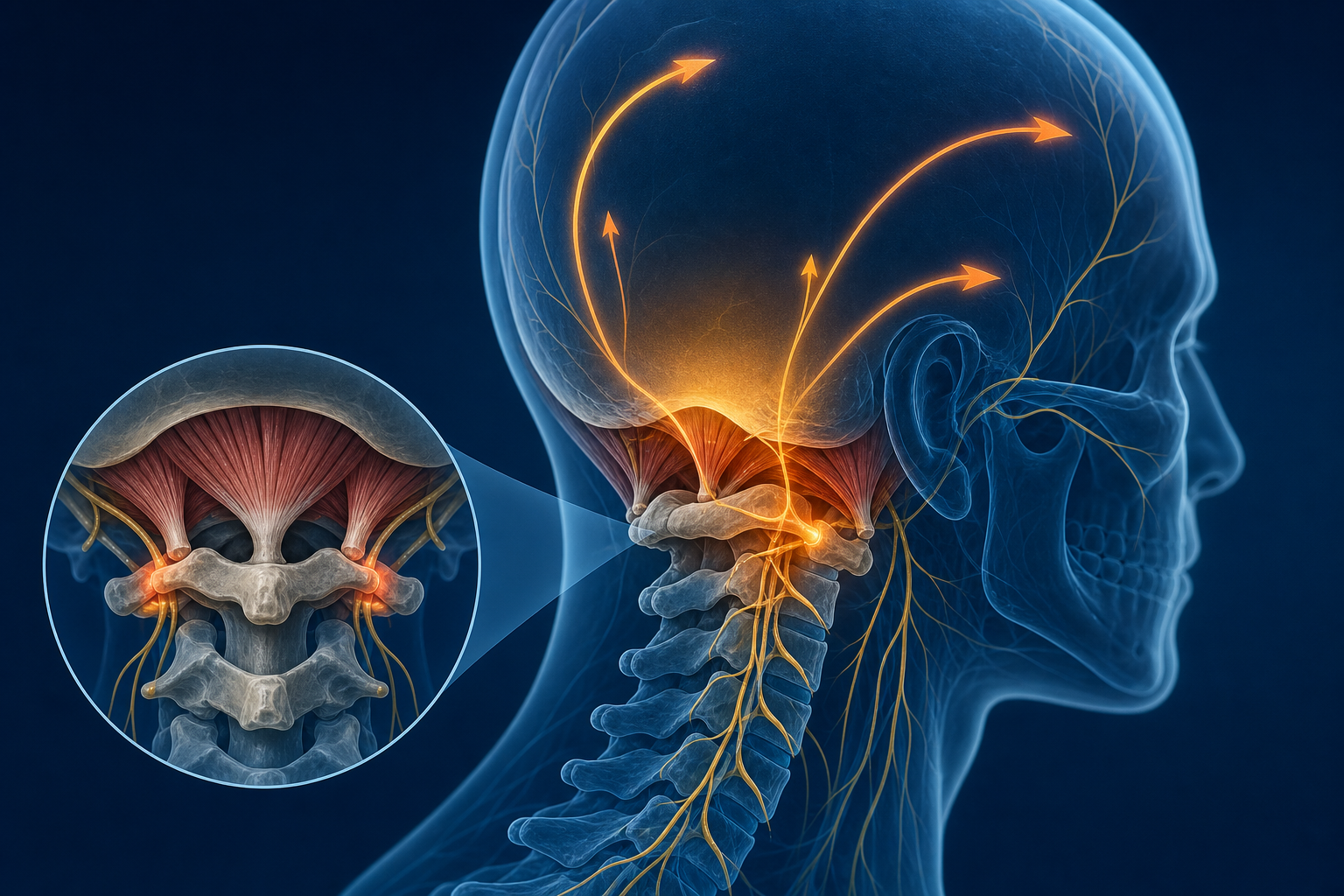
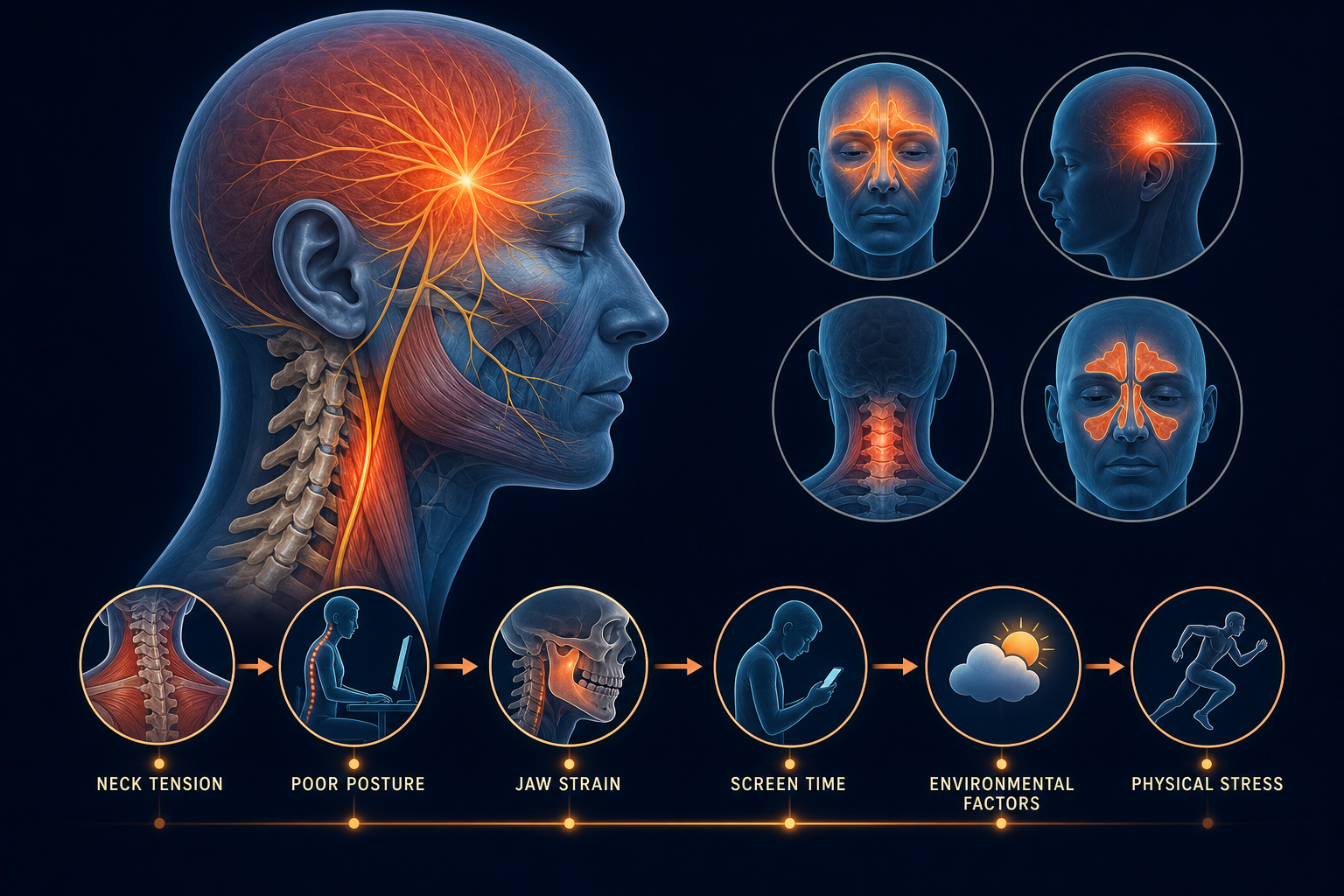
Chiropractic care may help certain headaches by improving motion in the cervical spine, reducing tension in the suboccipital muscles, and addressing joint irritation in the upper neck. The upper cervical joints, especially around the atlas and axis, share nerve pathways with head pain referral patterns. When neck motion is limited or muscles stay guarded, pain can refer into the temples, forehead, behind the eyes, or base of the skull.
Can chiropractic help tension headaches? It may help when tension headaches are associated with neck stiffness, forward-head posture, tight upper trapezius, tight levator scapulae, or prolonged desk work. Research reviews generally support manual therapy, exercise, and postural correction for some patients with tension-type and cervicogenic headache patterns, especially when care is combined with home exercises.
Tension-type headaches affect a large portion of adults worldwide, and neck pain commonly appears in patients with frequent headache patterns.
Common chiropractic goals for headache care
- Improve cervical ROM: especially rotation, extension, and side bending.
- Reduce neck-driven referral pain: often felt at the base of the skull, temples, or forehead.
- Decrease muscle guarding: especially in the suboccipitals, upper trapezius, and sternocleidomastoid.
- Improve posture tolerance: so screen time, driving, and reading do not trigger symptoms as quickly.
- Build a prevention plan: including mobility work, ergonomic changes, hydration habits, and sleep-position changes.
Patients who want a deeper explanation of upper cervical headache patterns can review upper cervical chiropractic care for headaches.
Which Headache Types May Respond to Chiropractic Care?
Headache type matters because chiropractic care does not treat every headache the same way. A chiropractor should first determine whether your symptoms fit a mechanical pattern, a primary headache pattern, or a red-flag pattern that needs prompt medical evaluation.
Tension-type headaches
Tension-type headaches often feel like pressure around both sides of the head, forehead, temples, or back of the skull. How long do tension headaches last? They can last from 30 minutes to 7 days, and frequent episodes may occur on more than 10 days per month. Chiropractic care may focus on cervical mobility, soft-tissue tension, breathing mechanics, and workstation position.
Cervicogenic headaches
Cervicogenic headaches start from the neck and refer pain into the head. These headaches are often one-sided and may worsen with neck movement, sustained posture, or pressure over the upper cervical joints. A neck pain and headaches chiropractor will commonly check the C1-C2 joints, facet joints, and deep neck flexor endurance.
Migraine patterns with neck involvement
Migraine is not simply a neck problem, but neck stiffness can occur before, during, or after a migraine episode. Chiropractic care may support some patients by reducing musculoskeletal triggers, improving posture tolerance, and decreasing neck pain that overlaps with migraine patterns. Migraine symptoms with neurological changes need careful screening.
Headache pattern Common clues How chiropractic care may fit Typical timeline to reassess Tension-type headache Band-like pressure, tight neck and shoulders, desk-related flare-ups Manual therapy, spinal manipulation, soft-tissue work, posture training 2-4 weeks Cervicogenic headache One-sided pain, limited neck rotation, headache worse when moving neck Upper cervical assessment, joint mobilization, manipulation when appropriate, ROM exercise 3-6 weeks Migraine with neck pain Throbbing pain, light sensitivity, nausea, neck stiffness Supportive care for neck mechanics and trigger reduction 4-8 weeks Jaw-related headache Temple pain, jaw clicking, clenching, morning headache TMJ screening, cervical care, jaw relaxation drills, posture changes 3-6 weeksJaw tension can overlap with head and neck pain. For more on that connection, see upper cervical care for TMJ and TMD.
Benefits of Chiropractic Care for Headaches
The main benefits of chiropractic care for headaches are most likely when headaches have a neck, posture, or muscle-tension component. A good plan should track objective changes such as headache days per month, headache intensity, cervical rotation, sleep disruption, and work tolerance.
Evidence-supported benefits
- Reduced headache frequency: some patients report fewer headache days after several weeks of manual therapy and exercise.
- Reduced neck pain: cervical spinal manipulation and mobilization may help neck-related headache patterns.
- Improved ROM: better rotation and extension can reduce strain during driving, screen work, and exercise.
- Less reliance on passive coping: a structured plan gives you exercises, posture cues, and trigger management strategies.
Patient-reported benefits
Patient-reported benefits often include less pressure at the base of the skull, fewer flare-ups after computer work, improved sleep position tolerance, and better confidence with activity. These benefits should be measured, not assumed. If symptoms do not improve after a defined trial of care, the plan should change or referral should be discussed.
A typical trial may involve 4-6 visits over 2-3 weeks for mild to moderate neck-related headaches, followed by reassessment. More persistent headaches may require 6-8 weeks of combined chiropractic care, PT-style exercise, ergonomic changes, and self-care before the pattern is clear.
A practical treatment goal is a measurable change: fewer headache days, lower peak intensity, improved neck ROM, or shorter recovery time after a flare-up.
For a broader discussion of upper cervical care and general function, review upper cervical chiropractic and quality of life.
What Does a Chiropractor Check During a Headache Visit?
A chiropractor should check for headache patterns, neck mechanics, neurological warning signs, and daily triggers before starting care. The visit should not be limited to a quick adjustment. Headache care needs a clear exam because the source may involve the cervical spine, jaw, shoulder girdle, vision strain, sleep position, hydration, or a non-musculoskeletal cause.
History questions that guide the exam
- Where does the headache start: forehead, temples, behind the eye, base of skull, or one side?
- How often does it occur: daily, weekly, monthly, or after specific activities?
- Is the headache worse when moving neck, coughing, bending, or exercising?
- Do you have dizziness, vision changes, facial numbness, weakness, fever, or recent trauma?
- Does jaw clenching, chewing, or morning tightness increase symptoms?
Physical exam components
The exam may include cervical ROM, palpation of the suboccipitals and upper trapezius, deep neck flexor endurance testing, posture assessment, shoulder motion, TMJ screening, and neurological checks such as reflexes, sensation, strength, eye tracking, and coordination. If symptoms suggest a condition outside chiropractic scope, referral is appropriate.
Exam finding What it may suggest Common next step Limited upper cervical rotation Cervicogenic headache component Upper cervical mobility work and reassessment Tender suboccipital trigger points Muscle tension referral into head Soft-tissue care and home mobility drills Weak deep neck flexor endurance Poor neck stabilization with posture fatigue Low-load endurance exercise Neurological deficit Possible non-mechanical cause Prompt medical evaluationWhich Conservative Treatment Options May You Discuss?
Conservative headache care often works best when manual treatment is paired with movement training and trigger management. If you want a natural treatment for frequent headaches, ask the provider which parts of your plan are hands-on, which parts are active exercise, and what milestones will be used to decide whether care is working.
Chiropractic care vs massage for headaches
Chiropractic care focuses on joint motion, spinal mechanics, neurological screening, and movement patterns. Massage focuses more on soft-tissue tension in muscles such as the upper trapezius, suboccipitals, temporalis, and sternocleidomastoid. Both may help some headache patterns, but they are not the same intervention.
Treatment option Primary target Expected outcome Typical timeline Chiropractic adjustment or mobilization Cervical and thoracic joint motion Improved ROM, reduced neck-driven headache referral Reassess after 4-6 visits Massage or soft-tissue therapy Suboccipitals, upper trapezius, levator scapulae, temporalis Lower muscle guarding and pressure symptoms 1-3 sessions for short-term response Exercise therapy Deep neck flexors, scapular stabilizers, thoracic mobility Better posture endurance and fewer posture-triggered flares 3-6 weeks Ergonomic changes Workstation, screen height, driving posture Reduced daily mechanical load Immediate setup change; reassess in 2 weeks Acupuncture Pain modulation and muscle tension patterns May reduce headache frequency or intensity in some patients 4-8 visitsA headache treatment without pain pills should still be structured. Passive care alone rarely fixes recurring mechanical triggers. A complete plan usually includes spinal manipulation or mobilization when appropriate, soft-tissue work, strengthening, mobility drills, sleep-position guidance, and a clear flare-up strategy.
If dizziness or ear pressure overlaps with upper neck symptoms, you may find this related discussion useful: upper cervical treatment and Meniere’s recovery.
What Daily Habits Help Prevent Headache Flare-Ups?
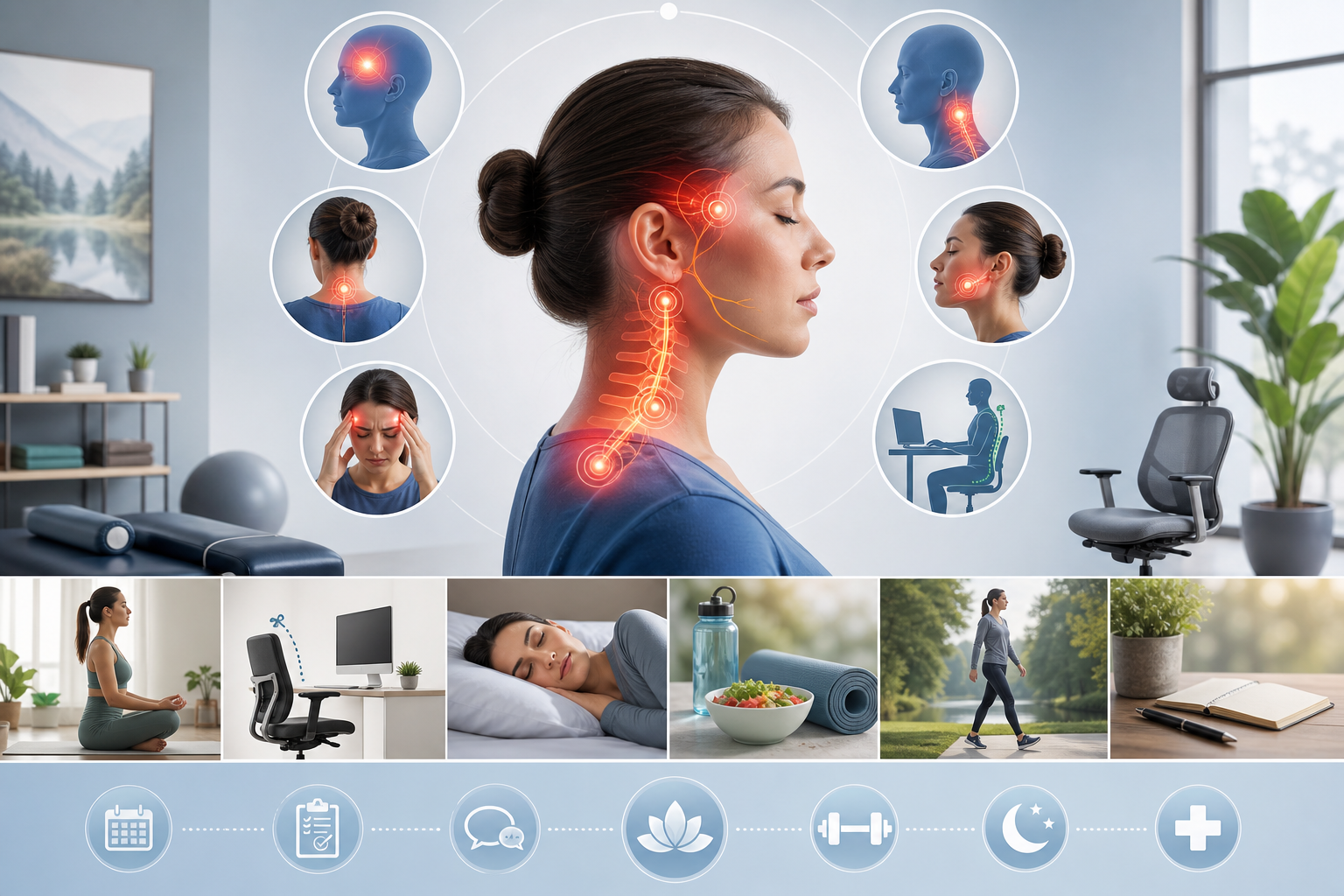
Daily habits to prevent headaches should reduce neck load, improve hydration consistency, limit jaw clenching, and increase movement breaks. Small changes work best when they are specific enough to repeat every day.
Desk and screen setup
- Place the top third of your monitor at eye level.
- Keep elbows near 90 degrees and shoulders relaxed.
- Move the screen closer if you lean forward to read.
- Use a chair that supports the mid-back, not just the low back.
- Take a 60-second movement break every 30-45 minutes.
Step-by-step home protocol: 5-minute neck reset
- Chin tuck: Sit tall. Glide your head straight back without looking down. Hold 5 seconds. Repeat 10 times.
- Suboccipital release: Place two fingertips under the base of your skull. Apply gentle pressure for 30-45 seconds while breathing slowly.
- Thoracic extension: Sit against a chair back. Support your head with your hands. Gently extend your upper back over the chair 8-10 times.
- Levator scapulae stretch: Turn your nose toward your armpit, then gently nod downward. Hold 20 seconds each side, 2 rounds.
- Jaw unclench drill: Place your tongue on the roof of your mouth, lips closed, teeth apart. Hold 60 seconds.
Stop the protocol if it causes sharp pain, dizziness, vision changes, facial tingling, or a sudden increase in headache intensity. Mild stretching pressure is acceptable; neurological symptoms are not.
Sleep and hydration checkpoints
- Use a pillow that keeps the neck neutral, not bent sharply upward or downward.
- Avoid stomach sleeping if it forces your neck to rotate for hours.
- Drink water consistently across the day rather than catching up at night.
- Limit long periods of chewing gum if temple pain or jaw fatigue is part of your pattern.
For more health education topics across chiropractic, rehabilitation, and wellness, you can explore more health topics on Medximity.
When Should You See a Healthcare Provider for Headaches?
You should see a provider when headaches are new, frequent, worsening, linked with neck pain, or interfering with daily activity. Is it normal to have daily headaches? No. Daily headaches deserve evaluation, especially when they are new, escalating, or require constant self-management.
Seek urgent care now for red flags
- Sudden “worst headache” or thunderclap onset
- Headache with facial droop, arm weakness, confusion, fainting, or trouble speaking
- Headache with fever, stiff neck, rash, or severe sensitivity to light
- New headache after a fall, collision, or head trauma
- New headache with vision loss, double vision, or severe dizziness
- New headache after age 50 or a headache that is clearly different from your usual pattern
Routine chiropractic evaluation may be reasonable when headaches are tied to neck stiffness, posture, jaw tension, upper back tightness, or headaches that build during computer work. A provider should screen first, treat second, and refer when symptoms do not match a mechanical pattern.
Recurring headaches should be tracked by days per month, intensity, duration, triggers, and response to care. A headache log often shows patterns that memory misses.
Simple headache log format
- Date and start time
- Location: forehead, temples, behind eye, base of skull, one side, both sides
- Intensity from 0-10
- Duration: minutes, hours, or days
- Neck ROM change: better, worse, or same
- Likely trigger: sleep, stress load, screen time, hydration, exercise, jaw clenching
What to Do Next
Choose a provider who evaluates headaches before treating them. The best chiropractor for headache relief is not simply the closest listing; it is a provider who explains your headache pattern, checks for red flags, tests cervical and neurological function, and gives you a measurable plan.
What to expect at the first visit
- A headache and health history, including onset, frequency, duration, and triggers
- Cervical ROM testing, posture assessment, and palpation of the upper neck and shoulder muscles
- Neurological screening when symptoms require it
- A discussion of whether chiropractic care, PT, massage, acupuncture, or referral is the right next step
- A short home plan with 1-3 exercises instead of a long list you will not use
Search terms like chiropractor for headaches near me can help you start, but your decision should depend on training, communication, exam quality, and whether the provider tracks outcomes. You can find a chiropractor near you through Medximity, compare local providers, and look for practices that treat neck-related headache patterns.
Questions to ask before choosing a chiropractor
- Do you evaluate cervicogenic, tension-type, and migraine-like headache patterns differently?
- What red flags would make you refer me out?
- How many visits before we reassess progress?
- Will I receive home exercises for neck mobility, posture endurance, or jaw tension?
- Do you coordinate with PT, massage, acupuncture, or other providers when needed?
Seek urgent care for red-flag symptoms. Schedule routine care if headaches are recurring, neck-related, posture-triggered, or not improving with basic self-care. You can also browse providers on Medximity to compare chiropractic, rehabilitation, and wellness options in your area.