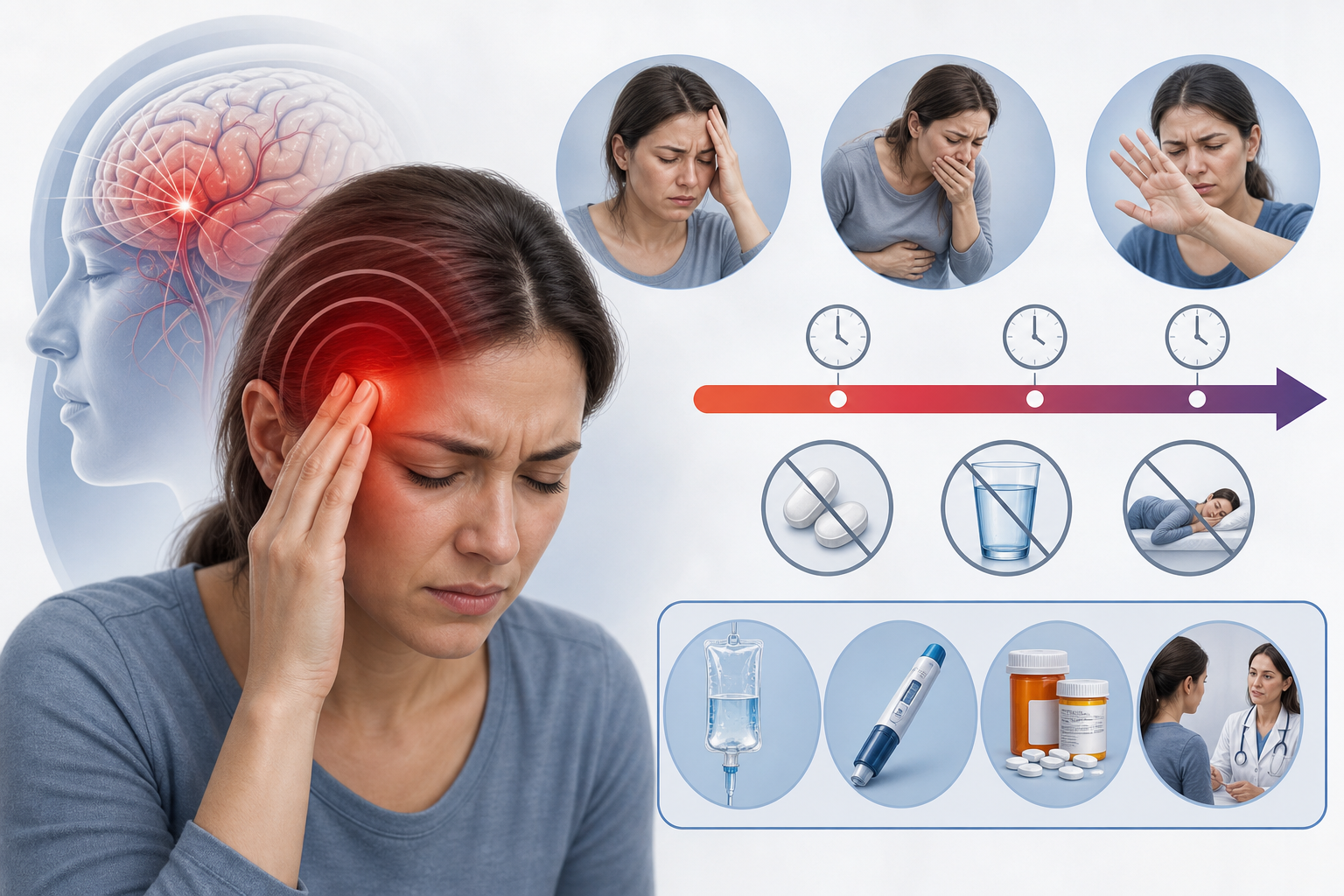
Understanding Migraine without aura, intractable, with status migrainosus: Symptoms, Causes, and Treatment starts with one key clinical point: this is a migraine pattern where head pain and migraine features last 72+ hours (status migrainosus) and do not respond to typical self-care (intractable). You need a plan that targets your nervous system sensitivity, neck and jaw drivers, sleep and hydration variables, and movement tolerance—while screening for emergency red flags. This guide covers the symptom pattern, likely causes, and non-pharmacologic treatment options used in chiropractic care, physical therapy, rehabilitation, and wellness.
What does “migraine without aura, intractable, with status migrainosus” mean?
Migraine without aura means you have migraine features (often throbbing or pulsating head pain, light sensitivity, sound sensitivity, nausea) without the neurologic warning signs called aura (like shimmering lights or zig-zag lines). The term status migrainosus is typically used when a migraine attack lasts more than 72 hours. The “intractable” label is used when the episode does not respond to typical measures and persists, often requiring urgent clinical evaluation and a structured plan. The International Classification of Headache Disorders (ICHD-3) defines migraine subtypes and status migrainosus criteria. Source: International Headache Society, ICHD-3 ().
- Duration: status migrainosus = typically >72 hours of continuous migraine symptoms or frequent relapses with minimal relief.
- Aura: absent (no visual/sensory/speech aura symptoms).
- Function: often significant impairment in work, driving, screen tolerance, and sleep.
- Clinical priority: rule out secondary causes and address modifiable triggers and musculoskeletal drivers.
Two anatomy facts matter for non-aura migraine: the trigeminal nerve (face/head sensation), the upper cervical joints (especially C1–C3), and the suboccipital muscles can amplify head pain through the trigeminocervical complex (a shared pain-processing region). This is one reason neck-focused rehab can reduce headache burden in selected patients. Source: American Migraine Foundation overview of migraine mechanisms ().
Symptoms: how this migraine pattern typically presents
Status migrainosus is not “just a long headache.” It is a sustained migraine state with persistent sensory sensitivity and reduced tolerance to routine activity. The symptom cluster is usually consistent across attacks, and tracking it helps your provider choose the right conservative care plan.
Core migraine symptoms (without aura)
- Head pain that is moderate to severe; often unilateral but can be bilateral; commonly pulsating.
- Photophobia (light sensitivity) and/or phonophobia (sound sensitivity).
- Nausea and sometimes vomiting.
- Worse with activity (stairs, bending, quick head turns) due to sensory amplification.
Common associated findings clinicians check
- Neck pain and reduced cervical ROM, especially extension and rotation.
- Jaw tension (masseter/temporalis overactivity) and morning clenching patterns.
- Scalp tenderness or sensitivity over the temples/occiput (trigeminal distribution).
- Vestibular features like dizziness or motion sensitivity (not aura, but commonly co-existing).
Clinical checkpoint: Any “first or worst” headache, new neurologic deficit, fever/stiff neck, confusion, fainting, or sudden thunderclap onset requires emergency evaluation. The CDC emphasizes urgent assessment for stroke warning signs such as facial droop, arm weakness, and speech difficulty. Source: CDC Stroke Signs and Symptoms ().
Timeline #1: A typical migraine attack lasts 4–72 hours. Status migrainosus extends beyond that threshold, so if you are at 72 hours with persistent migraine features, treat it as a higher-acuity situation and contact a qualified provider the same day.
Why does status migrainosus happen? (common causes and drivers)
Status migrainosus usually reflects a “stacking” problem: multiple drivers hit your nervous system at once and keep it sensitized. Your job is to identify the stack and remove the biggest pieces first.
- Sleep disruption: short sleep (<6 hours) or irregular sleep timing can lower migraine threshold.
- Hydration and skipped meals: dehydration plus inconsistent carbohydrate intake can sustain symptoms.
- Neck and upper back loading: prolonged flexion (laptop/phone) increases upper cervical and suboccipital tone.
- Jaw clenching (bruxism): sustained load through temporalis and masseter can drive head pain.
- Environmental overload: bright light, screen flicker, noise, and strong odors can maintain central sensitization.
- Overexertion or underexertion: sudden high-intensity training or complete inactivity can both be triggers.
Musculoskeletal contributors matter because the upper cervical spine shares pain processing with the trigeminal system. If you have migraine plus persistent neck stiffness, treating C1–C3 mobility, deep neck flexor endurance, and scapular control can reduce the “background noise” feeding the migraine state. Source: American Physical Therapy Association (APTA) patient resources on headache and PT care pathways ().
Practical rule: If your migraine is lasting days, assume at least two drivers are active (example: poor sleep + neck loading). Fixing only one often fails.
How do you know it’s migraine (not a dangerous headache)?
You cannot self-diagnose every prolonged headache safely. A clinician differentiates migraine from secondary headache using onset pattern, neurologic screen, vital signs, and targeted exam of the neck, jaw, cranial nerves, and balance system.
Red flags that need urgent or emergency evaluation
- Thunderclap onset (peaks in <1 minute) or “worst headache of your life.”
- New neurologic signs: facial droop, arm/leg weakness, numbness on one side, new slurred speech, new confusion.
- Fever, rash, stiff neck, or severe systemic illness.
- Headache after head/neck trauma, especially with worsening symptoms.
- New headache pattern after age 50 or with cancer/immunosuppression history.
Features that support migraine without aura
- Recurrent attacks with similar pattern over months/years.
- Head pain with photophobia/phonophobia and/or nausea.
- Symptoms worsened by routine physical activity.
- No aura symptoms (no transient visual/sensory/speech changes that precede pain).
Timeline #2: If you have continuous symptoms beyond 72 hours, schedule same-day clinical evaluation. If you have any red flags above, go to emergency care immediately.
Non-pharmacologic treatment options used in chiropractic, PT, and rehab
Conservative care for intractable migraine with status migrainosus focuses on reducing sensory load, restoring cervical and thoracic mechanics, and rebuilding tolerance to light, movement, and daily activity. The best plan is individualized, but the building blocks are consistent.
Treatment option Best fit (what it targets) Expected outcome Typical timeline Physical therapy (cervical + vestibular as needed) Neck ROM, deep neck flexors, scapular control, motion sensitivity Lower baseline neck tension; improved movement tolerance; fewer neck-triggered flares Typically 6–10 visits over 4–8 weeks with daily home program Chiropractic care (spinal manipulation/mobilization when appropriate) Upper cervical and thoracic joint mechanics; headache-related neck stiffness Improved cervical mobility; reduced cervicogenic contribution to migraine burden Often 2–6 visits over 2–4 weeks, then taper based on response Manual therapy + soft tissue work Suboccipitals, upper trapezius, levator scapulae, temporalis/masseter tension Short-term symptom downshift; better ROM to support exercise Same day relief is possible; sustained change needs 2–6 weeks plus exercise Graded aerobic activity Autonomic balance, sleep quality, migraine threshold Reduced attack frequency over time; improved recovery after flares 10–20 minutes, 3–5x/week; meaningful change often 4–12 weeks Trigger and load management Sleep timing, hydration, screen/light exposure, posture load Fewer prolonged attacks; shorter recovery window Some changes in 48–72 hours; stabilization over 2–6 weeksEvidence note: The National Institute of Neurological Disorders and Stroke (NINDS) describes migraine as a neurologic disorder influenced by triggers such as sleep changes, stress, and sensory input, supporting a multi-factor management strategy. Source: NINDS Migraine Information Page ().
- Key structures treated in rehab: C2–C3 facet joints, suboccipital muscles, trigeminal nerve sensitization pathways (indirectly via load/sensory control).
- Common exam findings that change the plan: limited cervical rotation, positive cervical flexion-rotation test, poor deep neck flexor endurance, TMJ tenderness, vestibular intolerance to head turns.
Home protocol: a step-by-step plan to reduce intensity during a prolonged migraine
This protocol aims to lower sensory input, reduce neck-driven amplification, and prevent deconditioning. Stop and seek urgent care if you develop red-flag symptoms (weakness, slurred speech, confusion, fever, thunderclap onset).
Step 1: Stabilize hydration and fueling (first 2–6 hours)
- Drink 16–24 oz of water over 60–90 minutes (steady sips, not chugging).
- Eat a small, simple meal with protein + carbohydrate (example: yogurt + fruit, eggs + toast). Avoid skipping meals for the rest of the day.
- Limit sensory overload: dim room lighting and reduce screen brightness. Use larger font and reduce scrolling (scrolling is a vestibular trigger for many people).
Step 2: Downshift the neck (10 minutes, repeat 2–4x/day)
- Supine suboccipital release: Lie on your back with two tennis balls in a sock placed under the base of your skull (not on the neck). Rest 60–90 seconds. Keep breathing slow.
- Chin tuck isometric: Still lying down, gently nod “yes” as if making a double chin. Hold 5 seconds, repeat 8–10 reps. You should feel the deep front neck muscles, not the sternocleidomastoid.
- Scapular set: Sitting or standing, pull shoulder blades slightly down and back (no shrug). Hold 5 seconds, repeat 10 reps.
Step 3: Restore motion tolerance (start when intensity is trending down)
- Short walk: 5 minutes at easy pace, indoors if light is a trigger. Add 1–2 minutes daily until you reach 15–20 minutes.
- Neck ROM “micro-doses”: Turn your head right/left to a comfortable limit, 5 reps each side, 2–3x/day. Avoid pushing into sharp pain.
Clinical target: Your goal is not to “push through.” Your goal is to reduce the migraine state enough that your nervous system tolerates normal light, movement, and sleep again.
What to track so your provider can treat this faster next time
Tracking turns a vague “bad migraine” into a treatable pattern. Bring a 7–14 day snapshot to your chiropractor or PT, especially after a status migrainosus episode.
- Start/stop times: when symptoms began, when you had meaningful relief, and whether pain ever fully stopped.
- Intensity curve: morning vs evening intensity (0–10 scale).
- Neck/jaw variables: neck stiffness (0–10), jaw clenching, chewing sensitivity, TMJ clicking.
- Screen tolerance: minutes before symptoms spike; brightness setting; scrolling vs static reading.
- Sleep: bedtime/wake time and total hours for the 3 nights before onset.
- Hydration/food: skipped meals, low fluid intake, heavy caffeine swings.
If you want to sanity-check whether your symptom pattern fits migraine vs another headache type, use the Medximity tool to check your symptoms, then bring the output to your visit.
What to Do Next
If you are dealing with migraine without aura, intractable, with status migrainosus, treat it as a high-acuity migraine state: you need same-day clinical guidance, plus a rehab plan to reduce recurrence.
- Seek urgent or emergency care now if you have thunderclap onset, new weakness/numbness, facial droop, slurred speech, confusion, fainting, fever/stiff neck, or a new severe headache pattern. These can indicate conditions that are not migraine.
- Schedule routine-but-soon care (next 24–72 hours) if you are past the 72-hour mark, you are repeatedly relapsing, or your neck/jaw is clearly amplifying symptoms.
- Choose the right provider type:
- Physical therapist for cervical rehab, vestibular rehab (if dizziness/motion sensitivity is present), graded return to activity, and home program progression.
- Chiropractor for cervical/thoracic joint assessment, mobilization/manipulation when appropriate, and coordination with exercise-based care.
- Rehabilitation/wellness providers for soft tissue work, posture/ergonomics coaching, and recovery routines that support sleep and activity consistency.
Find care in your area: find a physical therapy near you or find a chiropractor near you. You can also browse providers and explore more health topics to build a complete prevention plan.
FAQ
How long is status migrainosus?
Status migrainosus typically means migraine symptoms lasting more than 72 hours. If you are at or beyond that threshold, get same-day clinical guidance and screen for red flags.
Can neck problems trigger migraine without aura?
Yes. Upper cervical joints (C1–C3) and the suboccipital muscles can amplify head pain through shared pain-processing pathways with the trigeminal nerve. Treating cervical mobility and endurance can reduce the neck-driven component in selected patients.
What’s the difference between migraine and cervicogenic headache?
Migraine usually includes photophobia, phonophobia, and/or nausea and is often worsened by activity. Cervicogenic headache is more consistently linked to neck position and specific neck movements. Many people have overlap, which is why an exam of cervical ROM, joint sensitivity, and muscle function matters.
How many PT visits are typical for migraine-related neck dysfunction?
A common plan is 6–10 visits over 4–8 weeks with a daily home program. You should expect measurable changes in neck ROM and symptom irritability within the first 2–3 weeks if the neck is a meaningful driver.
What home exercises help during a prolonged migraine?
Start with low-load options: supine suboccipital release (60–90 seconds), chin tuck isometrics (8–10 reps of 5-second holds), and scapular sets (10 reps). Add short walks (5 minutes) once intensity trends down, then build toward 15–20 minutes.
When should I stop self-care and seek emergency evaluation?
Go now if you have thunderclap onset, new neurologic deficits (weakness, numbness on one side, facial droop, slurred speech), confusion, fainting, fever/stiff neck, or a new severe headache pattern. Use the CDC stroke warning signs as a quick screen. Source: CDC ().