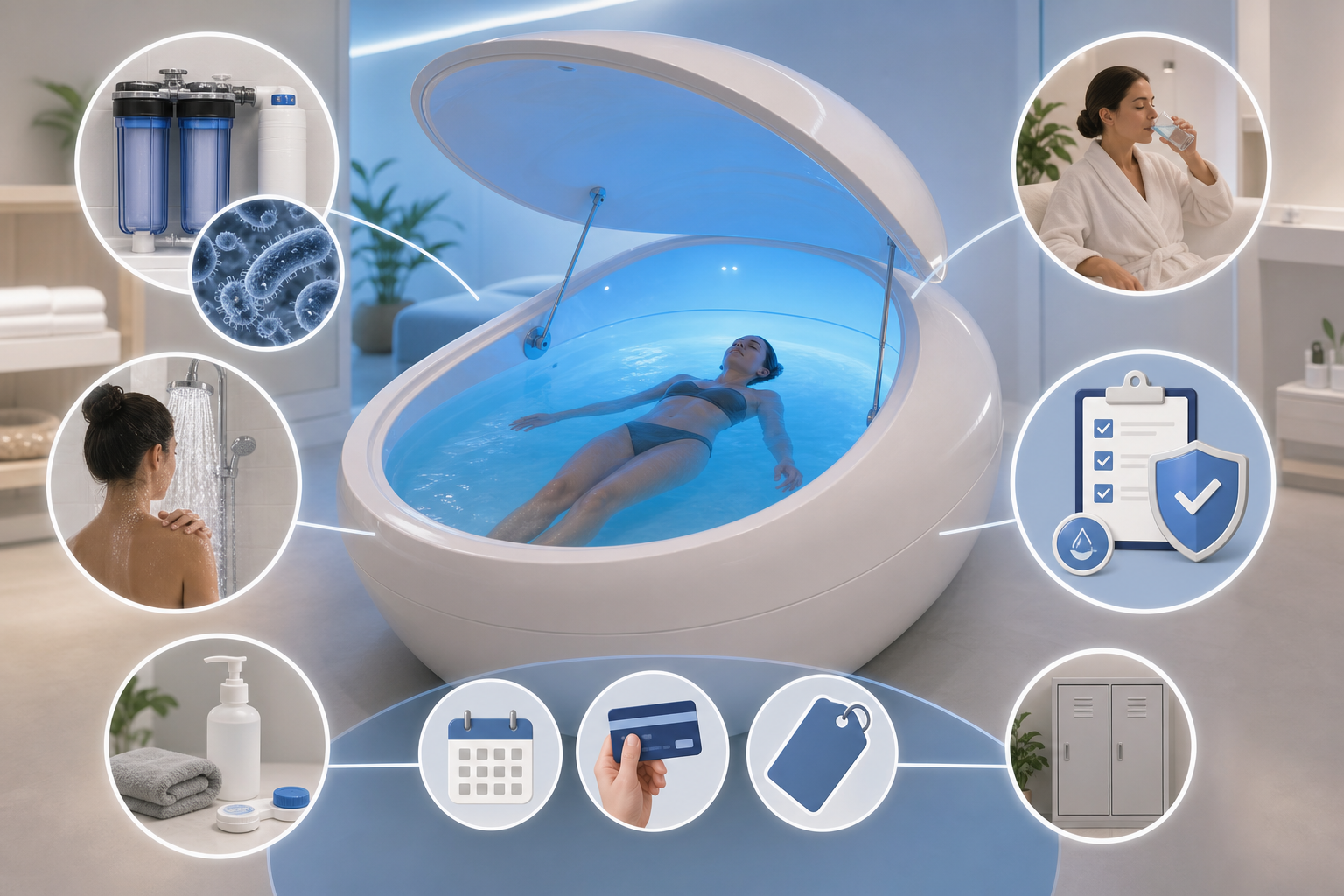
Questions to ask your float spa start with safety, water sanitation, and what to expect in the tank so you can decide if float therapy fits your goals and your health status. Before you book, confirm how the spa disinfects the float solution, what you should do before and after your session, and which conditions mean you should skip or modify your float.
Safety and Hygiene Protocols (what should you verify?)
A reputable float spa can explain its sanitation steps in plain language and show you what they do between clients. Float tanks use highly concentrated magnesium sulfate (Epsom salt) to increase buoyancy; high salinity can inhibit some microbes, but it does not replace filtration and disinfection.
- How is the water filtered between floats? Ask if they filter the full volume (or a defined turnover) after every session and what micron rating their filters use.
- What disinfection method is used? Common options include UV, ozone, or other non-chlorine systems. Ask how they verify that the system is working each day.
- Do you test water chemistry? Ask what they measure (pH, oxidizer level if used, salinity) and how often they log results.
- How are high-touch surfaces cleaned? Confirm cleaning of door handles, headrests, buttons, hair traps, and shower areas between clients.
- What is your policy if someone arrives with an illness? You want clear rescheduling rules that reduce exposure risk.
In the U.S., sanitation rules vary by state and local health departments. Ask whether the facility is inspected under local public health guidelines and how frequently. The CDC provides general guidance on preventing waterborne illness in aquatic venues and emphasizes that disinfection and filtration are essential layers of protection, not optional add-ons (CDC Healthy Swimming).
Quick red flags
- No written cleaning checklist or staff can’t describe the process.
- They cannot tell you how often water is filtered or tested.
- Strong odors, visible debris, or slippery buildup in the tank or shower area.
What should you do before your first float session?
Preparation is mostly about skin care, timing, and avoiding avoidable discomfort. Salt water stings on broken skin and can irritate sensitive areas, so plan around shaving, waxing, and minor cuts.
Pre-float checklist (do this the day of your session)
- Skip shaving or waxing for 12–24 hours to reduce burning on micro-abrasions.
- Check your skin for cuts, rashes, or fresh scrapes. If you have open skin, reschedule or ask the spa about protective options (some provide petroleum-free barrier products).
- Eat a light meal 60–90 minutes before so you’re not distracted by hunger or a full stomach.
- Avoid caffeine for 4–6 hours if you’re sensitive to it and want a calmer session.
- Remove contact lenses if possible. Salt water in the eyes is miserable; most spas provide a rinse bottle and ear plugs.
What to expect inside the tank
- Buoyancy: you float with minimal effort; your neck and low back typically unload.
- Reduced sensory input: tanks/pods lower light and sound; rooms often have optional music and lighting controls.
- Session length: first sessions are commonly 60 minutes. Many people tolerate 60 minutes well; if you’re unsure, ask if they offer 30–45 minute first-timer sessions.
Red flag—seek urgent care if you develop severe shortness of breath, chest pain, fainting, or a rapidly spreading rash/swelling after any wellness service. Those symptoms are not “normal float effects.” For general emergency guidance, see MedlinePlus Emergency Medical Services.
Who should not float (or should ask for modifications)?
Float therapy is not medical treatment, but it can change how your body feels by reducing external load and altering sensory input. Ask your float spa about contraindications and be specific about your health history.
- Open wounds or skin infections: high-salt water stings and can worsen irritation; postpone until skin is intact.
- Uncontrolled seizure disorders: you need a clinician’s clearance and the spa’s safety plan; many spas will not float clients with uncontrolled seizures.
- Severe orthostatic dizziness or fainting: transitions in/out of the tank can be risky if you black out when standing.
- Pregnancy: many people float comfortably, but ask about water temperature, getting in/out safely, and whether the spa has rails or staff assistance.
- Ear problems: recurrent ear infections, eardrum issues, or recent ear procedures should be discussed; ear plugs are standard but not foolproof.
If your goal is pain relief, mobility, or stress regulation, consider pairing floating with a plan from a rehab provider. A find a physical therapist near you search can help you build a program that includes ROM work and strengthening, not just passive recovery.
Research on floatation-REST suggests potential benefits for stress and anxiety symptoms in some groups, but study designs vary and it is not a substitute for medical or behavioral health care. (Example: randomized and controlled studies summarized in peer-reviewed literature such as PLOS ONE and related journals.)
Pricing, Packages, and Policies (what affects the real cost?)
Float pricing varies by city, session length, and membership model. You want to know the true per-session cost, what’s included, and what happens if you need to reschedule.
- What is included in the session price? Ask about towels, robe, shower products, ear plugs, hair dryer, and post-float lounge time.
- Do you offer first-timer rates? Many spas discount the first 60 minutes.
- What is the membership minimum? Clarify whether you can pause, transfer sessions, or cancel.
- What is the late-cancel/no-show policy? Get the exact cutoff time (often 12–24 hours).
- Are there add-ons? Examples include longer sessions, massage chair time, or aromatherapy in the room (if offered).
Logistics and Facility Details (questions that prevent a bad first visit)
Small facility details determine whether your float is comfortable and safe. Ask about tank type, water temperature, accessibility, and privacy.
- What tank/pod style do you use? Open pools feel less enclosed; pods feel more private. If you dislike tight spaces, ask for the most open option.
- What is the water and air temperature? Many spas target skin-neutral temperature (around 93–95°F) so your body “forgets” the boundary between air and water. Confirm their range.
- How do you handle accessibility? Ask about steps, grab bars, benches, and whether staff can explain safe entry/exit.
- How is ventilation handled? Good airflow reduces musty odors and improves comfort.
- What is your privacy policy? Confirm private rooms, locks, and staff entry procedures.
If you’re comparing wellness options, browsing local providers can help you decide what fits your goals. Use browse providers to see rehab and wellness services in your area, then compare them to float therapy for time, cost, and expected benefits.
How do you get the most out of a float? (simple protocol)
Your results depend on what you do in the 24 hours around the session. Use floating as a recovery tool, then reinforce it with movement.
Post-float routine (10 minutes, step-by-step)
- Rinse thoroughly to remove salt from skin folds (neck, armpits) and hairline.
- Hydrate with water after the session.
- Do 2 minutes of diaphragmatic breathing: inhale through your nose for 4 seconds, exhale for 6 seconds, repeat 10 breaths.
- Do a 6-minute mobility circuit (no equipment):
- Neck: gentle chin tucks x 10 (targets deep neck flexors, supports the cervical spine).
- Shoulders: wall slides x 10 (supports scapular control and the thoracic spine).
- Hips/low back: supine knee-to-chest stretch, 30 seconds each side x 2 (reduces tone around lumbar paraspinals and gluteus medius).
- Sleep plan: if you float in the evening, keep lights low and avoid screens for 30 minutes to see if sleep improves over 1–2 weeks.
For general sleep hygiene strategies (timing, light exposure, routines), see the NIH guidance from the National Heart, Lung, and Blood Institute: NHLBI Sleep Deprivation and Deficiency.
If you’re using float therapy to support training or rehab, track one measurable metric for 2–4 weeks: morning stiffness minutes, neck rotation ROM, or pain-free walking time. Objective tracking makes it clear whether the cost is justified.
What to Do Next
Start by calling your float spa and asking the sanitation, contraindication, and logistics questions above. If you have a musculoskeletal goal (neck pain, low back stiffness, reduced shoulder ROM), pair floating with an active plan from a rehab provider.
- For movement and pain goals: find a chiropractor near you or find a physical therapist near you.
- If you’re not sure what fits your symptoms: check your symptoms and bring the results to your visit.
- If you want more evidence-based wellness and rehab topics: explore more health topics.
Seek urgent care for chest pain, severe breathing trouble, fainting, sudden one-sided weakness, or rapidly worsening swelling/rash after a session. Schedule routine care if you have persistent pain or mobility limits lasting more than 2–4 weeks, or if symptoms repeatedly flare after passive recovery methods.