Living with Sprain of chondrosternal joint, initial encounter: A Comprehensive Guide starts with one key point: this is a chest wall injury at the rib-to-breastbone connection, and it usually improves with the right activity changes, targeted rehab, and time. A chondrosternal (sternocostal) sprain can create sharp, pinpoint pain near the sternum that spikes with deep breathing, coughing, rolling in bed, pushing up from a chair, or reaching overhead. Because chest pain can also signal urgent heart or lung problems, you need a clear plan for red flags, daily protection, and a step-by-step return to normal movement.
What a Chondrosternal Joint Sprain Is (and Why It Hurts So Much)
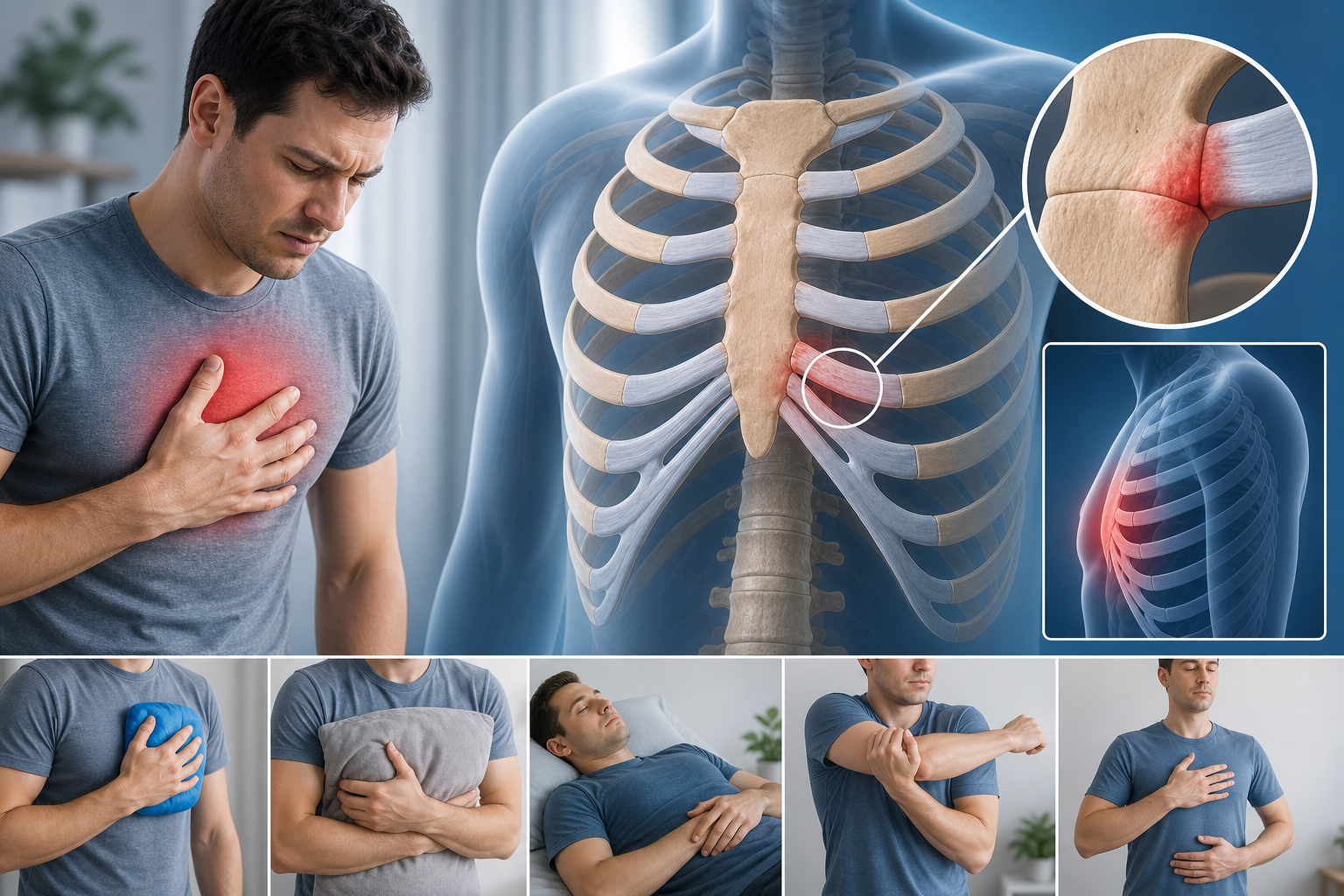
A chondrosternal joint sprain is irritation or micro-tearing of the connective tissues where your rib’s costal cartilage meets the sternum at the sternocostal (chondrosternal) joint. This region moves a little with every breath because the thoracic cage expands and rotates, so even “small” injuries can feel loud.
- Common pain pattern: sharp, localized pain near one rib-sternum junction (often ribs 2–5), worse with deep inhalation, cough/sneeze, trunk rotation, or pushing/pulling.
- Common exam finding: the pain is reproducible when you press on a specific spot along the sternum edge or costal cartilage.
- Why it mimics other problems: the chest wall shares nerve pathways with the neck, shoulder, and upper back, so you may also feel guarding in the pectoralis major, intercostal muscles, and serratus anterior.
Clinicians often discuss this category alongside costochondritis (inflammation at the costochondral/costosternal region). The self-care and rehab principles overlap: calm down the irritated tissue, keep the rib cage moving in a controlled way, then rebuild strength and tolerance. Mayo Clinic’s overview of costochondritis describes the classic localized chest wall tenderness and movement-related pain pattern used in clinical screening. (Source: Mayo Clinic, “Costochondritis,” https://www.mayoclinic.org/diseases-conditions/costochondritis/symptoms-causes/syc-20353946)
Chest wall injuries are typically managed conservatively after a focused exam rules out more serious causes. (Source: NCBI Bookshelf, “Chest Wall Trauma/Chest Wall Injuries,” https://www.ncbi.nlm.nih.gov/books/NBK430940/)
Is This Chest Pain an Emergency or a Chest Wall Sprain?
Chest wall sprain pain is usually reproducible with touch and specific movements; emergency chest pain is often not. You still need a safety screen because the cost of missing a heart or lung emergency is high.
Go to emergency care now
- Chest pressure/heaviness that does not change with pressing on the area
- Shortness of breath at rest, fainting, new confusion, or blue lips
- Pain spreading to your jaw, left arm, or upper back with sweating or nausea
- Sudden severe pain after a major fall, car crash, or direct blow to the chest
- Coughing up blood, or a new rapid heart rate with dizziness
More consistent with a chondrosternal sprain
- One clear tender point at the rib-sternum junction that you can “find” with a fingertip
- Pain increases with deep breathing, coughing, laughing, rolling, or reaching
- Pain decreases when you reduce trunk rotation or avoid pushing/pulling for a few days
Primary care and sports medicine literature notes that musculoskeletal chest pain is common and often identified by localized tenderness and reproducible pain with movement. (Source: American Academy of Family Physicians, “Musculoskeletal Chest Pain,” https://www.aafp.org/pubs/afp/issues/2018/0501/p571.html)
Clinical rule of thumb: if you cannot confidently reproduce the pain with a specific movement or palpation, treat it as “unclear” and get evaluated the same day.
What You Should Do in the First 7–14 Days (Initial Encounter Plan)
The first 1–2 weeks are about protecting the irritated cartilage and restoring calm, controlled rib motion. The goal is not “zero movement.” The goal is “no provocative spikes.”
- Modify load for 10–14 days: pause heavy lifting, dips/push-ups, bench press, aggressive stretching, and overhead work that forces rib flare.
- Change how you move: roll to your side before sitting up; keep elbows closer to your ribs when pushing up from bed or a chair.
- Breathing practice (2–3 minutes, 3–5x/day): slow nasal inhale, expand the lower ribs 360 degrees, long exhale. Stop before sharp pain.
- Heat vs. cold: use the one that reduces pain within 10 minutes. Many chest wall sprains prefer heat before movement and cold after activity.
Sleep positioning that reduces rib-sternum stress
- Back sleeping: place a small pillow under your knees to reduce trunk tension; keep arms supported on pillows to avoid shoulder traction on the chest wall.
- Side sleeping: hug a pillow to keep the top shoulder from rolling forward and pulling on the pectoralis major attachment.
- Avoid: stomach sleeping with one arm overhead (often provokes rib cage rotation and anterior chest strain).
What a provider checks at the initial visit
- Palpation mapping: pinpoint the painful sternocostal level (e.g., 3rd rib junction) and rule out diffuse pain patterns
- Breath mechanics: whether pain spikes at end-range inhale (often rib cage irritability) versus with exertion (needs medical screening)
- ROM testing: thoracic rotation, shoulder flexion/abduction, cervical ROM to see what loads the area
- Red flags: fever, unexplained shortness of breath, non-reproducible pain, abnormal vital signs
Johns Hopkins Medicine describes chest wall pain as a common musculoskeletal source of chest discomfort and emphasizes evaluation when symptoms are concerning. (Source: Johns Hopkins Medicine, “Chest Wall Pain,” https://www.hopkinsmedicine.org/health/conditions-and-diseases/chest-wall-pain)
What Rehab Looks Like (Chiropractic + Physical Therapy) and What to Avoid
Rehab works best when it targets rib mechanics, thoracic mobility, and scapular control without repeatedly “poking the bear.” Expect a staged plan: calm irritation, restore motion, then build capacity.
Treatment option Best for What you should notice Typical timeline Activity modification + breathing drills Early pain control; reducing flare-ups from daily tasks Less sharp pain with rolling, coughing, deep inhale 3–10 days to see a clear trend Physical therapy (ROM + graded loading) Stiff thoracic spine, weak scapular stabilizers, pain with reaching/lifting Improved thoracic rotation, better tolerance to work and exercise Typically 6–10 visits over 3–6 weeks Chiropractic manual therapy Thoracic/rib joint restriction contributing to chest wall strain Easier breathing mechanics; less protective muscle spasm Often 2–6 visits over 2–4 weeks, then taper Soft-tissue therapy (manual/myofascial) Overactivity in pectoralis major/minor, intercostals, serratus anterior Less pulling sensation; improved shoulder motion without chest pinch 1–3 sessions to confirm response; continue as needed Ergonomic changes Desk work, driving, childcare lifting, repetitive pushing/pulling Fewer end-of-day flare-ups Immediate effect if the trigger is removed- What to avoid early: aggressive chest stretching that creates sharp pain, heavy bench/flies, deep twisting under load, and “testing it” with repeated push-ups.
- What to keep: pain-limited walking, gentle thoracic rotation, and controlled breathing expansion.
Progress rule: soreness that settles within 24 hours is usually acceptable; pain that escalates for 48–72 hours means the load was too high.
How Long Recovery Takes and What Each Stage Usually Looks Like
Most uncomplicated chondrosternal sprains improve noticeably in 2–6 weeks, with higher-load comfort returning in about 6–12 weeks. If you keep provoking the area (heavy lifting, repeated pushing, high-volume coughing without support), recovery often drifts toward the longer end.
Week 0–2: Calm the tissue, keep motion
- Goal: reduce pain spikes with breathing, rolling, and transitions
- Typical wins: easier sleep positioning, less guarding in the intercostals
- Do: breathing drills, gentle thoracic ROM, short walks
Weeks 3–6: Restore thoracic/rib mobility, begin strength
- Goal: reach overhead and rotate with less pinch at the sternum edge
- Typical wins: improved shoulder flexion without chest pull; fewer flare-ups at work
- Do: scapular strengthening, controlled pushing patterns (wall-based first)
Weeks 6–12: Build tolerance for lifting and sport
- Goal: return to pressing, heavier carries, and faster movements without sharp pain
- Typical wins: normal cough/sneeze without “stabbing” sensation
- Do: gradual return to push-ups/bench with strict form and conservative volume
If pain stays unchanged after 10–14 days of appropriate modification, or if it keeps recurring at the same intensity for 6+ weeks, get re-evaluated for contributing factors like thoracic stiffness, rib dysfunction, or a persistent overload pattern. Chest wall injury references emphasize reassessment when symptoms persist or the mechanism suggests more serious injury. (Source: NCBI Bookshelf, https://www.ncbi.nlm.nih.gov/books/NBK430940/)
Home Program: 10 Minutes a Day to Reduce Chest Wall Pain and Restore Motion
This short protocol targets rib cage expansion, thoracic rotation, and scapular control to unload the chondrosternal junction. Stop any step that triggers sharp, localized pain at the sternum edge.
-
Supported diaphragmatic breathing (2 minutes)
- Lie on your back with knees bent.
- Place one hand on the lower ribs, not the upper chest.
- Inhale through your nose for 4 seconds, expand the lower ribs outward.
- Exhale for 6 seconds; let the ribs soften down.
- Do 6–10 slow breaths.
-
Open-book thoracic rotation (2 sets of 6 each side)
- Lie on your side with hips and knees bent, arms straight in front.
- Rotate your top arm and upper back open like a book.
- Keep the knees stacked to limit lumbar twist.
- Pause 1–2 seconds; return slowly.
-
Wall slide with exhale (2 sets of 8)
- Stand with forearms on a wall, elbows at shoulder height.
- Slide arms up 6–10 inches while you slowly exhale.
- Keep ribs “down” (avoid rib flare) to reduce sternum stress.
-
Scapular retraction holds (5 reps of 10 seconds)
- Sit tall; gently pull shoulder blades back and down.
- Keep the neck relaxed; do not arch the low back.
- This unloads overactive pectoralis minor and supports better rib mechanics.
Self-test: after the 10-minute session, you should breathe deeper with less “catch.” If symptoms spike, cut the reps in half and shorten the range.
Daily Living Modifications That Actually Protect the Sternum-Cartilage Junction
The chondrosternal joint gets irritated by repeated rib flare, trunk rotation under load, and pushing patterns that recruit the chest before the shoulder blade stabilizers. Change the mechanics and you reduce flare-ups.
- Getting out of bed: roll to your side, drop legs off, push up with the elbow/forearm instead of a wide-arm press.
- Lifting a child or groceries: keep the load close to your body; exhale during the lift to reduce rib flare.
- Driving: bring the seat closer so you are not reaching; keep shoulders relaxed to reduce constant pull on the pectoralis major.
- Desk work: support the forearms; elbows at ~90 degrees reduces forward shoulder drift and chest wall tension.
- Cough/sneeze support: gently brace the painful area with a pillow or your forearm to reduce sudden shear at the costal cartilage.
If you want additional screening guidance before booking care, use check your symptoms and then schedule an exam for a definitive plan.
FAQ: Chondrosternal Joint Sprain (Initial Encounter)
How do you know if chest pain is from a chondrosternal sprain or something cardiac?
Chondrosternal sprain pain is usually localized and reproducible with pressing on a specific rib-sternum spot or with movements like trunk rotation and deep inhalation. Emergency cardiac-type symptoms include chest pressure with shortness of breath, sweating, fainting, or pain spreading to the jaw/arm; those require urgent evaluation. A clinician uses history, vitals, red-flag screening, and a chest wall exam to sort this out. (Source: AAFP, https://www.aafp.org/pubs/afp/issues/2018/0501/p571.html)
What treatments help without invasive procedures?
Conservative care typically centers on activity modification, graded mobility work, manual therapy aimed at thoracic and rib mechanics, and progressive strengthening of the shoulder blade stabilizers. Many cases overlap with costochondritis-style management: reduce provocation, restore motion, and rebuild tolerance. (Source: Mayo Clinic, https://www.mayoclinic.org/diseases-conditions/costochondritis/symptoms-causes/syc-20353946)
How long until you can exercise normally?
Many people can restart modified training within 2–3 weeks if daily pain is trending down and breathing is comfortable. Higher-load pressing and heavy lifting often take 6–12 weeks to feel normal because the costal cartilage region dislikes repeated shear. Use a 24-hour response rule: if symptoms spike the next day, reduce range, load, or volume.
Why does it hurt more when you take a deep breath?
Your ribs rotate and elevate with inhalation, and the sternocostal junction experiences small but repeated motion. When the costal cartilage and supporting ligaments are irritated, end-range rib expansion can create a sharp catch. Breathing drills that expand the lower ribs (not just the upper chest) often reduce this trigger over 1–2 weeks.
When should you follow up if it’s not improving?
Get re-evaluated if pain is not clearly improving after 10–14 days of appropriate modification, if it limits normal breathing, or if new red flags appear. Persistent symptoms may reflect ongoing mechanical triggers (thoracic stiffness, scapular control deficits, repetitive work demands) that respond well to a structured PT or chiropractic plan. (Source: Johns Hopkins Medicine, https://www.hopkinsmedicine.org/health/conditions-and-diseases/chest-wall-pain)
What to Do Next
Book an in-person exam if you have localized sternum-edge pain that spikes with breathing, coughing, rolling, or reaching and has lasted more than a few days. Start with a physical therapy provider for a graded exercise plan and movement retraining, or a chiropractic provider for thoracic/rib mechanics and manual care; many patients use both in a coordinated plan.
- Seek urgent care now for any red-flag symptoms listed earlier (shortness of breath at rest, fainting, spreading pain, sweating/nausea with chest pressure).
- Schedule routine care within 3–7 days if pain is reproducible, movement-related, and not trending better with basic modification.
- What to expect at the first visit: palpation to identify the specific sternocostal level, thoracic/shoulder ROM testing, breathing mechanics assessment, and a home program you can do daily.
Use Medximity to find the right clinician quickly: find a physical therapy near you, find a chiropractic near you, or browse providers. For related guides, explore more health topics.