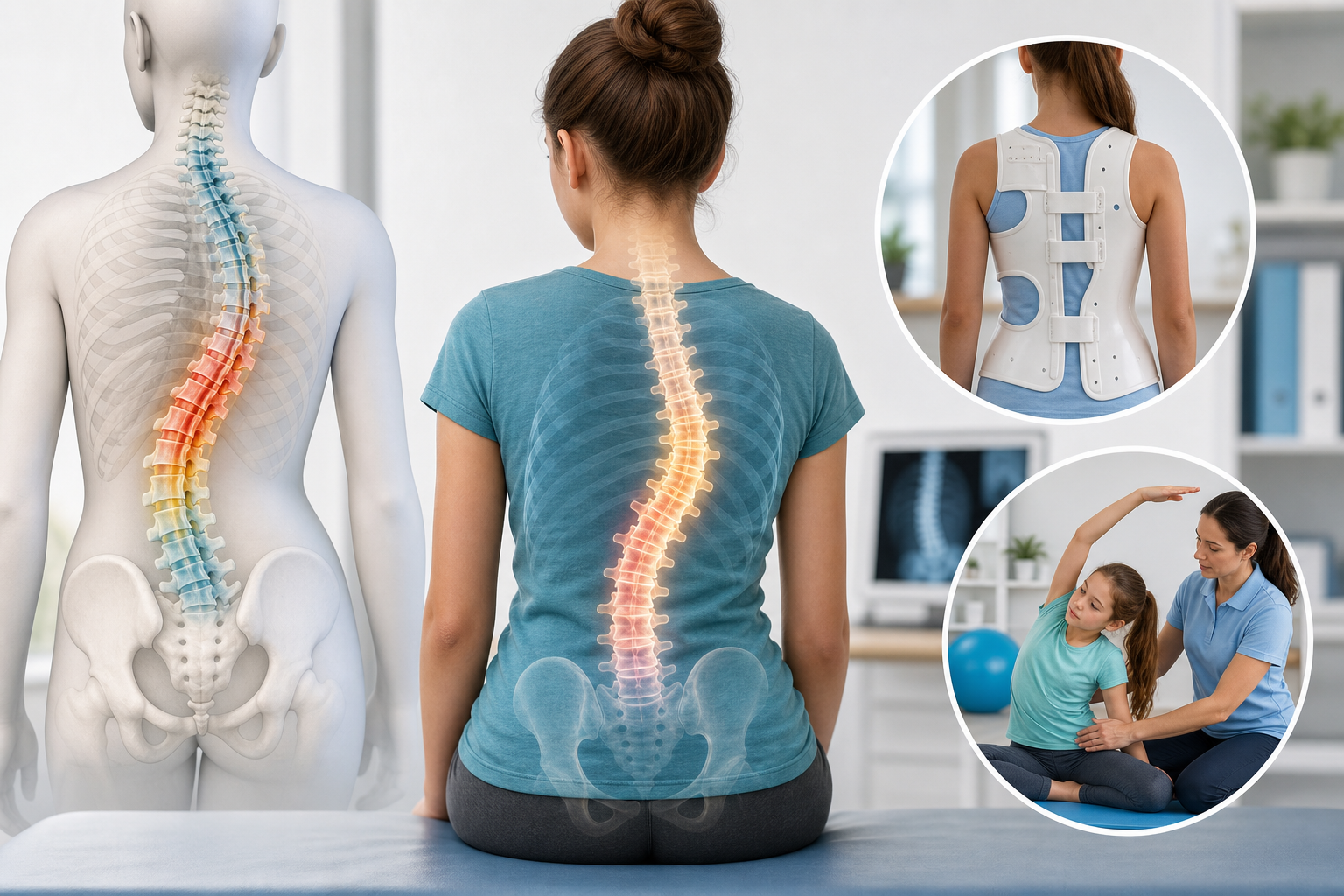
Adolescent idiopathic scoliosis, lumbosacral region: What Patients Need to Know starts with one key fact: the lower curve (near L4–L5 and L5–S1) can change how your pelvis sits and how your spine loads during walking, sitting, and sports. Most cases are managed with monitoring plus targeted rehab to control progression and reduce mechanical stress. Your job is to confirm the diagnosis (Cobb angle + skeletal maturity) and follow a plan that matches your curve size and growth stage.
What “adolescent idiopathic scoliosis in the lumbosacral region” actually means
Adolescent idiopathic scoliosis (AIS) means a side-bending curve of the spine that starts between ages 10–18, with no single identifiable cause. “Lumbosacral region” means the main curve apex is low in the lumbar spine and influences the junction where the lumbar spine meets the sacrum.
Three structures matter immediately in lumbosacral AIS:
- L4–L5: a high-motion segment that often takes extra shear and rotation with a low lumbar curve.
- L5–S1: the base of the lumbar spine; pelvic tilt and load transfer show up here.
- Sacroiliac (SI) joints: the pelvis-spine “bridge” that can become asymmetric when the pelvis hikes or rotates.
AIS is defined as a spinal curve of at least 10 degrees Cobb angle on standing X-ray. In lumbosacral curves, you also pay attention to pelvic obliquity (one side of the pelvis higher), trunk shift (ribcage over one hip), and rotational prominence on forward-bend testing.
Data point you can use: AIS affects roughly 2–3% of adolescents; only a smaller subset progress to larger curves that require intensive management. Screening and early identification are designed to catch curves while growth remains.
If you want a quick overview of how spine curves are assessed and tracked, see scoliosis screening and monitoring basics.
Why does a lumbosacral curve matter for function and pain?
A low lumbar/lumbosacral curve matters because it changes how forces travel from your trunk into your pelvis and legs. You can be completely pain-free and still benefit from a plan, because progression risk is mostly about growth and curve magnitude, not pain.
Mechanical effects you can notice
- Pelvic tilt or hip hike when you stand: your waistband may look uneven.
- Asymmetric low-back loading during sports: one side of the low back tightens faster.
- Leg-length appearance changes: functional leg-length difference can show up when the pelvis rotates.
What drives symptoms (when symptoms happen)
When AIS causes discomfort, it’s typically from mechanical strain rather than tissue damage. Common contributors include:
- Quadratus lumborum overwork on the “high hip” side.
- Iliopsoas stiffness that increases lumbar extension and rotation bias.
- Gluteus medius weakness that reduces pelvic control during single-leg stance (walking, running, stairs).
Useful clinical rule: pain level does not reliably predict curve size. A small curve can be sore; a larger curve can be painless. Use imaging + growth markers to guide risk.
For a practical breakdown of how strength and mobility affect spine loading, read core stability basics for back support.
How is AIS in the lumbosacral region diagnosed and measured?
Diagnosis is based on a physical exam plus standing spinal imaging that measures the Cobb angle. In lumbosacral AIS, the exam also checks pelvic position and hip ROM because those can mimic or amplify a low curve.
- Forward bend test: looks for trunk rotation and asymmetry.
- Standing posture assessment: shoulder balance matters, but pelvis and trunk shift matter more in low curves.
- Standing X-rays: confirm Cobb angle and identify curve pattern (single vs double curve).
- Skeletal maturity: growth remaining predicts progression risk. Providers often use Risser stage or other maturity markers.
Tracking schedule (typical): mild curves are often rechecked every 4–6 months during rapid growth; intervals may lengthen once growth slows.
Expect your provider to document baseline photos or posture measures, plus objective strength and ROM tests. If you’re building your care team, find a physical therapy near you and ask whether they routinely manage AIS with structured exercise programs.
What treatments work without forbidden options, and how long do they take?
Most nonoperative care for lumbosacral AIS focuses on (1) monitoring progression, (2) improving spinal and pelvic control, and (3) reducing asymmetrical loading during growth spurts. The timeline depends on curve size and growth stage.
Exercise-based scoliosis programs (what you’re actually training)
Programs vary, but effective plans usually include:
- 3D breathing and ribcage expansion to de-rotate and improve trunk control.
- Pelvic control drills to reduce hip hike and trunk shift.
- Anti-rotation core work to resist twisting forces (especially important for low lumbar curves).
Typical timeline: a structured plan often starts with 6–10 supervised sessions over 6–10 weeks, then transitions to home work 4–5 days/week for maintenance and growth-phase management.
Chiropractic care and manual therapy (what it can and cannot do)
Chiropractic adjustments and manual therapy can help mobility, comfort, and movement quality around stiff segments. They do not “erase” a structural curve, but they can improve how you move with the curve.
- Targets often include the thoracolumbar junction, L4–L5, and pelvic mechanics at the SI joints.
- Best use: paired with active rehab (strength + motor control), not as a stand-alone plan.
Typical timeline: comfort and ROM changes can show up within 2–4 weeks of consistent care, while postural control takes longer and depends on adherence to exercises.
Bracing (when it’s considered)
Bracing is typically considered when curve magnitude and growth remaining create a higher risk of progression. Your provider will base this on Cobb angle range, maturity, and documented change over time.
Practical takeaway: bracing decisions depend on objective measurements over time, not a single visit.
If you want a deeper primer on conservative options, see scoliosis-focused PT exercises and chiropractic care for scoliosis: realistic goals.
Treatment comparison table: what to expect and when
Treatment option Best for Expected outcomes (typical) Timeline Monitoring + home program Mild curves with low progression risk Maintain function, support posture, watch for progression Recheck every 4–6 months during growth; home work 10–20 min, 4–5 days/week Physical therapy (scoliosis-specific + strengthening) Mild to moderate curves, especially during growth spurts Improved pelvic control, better ROM, reduced asymmetrical loading, clearer exercise plan 6–10 visits over 6–10 weeks, then maintenance through growth Chiropractic care + manual therapy (paired with exercise) Stiffness, movement restrictions, comfort limits that block training Improved mobility and tolerance for strengthening; symptom relief in many cases Often 2–6 weeks for noticeable mobility/comfort change; ongoing as needed Bracing + exercise program Higher progression risk with growth remaining Reduce likelihood of curve progression when worn as prescribed; maintain activity with modifications Months to years depending on growth; reassess at scheduled imaging intervalsHome program: a 10-minute lumbosacral scoliosis routine you can start today
This routine targets pelvic control, anti-rotation strength, and hip stability—three levers that matter for low lumbar curves. Do it on nonconsecutive days at first, then build to 4 days/week. Stop if you get sharp pain, numbness, or symptoms traveling below the knee.
Step-by-step (10 minutes)
- 90/90 breathing with pelvic tuck (2 minutes)
- Lie on your back with hips and knees at 90° (feet on a chair).
- Gently tuck your pelvis (flatten low back slightly), exhale fully, then inhale through your nose into your lower ribs.
- Do 5 slow breaths, rest 20 seconds, repeat.
- Side plank from knees (2 sets each side)
- Elbow under shoulder, knees bent, hips forward.
- Lift hips and hold 15–25 seconds. Keep ribs stacked over pelvis (don’t twist).
- Progress by increasing hold time to 30–45 seconds.
- Bird-dog anti-rotation (2 sets of 6 reps/side)
- Hands under shoulders, knees under hips.
- Reach opposite arm/leg long; pause 2 seconds without shifting pelvis.
- Keep your low back quiet; motion comes from hips and shoulders.
- Hip abduction “wall press” (2 sets of 20 seconds/side)
- Stand sideways to a wall, knee bent 30–45°.
- Press the outside of your knee gently into the wall without leaning your trunk.
- You should feel gluteus medius working.
Consistency beats intensity: 10 minutes done 4 days/week for 8 weeks usually outperforms a hard 45-minute session done once.
For additional exercise ideas and progressions, see scoliosis exercises you can do at home.
When is a lumbosacral curve a red flag?
AIS is usually a stable, manageable condition, but certain findings require faster medical evaluation to rule out non-idiopathic causes or neurologic involvement. Do not self-manage these.
- New weakness in the foot or ankle (tripping, foot slap, inability to heel-walk).
- Numbness spreading down the leg with progressive loss of sensation.
- Bowel or bladder control changes (urgent evaluation).
- Severe, unrelenting night pain or pain with fever/illness signs.
- Rapid curve change noticed over weeks (visible trunk shift increasing quickly).
Emergency rule: bowel/bladder changes or rapidly worsening leg weakness are not “wait and see” problems. Seek urgent care.
For general guidance on back-related warning signs and safer activity decisions, browse explore more health topics.
FAQ: Adolescent idiopathic scoliosis, lumbosacral region
Can exercises reduce the Cobb angle?
Exercises are used to improve posture control, strength, and movement mechanics, and research suggests they can help some patients reduce progression risk and sometimes improve measured angles. Your best measurable goal is usually stable imaging over time plus better pelvic control and function.
How many PT visits are typical for lumbosacral AIS?
A common starting plan is 6–10 visits over 6–10 weeks to learn a scoliosis-specific program and progress it safely. Many patients then check in every 4–8 weeks during growth spurts to adjust exercises and monitor symmetry.
Can you play sports with a lumbosacral scoliosis curve?
In most cases, yes. Your limiter is usually mechanics: if you cannot control pelvic drop, trunk shift, or rotation during running/jumping, you need targeted strength and technique work. Your PT can screen single-leg squat, hop control, and trunk endurance to guide safe return.
Does chiropractic care help AIS?
Chiropractic care can improve joint mobility, reduce stiffness, and help you tolerate training. It is most useful when paired with a structured exercise program that targets pelvic control and anti-rotation strength.
How often do you need X-rays?
Imaging frequency depends on curve size and growth remaining. A common pattern is every 4–6 months during rapid growth for curves being monitored, with longer intervals when growth slows or the curve remains stable. Your provider should explain the schedule and what change would trigger a plan update.
What sleeping position is best for lumbosacral scoliosis?
Use the position that keeps your pelvis level and your low back neutral. Side-sleepers often do well with a pillow between the knees; back-sleepers often do well with a pillow under the knees. Avoid positions that repeatedly twist your pelvis relative to your ribcage.
What to Do Next
Start by confirming three numbers: Cobb angle, curve pattern (where the apex sits), and skeletal maturity (how much growth remains). Those determine monitoring frequency and whether you need supervised rehab or bracing discussion.
- Book the right provider: find a physical therapy near you for scoliosis-specific exercise programming; consider adding a provider for manual therapy support via find a chiropractor near you if stiffness or pelvic mechanics limit training.
- What to expect at the first visit: posture and gait check, hip ROM (especially flexion and internal rotation), trunk endurance testing, and a home program you can repeat accurately.
- Bring this checklist: last imaging report (Cobb angle), growth history (recent height changes), sport/activity goals, and a list of movements that consistently trigger low-back tightness.
- Seek urgent care today if you have bowel/bladder changes, rapidly worsening leg weakness, or numbness that is spreading.
If you’re comparing options or building a care team, you can also browse providers and review condition-specific education in scoliosis-focused PT exercises and chiropractic care for scoliosis: realistic goals.