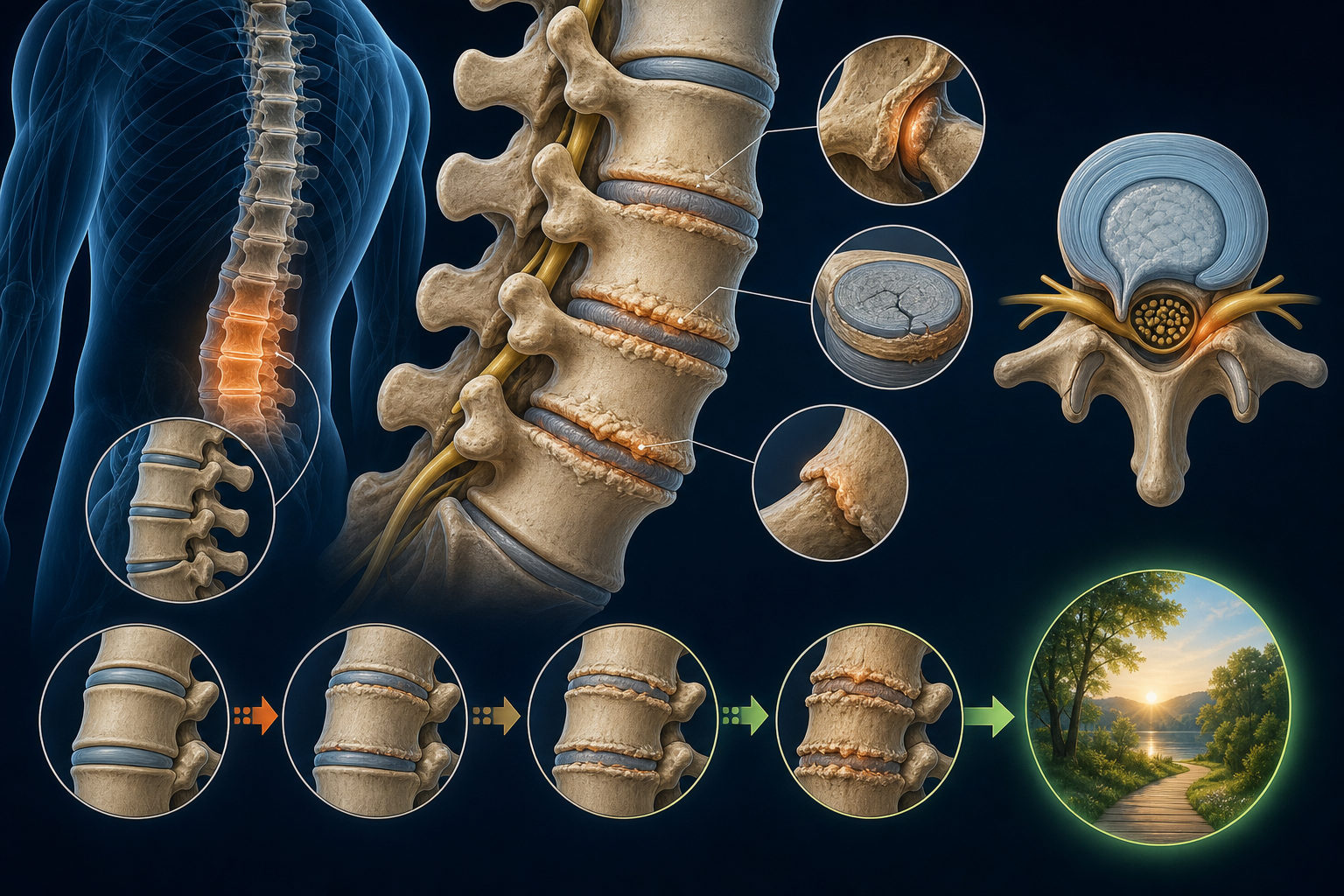
Understanding Lumbar Spondylosis (Arthritis of the Lower Back): Symptoms, Causes, and Treatment starts with a simple idea: the lower back changes over time. For many adults, those changes involve the spinal joints, discs, ligaments, and bones. Lumbar spondylosis is the medical term often used to describe age-related wear-and-tear changes in the lumbar spine, sometimes called arthritis of the lower back.
Lumbar spondylosis does not mean every person will have severe pain or lose mobility. Some people have visible arthritic changes on imaging and few symptoms. Others have stiffness, aching, or pain that affects standing, walking, sleep, work, or daily activity. The right care plan depends on your symptoms, exam findings, health history, and goals.
This article explains what lumbar spondylosis is, common lower back arthritis symptoms in adults, what causes arthritis in the lower back, how it differs from a herniated disc, and what nonsurgical options may help. If you are actively looking for care, Medximity can help you find conservative providers, including physical therapists near you and chiropractors near you.
What Is Lumbar Spondylosis?
Lumbar spondylosis is a broad term for degenerative changes in the lower portion of the spine. The lumbar spine includes five vertebrae, commonly labeled L1 through L5, along with cushioning discs, facet joints, spinal ligaments, muscles, and nerves. These structures help support body weight, allow bending and twisting, and protect the nerves that travel from the spine into the legs.
When clinicians talk about lumbar spondylosis, they may be referring to one or more of the following changes:
- Facet joint arthritis: irritation or degeneration in the small joints at the back of the spine.
- Disc degeneration: loss of disc hydration, height, or flexibility over time.
- Bone spurs: small bony overgrowths that may develop near joints or discs.
- Thickened ligaments: soft tissues around the spine may become less flexible and take up more space.
- Stiffness and reduced motion: the spine may not move as smoothly as it once did.
These findings are common as people age. They are not automatically dangerous, and they do not always match the level of pain a person feels. A provider will usually look at the full picture: your symptoms, physical exam, movement patterns, nerve function, and, when needed, imaging results.
If you are comparing lumbar spondylosis with other back pain causes, you may also find Medximity’s guide to low back pain symptoms and treatment options helpful.
Lower Back Arthritis Symptoms in Adults
Lower back arthritis symptoms in adults can vary from mild stiffness to more persistent pain. Symptoms often develop gradually rather than after one single event. Some people notice symptoms mainly in the morning. Others feel worse after standing, walking, lifting, or spending a long time in one position.
Common symptoms of lumbar spondylosis
- Dull, aching pain across the lower back
- Morning stiffness that may improve after gentle movement
- Reduced flexibility with bending backward, twisting, or standing upright
- Pain that worsens after prolonged standing or walking
- Discomfort that improves with sitting, changing positions, or resting
- Muscle tightness or spasms around the low back, hips, or buttocks
- Occasional pain that travels into the buttock, hip, or thigh
- A grinding, catching, or stiff sensation with certain movements
Some symptoms overlap with other spine conditions, including disc injuries, sacroiliac joint irritation, spinal stenosis, and muscle strain. That is why an evaluation is useful when pain persists, worsens, or limits normal activity.
Pain when standing with lumbar spondylosis
Pain when standing with lumbar spondylosis is a common complaint. Standing often places the lumbar spine into a slightly extended position. For some people, extension can increase pressure on the facet joints or narrow available space around sensitive tissues. This may lead to aching in the lower back, pressure in the buttocks, or fatigue in the back muscles.
Many people instinctively feel better when they sit, lean forward, or place a foot on a step. Those positions may reduce stress on certain lower-back structures. However, patterns differ from person to person. A physical therapist, chiropractor, or other qualified provider can assess whether your pain is mainly joint-related, muscle-related, nerve-related, or connected to another condition.
Can lumbar spondylosis cause leg symptoms?
Lumbar spondylosis can sometimes be associated with leg symptoms, especially if degenerative changes contribute to nerve irritation or narrowing around the spinal canal or nerve openings. Possible symptoms may include pain, tingling, numbness, heaviness, or weakness into the buttock, thigh, calf, or foot. These symptoms should be evaluated by a qualified provider, especially if they are new, worsening, or affecting balance or walking.
If your symptoms travel down the leg, it may be useful to learn more about sciatica and radiating leg pain. Sciatica is not a diagnosis by itself; it describes nerve-type pain that may have several causes.
What Causes Arthritis in the Lower Back?
Many patients ask, what causes arthritis in the lower back? In most cases, lumbar spondylosis develops from a combination of aging, mechanical stress, genetics, activity history, posture, previous injuries, and general health factors. It is rarely caused by one thing alone.
Age-related spinal changes
Discs naturally lose some water content and elasticity over time. Facet joints may experience cartilage changes. Ligaments may become thicker or less flexible. These changes can alter how load is shared across the lower back. In many adults, these changes are part of the normal aging process, but they may become painful when tissues are irritated or when movement becomes limited.
Repetitive stress and work demands
Jobs or activities that involve repeated bending, twisting, lifting, prolonged standing, vibration, or awkward postures may contribute to lumbar stress. This does not mean activity is harmful. In fact, appropriate movement is often helpful. The issue is usually a mismatch between physical demands, recovery, strength, mobility, and body mechanics.
Previous back injuries
A prior back injury may change movement patterns or increase sensitivity in the region. Some people develop protective muscle guarding, reduced hip mobility, or altered lifting habits after an injury. Over time, those patterns may contribute to ongoing discomfort. A rehabilitation-focused approach may help address these movement patterns safely.
Genetics and body structure
Some people are more likely to develop degenerative spine changes because of inherited factors. Spinal shape, joint structure, disc health, and connective tissue characteristics can vary from person to person. Genetics may influence risk, but it does not determine how much pain someone will have or how well they may respond to conservative care.
Muscle weakness, stiffness, and deconditioning
The lower back works best when the hips, core, gluteal muscles, and trunk stabilizers share the load. When these areas become weak, stiff, or poorly coordinated, the lumbar spine may absorb more stress. Physical therapy for lower back arthritis often focuses on improving this support system rather than only treating the painful area.
Lumbar Spondylosis vs Herniated Disc
Many people search for lumbar spondylosis vs herniated disc because both conditions can cause low back pain and sometimes leg symptoms. They are related to the spine, but they are not the same.
How lumbar spondylosis is different
Lumbar spondylosis is a broad description of degenerative changes in the lower back. It may involve discs, facet joints, ligaments, and bone spurs. Symptoms often include stiffness, aching, and pain that is influenced by posture, standing, walking, or extension-based movements.
How a herniated disc is different
A herniated disc occurs when disc material pushes beyond its usual boundary. If that material irritates or compresses a nearby nerve, symptoms may travel down the leg. A herniated disc may happen gradually or after a specific movement, lift, or injury. Common symptoms may include sharp leg pain, numbness, tingling, or weakness, depending on the nerve involved.
To compare symptoms more closely, visit Medximity’s overview of herniated disc causes, symptoms, and conservative care.
Can a person have both?
Yes. Some adults have lumbar spondylosis and a disc bulge or herniation at the same time. Imaging may show several findings, but not every finding is necessarily the main pain generator. A provider may use your history, exam, symptom behavior, and functional limitations to determine which findings are most relevant to your care plan.
How Long Does Lumbar Spondylosis Last?
How long does lumbar spondylosis last? The structural changes associated with lumbar spondylosis are often long-term, but symptoms can fluctuate. Many people have flare-ups that improve over days or weeks with the right combination of activity modification, guided exercise, hands-on care, and time. Others have recurring stiffness or discomfort that requires ongoing management.
Because lumbar spondylosis is often degenerative, the goal of care is usually not to make the spine look younger on an X-ray. The more practical goals are to reduce symptom sensitivity, improve movement, build strength, support daily function, and help you understand how to manage flare-ups.
Recovery time depends on several factors, including symptom severity, nerve involvement, activity level, sleep, stress, general health, and consistency with a home program. A provider can help you set realistic expectations after an exam.
When to See a Provider for Lower Back Arthritis
You do not need to wait until pain is severe to seek help. Consider seeing a qualified provider if lower back pain or stiffness lasts more than a few days, keeps returning, limits work or daily activity, or makes you avoid movement. Early conservative care may help identify modifiable factors such as mobility restrictions, strength deficits, posture habits, and aggravating activities.
Seek prompt medical evaluation for red-flag symptoms
Some symptoms require timely medical attention. Contact a healthcare provider promptly if you have back pain with significant leg weakness, worsening numbness, loss of bowel or bladder control, numbness in the groin or saddle area, fever, unexplained weight loss, history of cancer, major trauma, or pain that is constant and not relieved by rest. These symptoms do not always mean something serious is present, but they should not be ignored.
Who is the best provider for lower back arthritis?
The best provider for lower back arthritis depends on your symptoms and needs. Many patients begin with a physical therapist, chiropractor, primary care clinician, sports medicine provider, orthopedic specialist, or rehabilitation-focused clinician. For conservative care, physical therapists and chiropractors often help patients address movement, strength, joint mobility, posture, and self-management strategies.
If you are looking for chiropractic care for lumbar spondylosis near me, you can search Medximity for local chiropractors who treat low back pain. If you want guided exercise and rehabilitation, you can also explore physical therapy providers in your area.
How Lumbar Spondylosis Is Evaluated
A careful evaluation helps determine whether your symptoms are consistent with lumbar spondylosis, another back condition, or a combination of factors. The evaluation may include a conversation about your pain pattern, movement testing, strength testing, nerve screening, and review of your daily activities.
Health history and symptom pattern
Your provider may ask when symptoms began, what makes them better or worse, whether pain travels into the leg, how long you can stand or walk, and whether sleep or work is affected. They may also ask about prior injuries, activity level, medical conditions, and previous treatments.
Movement and functional testing
The exam may include bending forward, bending backward, side bending, rotating, walking, squatting, or standing on one leg. These tests help identify whether symptoms are aggravated by extension, flexion, loading, hip motion, or certain movement patterns.
Nerve screening
If leg symptoms are present, your provider may check reflexes, sensation, muscle strength, and nerve tension signs. This can help determine whether nerve irritation may be contributing to pain, tingling, numbness, or weakness.
Imaging when appropriate
X-rays, MRI, or other imaging may be considered in some cases, especially if symptoms are severe, persistent, worsening, or associated with neurologic changes. Imaging can show structural findings such as disc degeneration, facet arthritis, spinal narrowing, or bone spurs. However, imaging findings must be interpreted carefully because many adults have age-related changes without significant pain.
Lumbar Spondylosis Treatment Without Surgery
Many people search for lumbar spondylosis treatment without surgery. Conservative care is often the first approach for lower back arthritis symptoms, especially when there are no serious red flags or progressive neurologic deficits. Treatment plans vary, but they often combine education, movement, strengthening, manual therapy, and activity modification.
Conservative care does not promise to reverse arthritis. Instead, it may help reduce pain sensitivity, improve mobility, build support around the spine, and make daily activities more manageable.
Physical therapy for lower back arthritis
Physical therapy for lower back arthritis usually begins with an assessment of how you move, where you are limited, and what activities trigger symptoms. A physical therapist may design a plan that includes mobility work, core and hip strengthening, balance training, walking progression, posture strategies, and a home exercise program.
Exercises are typically progressed gradually. Early sessions may focus on comfortable movement and symptom control. Later sessions may build endurance, strength, and confidence with tasks such as lifting, stairs, standing, walking, or returning to recreation.
To learn more about the role of rehabilitation, visit Medximity’s page on physical therapy treatment and what to expect.
Chiropractic care for lumbar spondylosis
Chiropractic care may help some patients with lumbar spondylosis by addressing joint mobility, muscle tension, spinal mechanics, and movement tolerance. Depending on the provider and your exam findings, care may include spinal manipulation or mobilization, soft tissue therapy, stretching, corrective exercise, ergonomic coaching, and home-care guidance.
Not every technique is appropriate for every patient. A chiropractor should review your symptoms, health history, comfort level, and any relevant imaging before recommending a plan. If you want to understand common techniques, Medximity offers an overview of chiropractic adjustment and spinal manipulation.
Natural treatment for lumbar spondylosis
Many patients ask about natural treatment for lumbar spondylosis. In this context, natural usually means nonsurgical, non-drug strategies that support movement and function. Options may include guided exercise, walking, stretching, strengthening, heat or cold, weight-management support when appropriate, sleep improvements, stress management, and ergonomic changes.
Natural care is not the same as doing everything alone. A provider can help you choose exercises and strategies that match your symptoms. This is especially important if you have leg symptoms, balance problems, osteoporosis, recent trauma, or other health conditions.
How to Relieve Lumbar Spondylosis Pain at Home
If you are wondering how to relieve lumbar spondylosis pain, the safest starting point is usually gentle, tolerable movement rather than complete rest. Prolonged bed rest may increase stiffness and deconditioning for many people. That said, your activity should be guided by your symptoms and by advice from a qualified provider.
Try gentle movement breaks
Short, frequent movement breaks may help reduce stiffness. Some people feel better with easy walking, pelvic tilts, gentle knee-to-chest movements, or supported stretching. The goal is not to push through sharp pain. The goal is to find movements that feel safe and help your back loosen gradually.
Modify standing and walking
If standing increases symptoms, try changing position before pain builds. You might shift weight, place one foot on a low step, take brief sitting breaks, or alternate between standing and walking. Supportive footwear and avoiding long periods in one posture may also help some people.
Use heat or cold based on comfort
Heat may help relax tight muscles and reduce stiffness for some patients. Cold may feel better during a flare-up with sharper irritation. Use either option cautiously and avoid direct skin exposure that could cause irritation. If you have reduced sensation or circulation problems, ask a provider before using temperature-based strategies.
Build strength gradually
Strengthening the hips, glutes, abdominal muscles, and back muscles may help support the lumbar spine. Exercises should be chosen carefully and progressed over time. A physical therapist or chiropractor can help you avoid exercises that aggravate symptoms and focus on ones that fit your current ability.
Improve workstation and lifting habits
Ergonomics can matter, especially if you sit, stand, drive, or lift for long periods. Helpful changes may include adjusting chair height, using lumbar support, placing screens at eye level, avoiding repeated twisting while lifting, and keeping frequently used items within easy reach. Small changes can reduce cumulative stress throughout the day.
What to Expect From Conservative Care
Starting care for lumbar spondylosis can feel easier when you know what to expect. Most conservative visits are focused on understanding your symptoms, improving movement, and building a plan you can continue between appointments.
Your first visit
At the first visit, the provider will likely ask about your symptoms, goals, work demands, activity level, prior treatments, and medical history. They may assess posture, gait, range of motion, strength, balance, flexibility, and nerve signs. You should have time to ask questions and explain what activities matter most to you.
Your treatment plan
A plan may include in-office care, home exercises, education, and progress checks. Physical therapy may emphasize therapeutic exercise and functional training. Chiropractic care may include manual therapy, spinal mobilization or adjustment when appropriate, soft tissue care, and movement coaching. Many patients benefit from a blended approach that addresses both mobility and strength.
Tracking progress
Progress is not always measured only by pain level. Your provider may also track how long you can stand, how far you can walk, how well you sleep, whether you can lift safely, and how quickly flare-ups settle. These practical measures often show improvement before symptoms are completely gone.
When your plan may need to change
If symptoms are not improving, are worsening, or are spreading into the leg, your provider may modify your plan or recommend further medical evaluation. A responsible conservative provider should recognize when a different assessment is needed.
Staying Active With Lumbar Spondylosis
Activity is often an important part of managing lumbar spondylosis, but the right amount and type of activity vary. Some people do well with walking, swimming, cycling, yoga-style mobility, resistance training, or supervised rehabilitation. Others need a slower start because standing, extension, or impact increases symptoms.
A useful rule is to look for activities that feel manageable during the activity and do not cause a major symptom increase later that day or the next morning. Mild soreness can happen when starting new exercises, but sharp pain, increasing leg symptoms, or progressive weakness should be discussed with a provider.
Questions to Ask a Provider
When you meet with a provider, it may help to bring clear questions. Good questions can make your visit more productive and help you understand your options.
- Do my symptoms seem consistent with lumbar spondylosis, or could another condition be involved?
- Are there signs of nerve irritation?
- What activities should I temporarily modify?
- Which exercises are safest for me to start with?
- How should I respond if symptoms flare?
- How will we measure progress?
- When would imaging or referral be considered?
Finding Care for Lumbar Spondylosis Near You
If lower back arthritis symptoms are affecting your daily life, a conservative provider can help you understand your options and build a realistic plan. Medximity connects patients with providers who treat spine-related pain, mobility limitations, and rehabilitation needs.
You can start by searching for chiropractic care for lumbar spondylosis near you or comparing physical therapy providers for lower back arthritis. If your symptoms include radiating leg pain, you may also want to review providers experienced with back and nerve-related conditions.
Frequently Asked Questions About Lumbar Spondylosis
What is lumbar spondylosis?
Lumbar spondylosis is a term for degenerative changes in the lower back, including changes in the discs, facet joints, ligaments, and bones. It is sometimes called arthritis of the lower back. It is common in adults, especially with age, but symptoms vary widely.
What are the most common lower back arthritis symptoms in adults?
Common symptoms include low back aching, stiffness, reduced flexibility, pain with prolonged standing or walking, and muscle tightness. Some people may also have buttock, hip, or leg symptoms if nearby nerves are irritated.
Why do I have pain when standing with lumbar spondylosis?
Standing can increase extension and loading in the lower back. For some people, this may irritate facet joints, tight muscles, or narrowed areas around the spine. A provider can evaluate your movement pattern and help identify strategies that may reduce standing-related pain.
Is lumbar spondylosis the same as a herniated disc?
No. Lumbar spondylosis refers to degenerative changes in the lower back. A herniated disc occurs when disc material pushes beyond its normal boundary and may irritate a nerve. A person can have both conditions, so an exam is often helpful.
Can lumbar spondylosis be treated without surgery?
Many people manage lumbar spondylosis symptoms with nonsurgical care such as physical therapy, chiropractic care, exercise, activity modification, ergonomic changes, and self-management strategies. The best approach depends on your symptoms and exam findings.
How long does lumbar spondylosis last?
The degenerative changes themselves are usually long-term, but symptoms can improve, worsen, or fluctuate. Many flare-ups improve with appropriate conservative care, but some people need ongoing management to maintain mobility and function.
When should I see a provider?
Consider seeing a provider if pain lasts more than a few days, keeps returning, limits activity, or travels into the leg. Seek prompt evaluation for severe or worsening weakness, numbness, loss of bowel or bladder control, fever, major trauma, or other concerning symptoms.
This article is for educational purposes only and is not a substitute for professional medical advice, diagnosis, or treatment. Always consult a qualified healthcare provider about your specific condition. If you may be experiencing a medical emergency, call 911 or seek emergency care immediately.


